






Why Native MS Experiments Fail: Buffer, Stability, and Complex Preservation Issues to Check Before Analysis
Introduction
Native MS projects often fail before the mass spectrometer is the real problem. A purified complex may look clean on SDS-PAGE, yet native spectra show only free subunits. A buffer that works for storage may suppress electrospray completely. A ligand-bound form may dissociate during desalting, leaving an apo mass that looks like a binding failure. These outcomes are common when buffer chemistry, protein stability, and complex preservation are not checked before analysis.
Non-denaturing mass spectrometry depends on intact assemblies surviving sample handling and soft ionization. When that chain breaks, the spectrum can be empty, congested, or dominated by dissociated species even though the protein itself is present. This article explains why native MS experiments fail, focuses on buffer, stability, and complex preservation issues, and outlines practical checks to complete before analysis.
Common Failure Scenarios in Native MS
Failure usually appears as one of a few recognizable patterns.
No useful signal appears after infusion or spray, even though protein concentration looks adequate by UV or gel. Broad, unresolved envelopes dominate the spectrum and cannot be confidently deconvoluted. Only subunit masses are observed when a multi-subunit complex was expected. Small binding-related mass shifts disappear after buffer exchange. Multiple overlapping adduct clusters obscure stoichiometry assignment.
These patterns can share the same root causes. Salts and detergents interfere with ionization. The protein precipitates or aggregates during exchange. The complex is unstable in the volatile buffer selected for native MS. Instrument settings are too harsh and strip the assembly in the gas phase. Separating sample issues from instrument issues starts with a pre-analysis checklist.
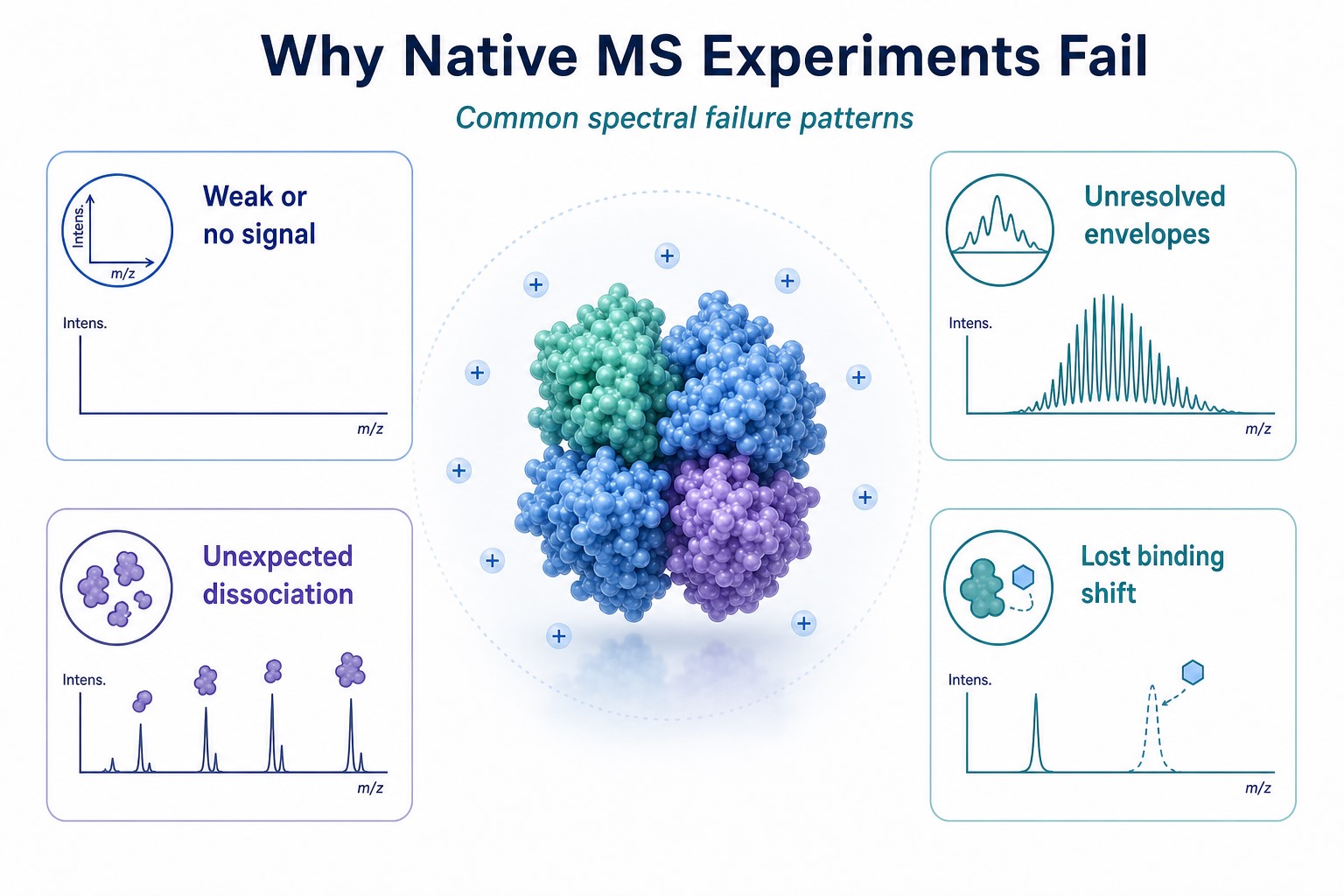
Figure 1. Native MS failures often present as weak signal, unresolved envelopes, unexpected dissociation, or lost binding mass shifts.
Root Causes Behind Native MS Failure
Most native MS failures come from a mismatch between what the complex needs to stay assembled and what the mass spectrometer needs for clean ionization.
Volatile buffers such as ammonium acetate support electrospray, but they are not universal stabilizers for every protein. Non-volatile salts, glycerol, detergents, and residual purification additives can remain after incomplete exchange and suppress signal. Concentration, freeze-thaw history, and storage temperature can push proteins toward aggregation before spray begins. Weak complexes may require specific pH, ionic strength, or cofactors that are lost during desalting.
A useful way to organize root causes is by failure domain:
- Buffer compatibility and desalting quality
- Protein and complex stability during handling
- Preservation of non-covalent associations through ionization
Checking these domains before acquisition prevents many failed sessions.
Buffer Issues to Check Before Analysis
Buffer problems are a common reason native MS experiments fail.
Non-volatile salts and additives
Phosphate, Tris with high salt, NaCl, imidazole carryover, glycerol, and many detergents interfere with native electrospray. Even low residual levels can broaden peaks or collapse signal. Confirm that the final spray buffer is volatile and that exchange or desalting was complete enough for the sample type.
pH and ionic strength mismatch
A complex may be stable in its storage buffer but unstable after transfer into ammonium acetate at a different pH or ionic strength. Review the known pH stability window of the protein and test whether the selected native buffer keeps the sample clear and soluble.
Incomplete buffer exchange
Short spin-column or dialysis steps can leave mixed buffer systems. Incomplete exchange often produces adduct-rich spectra or unstable spray. Extend exchange steps when spectra show persistent salt clusters, or use an alternative desalting format suited to the protein size and concentration.
Detergent and membrane-protein special cases
Detergent micelles and some amphiphiles complicate native MS. If detergent is required for solubility, plan a compatible native strategy before assuming a standard soluble-protein buffer exchange will work.
Buffer readiness means the sample is soluble, volatile-buffer compatible, and free enough of non-volatile contaminants to support stable spray.
Stability Issues to Check Before Analysis
Stability failures can look like method failures.
Aggregation and precipitation
Native buffer exchange can trigger haze, pellets, or sudden concentration loss. Check appearance, recover concentration after exchange, and confirm that the protein remains in solution at the intended spray concentration.
Freeze-thaw and handling stress
Repeated freeze-thaw cycles, extended room-temperature holds, or aggressive mixing can reduce complex recovery. Prefer fresh aliquots when possible and minimize unnecessary handling between exchange and analysis.
Concentration outside a workable window
Too dilute samples may give weak envelopes. Too concentrated samples may aggregate or produce unstable spray. Confirm concentration after exchange rather than relying only on the pre-exchange stock value.
Time-dependent dissociation or degradation
Some assemblies lose integrity over hours in volatile buffer. If prior work shows time sensitivity, schedule exchange close to acquisition and document hold time.
Stability readiness means the protein remains soluble and chemically intact under the exact buffer and timing planned for native MS.
Complex Preservation Issues to Check Before Analysis
Even when signal is strong, native MS can fail as an assembly experiment if the complex does not survive.
Weak non-covalent interfaces
Low-affinity complexes may dissociate during desalting or in the source. If only subunits appear, review whether the buffer lacks a required cofactor, metal, or partner stoichiometry, or whether softer source settings are needed.
Missing partners or incorrect ratios
A complex prepared at the wrong subunit ratio may not form the intended species. Confirm input stoichiometry and whether unbound subunits were removed before analysis.
Overly harsh source or transfer settings
Native MS still requires enough energy for ion transmission. Excess collision energy, elevated temperatures, or aggressive desolvation can strip assemblies and create false dissociation profiles. Start with gentle settings and increase only as needed for signal.
Ligand loss during exchange
Small-molecule partners can dialyze away or re-equilibrate during desalting. If binding-state measurement is the goal, review whether ligand should be maintained in the exchange buffer at a controlled level compatible with ionization.
Complex preservation readiness means the intended assembled or bound form has a realistic chance of surviving from vial to spectrum.
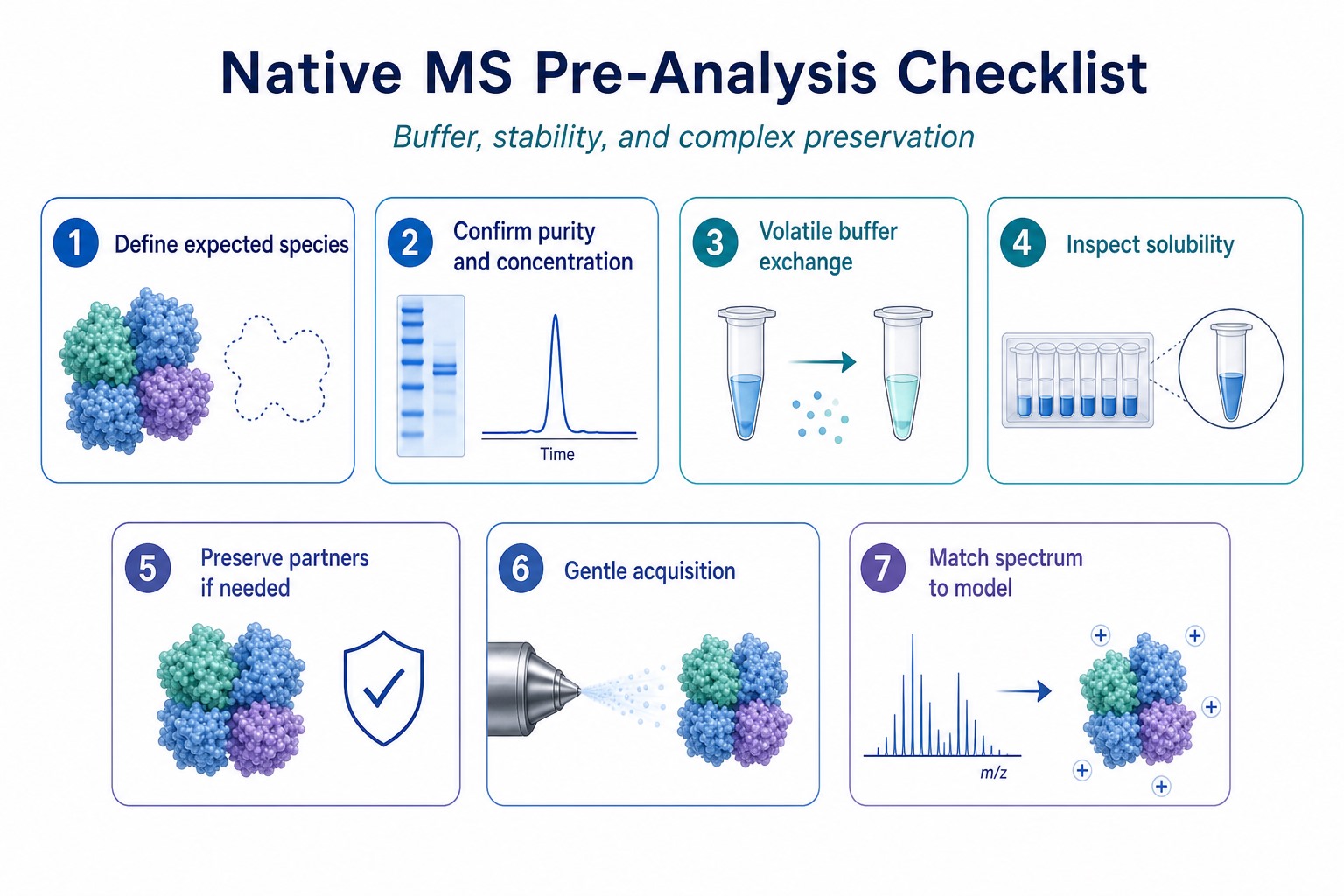
Figure 2. Before native MS, check buffer compatibility, sample stability, and whether the intended complex or bound form can be preserved.
Related Services
Protein Molecular Weight Determination Service
Therapeutics Characterization Service | Advanced Structure
Antibody Drug Analysis Service
Teams troubleshooting weak native spectra or unexpected dissociation can consult MtoZ Biolabs to review buffer history, sample handling, and whether a revised native MS plan is needed for the current project phase.
Step-by-Step Pre-Analysis Checklist
A practical checklist reduces failed acquisitions.
Step 1. Define the expected intact species
Write down the expected monomer, oligomer, complex stoichiometry, or bound mass. Native MS interpretation needs a model before spray begins.
Step 2. Confirm purity and concentration
Review purity indicators and measure concentration on the aliquot intended for exchange. Aggregates, DNA, and excess contaminant proteins commonly degrade native spectra.
Step 3. Exchange into a volatile native-compatible buffer
Transfer into ammonium acetate or another validated volatile system at a pH and ionic strength suited to the protein. Remove non-volatile salts and incompatible additives.
Step 4. Inspect solubility after exchange
Check for precipitation, turbidity, or major concentration loss. If the sample fails visually, revise buffer conditions before loading the instrument.
Step 5. Preserve required partners when binding is the goal
Maintain cofactors or ligands when scientifically justified and ionization compatible. Document whether the unbound form is an acceptable fallback.
Step 6. Start with gentle acquisition settings
Use soft source and transfer settings first. Increase energy only when needed to improve transmission, while watching for signs of complex stripping.
Step 7. Review spectra against the expected model
Ask whether observed masses match the intended assembly, a dissociated subunit set, or an adduct-dominated profile. That comparison decides the next corrective action.
For projects with repeated native MS failures, MtoZ Biolabs can help separate buffer and stability issues from acquisition settings and redesign the pre-analysis sequence.
Expected Results and How to Verify Them
A successful native MS pre-check should produce more than a pretty spectrum. It should produce interpretable evidence.
Expected signs of readiness include stable spray, resolved charge-state envelopes, and deconvoluted masses that match the planned monomer, oligomer, complex, or bound model within a scientifically reasonable mass window. If subunits dominate despite gentle settings and compatible buffer, the complex may be unstable under the tested conditions rather than simply under-optimized on the instrument.
Verification can include paired denaturing intact mass on a related aliquot to confirm covalent subunit baselines, repeat exchange with adjusted pH or ionic strength, or a short stability hold test to see whether the assembly persists. The goal of verification is to decide whether the failure is sample preservation or acquisition setup.
A practical go or no-go review should confirm four points. Buffer should be volatile, fully exchanged, and yield a clear sample. Stability should show retained concentration without obvious aggregation. Complex preservation should make the expected assembly or bound mass plausible. Spectrum review should show envelopes that match the planned model rather than unresolved adducts or harsh dissociation.
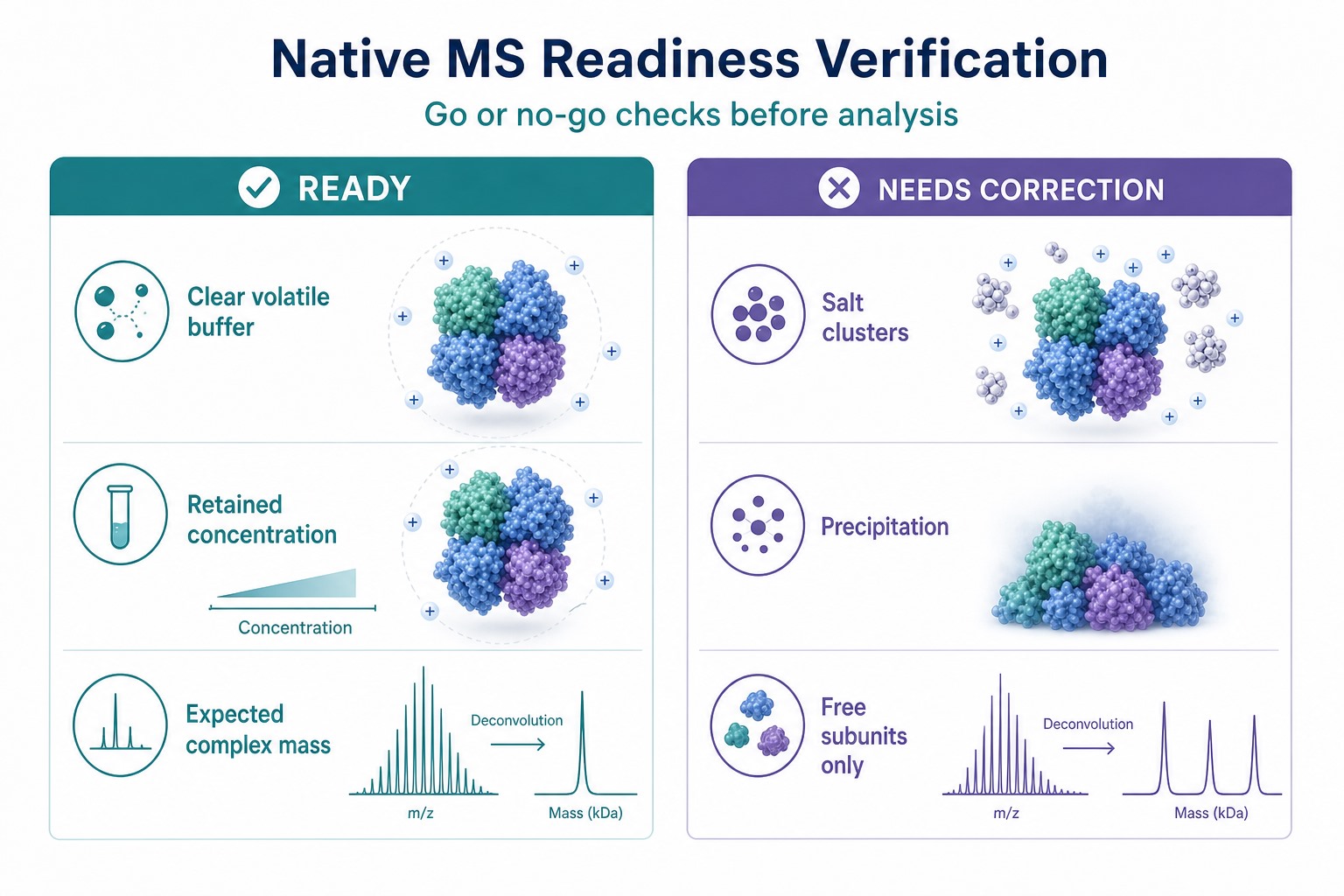
Figure 3. Verify readiness by checking buffer quality, stability after exchange, and whether observed masses match the intended complex or binding model.
Key Precautions Before Native MS
A few precautions prevent repeated failure cycles.
Do not assume storage buffer equals spray buffer. Do not interpret missing complexes as biological absence before buffer and setting controls are reviewed. Do not over-concentrate unstable proteins to compensate for weak signal. Do not skip a covalent mass baseline when stoichiometry assignment is critical. Do not treat one failed volatile-buffer condition as proof that native MS cannot work for the target.
Native MS is sensitive to sample history. Documentation of buffer composition, exchange method, concentration after exchange, and hold time makes troubleshooting faster and more reliable.
Frequently Asked Questions
1. Why do native MS experiments fail even when the protein looks pure?
Purity on a gel does not guarantee volatile-buffer compatibility, solubility after exchange, or complex survival under soft ionization conditions.
2. What buffer issues commonly break native MS?
Non-volatile salts, detergents, incomplete exchange, and pH or ionic strength conditions that destabilize the protein are common causes.
3. How can I tell stability failure from instrument failure?
If the sample precipitates, loses concentration, or only shows subunits across gentle settings and revised buffers, stability or preservation is the likely issue.
4. Why does my complex appear as free subunits in native MS?
The assembly may be weak in the selected buffer, partners may be missing, exchange may have stripped ligands, or source settings may be too harsh.
5. Should ligand be added back during buffer exchange?
When binding-state measurement is required and the ligand is volatile-buffer compatible, controlled maintenance of the partner can be necessary. This should be planned before analysis.
6. What should be checked first before repeating a failed native MS run?
Confirm expected mass models, buffer volatility, post-exchange solubility and concentration, and whether gentle acquisition settings were used.
Conclusion
Native MS experiments often fail because buffer chemistry, protein stability, and complex preservation are not aligned before analysis. Non-volatile additives suppress ionization. Unstable proteins aggregate or degrade during exchange. Weak assemblies and bound forms can dissociate before or during measurement. A structured pre-analysis checklist reduces these risks by confirming expected species, volatile-buffer readiness, solubility, partner preservation, and gentle acquisition settings.
When failures persist, separate sample preservation issues from instrument setup and revise one variable at a time. Researchers preparing native MS for complex, stoichiometry, or binding questions can contact MtoZ Biolabs to review sample history and build a pre-analysis plan matched to the current project phase.
How to order?




