






Whole-Cell Samples or Isolated Mitochondria: How Should a Proteomics Study Be Designed?
The starting material for a mitochondrial proteomics study should follow the claim, not the convenience of sample preparation. Whole-cell lysate measures the total proteome and lets you review mitochondrion-annotated proteins within a broader cellular map. Isolated or enriched mitochondria concentrate the analysis on organelle material and improve recovery of lower-abundance mitochondrial proteins that are often diluted in a total lysate. When the conclusion is organelle-specific, enriched mitochondria are the stronger starting point. When the conclusion is cellular and mitochondrial proteins are only part of a wider question, whole-cell proteomics can serve. The practical risk is not choosing the harder path, but choosing the easier path and later overstating what the data can support.
The decision is a sample-matrix choice that sets claim scope, sample amount, enrichment consistency, and how replicates are defined. In a total lysate, mitochondrial proteins compete with the entire cellular proteome, so less abundant organelle proteins are harder to detect and quantify reliably. Enrichment concentrates mitochondrial material before digestion and acquisition, which shifts depth toward organelle-relevant proteins.
Whatever path you choose, keep it identical across every study arm. A comparison that mixes whole-cell lysate in one arm with enriched mitochondria in another cannot be interpreted cleanly, because preparation differences can mimic biology. Lock the starting material before collection, then plan amount, enrichment chemistry, and replicate counts from that single choice.
Whole-Cell Versus Isolated Mitochondria: Sample-Matrix Comparison
The table below compares the two starting materials across the design dimensions that drive amount planning, enrichment workflow, and interpretation scope.
|
Design dimension |
Whole-cell samples |
Isolated or enriched mitochondria |
|---|---|---|
|
Claim scope |
Whole-cell or broad cellular profiling |
Organelle-specific comparison |
|
Mitochondrial coverage |
Diluted by abundant cytosolic protein |
Concentrated on mitochondrial material |
|
Preparation |
Total lysate, simpler to prepare |
Isolation or enrichment required |
|
Typical stage |
Early exploration of a new system |
Focused organelle comparison |
|
Interpretation limit |
Weak for low-abundance mitochondrial proteins |
Enrichment profile, not absolute purity |
Whole-cell profiling is not an inferior method. It answers a broader question. Enrichment answers a narrower and deeper one. The right choice follows the conclusion the study needs to reach.
Not sure which starting material fits your study? Share your research objective, sample type, available amount, and preparation status through our Mitochondrial Proteomics Project Inquiry Formto discuss initial feasibility.
What Each Starting Material Means for the Data
A whole-cell lysate captures proteins from every compartment. Mitochondrion-annotated entries appear within a much larger list dominated by cytosolic and nuclear proteins. This suits early work, when the question is still cellular and an organelle focus has not been committed. The limitation is coverage depth for the organelle, because abundant non-mitochondrial proteins can mask the mitochondrial fraction during detection and quantification.
Isolated or enriched mitochondria shift the measurement toward organelle material. The output is an enrichment profile rather than a perfectly pure organelle proteome, yet the analysis is far more centered on mitochondrial and mitochondria-associated proteins. This route fits an organelle-specific claim, and it is usually the stronger starting point when low-abundance mitochondrial proteins carry the biology.
Do not read a whole-cell result as an organelle-specific finding. A protein annotated as mitochondrial in a total lysate still sits in a cellular context, and attributing its change to the mitochondrion alone overstates what the design supports. If the manuscript claim is organelle-centered, the starting material should match that scope from the first harvest.
Starting-Material Decision Path
Use the steps below to settle the sample matrix before collection begins.
Step 1. Write the claim scope in one sentence.
If the sentence describes a whole-cell or broad cellular change, whole-cell lysate may fit. If it describes a mitochondrion-specific shift, move to enriched mitochondria.
Step 2. Check whether low-abundance mitochondrial proteins carry the biology.
When the proteins of interest are abundant in total lysate, whole-cell work may still detect them. When the signal sits near the detection limit in bulk material, enrichment is usually necessary for a reliable comparison.
Step 3. Confirm the same matrix across all arms.
Every group in the comparison must use the same starting material and the same enrichment chemistry. A single arm processed differently invalidates cross-group interpretation.
Step 4. Select the submission path and plan amount.
|
Submission path |
Planning amount |
Notes |
|---|---|---|
|
Cells for in-house enrichment |
~5×10^7 cells |
Enrichment performed from cultured material |
|
Animal tissue for in-house enrichment |
~200 mg |
Enrichment performed from tissue |
|
Client-isolated mitochondrial protein |
≥50 μg, 80 to 100 μg preferred; concentration ≥0.5 μg/μL, preferably ≥1 μg/μL |
Submitted ready for proteomics |
These are planning baselines rather than fixed requirements for every matrix. Low-yield isolations, unusual tissues, or scarce clinical material should be confirmed before collection. Whichever path you choose, apply it identically across arms.
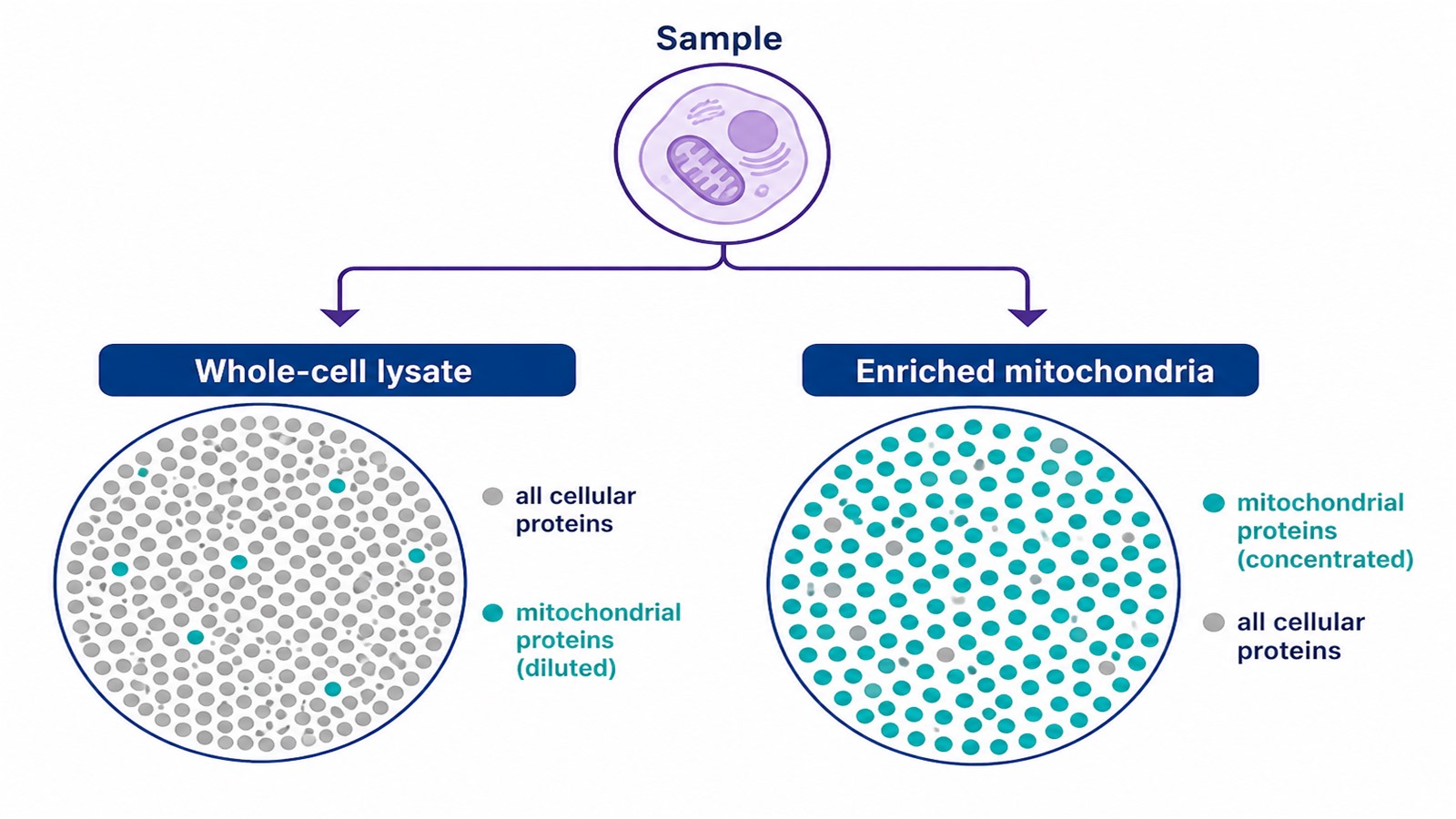
Figure 1. Whole-cell lysate dilutes mitochondrial proteins across the full proteome, while enrichment concentrates them before analysis.
Design Consequences: Amount, Consistency, and Replicates
The starting-material choice cascades into the rest of a mitochondrial proteomics study, which is why it belongs at the design stage rather than the bench stage.
Amount planning follows the path. Enrichment from cells or tissue consumes material before digestion, so each biological unit needs enough input to survive the workflow. A thin sample leaves no room for a repeat run or a second acquisition mode. Client-isolated protein at the lower end of the recommended range may succeed, but it offers little reserve if a step needs repeating.
Enrichment consistency becomes a design rule. When a claim depends on comparing organelle proteomes across arms, the enrichment chemistry and handling must be matched, or one arm may look organelle-enriched while another resembles bulk lysate. Batch effects from uneven enrichment are difficult to remove after acquisition.
Replicate definition stays biological. Independent animals or independent culture flasks are units, while multiple aliquots from a single isolation are not. This holds whether the input is whole-cell or enriched, and it protects any later comparison from preparation noise. Technical repeats of one extract report instrument variation on platforms such as the Orbitrap Exploris 480 or timsTOF Pro, but they do not substitute for biological replication.
Quantitative comparisons from enriched material typically use DDA analyzed with MaxQuant or Proteome Discoverer for small pilots, or DIA analyzed with Spectronaut or DIA-NN for larger matched cohorts. The acquisition route should be chosen after the sample matrix and cohort structure are realistic.
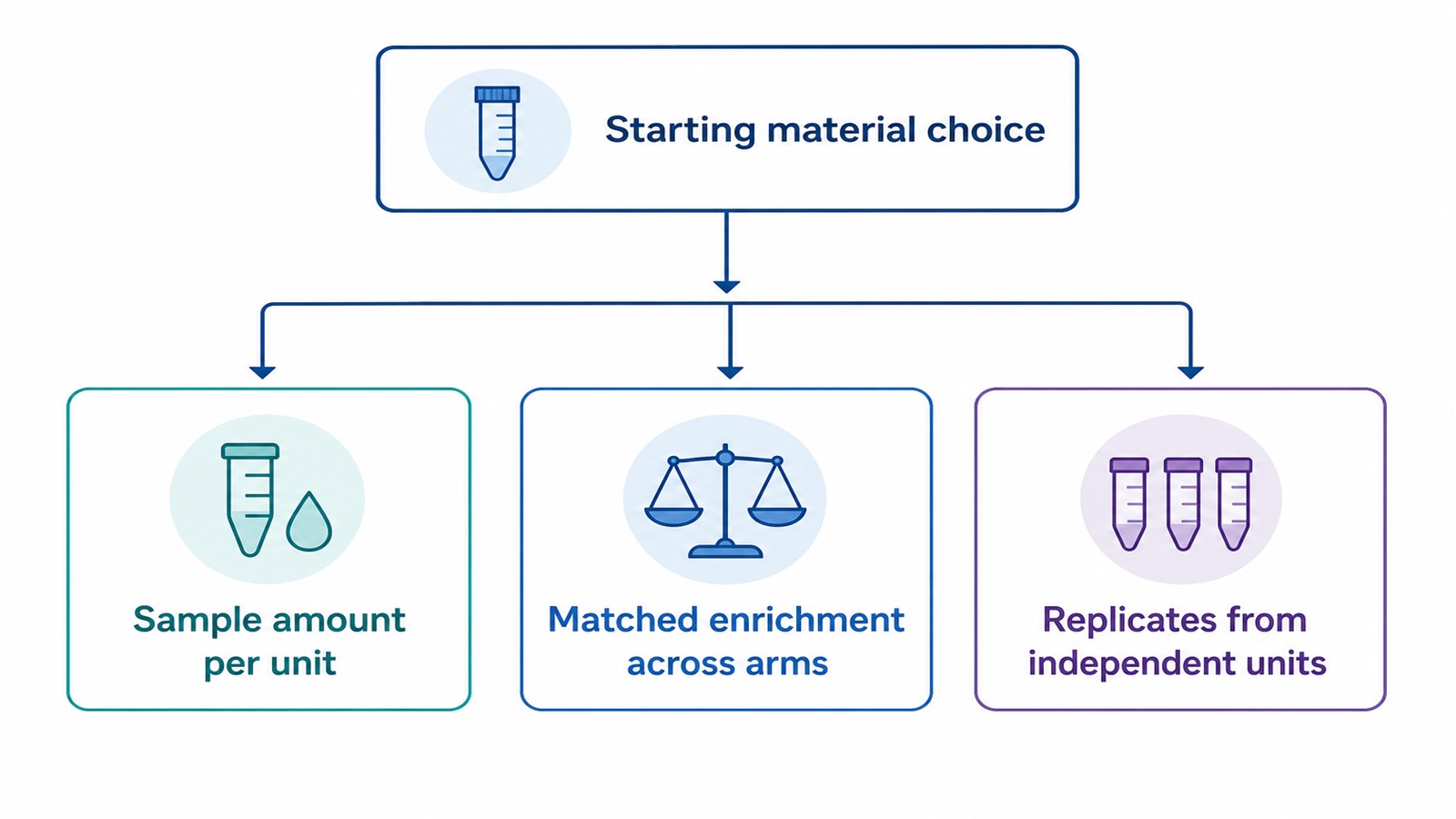
Figure 2. The starting-material choice sets sample amount, enrichment consistency, and how replicates are defined.
A Starting-Material Design Checklist
Work through these points before collection. A blank answer usually signals a design gap.
- The claim scope is written down as cellular or organelle-specific.
- The starting material matches that scope.
- The same starting material is used across every arm.
- The submission path is fixed, whether cells, tissue, or isolated protein.
- The amount per unit meets the planning baseline for that path.
- Enrichment chemistry is planned identically for all arms.
- Biological replicates are counted from independent units, not aliquots.
- Groups are balanced across preparation batches and run order.
A short review with MtoZ Biolabs at this stage can confirm the plan holds together before material is committed.
Related Services
Mitochondrial Proteomics Service
Mitochondrial Isolation and Mitochondrial Protein Purification Service
Subcellular Proteomics Service
Frequently Asked Questions
Should I use whole-cell samples or isolated mitochondria for proteomics?
Use whole-cell samples for broad cellular profiling or early exploration, and isolated or enriched mitochondria for an organelle-specific claim where lower-abundance mitochondrial proteins must be recovered reliably.
Why are mitochondrial proteins hard to see in a whole-cell lysate?
In a total lysate, mitochondrial proteins compete with the entire cellular proteome. Abundant cytosolic and other compartment proteins dilute the organelle fraction, so low-abundance mitochondrial proteins are harder to detect and quantify.
How much sample is needed for isolated mitochondria work?
Plan around ~5×10^7 cells or ~200 mg of tissue for in-house enrichment, or client-isolated mitochondrial protein at ≥50 μg with 80 to 100 μg preferred and a concentration of ≥0.5 μg/μL, preferably ≥1 μg/μL. Confirm unusual matrices early.
Can Whole-Cell and Mitochondrial-Enriched Samples Be Included in the Same Study?
Yes, but they should be treated as separate analytical datasets rather than as directly comparable sample matrices. Whole-cell data can provide broader cellular context, while mitochondrial-enriched data can provide greater analytical focus on proteins recovered with the enriched fraction.
Does enrichment give a pure mitochondrial proteome?
Enrichment produces an enrichment profile, not absolute purity. It concentrates mitochondrial and mitochondria-associated proteins, which is usually enough for a matched organelle comparison when handling is consistent.
Conclusion
Whether to analyze whole-cell samples or isolated mitochondria is a study-design decision that follows the claim. A cellular or exploratory question can use whole-cell proteomics, while an organelle-specific question calls for isolated or enriched mitochondria, with matched enrichment across arms. That single choice then sets sample amount, consistency requirements, and how replicates are defined, so mitochondrial protein analysis stays aligned with the conclusion the study needs to reach.
Researchers planning a project can review the starting material with MtoZ Biolabs before collection. It helps to arrive with the sample type, sample amount, planned study groups, and the expected analytical output, so the design and the deliverable match from the start.
How to order?




