






When Protein Mass Spectrometry Results Are Inconclusive: Common Causes and How to Improve Analytical Confidence
Introduction
Protein mass spectrometry can deliver high-confidence identification, intact mass confirmation, PTM mapping, and complex characterization, yet many projects still receive inconclusive results. A peptide mapping run may identify many peptides without resolving the modification site of interest. An intact mass analysis may show multiple overlapping masses that do not map cleanly to one expected species. A native MS experiment may suggest assembly heterogeneity without enough clarity to support a firm stoichiometry call. A proteomics dataset may report protein candidates with weak coverage and conflicting quantification.
Inconclusive protein MS results are often treated as instrument failure, but the causes are usually more specific. Sample quality, workflow mismatch, insufficient MS depth, matrix interference, and over-interpretation all reduce analytical confidence. The practical question is not only why the result is ambiguous, but what should be changed before repeating the experiment or reporting the data.
This article explains common causes of inconclusive protein mass spectrometry results and practical steps to improve analytical confidence.
When Inconclusive Results Become a Project Problem
Inconclusive MS output becomes a bottleneck when a decision must be made on incomplete evidence.
Common scenarios include biologics QC, where intact mass or peptide mapping does not clearly confirm the expected product form. PTM investigation, where modified peptides are detected but localization remains uncertain. Protein identification from complex mixtures, where multiple candidates match partial evidence. Comparability studies, where batch differences are suggested but not confirmed with enough specificity. Discovery-stage protein characterization, where early data are used before the workflow is matched to sample complexity.
In each case, the issue is not absence of all signal. The issue is that the available signal does not support the conclusion the project needs.
What an Inconclusive Protein MS Result Looks Like
Inconclusive results take several forms depending on workflow type.
Peptide mapping may show low sequence coverage, ambiguous modified peptide assignment, or poor reproducibility across runs. Intact mass analysis may show broad heterogeneity, unresolved mass envelopes, or multiple species near the expected mass. Bottom-up proteomics may identify proteins with few unique peptides or low confidence scores. Native MS may show partial dissociation or charge-state overlap that prevents confident complex assignment. Quantitative proteomics may produce unstable ratios or poor replicate agreement.
Recognizing the result type helps identify whether the problem originates in sample prep, method selection, acquisition, or interpretation.
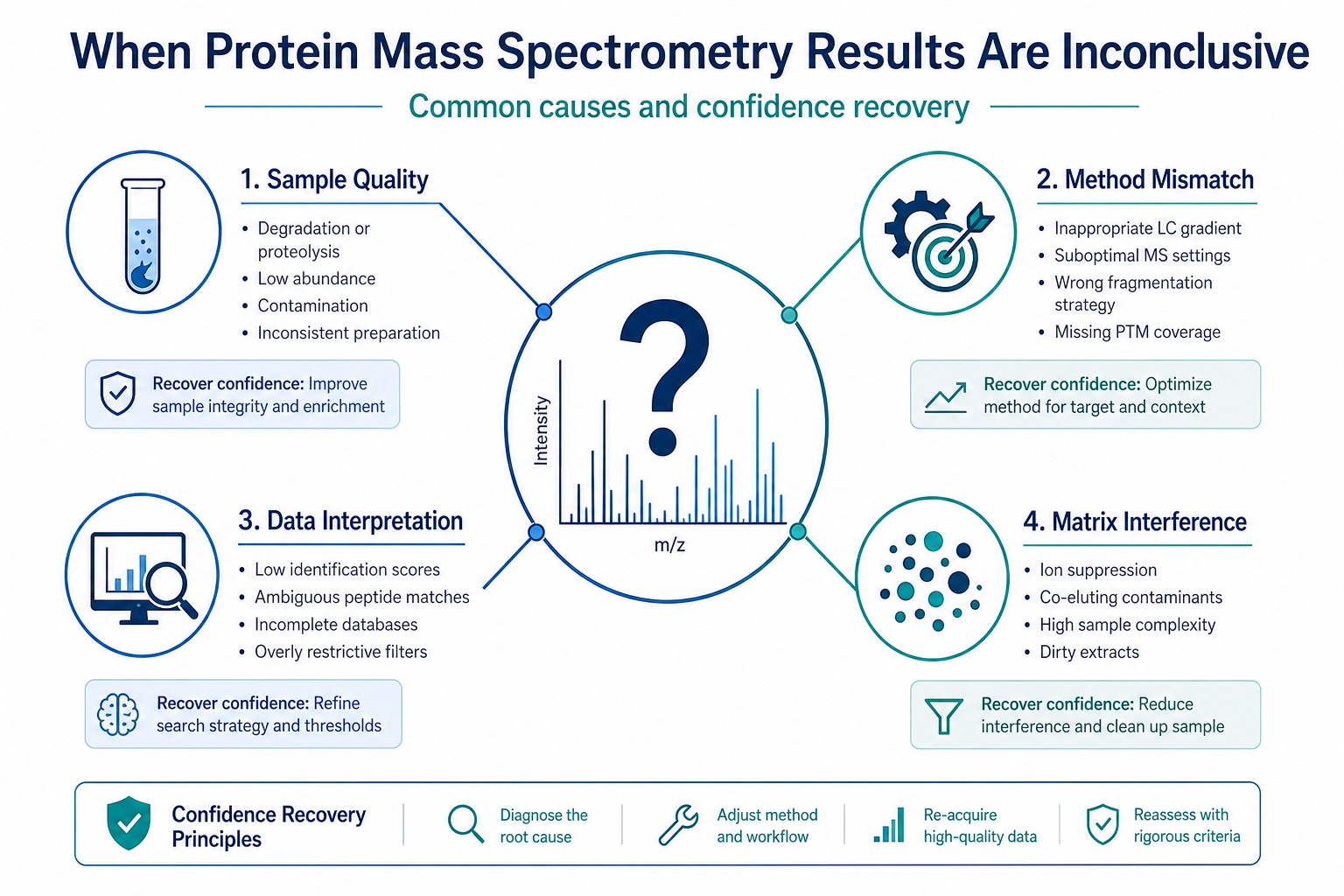
Figure 1. Inconclusive protein MS results often arise from sample quality, workflow mismatch, interpretation limits, and matrix interference rather than from MS failure alone.
Common Cause 1: Sample Preparation Problems
Sample preparation is the most frequent source of inconclusive protein MS data.
Insufficient purity leaves contaminating proteins that dilute relevant signal or create false identifications. Improper digestion produces missed cleavages, over-digestion, or chemical artifacts that complicate peptide mapping. Inadequate cleanup leaves salts, detergents, or buffer components that suppress ionization. Protein aggregation or degradation generates heterogeneous products that confuse intact mass interpretation. Incomplete reduction and alkylation can mask disulfide-linked peptides or create mixed disulfide states.
Sample prep review should be the first troubleshooting step when confidence is low.
Common Cause 2: Workflow Mismatch
A capable mass spectrometer cannot compensate for the wrong workflow choice.
Intact mass analysis cannot answer residue-level PTM localization questions. Standard bottom-up proteomics may miss large proteoforms or intact assembly information. Native MS is not the right primary method for comprehensive sequence coverage. Peptide mapping without appropriate enzyme selection may miss critical regions. PTM workflows without enrichment may fail to detect low-abundance modified peptides in complex backgrounds.
Workflow mismatch produces data that are scientifically usable but not sufficient for the claim being made.
Common Cause 3: Insufficient MS Depth or Replicate Support
Inconclusive results often reflect insufficient analytical depth rather than total method failure.
Low peptide coverage may result from too little sample, suboptimal LC separation, or short acquisition times. Modified peptides may be present but under-sampled relative to unmodified forms. Intact mass heterogeneity may be real but unsupported because only one acquisition was performed. Quantitative comparisons may look unstable because replicate number is too low or batch effects were not controlled.
Repeating an underpowered experiment without changing depth or replicate design often reproduces the same ambiguity.
Related Services
Protein Molecular Weight Determination Service
Protein Identification Service
Primary Structure Analysis Service
Teams receiving inconclusive protein MS data can consult MtoZ Biolabs to review sample status, workflow fit, and the analysis path best matched to the confidence level required.
Common Cause 4: Matrix and Additive Interference
Matrix interference can reduce confidence even when the protein sample is otherwise acceptable.
Salts, detergents, polyethylene glycol, carrier proteins, and formulation excipients suppress peptide or intact protein ionization. High-abundance contaminants can dominate MS acquisition and reduce sampling of the target protein. Blood-derived matrices, culture media, and purification buffers may introduce background ions that complicate assignment. Native MS is especially sensitive to non-volatile additives that disrupt gentle ionization.
Matrix review should be part of any troubleshooting plan when spectral quality is weak or ambiguous.
Common Cause 5: Over-Interpretation of Weak Evidence
Sometimes the experiment is acceptable but the conclusion exceeds the data.
A few peptide matches may be treated as full sequence confirmation. A broad intact mass envelope may be forced into one expected mass without considering heterogeneity. A single modified peptide may be reported as localized PTM evidence without supporting fragment ions. Native MS may be used to claim stoichiometry when partial dissociation or adducts remain unresolved. Quantitative differences may be overcalled from one replicate or weak statistical support.
Improving analytical confidence often requires narrowing the claim to what the data actually support.
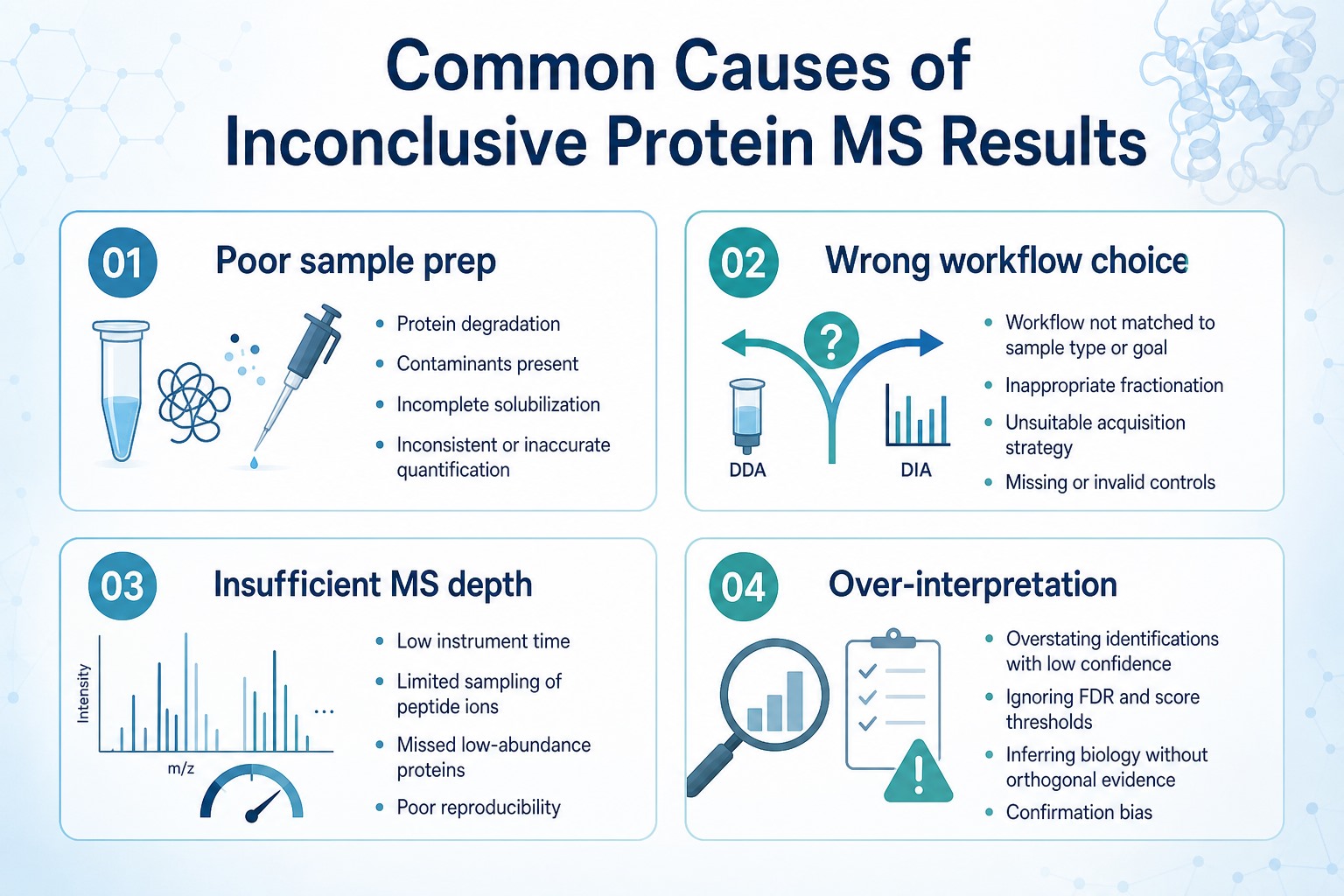
Figure 2. Inconclusive protein MS results commonly arise from sample prep problems, workflow mismatch, insufficient depth, and over-interpretation.
Step 1: Refine Sample Preparation
The first improvement step is to review and refine sample preparation.
Confirm protein identity, purity, and concentration before MS analysis begins. Optimize digestion conditions for the protein class and analytical question. Remove salts, detergents, and interfering additives through appropriate cleanup or buffer exchange. Use reduction and alkylation consistently when disulfide mapping or subunit analysis is required. Split precious samples only after a qualification run confirms prep suitability.
Better sample prep often improves confidence more than repeating the same low-quality material.
Step 2: Match the Workflow to the Question
The second step is to align workflow choice with the required conclusion.
Use peptide mapping or LC-MS/MS for sequence and PTM localization questions. Use intact mass analysis for global mass confirmation and heterogeneity screening. Use native MS when non-covalent assembly or stoichiometry is the primary question. Use enrichment or targeted acquisition when low-abundance modified peptides are expected. Use complementary workflows when one method alone cannot support the full claim.
A matched workflow reduces inconclusive output by generating the right type of evidence from the start.
Step 3: Add Orthogonal Data and Controls
Orthogonal evidence is one of the strongest ways to improve confidence.
Pair peptide mapping with intact mass analysis when both sequence-level and whole-protein mass evidence are needed. Use modified and unmodified peptide comparison for PTM claims. Include reference standards or prior qualified material when comparability is the goal. Add replicate runs to distinguish biological heterogeneity from run-to-run instability. Use control samples to separate background from true target signal.
Orthogonal data help resolve ambiguity that a single MS layer cannot eliminate.
Step 4: Increase Depth, Replicates, and Expert Review
Confidence often improves when analytical depth and review standards increase.
Extend LC-MS/MS acquisition time or repeat runs to raise peptide coverage. Use targeted MS methods for predefined modified peptides or regions of interest. Increase replicate number for quantitative or comparability studies. Apply manual expert review for ambiguous modified peptide localization or complex intact mass assignment. Document confidence tiers rather than forcing binary yes or no conclusions.
Expert review is especially important for biologics, PTMs, and native assembly interpretation.
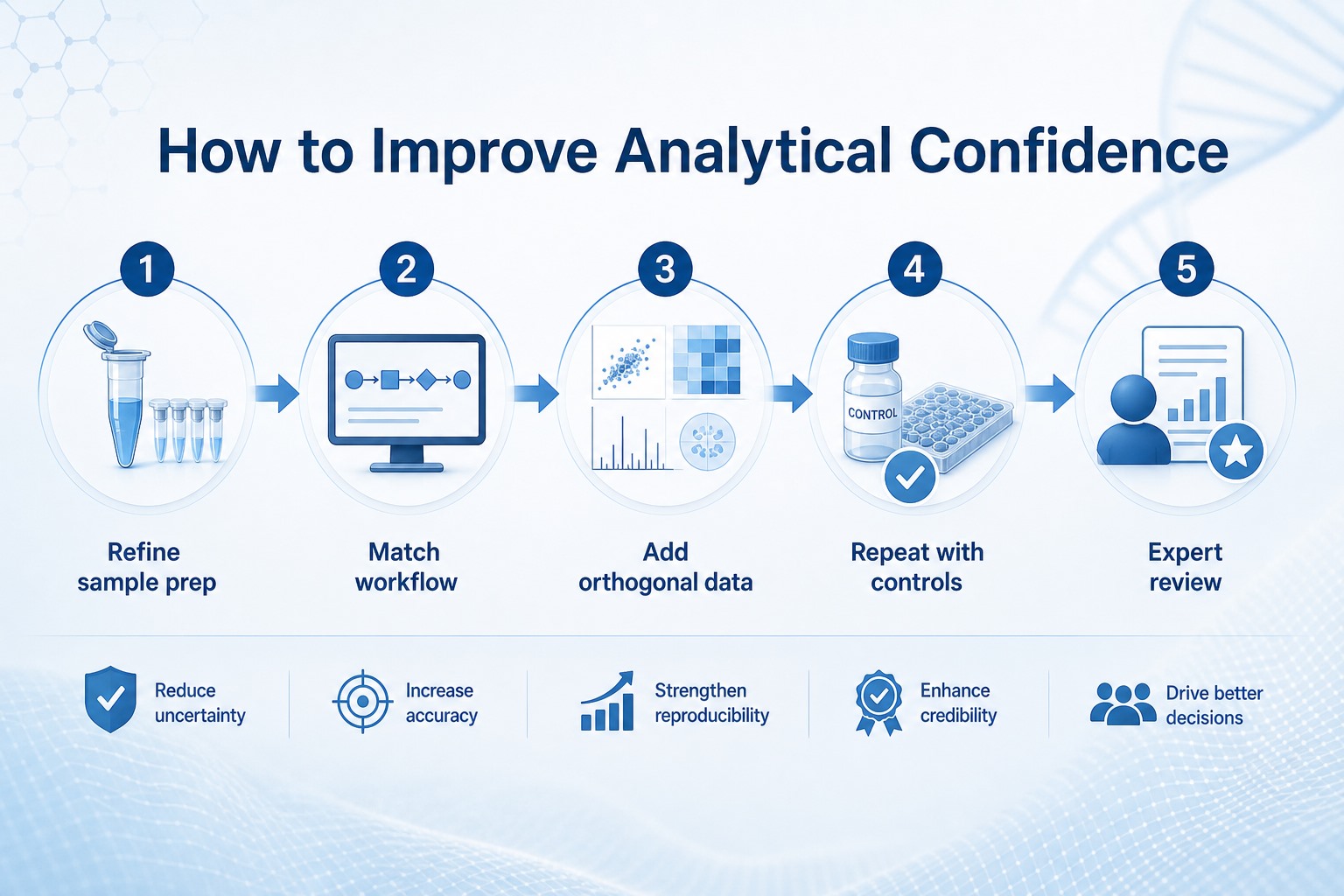
Figure 3. Analytical confidence improves through refined sample prep, workflow matching, orthogonal data, replicate depth, and expert review.
Troubleshooting Guide by Result Type
Different inconclusive result types suggest different first fixes.
|
Inconclusive Result Type |
Likely Primary Cause |
First Improvement Step |
|---|---|---|
|
Low peptide coverage |
Sample prep or insufficient LC-MS/MS depth |
Optimize digestion and extend acquisition |
|
Ambiguous PTM localization |
Weak fragment evidence or wrong enrichment |
Targeted MS/MS and modified peptide controls |
|
Unresolved intact mass |
Heterogeneity or matrix interference |
Cleanup, replicate intact analysis, deconvolution review |
|
Weak protein ID in mixture |
Contaminants or low unique peptides |
Purify target and increase depth |
|
Unclear native assembly |
Buffer additives or harsh source conditions |
Native buffer optimization and control comparison |
Troubleshooting should start with the result type rather than with generic instrument adjustment alone.
Expected Outcomes After Confidence Improvement
A stronger protein MS package should make the supported conclusion explicit.
Expected improvements include higher peptide coverage with clearer unique evidence. More defensible modified peptide assignment with supporting fragment ions. Cleaner intact mass interpretation with heterogeneity documented rather than ignored. Better replicate consistency in quantitative or comparability studies. Clear separation between confirmed, provisional, and unsupported findings in the final report.
The goal is not perfect data in every case. The goal is a conclusion level that matches the evidence.
Frequently Asked Questions
1. What makes protein mass spectrometry results inconclusive?
Results become inconclusive when the data do not support the required conclusion with enough specificity, often due to sample prep, workflow mismatch, insufficient depth, or over-interpretation.
2. Should an inconclusive result always be repeated?
Not always with the same method. Repeating without fixing sample prep, workflow fit, or depth often reproduces the same ambiguity.
3. How can peptide mapping confidence be improved?
Optimize digestion, increase LC-MS/MS depth, use appropriate controls, and add intact mass or targeted MS support when needed.
4. When is native MS inconclusive?
When buffer additives, partial dissociation, charge-state overlap, or insufficient replicate support prevent confident assembly assignment.
5. What is the best way to report inconclusive data?
Use confidence tiers and clearly separate confirmed, provisional, and unsupported findings rather than overcalling weak evidence.
Conclusion
Inconclusive protein mass spectrometry results usually reflect specific weaknesses in sample preparation, workflow selection, analytical depth, matrix handling, or interpretation rather than a generic failure of mass spectrometry itself. Improving analytical confidence begins with defining the conclusion the project requires, then refining sample prep, matching the workflow to that question, adding orthogonal evidence, and applying replicate depth with expert review. Many inconclusive outcomes become actionable once the claim is adjusted to the evidence or the experiment is redesigned to generate stronger support.
Programs that review sample status and workflow fit before repeating inconclusive runs save time and obtain more reliable MS packages. Researchers troubleshooting inconclusive protein MS data can contact MtoZ Biolabs to review sample quality, method selection, and the analysis path needed to reach the required confidence level. For projects requiring integrated sequence, mass, and modification evidence, MtoZ Biolabs can also help design complementary workflows that reduce ambiguous reporting.
How to order?




