






What Samples Are Suitable for Histone Acetylation Analysis?
Histone acetylation is a critical epigenetic modification involved in chromatin regulation, participating widely in gene transcription, the cell cycle, DNA repair, and metabolic regulation. Its dynamic changes reflect cellular states, disease progression, and responses to environmental or experimental stimuli. Highly sensitive and accurate histone acetylation analysis not only reveals epigenetic patterns within complex biological systems but also provides essential data for drug development and biomarker research. Whether using cell models in basic research or tissue and blood samples in clinical studies, careful sample selection and standardized handling are prerequisites for obtaining reliable acetylation information.
Scientific Basis of Histone Acetylation Analysis
Histone acetylation primarily occurs on lysine residues of histones, catalyzed by histone acetyltransferases (HATs), while histone deacetylases (HDACs) remove these modifications. Among commonly studied acetylation marks, H3K9ac and H3K27ac are frequently used as indicators of transcriptional activity. Given the key role of acetylation in regulating chromatin structure, changes in acetylation levels can directly reflect gene expression and cellular function.
The main technical approaches for histone acetylation analysis include:
-
Antibody-Based Immunoenrichment: Targeted enrichment of histones or peptides with specific acetylation sites to increase detection sensitivity for low-abundance modifications.
-
Mass Spectrometry Analysis (LC-MS/MS): Combines high-resolution qualitative and quantitative analysis to simultaneously detect multiple acetylation sites and construct systematic epigenetic maps.
The critical aspect of successful analysis lies in careful sample selection and processing to prevent modification loss due to deacetylase activity and to ensure accuracy and reproducibility.
Sample Types Suitable for Histone Acetylation Analysis
1. Cell Line Samples
Cell lines are commonly used experimental models that provide stable and controllable sample sources. Dynamic changes in acetylation can be monitored via drug treatments or genetic manipulation.
-
Sample Handling: Rapidly wash cells post-harvest and extract nuclear proteins in a buffer containing HDAC inhibitors to prevent deacetylation.
-
Key Advantages: Controlled culture conditions and high reproducibility make them suitable for mechanistic studies.
2. Animal Tissue Samples
Animal models reflect physiological or pathological acetylation levels and are suitable for investigating disease mechanisms or drug interventions.
-
Sample Handling: Rapidly freeze tissues in liquid nitrogen and store at -80°C to prevent protein degradation. High-lipid tissues (e.g., brain, liver) require optimized lysis buffers to reduce lipid interference.
-
Key Advantages: Provide biologically meaningful in vivo data that can be directly linked to experimental treatments or disease models.
3. Peripheral Blood Mononuclear Cells (PBMCs) and Immune Cells
PBMCs or specific immune cell populations can be used in clinical sample studies to reflect individual epigenetic states.
-
Sample Handling: After blood collection, quickly isolate and freeze cells or immediately extract nuclear proteins.
-
Key Advantages: Useful for dynamic monitoring of disease progression or drug response.
4. Clinical Tissue or Biopsy Samples (FFPE or Frozen)
Clinical samples are directly associated with disease states and are critical for exploring epigenetic biomarkers.
-
Sample Handling: Frozen tissues are most suitable for acetylation analysis. FFPE tissues require de-crosslinking treatment, which may reduce signal intensity.
-
Key Advantages: Provide real-world data for translational research.
Sample Amount and Quality Requirements
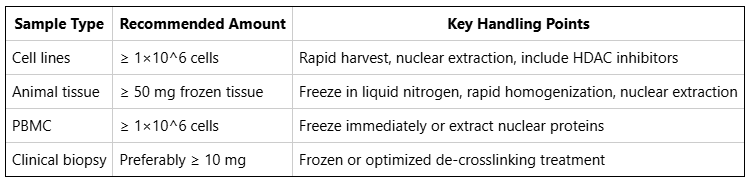
Note: Addition of HDAC inhibitors and protease inhibitors during sample processing is essential to preserve the integrity of acetylation modifications.
Technical Advantages of MtoZ Biolabs
MtoZ Biolabs offers the following technical advantages in histone acetylation analysis:
-
Optimized Nuclear Protein Extraction: Applicable to cells, tissues, and clinical samples, ensuring complete acetylation information.
-
Efficient Histone Enrichment: Enhances detection sensitivity of low-abundance acetylation marks.
-
High-Resolution Mass Spectrometry: Orbitrap platforms support multi-site qualitative and quantitative analysis with high accuracy and reliability.
-
Multi-Modification Analysis: Simultaneously analyzes acetylation, methylation, phosphorylation, and other epigenetic modifications, providing a comprehensive perspective for studying complex biological systems.
Through these technical advantages, researchers can obtain stable, reproducible, and biologically interpretable acetylation data, supporting full-process applications from basic research to clinical translation.
By carefully selecting samples and combining rapid freezing, nuclear protein extraction, and acetylation enrichment strategies, reliable histone acetylation information can be obtained. Accurate detection of low-abundance marks relies on high-resolution mass spectrometry and optimized analysis workflows, providing a solid foundation for epigenetic studies. MtoZ Biolabs integrates advanced mass spectrometry technology with professional sample processing solutions to deliver high-quality histone acetylation analysis services for both research and clinical applications.
MtoZ Biolabs, an integrated chromatography and mass spectrometry (MS) services provider.
Related Services
How to order?




