






What Is the Workflow for Targeted PTM Analysis?
-
Research objectives (e.g., pathway mechanism investigation, target validation, or analysis of drug action)
-
PTM type (e.g., phosphorylation vs. acetylation, which can require substantially different sample-handling procedures)
-
Sample number and sample type (cells, tissues, serum, FFPE, etc.)
-
Quantification strategy (e.g., label-free, TMT/iTRAQ, SILAC, etc.)
-
Trypsin: the most widely used option and applicable to most PTM workflows
-
Lys-C, Glu-C, etc.: used to improve sequence coverage and increase coverage of specific modification sites
-
Orbitrap Exploris 480
-
Q Exactive HF-X
-
timsTOF Pro 2 (well suited to short gradients and high-throughput analyses)
-
DDA (Data-Dependent Acquisition): suitable for screening and discovery of modification sites
-
PRM/SRM (Targeted MS): suitable for quantitative verification of known modification sites
-
DIA (Data-Independent Acquisition): provides broad coverage while maintaining quantitative robustness
-
Raw data processing (e.g., MaxQuant, Proteome Discoverer, Spectronaut, etc.)
-
PTM site identification and evaluation of site-localization confidence (Site Localization Score)
-
Quantitative analysis (relative quantification or absolute quantification)
-
Functional enrichment analysis (GO, KEGG)
-
Analysis of dynamic trends (comparisons across time points or treatment groups)
-
Customized, high-specificity enrichment solutions for modified peptides
-
Ultra-sensitive detection of low-abundance PTM sites
-
Quantification and verification services for targeted PTMs (supporting PRM/SRM)
-
Integrated analyses combining PTM dynamics with functional enrichment
Post-translational modifications (PTMs) participate extensively in fundamental biological processes, including cellular signal transduction, metabolic regulation, and gene expression. Their dynamic alterations often serve as important molecular indicators of disease onset, progression, and responses to therapy. With rapid advances in mass spectrometry (MS), targeted PTM analysis has become a powerful approach for elucidating regulatory mechanisms in complex biological systems. In contrast to global proteomics, targeted PTM analysis concentrates on specific modification types and key modification sites, thereby offering improved detection sensitivity and quantitative precision.
The Targeted PTM Analysis Workflow
Targeted PTM analysis typically comprises the following key steps:
1. Experimental Design and Sample Preparation
Accurate characterization of protein modifications begins with a well-designed experimental plan. In this step, it is necessary to define:
During sample preparation, it is particularly important to inhibit enzymes that remove or alter modifications (e.g., phosphatases or deacetylases) in order to prevent PTM loss.
2. Protein Extraction and Enzymatic Digestion
For PTM-focused workflows, protein extraction should employ an effective lysis buffer supplemented with appropriate inhibitors to preserve the stability of target modifications. Common digestion strategies include:
Notably, certain PTMs (e.g., ubiquitination) can yield characteristic modified peptides after digestion, which require dedicated recognition during identification.
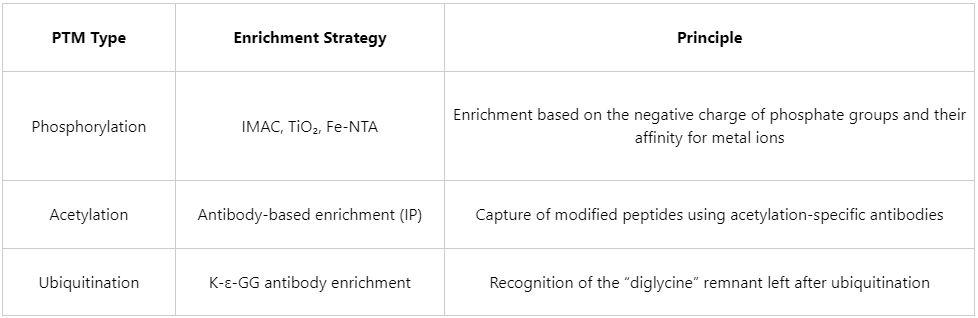
3. Modified Peptide Enrichment (PTM Enrichment)
This is the most critical step in targeted PTM analysis. Because modified peptides are typically present at very low abundance within the full proteome, the selected enrichment strategy directly determines analytical depth and overall data quality.
Common enrichment approaches include:
4. High-Resolution Mass Spectrometry (LC–MS/MS)
Following enrichment, modified peptides are analyzed on high-sensitivity MS platforms. Recommended systems include:
The data-acquisition strategy should be selected based on the study objective:
5. Data Analysis and PTM Site Annotation
Data processing and interpretation generally include:
In addition, for reversible PTMs such as phosphorylation, downstream interpretation should also consider regulatory relevance as well as upstream–downstream pathway relationships.
Advantages of MtoZ Biolabs in Targeted PTM Analysis
In targeted PTM analysis, MtoZ Biolabs leverages advanced MS platforms, multidimensional enrichment strategies, and a high-quality data-analysis workflow to provide:
Whether the focus is signaling pathway regulation, target discovery, or studies of pharmacodynamic mechanisms, we can provide tailored, high-quality targeted PTM research solutions.
Overall, the targeted PTM workflow involves multiple critical steps, from sample preparation to MS detection and subsequent data interpretation, and each step directly affects the detection efficiency and quantitative accuracy of PTM sites. Appropriate enrichment strategies and quantification methods, together with high-resolution MS platforms and rigorous data analysis, are essential for elucidating PTM-mediated regulatory mechanisms in biological processes. If you are conducting or planning PTM-related studies, you are welcome to contact the technical team at MtoZ Biolabs for individualized analytical recommendations and experimental design support.
MtoZ Biolabs, an integrated chromatography and mass spectrometry (MS) services provider.
Related Services
Targeted Post-Translational Modification (PTM) Detection Service
How to order?




