






What is Native Mass Spectrometry?
Introduction
Protein characterization often begins with peptide mapping or denaturing intact mass analysis. Those methods answer sequence and covalent modification questions well. They are less suited to questions about oligomeric state, non-covalent assembly, or ligand occupancy in solution. A structural biology team may need to confirm whether a purified complex remains assembled after buffer exchange. A biologics process group may need to check whether an antibody-related product exists mainly as the intended assembly rather than as dissociated subunits. A formulation scientist may need rapid mass evidence that a cofactor remains bound under native-like conditions.
Native mass spectrometry is designed for these intact-architecture questions. The method measures proteins and protein assemblies under conditions that preserve folded structure and non-covalent interactions, then reports mass distributions for whole molecules and complexes. Understanding this approach helps teams decide when native MS should complement denaturing intact mass, peptide mapping, or other structural methods.
This article defines the technique, explains how native MS works, reviews technical strengths and current limitations, and outlines common application settings in protein and biotherapeutic research.
What Native Mass Spectrometry Means
Native mass spectrometry is a mass spectrometry approach that analyzes intact proteins and protein complexes under native-like or near-physiological solution conditions. The central goal is to keep non-covalent interactions and overall folded architecture intact during sample preparation and ionization, then measure the resulting ions by mass-to-charge ratio.
In a typical native MS experiment, a purified protein is exchanged into a volatile aqueous buffer such as ammonium acetate. Soft electrospray ionization transfers the protein into the gas phase with limited unfolding. The mass spectrometer records charge-state envelopes for monomers, oligomers, or multi-subunit assemblies. Deconvolution converts those envelopes into neutral mass values that can be compared with expected subunit and complex masses.
Native MS is therefore an intact-level measurement method. The technique reports assembly state, stoichiometry, and global mass heterogeneity. Native MS does not replace residue-level sequencing or site-specific modification mapping.
Why Native MS Matters in Protein Analysis
Native MS matters because many biologically and pharmaceutically relevant proteins function as assemblies rather than as isolated polypeptide chains. Binding partners, oligomer transitions, and ligand occupancy can change activity, stability, and product quality even when the primary sequence remains unchanged.
Denaturing methods can confirm subunit masses after disruption of non-covalent contacts. Native MS provides direct mass evidence for the assembled forms that exist under gentler solution conditions. That evidence is useful when teams need to:
- Confirm oligomeric state for multi-chain proteins
- Verify complex stoichiometry after purification
- Detect non-covalent protein-ligand or protein-cofactor binding
- Review intact glycoform distributions at the whole-protein level
- Compare assembly status across process or formulation conditions
For biologics characterization, native MS helps connect molecular weight data to product architecture. For structural biology, native MS offers a rapid check of assembly integrity before more resource-intensive structural experiments.
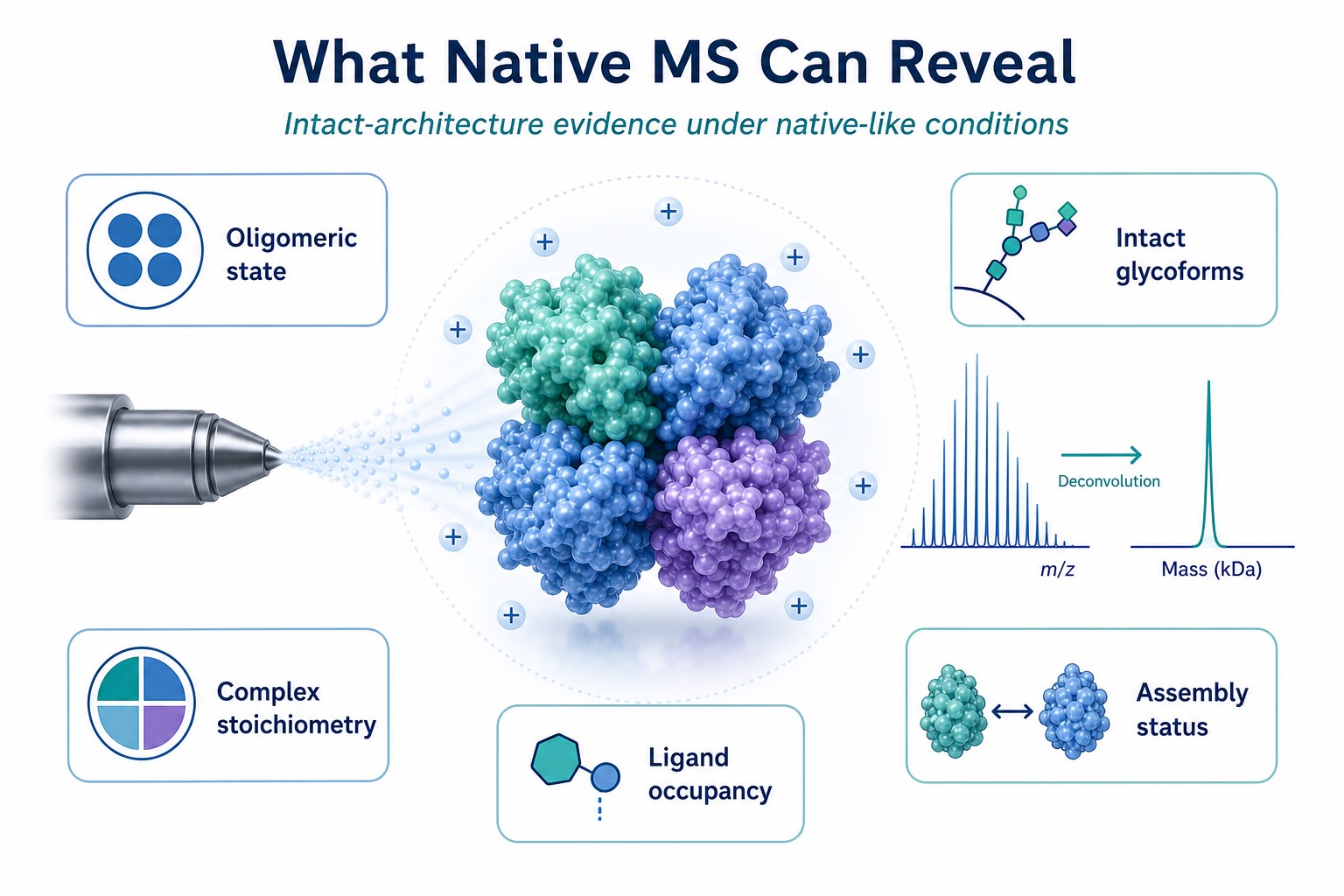
Figure 1. Native MS can reveal oligomeric state, complex stoichiometry, ligand occupancy, intact glycoforms, and assembly status.
How Native MS Works
A native MS project follows a defined analytical sequence. Each stage is tuned to protect non-covalent interactions while still generating interpretable mass spectra.
Sample qualification
The sample should be sufficiently pure and concentrated for direct intact analysis. Aggregates, free nucleic acids, detergents, and non-volatile salts often suppress ionization or broaden peaks. Qualification confirms whether the material is ready for native buffer exchange.
Native buffer exchange
Proteins are transferred into volatile native-compatible buffers, commonly ammonium acetate at controlled pH and ionic strength. Buffer exchange removes salts and additives that interfere with electrospray while keeping conditions mild enough to support folded assemblies.
Soft ionization and high-mass detection
Gentle electrospray settings generate low-charge protein ions that typically appear at higher m/z values than denatured proteins. The instrument must transmit and detect these high-mass ions with adequate sensitivity.
Spectrum acquisition and deconvolution
Charge-state envelopes are collected and converted into neutral mass values. Observed masses are then assigned to expected monomers, oligomers, bound complexes, or heterogeneous proteoforms.
Expert interpretation
Charge-state overlap, adduct formation, and partial dissociation can complicate automated assignment. Expert review connects measured masses to plausible assembly models and documents remaining ambiguity.
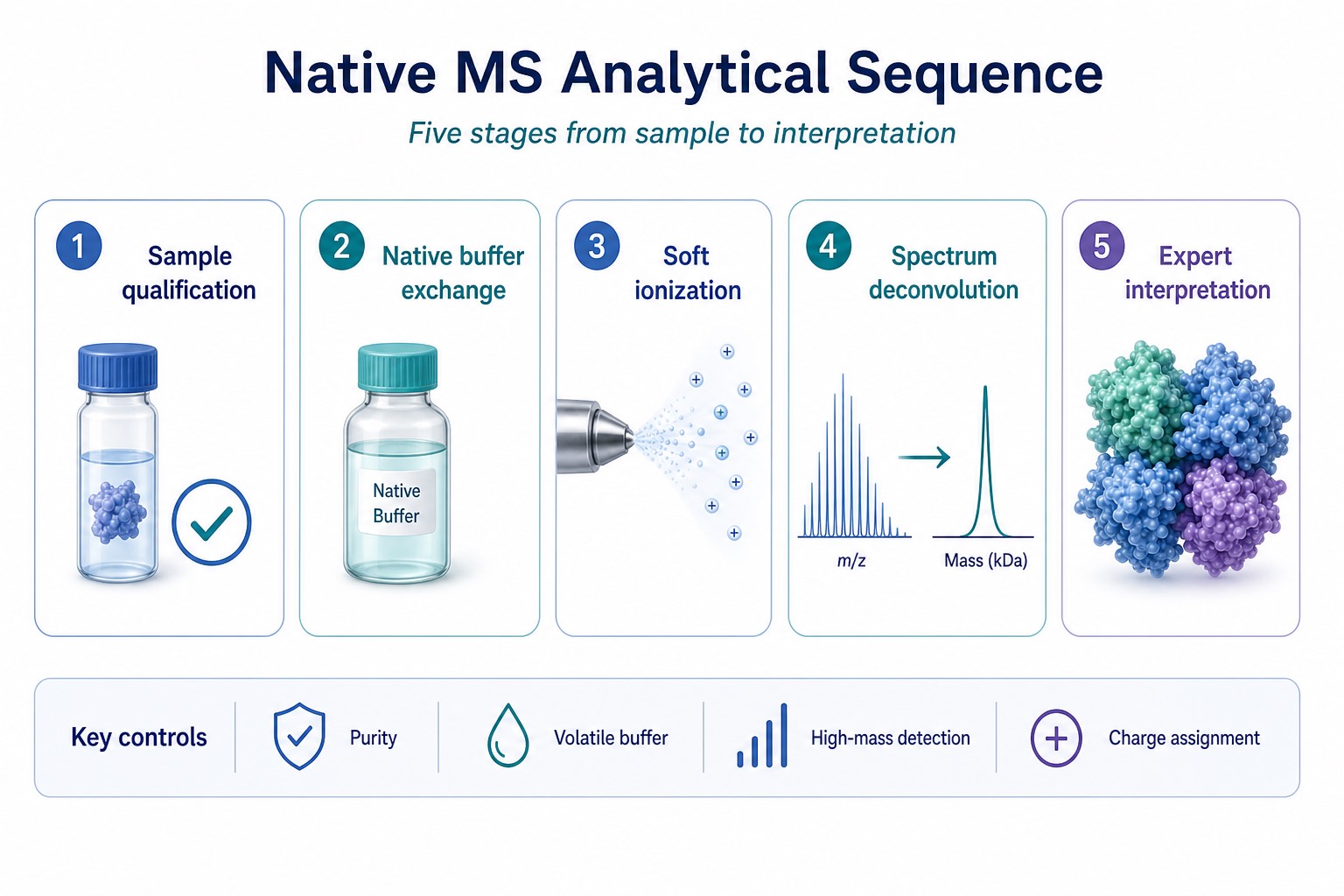
Figure 2. The native MS analytical sequence runs from sample qualification and buffer exchange through soft ionization, spectrum deconvolution, and expert interpretation.
Native MS Compared with Denaturing Mass Spectrometry
Native and denaturing mass spectrometry answer related but different questions. The comparison below summarizes the practical differences teams encounter when selecting an intact-protein method.
|
Feature |
Native MS |
Denaturing Intact Mass |
|---|---|---|
|
Solution conditions |
Volatile native-compatible aqueous buffers |
Organic solvents, acid, or other denaturants common |
|
Non-covalent interactions |
Preserved when method conditions are suitable |
Disrupted |
|
Typical analytical focus |
Assembly state, stoichiometry, bound complexes |
Subunit or intact covalent mass |
|
Charge-state pattern |
Lower charge states at higher m/z |
Higher charge states at lower m/z |
|
Primary output |
Complex and oligomer mass distributions |
Subunit or denatured intact mass values |
|
Best paired with |
Structural biology and biologics assembly review |
Sequence confirmation and covalent modification support |
Many programs use both approaches. Denaturing intact mass and peptide mapping confirm sequence and covalent modifications. Native MS then reports whether the expected assembled form is present under native-like conditions.
Technical Advantages of Native MS
The technical value of native MS comes from direct intact-level measurement under conditions that retain non-covalent structure.
Native MS reports oligomeric state and subunit stoichiometry from measured complex masses without requiring digestion.
Native MS can detect non-covalent associations such as protein-protein, protein-ligand, and protein-cofactor complexes when those interactions survive buffer exchange and ionization.
Native MS provides intact glycoform and proteoform distribution information at the whole-molecule level, which complements peptide-level modification mapping.
Native MS supports rapid comparison of assembly status across related samples, including purification fractions and formulation conditions, when sample quality is suitable.
Native MS generates mass-based evidence that can be compared with theoretical subunit and complex models, supporting transparent data interpretation.
These advantages are technical capabilities. They do not mean native MS can answer every structural or sequence question alone.
Current Limitations of Native MS
Native MS also has clear boundaries that should be stated before project planning.
Sample purity and buffer compatibility strongly affect data quality. Non-volatile salts, detergents, and complex matrices can prevent useful spectra.
Sensitivity for low-abundance or highly heterogeneous assemblies can be limited, especially when multiple overlapping species share the same m/z region.
Native MS does not provide residue-level sequence coverage. Peptide mapping or related methods remain necessary for sequence confirmation and site-specific modification localization.
Partial dissociation in the gas phase can complicate stoichiometry assignment if instrument settings are not carefully controlled.
Very large or poorly defined assemblies may produce congested spectra that require complementary separation or orthogonal structural methods.
Recognizing these limitations helps teams place native MS in the right phase of a characterization plan rather than treating the method as a standalone substitute for all protein analysis needs.
Related Services
Protein Molecular Weight Determination Service
Therapeutics Characterization Service | Advanced Structure
Antibody Drug Analysis Service
Teams evaluating whether native MS fits a given protein or biologic can consult MtoZ Biolabs to review sample status, expected assembly model, and the analytical depth required for the project phase.
Typical Applications of Native MS
Native MS is used when intact architecture and binding state are central to the scientific or product question.
Protein complex stoichiometry
Native MS is applied to purified multi-subunit complexes to confirm whether observed masses match expected stoichiometric models after purification and buffer exchange.
Oligomeric state assessment
Native MS can distinguish monomers, dimers, and higher-order oligomers when those forms produce separable intact mass envelopes.
Non-covalent ligand and cofactor binding
Native MS can report mass shifts consistent with bound ligands or cofactors under native-like conditions, supporting binding-state review before deeper biophysical experiments.
Biotherapeutic assembly and intact heterogeneity review
Native MS is used in antibody-related and other biologic programs to review intact assembly status and global proteoform heterogeneity, including glycoform distributions at the whole-protein level.
Process and formulation comparison support
Native MS can compare assembly profiles across selected process intermediates or formulation conditions when samples are compatible with native buffer exchange.
For programs that need native MS together with denaturing intact mass or antibody-focused characterization, MtoZ Biolabs can help align the analytical sequence with the current project phase.
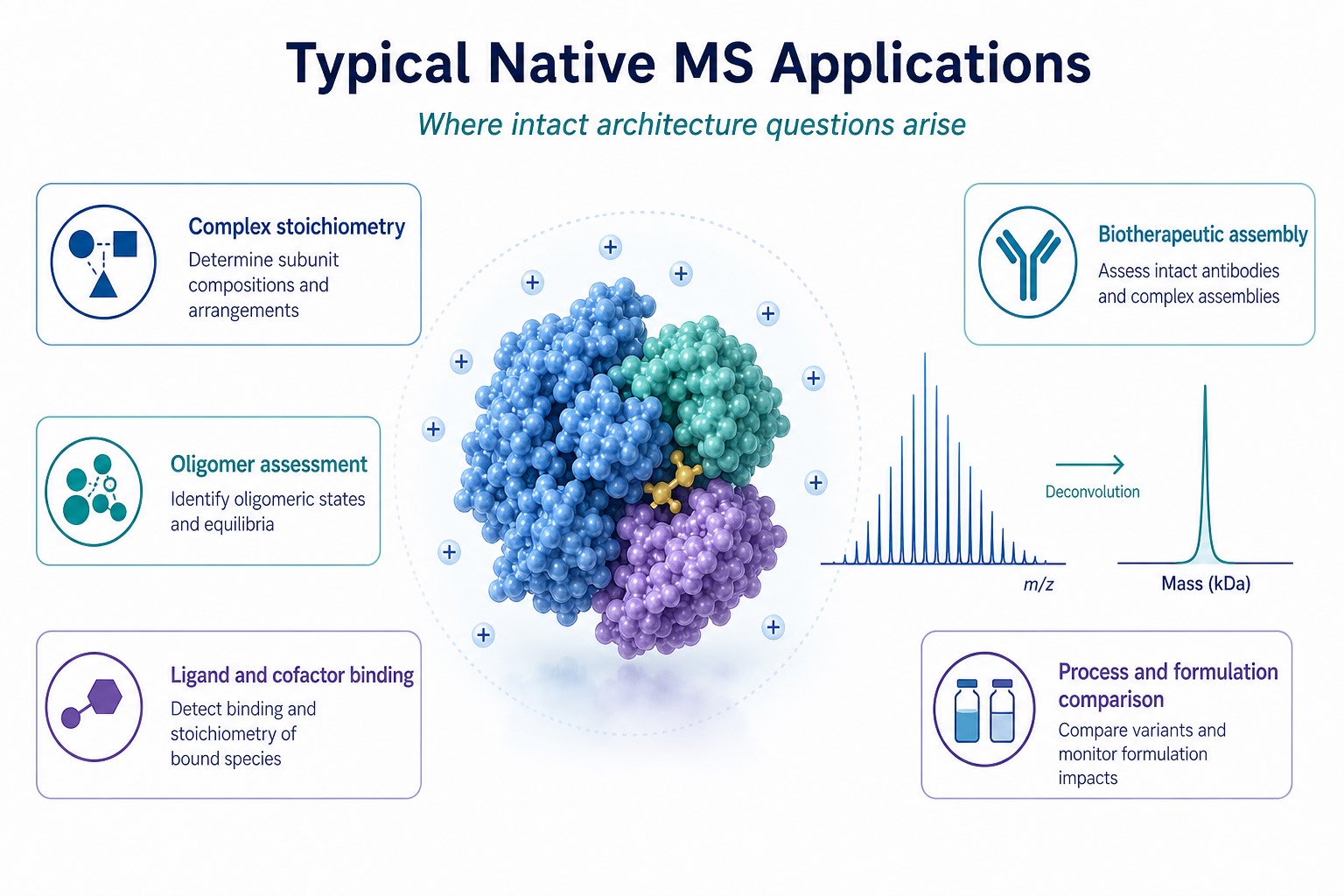
Figure 3. Typical native MS applications include complex stoichiometry, oligomer assessment, ligand and cofactor binding, biotherapeutic assembly, and process or formulation comparison.
Outlook for Intact Native Analysis
Native MS continues to expand as high-mass transmission, improved resolving power, and native-compatible separation strategies become more accessible. These developments improve the ability to resolve closely related intact species and congested assemblies.
At the same time, native MS is increasingly used as one layer in multi-method characterization. Native MS provides assembly and stoichiometry context. Denaturing intact mass, peptide mapping, ion mobility, and structural methods such as cryo-EM or crystallography address complementary questions. The practical future of native MS is therefore integrative: faster intact-architecture evidence that guides, rather than replaces, deeper structural and sequence workflows.
For researchers and biologics teams, the key skill is method matching. Native MS is selected when assembly state matters. Other MS layers are selected when sequence, covalent modification, or residue localization is the primary need.
Frequently Asked Questions
1. What is native mass spectrometry?
Native MS is an intact-protein mass spectrometry approach that measures proteins and protein complexes under native-like conditions so that non-covalent interactions and overall folded architecture can be preserved during analysis.
2. How does native MS differ from denaturing intact mass analysis?
Native MS uses gentler aqueous buffers and soft ionization to preserve assemblies. Denaturing intact mass analysis typically disrupts non-covalent interactions to report subunit or denatured intact masses.
3. What questions can native MS answer?
Native MS can address oligomeric state, complex stoichiometry, non-covalent binding, and intact proteoform or glycoform distributions at the whole-molecule level.
4. What sample requirements are common for native MS?
Samples are usually purified proteins exchanged into volatile native-compatible buffers. Salts, detergents, and complex matrices often need removal before useful spectra can be obtained.
5. Can native MS replace peptide mapping?
No. Native MS reports intact architecture and mass distributions. Peptide mapping remains necessary for sequence confirmation and site-specific modification localization.
6. When should a team choose native MS?
Native MS is a practical choice when the primary question concerns assembly state, stoichiometry, or non-covalent binding under native-like conditions rather than residue-level sequence detail.
Conclusion
Native mass spectrometry is an intact-level analytical approach for proteins and protein complexes analyzed under conditions designed to preserve non-covalent structure. The method reports assembly state, stoichiometry, binding-related mass shifts, and global intact heterogeneity. Native MS complements denaturing intact mass and peptide-based methods rather than replacing them.
For protein chemistry, structural biology, and biotherapeutic characterization programs, the practical value of native MS depends on clear question framing and suitable sample preparation. When assembly architecture is the missing piece of evidence, native MS provides direct mass-based answers that sequence-only workflows cannot supply. Researchers planning native MS for protein or biologic samples can contact MtoZ Biolabs to discuss sample readiness and the analytical approach matched to the current project phase.
How to order?




