






What Does a Mitochondrial Proteomics Analysis Include?
A mitochondrial proteomics analysis typically includes sample assessment, mitochondrial isolation or protein extraction as needed for the input material, protein identification by LC-MS/MS, quantitative comparison when the design supports it, differential analysis for defined groups, and a documented report package. Functional and pathway annotation should be confirmed project by project rather than assumed as a fixed default. PTM profiling and multi-omics integration are optional extensions outside the core protein inventory and abundance path.
Mitochondrial protein analysis is therefore a modular proteomics workflow, not a bundled mitochondrial-function assay kit. Teams matching scope to claim can share sample type, whether mitochondria are already extracted, group design, and required modules with MtoZ Biolabs before the analysis plan is locked.
Sample Assessment
Sample assessment is the first included step because it decides whether the planned modules can run as intended.
Assessment usually reviews:
- Sample class: cells, animal tissue, or already extracted mitochondria.
- Approximate amount and concentration against planning guidance.
- Buffer and additive notes for extracted mitochondrial preparations.
- Storage history, freeze-thaw count, and shipping condition.
- Group map and biological replicates when comparison is expected.
- The claim sentence: inventory, remodeling, or candidate ranking for follow-up.
Current planning references are about 5×10^7 cells, about 200 mg animal tissue, or extracted mitochondrial protein of at least about 50 µg with about 80-100 µg commonly planned, at a concentration commonly planned around 1 µg/µL. These values support feasibility planning. They do not guarantee a fixed identification depth for every matrix.
Borderline amounts, unusual buffers, or poorly tracked preparations should be reviewed case by case before acquisition is scheduled. Skipping assessment is how mismatched inputs reach LC-MS/MS and later look like weak biology.
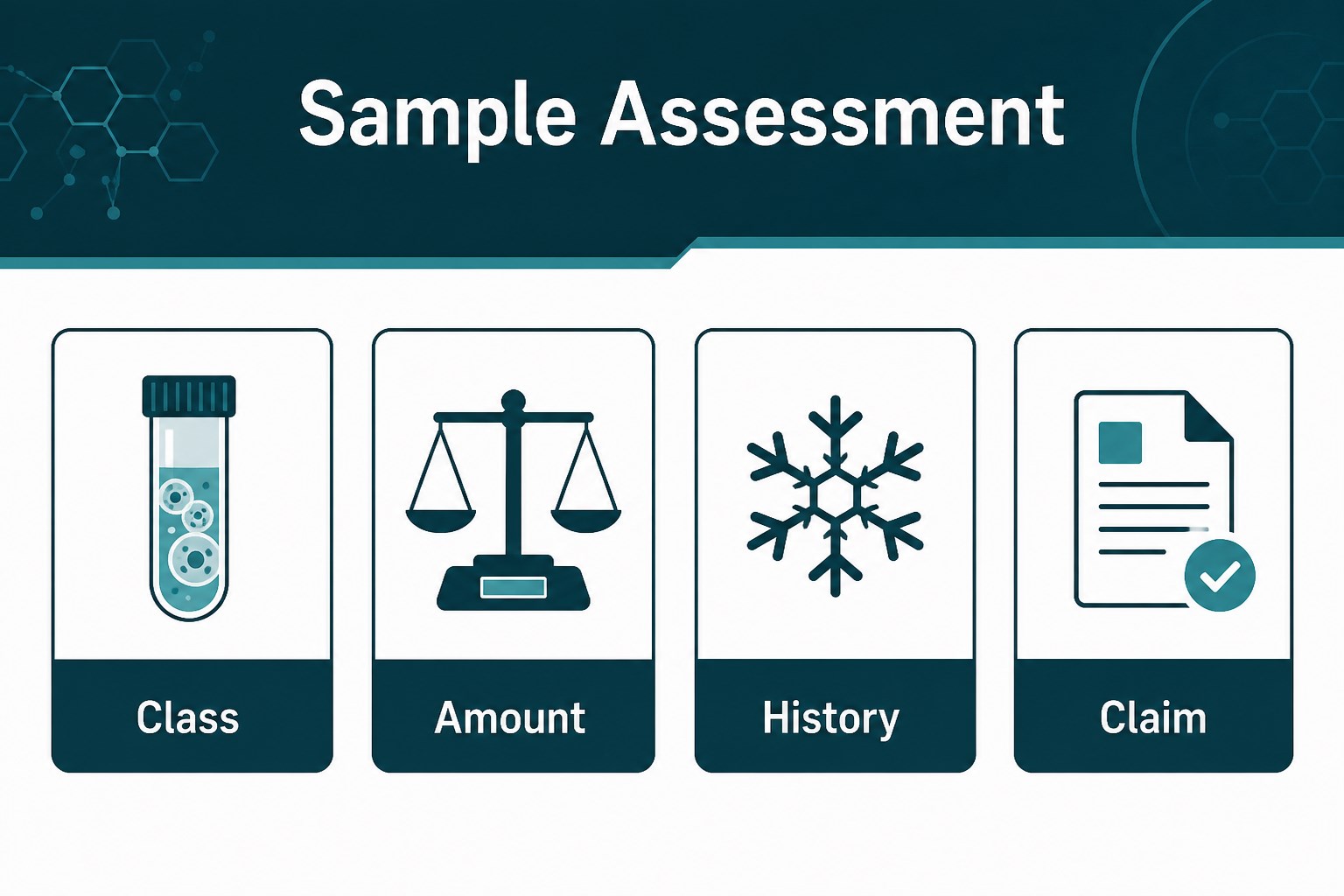
Figure 1. Sample assessment checks material class, amount, handling history, and the claim the dataset must support.
Mitochondrial Isolation and Protein Extraction
Isolation and extraction sit next in the analysis path, but they are not the same module.
If the input is cells or tissue, mitochondria usually need to be enriched or isolated before a mitochondria-focused proteome is acquired. Isolation quality affects contaminant burden, integrity, and between-group consistency, so the isolation plan should be matched across comparison arms. If the laboratory already holds extracted mitochondria, the analysis can start from that preparation once amount, concentration, and buffer chemistry are documented.
Protein extraction and digestion for LC-MS/MS are part of the proteomics analytical path once mitochondrial or mitochondria-enriched material is ready. That step converts the preparation into peptides for acquisition. It does not replace a careful isolation decision earlier in the chain.
A practical scope rule is:
- Isolation: confirm whether it is already completed by the submitter or needs to be arranged for the study.
- Extraction and digestion: expect them as part of standard mitochondrial protein analysis once the input is accepted.
- Phenotype assays that measure respiration, membrane potential, ROS, or ultrastructure: keep them outside this proteomics package.
Protein Identification
Protein identification is the core included module for almost every mitochondrial proteomics project.
Identification answers which proteins and peptides were detected in the recovered preparation. Outputs typically include protein accessions, peptide support, and search metadata from the chosen acquisition path. Platform options for this service line include Orbitrap Exploris 480, timsTOF Pro, and Orbitrap Astral. DDA paths are commonly processed with MaxQuant or Proteome Discoverer; DIA paths with Spectronaut or DIA-NN.
Identification is useful for inventory questions and for checking whether expected mitochondrial-associated proteins appear. It is not automatic proof that every detected protein is exclusively mitochondrial. Presence supports association with the preparation; exclusive localization still needs orthogonal evidence when the claim is critical. No fixed protein count should be assumed across all projects.
Quantitative Comparison
Quantitative comparison is included when the study is designed for abundance contrasts across samples or groups.
This module produces relative abundance matrices that allow proteins to be compared under matched handling and acquisition. Choose mode from the question: DDA-oriented workflows suit flexible discovery settings; DIA-oriented workflows suit consistent cohort-wide quantification when the sample set is defined early.
Quantitative comparison is not required for a single-condition inventory. It becomes essential when the claim is remodeling, treatment response, or genotype contrast. Instruments measure the peptides delivered by the preparation; they do not correct unmatched isolation or unbalanced group design.
Differential Analysis
Differential analysis builds on quantification when groups are predefined.
It ranks proteins that differ between conditions and organizes candidate lists for follow-up. Biological replicates, matched isolation or extraction handling, and balanced run order decide whether those ranks reflect biology rather than technical drift.
Treat differentials as prioritized candidates, not final mechanistic conclusions. Contaminant-driven changes, integrity-linked losses, and unmatched prep can all create group-aligned contrasts that look biological until isolation and design records are checked.
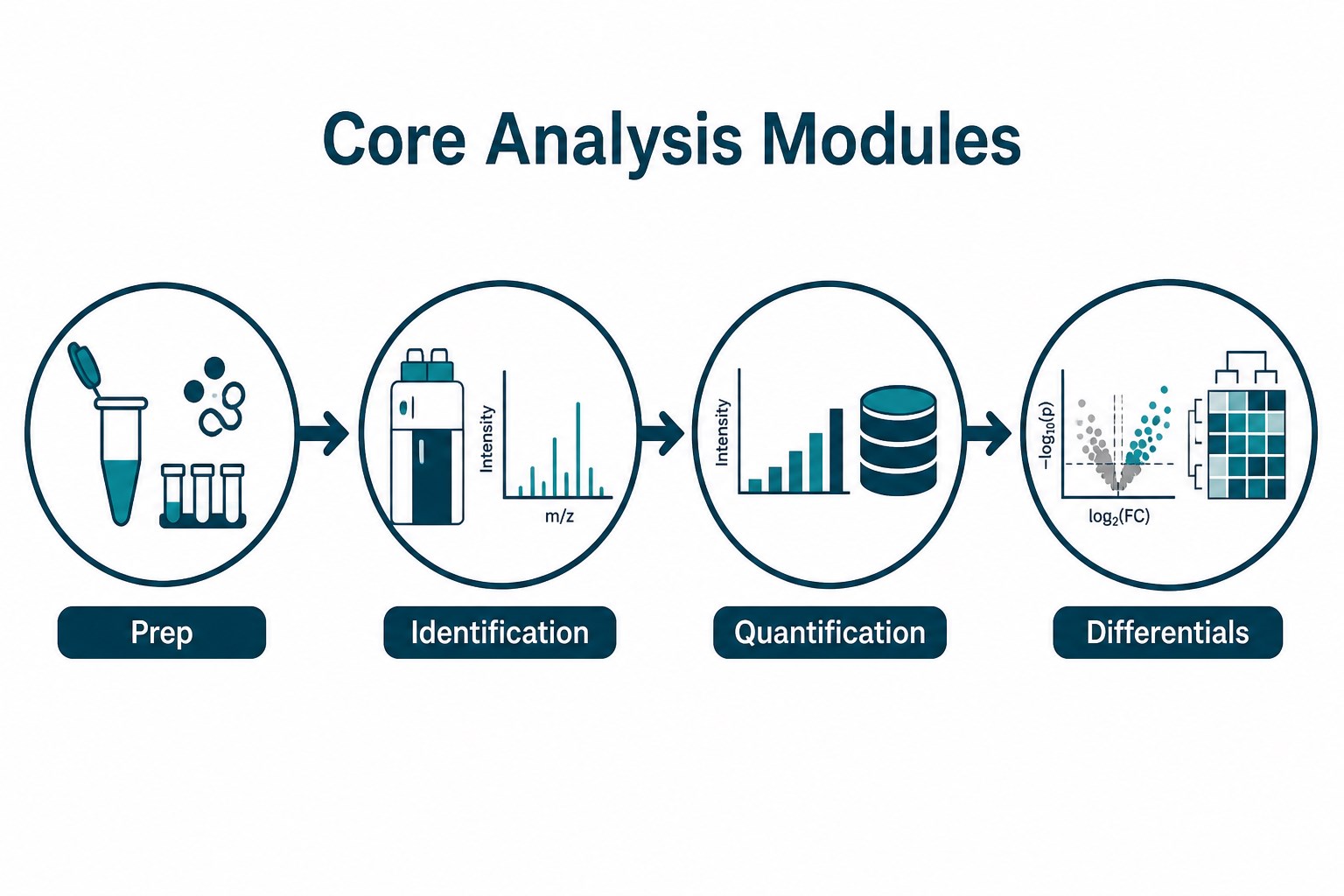
Figure 2. Core mitochondrial proteomics modules move from preparation into identification, quantification, and ranked differentials.
Functional and Pathway Annotation
Functional and pathway annotation is often requested after differentials appear, but it is not a guaranteed default module for every mitochondrial proteomics analysis.
GO, KEGG, or similar annotation views should be confirmed project by project. When included, they help organize candidates into biological themes. When omitted, the core package still delivers identification and, where designed, quantification and differentials. Do not assume pathway maps are automatic simply because proteins were identified.
Annotation also does not convert proteomics abundance changes into proven pathway activity. OXPHOS activity, membrane potential, ROS burden, and related functional endpoints remain separate assays even when pathway labels look compelling.
PTM and Multi-Omics Optional Extensions
PTM-focused work and multi-omics integration are optional extensions, not automatic contents of a standard mitochondrial protein analysis package.
Phosphorylation, acetylation, or other PTM designs need dedicated enrichment and analysis planning. Metabolomics, lipidomics, or transcriptomics layers need their own sample plans and interpretation rules. They can be scientifically complementary to mitochondrial proteomics, but they should be scoped as separate modules or separate studies rather than assumed add-ons inside the core identification and abundance path.
If your decision depends on a PTM site list or a cross-omics joint model, state that at kickoff so the project is not misread as a standard proteome inventory.
Main Deliverables
The main deliverables of a mitochondrial proteomics analysis should be explicit at the start.
A typical included package can cover:
- Raw mass spectrometry files.
- Identification outputs from the stated DDA or DIA path.
- Quantification matrices when the design is quantitative.
- Differential tables when groups were defined.
- A project report summarizing methods and main result files.
Annotation or pathway files, PTM reports, and multi-omics joint summaries belong in the deliverable list only when those modules were confirmed. Planning guidance for turnaround is about 4 weeks, with timing still dependent on sample condition and complexity.
|
Analysis module |
Usually included? |
What to confirm at kickoff |
|---|---|---|
|
Sample assessment |
Yes |
Material class, amounts, claim sentence |
|
Isolation |
Depends on input |
Already extracted vs still needed |
|
Protein extraction for LC-MS/MS |
Yes, once input accepted |
Buffer notes and integrity history |
|
Protein identification |
Yes |
DDA or DIA path |
|
Quantitative comparison |
When designed |
Groups, replicates, matched handling |
|
Differential analysis |
When groups defined |
Contrast map and candidate use |
|
Functional or pathway annotation |
Confirm per project |
Whether annotation files are required |
|
PTM or multi-omics extension |
Optional |
Separate scope and samples if needed |
When the module list is complete, send sample type, amounts, isolation status, group design, and the deliverables you need back. MtoZ Biolabs can confirm which items sit inside the mitochondrial proteomics analysis and which need separate planning.
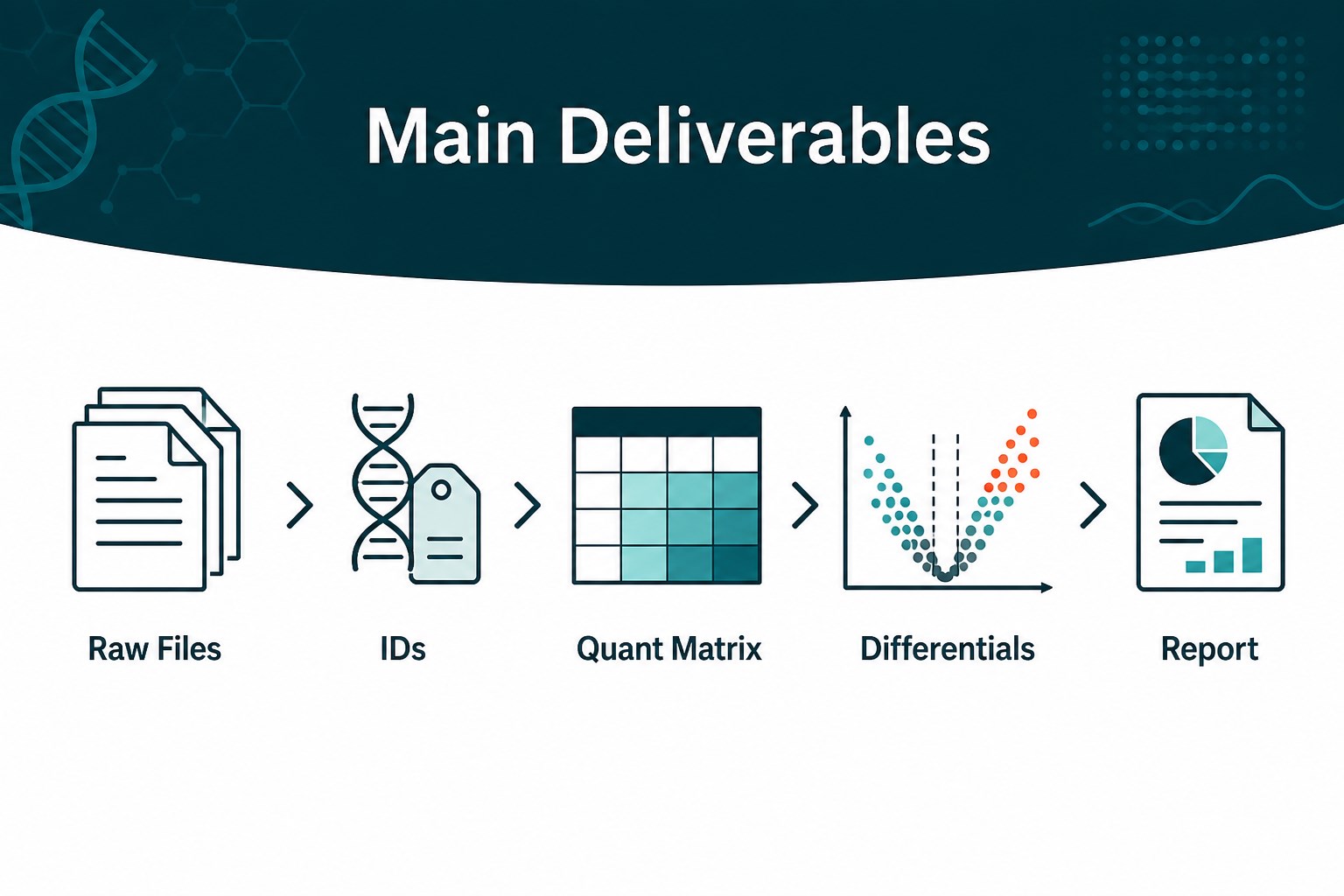
Figure 3. Core deliverables center on raw files, identification, quantification when designed, differentials when grouped, and the project report.
Related Services
Teams aligning analysis modules with organelle proteomics options can review the services below while scope is still open.
Mitochondrial Proteomics Service
The main route for mitochondrial proteomics and mitochondrial protein analysis once modules and deliverables are confirmed.
Subcellular Proteomics Service
Use this when the included analysis spans multiple subcellular fractions rather than a mitochondria-focused package alone.
Subcellular Structure and Organelle Proteomics Service
A broader organelle proteomics option when mitochondrial modules sit inside a multi-compartment study design.
Frequently Asked Questions
1. What does a mitochondrial proteomics analysis include?
It typically includes sample assessment, isolation or extraction as needed, protein identification, quantification and differentials when designed, and a report package. Annotation, PTM, and multi-omics need separate confirmation.
2. Can MtoZ Biolabs Perform Mitochondrial Isolation Before Proteomics?
Yes. MtoZ Biolabs can perform mitochondrial isolation from supported cell or tissue samples before LC-MS/MS analysis. Client-prepared mitochondrial fractions or extracted mitochondrial protein may also be accepted after sample amount, concentration, buffer composition, and preparation status are reviewed.
3. Are pathway annotation results included by default?
No. Functional and pathway annotation should be confirmed project by project rather than assumed as a fixed module.
4. Does the analysis include PTM or multi-omics?
Those are optional extensions. Standard mitochondrial protein analysis centers on protein identification and abundance comparison.
5. What are the main deliverables?
Raw files, identification outputs, quantification matrices when designed, differential tables when groups are defined, and a project report.
6. Are functional mitochondrial assays part of this package?
No. Respiration, membrane potential, ROS, enzyme activity, and imaging assays sit outside this proteomics analysis and need separate plans.
Conclusion
A mitochondrial proteomics analysis is a defined set of modules: assess the sample, prepare mitochondrial protein for LC-MS/MS, identify proteins, quantify and rank differentials when the design supports it, and deliver a reviewable report. Annotation, PTM, and multi-omics can extend that path, but only when confirmed.
If the included modules match the claim before samples move, mitochondrial protein analysis is far easier to interpret and to schedule. Teams ready to lock the module list can review sample type, isolation status, group design, and deliverables with MtoZ Biolabs before the project starts.
How to order?




