






What Determines Target Coverage in Targeted Lipidomics?
-
List status: whether the target is already on the established detection panel or needs new method work.
-
Reference standards: whether authentic standards exist and are available to anchor identification and quantification.
-
Lipid chemistry and matrix: how well the species can be separated and detected in the specific sample type you are submitting.
-
Abundance and dynamic range: whether the target is present at levels the method can measure against a much larger lipid background.
-
Match against the detection list. Separate on-list targets (routine) from off-list targets (evaluation needed).
-
Check standards for off-list targets. Confirm whether authentic reference standards exist and can be sourced.
-
Define the quantification level. Decide whether relative comparison is enough or whether defined concentrations - and therefore calibration curves and internal standards - are required.
-
Consider matrix and abundance. Flag any targets expected to be low in your specific sample type.
-
Confirm sample type and amount. Make sure the plan matches the workflow, especially for specialized matrices.
Target coverage in targeted lipidomics comes down to one central question: are the lipids of interest already included in the established detection panel, or do they require additional evaluation before measurement?
Lipids included in the current targeted detection list can be measured through an established workflow. Targets outside the current detection list are not necessarily excluded, but they require feasibility assessment or custom method development. Reference-standard availability, lipid chemistry, sample matrix, and target abundance all influence whether and how they can be measured. The practical first step is to compare your target list with the current detection list, then identify off-list targets that require further assessment before study design is finalized. MtoZ Biolabs can review an on-list versus off-list split for your lipid target list before the study is locked.
What "Coverage" Really Depends On
It is easy to assume coverage is a fixed property of the instrument, but in targeted lipidomics it is really the product of several factors coming together. A lipid is considered covered when there is an appropriate method to detect it, distinguish it from structurally related species, and - when quantitative results are required - measure it reliably in the relevant matrix.
Four things carry most of the weight:
When these factors are well aligned, coverage assessment becomes more predictable. When one or more is uncertain - usually an off-list target or a missing standard - that is exactly what the feasibility step is designed to resolve.
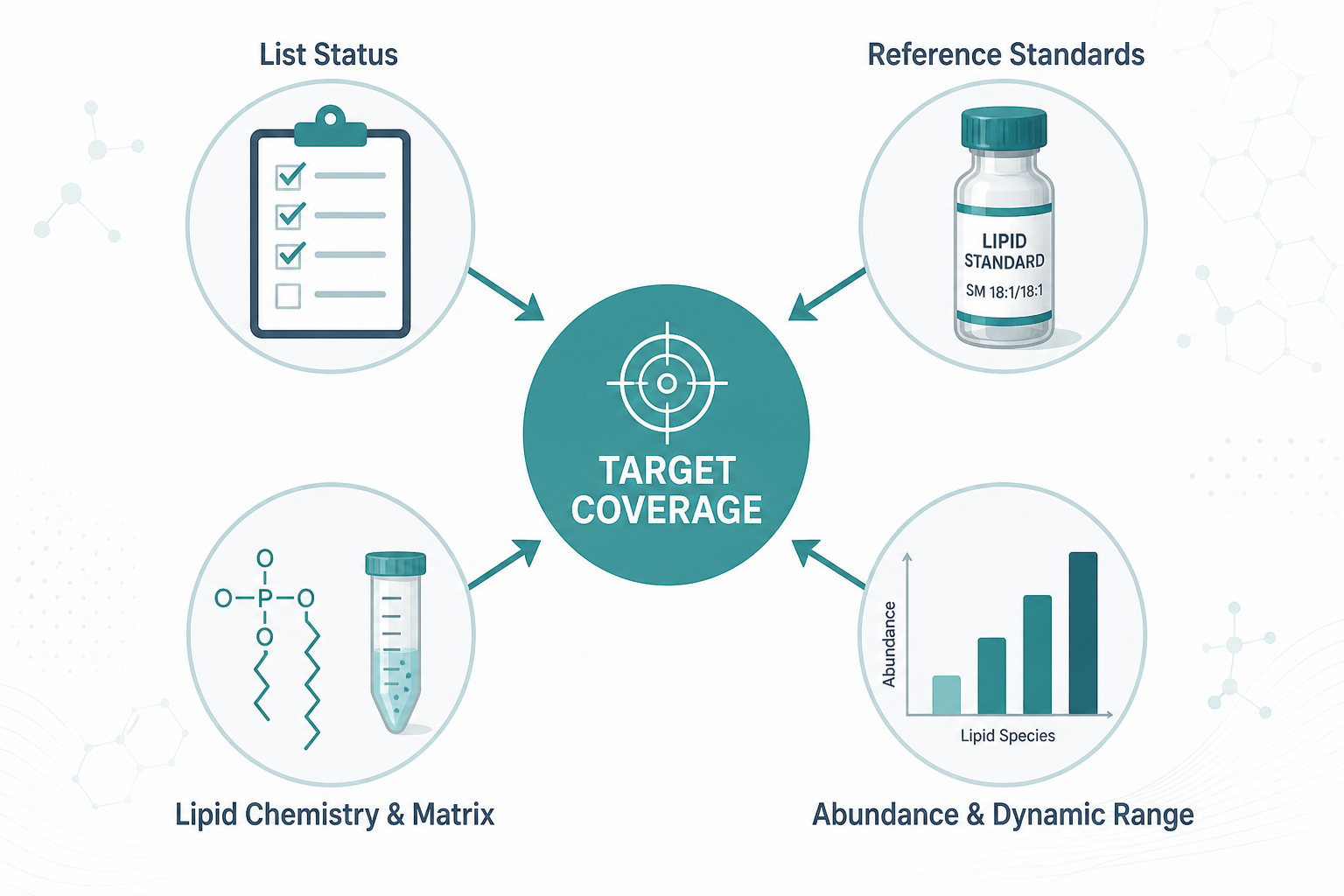
Figure 1. Coverage depends on list status, reference-standard availability, lipid chemistry and matrix, and target abundance.
On-List vs Off-List Targets
The single most useful distinction for planning is whether your targets are on the current detection list.
On-list targets are the routine case. These lipids already have an established, validated measurement approach, so they can be scheduled as standard targeted lipidomics work with predictable handling. If your entire list sits inside the panel, coverage planning is mostly a matter of confirming matrix and sample amount.
Off-list targets are not necessarily excluded, but they require feasibility assessment before the analytical scope can be confirmed. Bringing a new lipid into a targeted method usually involves sourcing authentic reference standards, developing and checking the measurement conditions, and confirming the target behaves well in your matrix. For custom-developed targets, the standard-compound purchase, calibration-curve preparation, and method-development effort are typically part of the client's project scope, so it helps to know early which of your targets fall into this category.
A practical habit is to split your list into these two buckets at the outset. That way the on-list majority can proceed while the off-list minority goes through evaluation, rather than holding the whole project for a few uncertain species.
Why Reference Standards Matter So Much
Reference standards are the quiet determinant behind most coverage decisions, so they deserve a closer look.
For confident identification, and especially for quantification, a targeted method leans on authentic standards to anchor what it is measuring. This is one of the key differences between targeted measurement and untargeted annotation: instead of a library-based candidate match, you get a measurement tied to a known reference. When a target's standard is readily available, adding or confirming it is relatively direct. When no suitable standard exists, or it is difficult to obtain, that constraint - not the instrument - often sets the ceiling on coverage.
The level of quantification you actually need also shapes the standard requirement. A study that only needs to compare relative abundance between groups asks less of the standards than one that needs defined concentrations, which typically calls for calibration curves and, where appropriate, internal standards. Deciding the intended quantification level early keeps the standard plan realistic and avoids surprises once the method work begins.
Target definition also affects coverage assessment. Lipids may be described at different structural levels, from class or sum-composition levels to fully resolved molecular species. Clarifying the expected reporting level helps avoid mismatch between the requested target and the achievable analytical output.
Matrix, Abundance, and Sample Considerations
Even when a lipid target is included in the current detection panel, sample characteristics can influence measurement performance.
Different biological matrices contain distinct lipid backgrounds, which can affect extraction efficiency, signal response, and the ability to distinguish low-abundance targets from related lipid species. Target abundance should therefore be considered together with the sample type and analytical requirements during project planning.
Sample amount, collection conditions, and processing consistency also influence data quality, especially in comparative studies where relative differences between groups are the primary focus.
Common matrices, including plasma or serum, tissue, cells, urine, feces, and culture supernatant, can be considered for targeted lipidomics workflows. Specialized materials, such as CSF, exosome-derived samples, plant tissue, or microbial biomass, require project-specific assessment based on sample characteristics and target requirements.
A Practical Coverage Assessment
Bringing these factors together, a target list can be assessed in a few clear steps:
Working through this list turns a vague "can you measure these lipids?" into a concrete, target-by-target picture of what is routine, what needs development, and what to expect.
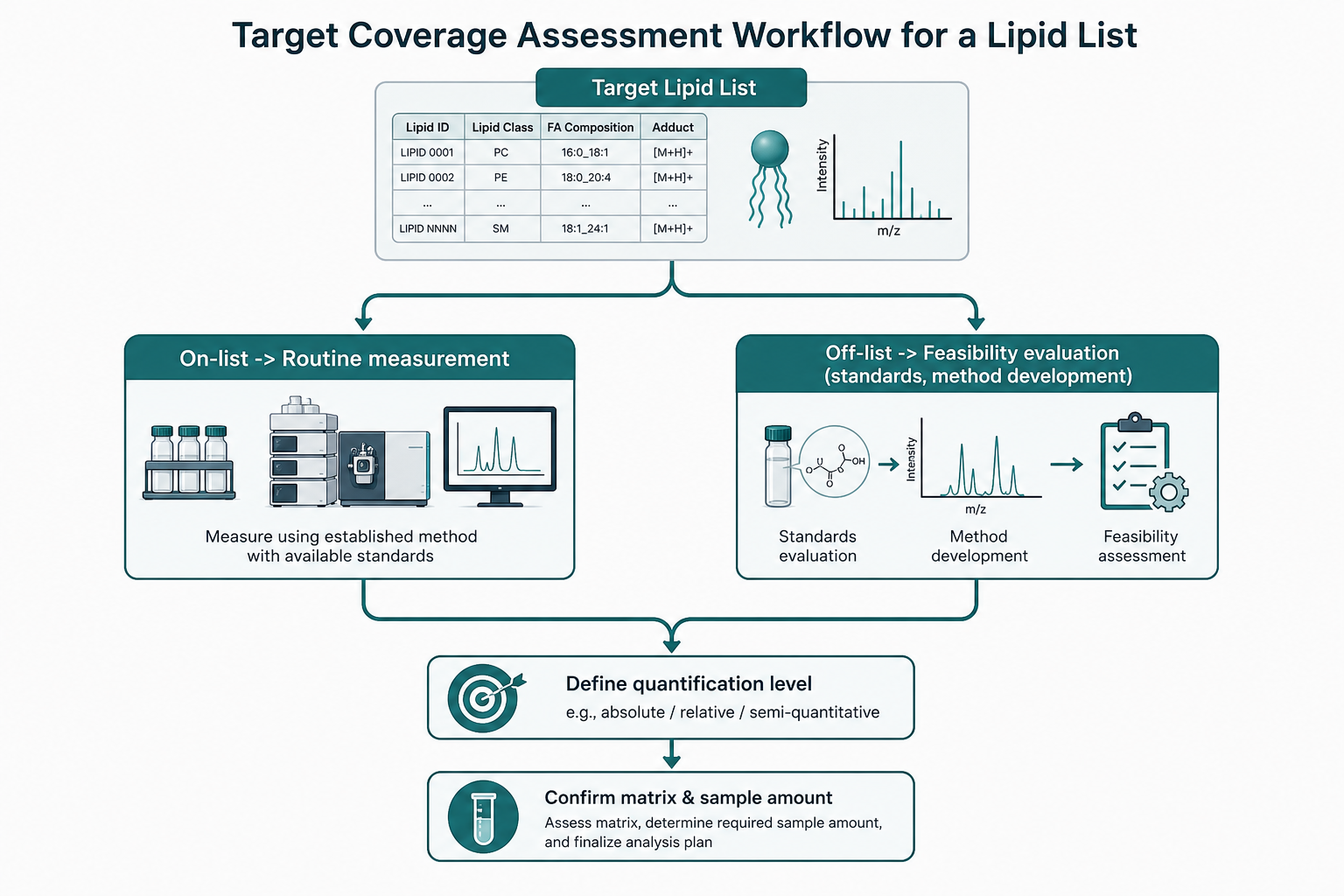
Figure 2. Split the list into on-list and off-list targets, then assess standards, quantification level, matrix, and sample amount.
Related Services
Metabolomics and Lipidomics Analysis Services
Targeted Lipidomics Analysis Service
Untargeted Lipidomics Analysis Service
Lipidomics Pathway Analysis Service
Frequently Asked Questions
1. How do I know if my target lipids are covered?
Check them against the current targeted detection list. On-list lipids are routine; off-list lipids go through a feasibility evaluation before they can be confirmed.
2. Can lipids outside the standard list still be measured?
Often yes, through separate evaluation or custom method development. That path depends on reference-standard availability and how the target behaves in your matrix.
3. How are reference standards handled for custom targets?
For custom-developed targets, reference-standard availability, acquisition requirements, calibration strategy, and method-development needs are evaluated during project setup.
4. Does targeted lipidomics give absolute concentrations?
It can, when the study needs it and appropriate standards and calibration are in place. If only relative comparison between groups is required, the standard requirement is lighter. Decide the intended level early.
5. What sample types can be considered for targeted lipidomics?
Common matrices include cells, tissue, plasma or serum, urine, feces, and culture supernatant. Specialized biological materials require project-specific review.
6. What should I prepare before requesting a quote?
Your target lipid list, the sample type and available amount, and the quantification level you need. That combination lets coverage be assessed target by target.
Conclusion
Target coverage in targeted lipidomics is not a single yes-or-no answer - it is the result of list status, reference-standard availability, lipid chemistry and matrix, and target abundance working together. On-list lipids are routine; off-list lipids are workable but need a feasibility step that turns on standards and method development.
The fastest way to move a project forward is to check your list against the detection list, split it into routine and evaluation buckets, and settle the quantification level and sample plan up front. Researchers with a target lipid list can consult MtoZ Biolabs for target-by-target assessment of coverage and feasibility before finalizing the analytical design.
How to order?




