






What Can Untargeted Lipidomics Reveal About Lipid Class Changes?
-
Class-level shifts, where the overall balance between lipid classes changes - for example, a relative increase in one glycerophospholipid class alongside a decrease in another.
-
Chain-composition shifts, where species within a class move toward longer or shorter acyl chains, or toward more or fewer double bonds.
-
Species-level redistribution, where the total for a class looks stable but the individual species inside it are rearranged.
-
Prioritize candidate features by considering the magnitude and consistency of change, statistical support, signal quality, annotation confidence, and biological relevance.
-
Read those candidates in the context of the biology you expect, rather than treating every annotated feature as equally solid.
-
Identify the candidates most relevant to the study question for further evaluation or separately reviewed follow-up.
Untargeted lipidomics is commonly used to investigate broad changes in lipid composition between conditions, including shifts across lipid classes and molecular species.
In a comparative design, untargeted lipidomics profiles detectable lipid features across groups and helps identify relative changes at both lipid-class and molecular-species levels. It can reveal patterns such as relative shifts between lipid classes or changes in chain length and degree of unsaturation within a class. These results are comparative and primarily relative, while lipid species may receive candidate annotations based on the available analytical evidence. Priority candidates may be considered for separately reviewed follow-up according to target coverage and project scope.
What "Lipid Remodeling" Actually Means in Data
Lipid alterations often occur as coordinated changes across multiple related molecular species rather than as isolated changes in individual lipids. Under different biological conditions, these changes may appear as broader shifts across related lipid species. That coordinated pattern is what people mean by lipid remodeling, and it is one of the patterns that untargeted lipidomics can help characterize.
In practice, remodeling appears in a few recognizable ways:
Compared with predefined targeted analysis, untargeted lipidomics is better suited to exploring broader class- and species-level patterns when the relevant lipids have not yet been defined.
Observing changes across multiple lipid classes can provide broader context than examining individual lipid measurements alone. A coordinated shift across different lipid classes may provide biological context for the observed remodeling pattern, although such associations do not by themselves establish a mechanism. That cross-class perspective is one of the reasons untargeted profiling is useful when the relevant lipid changes have not yet been defined.
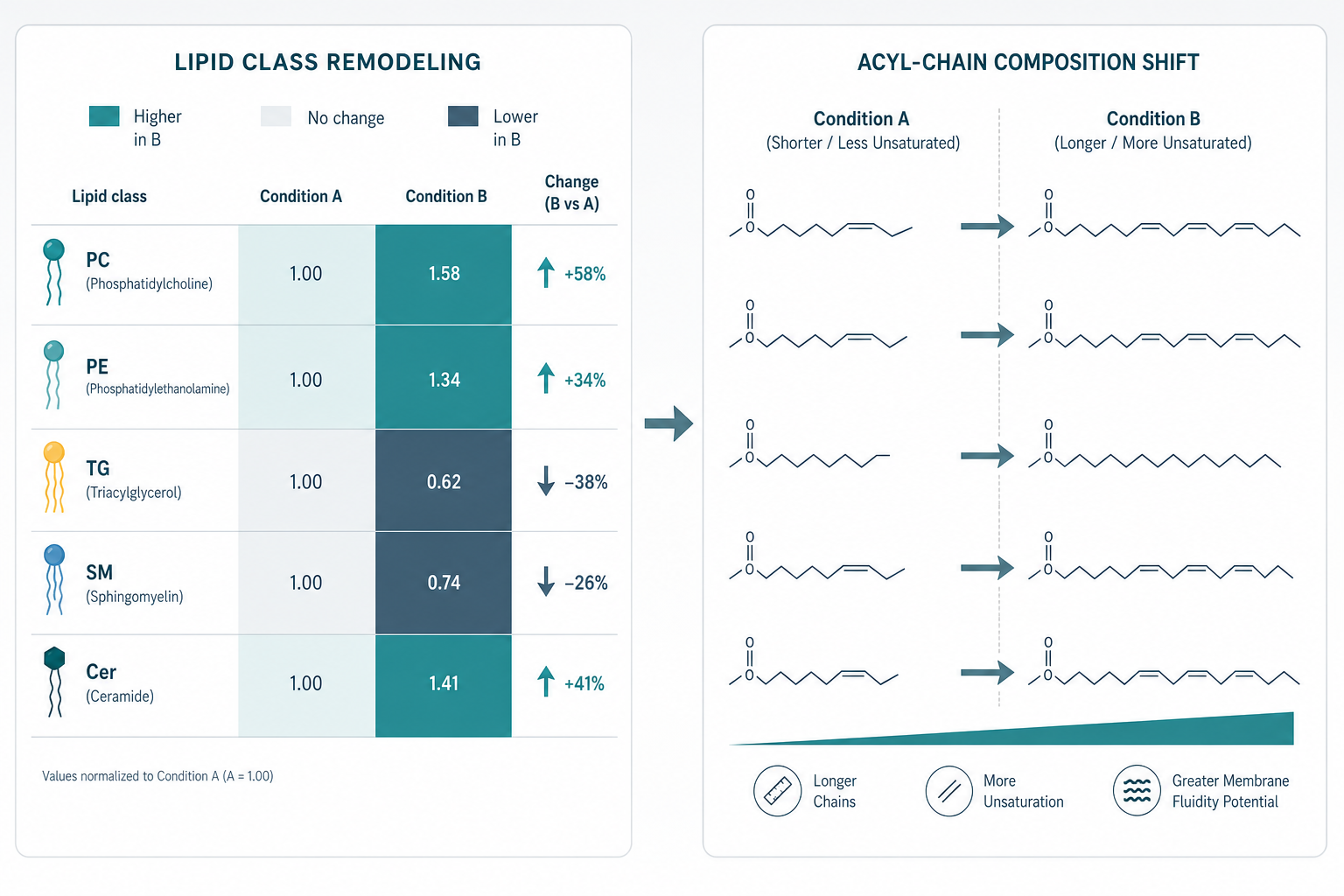
Figure 1. Untargeted lipidomics captures coordinated shifts across lipid classes and their molecular species between conditions.
What the Analysis Can Show You
For a comparative study - treated versus control, disease model versus wild type, timepoint versus baseline - an untargeted lipidomics run typically supports several layers of interpretation.
At the broadest level, it gives a profile of detectable lipids across all your samples, which already lets you compare the overall lipid composition of each group. Differential analysis can highlight lipid classes and species that differ between conditions, while multivariate views can show broader group-related patterns or overlap. Lipid features associated with these patterns can then be prioritized for further interpretation.
The key point is that these findings are comparative and relative. Untargeted lipidomics primarily supports relative comparisons between groups, showing whether detectable lipid features are higher or lower under different conditions. Absolute concentration measurements require an appropriately designed and validated quantitative approach and should not be inferred from untargeted relative data.
How Annotations Work, and How to Read Them
This is the part worth being precise about, because it shapes how you can write up the results.
Untargeted lipid features may receive candidate annotations based on available lipid databases, spectral libraries, and structural evidence. The confidence and structural resolution of each annotation depend on the supporting evidence available for that feature, so candidate annotations should not automatically be treated as confirmed molecular identities.
The realistic and defensible workflow is to let the data nominate candidates and then interpret them sensibly:
Describing untargeted output as a pattern of class- and species-level lipid changes that warrants further evaluation is more appropriate than presenting the results as definitively identified or absolutely quantified lipids.
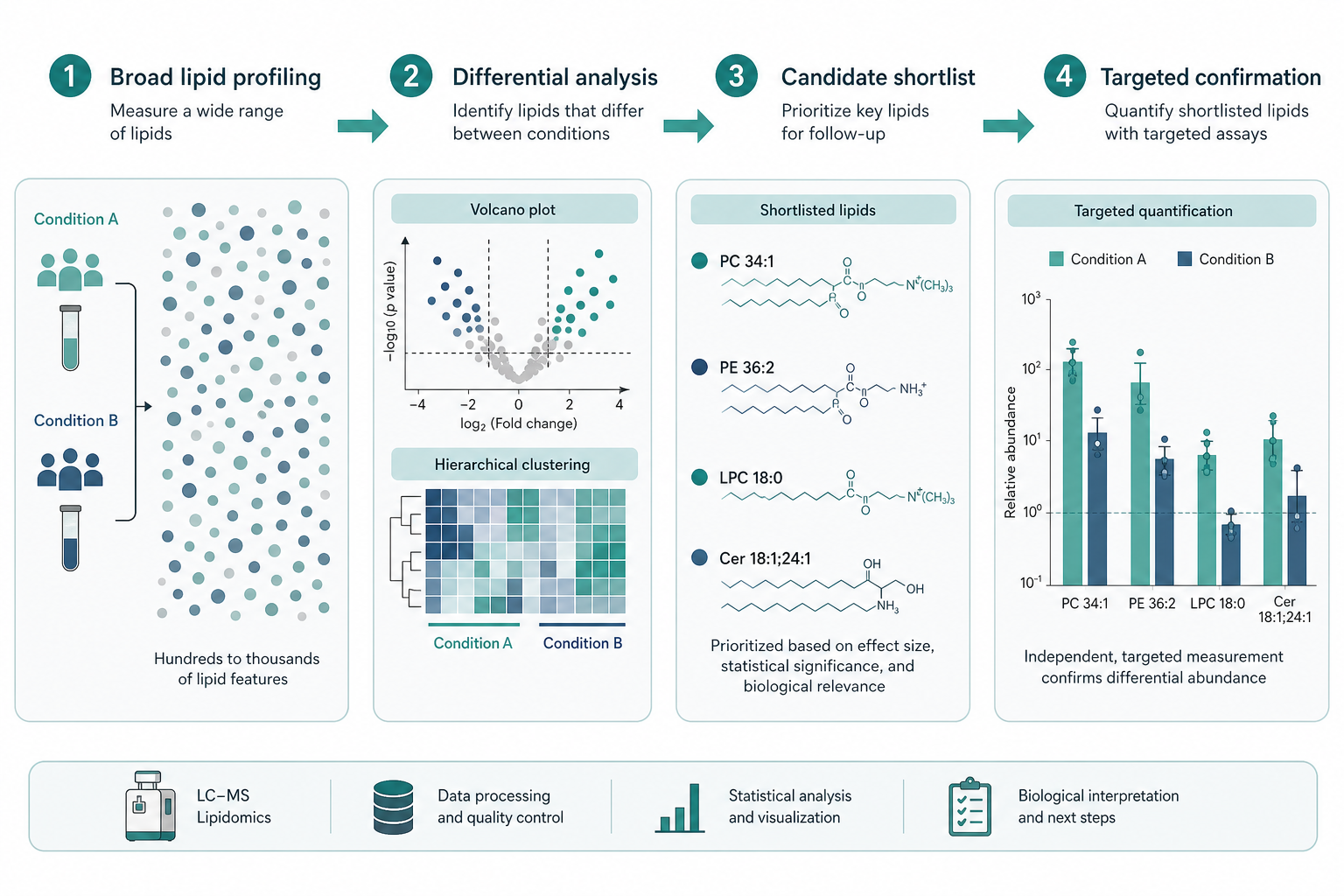
Figure 2. Discovery profiling identifies differential lipid classes and candidate species; selected candidates may be considered for separately reviewed follow-up.
From Discovery to Focused Follow-up
Untargeted lipidomics can be used independently for broad comparative profiling or as an exploratory stage before more focused follow-up.
Once remodeling patterns emerge, selected lipid candidates may be considered for targeted lipidomics follow-up. Targeted lipidomics focuses on a predefined lipid target list, but target coverage and the applicable analytical scope require project-specific review before the project is confirmed. Whether untargeted findings are suitable for targeted follow-up depends on the proposed targets, available analytical coverage, and study design.
If pathway-level interpretation is relevant to the study, this can also be considered during project planning so that lipid changes are interpreted in the context of related metabolic processes where appropriate.
Samples and Practical Planning
Sample type and handling influence lipid extraction efficiency and downstream interpretation in untargeted lipidomics. Common biological matrices, including cells, tissue, plasma or serum, urine, feces, CSF, saliva, culture supernatant, plant tissue, and microbial samples, can be considered depending on the study design.
Available sample amount, collection conditions, storage, and processing consistency should be reviewed before the experiment because lipid profiles are sensitive to preanalytical variation. Less common materials, including exosome-derived samples, require project-specific assessment based on sample characteristics and analytical objectives.
Related Services
Metabolomics and Lipidomics Analysis Services
Untargeted Lipidomics Analysis Service
Targeted Lipidomics Analysis Service
Lipidomics Pathway Analysis Service
Frequently Asked Questions
1. What does untargeted lipidomics reveal beyond measuring individual lipids?
It can reveal broader class- and species-level patterns across detectable lipid features, helping distinguish an isolated change from a wider remodeling pattern.
2. Does untargeted lipidomics give absolute concentrations?
No. Untargeted lipidomics primarily supports relative comparisons between groups. Absolute concentration measurements require an appropriately designed quantitative approach.
3. Are the lipid identifications confirmed?
Untargeted lipid features may receive candidate annotations based on available databases, spectral libraries, and structural evidence. These annotations do not automatically represent confirmed molecular identities, and selected candidates may require separately reviewed follow-up.
4. Can it detect changes in chain length or saturation?
Yes. Untargeted lipidomics can reveal changes in species composition within a lipid class, including shifts associated with chain length or degree of unsaturation, depending on the structural resolution supported by the analytical data.
5. What sample types work for comparative lipidomics?
Common sample types include cells, tissue, plasma or serum, urine, feces, CSF, saliva, culture supernatant, plant tissue, and microbial samples. Less common biological materials require project-specific review.
6. How should I plan a comparison to avoid artifacts?
Keep collection, extraction, storage, and handling as consistent as possible across groups, and consider sample input and biological replication during study planning to reduce avoidable preanalytical variation.
Conclusion
Untargeted lipidomics is well suited to questions about how lipid composition changes broadly between conditions. It can reveal class-level shifts, changes in chain composition, and species-level redistribution that may be missed by narrowly focused measurements.
The results should be interpreted as relative comparative patterns with candidate lipid annotations rather than automatically confirmed molecular identities or absolute concentrations. Selected candidates may be considered for separately reviewed follow-up when target coverage and project scope are suitable. MtoZ Biolabs can review the study objective, sample information, comparison design, and proposed follow-up targets to help define an appropriate lipidomics workflow before project initiation.
How to order?




