






Ubbelohde Viscometer Analytical Service
Ubbelohde Viscometer Analytical Service is a high-precision liquid viscosity testing service based on the principle of capillary flow. Viscosity is one of the most important physical parameters of fluids and plays a critical role in the stability of pharmaceutical formulations, molecular weight characterization of polymers, performance evaluation of lubricants and additives, and functional studies of biomacromolecule solutions such as polysaccharides and proteins. With its unique constant-level design, the ubbelohde viscometer effectively minimizes the influence of surface tension, ensuring accuracy and reproducibility of measurement results.
Technical Principles
The working principle of the ubbelohde viscometer is based on capillary flow dynamics. At a constant temperature, the time required for a liquid to pass through a narrow capillary under the influence of gravity is proportional to its viscosity. The unique design of the ubbelohde viscometer maintains a constant liquid level during measurement, effectively reducing the interference of surface tension and liquid level fluctuations. By precisely measuring the flow time and combining it with the liquid density and the capillary constant, the dynamic viscosity or relative viscosity value can be calculated.
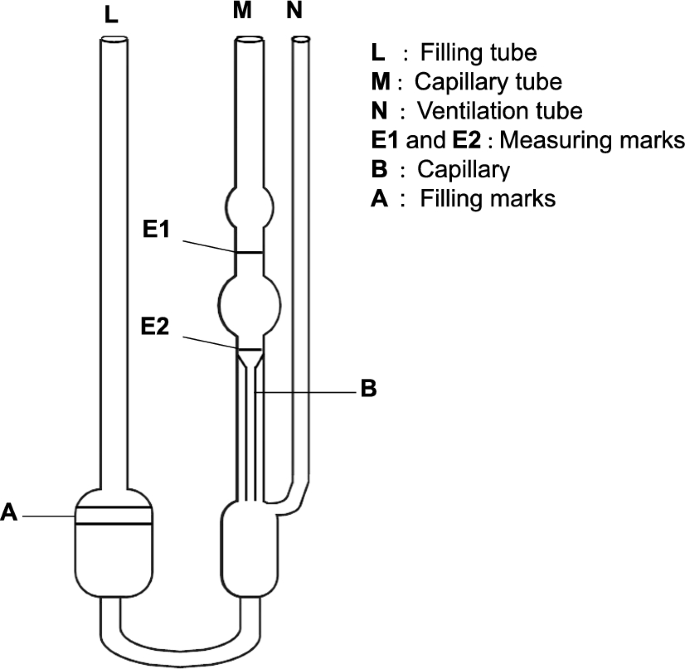
Bin Hajeb AM. et al. Arab J Sci Eng. 2025.
Figure 1. Ubbelohde Viscometer
Services at MtoZ Biolabs
MtoZ Biolabs provides Ubbelohde Viscometer Analytical Service for the determination of dynamic viscosity and relative viscosity of dilute solutions, including polymer characterization and studies of biomacromolecule solutions such as polysaccharides and proteins. Using the ubbelohde viscometer, we are able to deliver high-precision and reproducible viscosity data to support pharmaceutical formulation development, polymer molecular weight characterization, and performance evaluation of biomaterials.
Analysis Workflow
The general process of Ubbelohde Viscometer Analytical Service is as follows:
1. Sample Preparation
Dissolve and pre-treat the sample according to its type (solution or solid powder) to ensure a homogeneous, bubble free solution.
2. Temperature Control
Place the viscometer in a constant-temperature water bath to avoid the influence of temperature fluctuations.
3. Flow Testing
Introduce the sample into the ubbelohde viscometer, allow it to pass through the capillary under gravity, and accurately record the flow time.
4. Data Calculation
Combine the sample density and capillary constant to calculate dynamic viscosity, relative viscosity, or intrinsic viscosity.
5. Result Verification
Ensure reliability and reproducibility of results through repeated measurements and standard references.
6. Report Output
Generate a complete report including experimental conditions, raw data, and result interpretation.
Service Advantages
- High Precision and Reproducibility: The Ubbelohde viscometer adopts a constant-level design that effectively minimizes the impact of surface tension and liquid level fluctuations, ensuring accuracy in viscosity measurement.
- Wide Applicability: Compatible with Newtonian fluids and certain non-Newtonian fluids, covering pharmaceutical, chemical, and materials research.
- Multi-Parameter Output: Provides not only dynamic viscosity but also relative viscosity, intrinsic viscosity, and other parameters.
- Customized Solutions: Testing conditions can be adjusted according to client requirements to meet diverse research and development needs.
Sample Submission Suggestions
1. Sample Types
Solutions, powders, or solid samples are all acceptable.
2. Storage and Transportation
Please use sealed containers for packaging. Temperature sensitive samples are recommended to be transported under low-temperature conditions.
It is recommended to contact the MtoZ Biolabs technical team prior to sample submission to obtain detailed and tailored guidelines for sample preparation and submission.
Applications
Application examples of Ubbelohde Viscometer Analytical Service:
1. Biomacromolecule Research
Analyze the viscosity behavior of polysaccharide, protein, and nucleic acid solutions to evaluate their conformational changes, interactions, and stability.
2. Pharmaceutical Industry
Used for viscosity testing of injectables, excipient solutions, and polymer-based additives to ensure formulation flowability and stability, and to guide formulation optimization.
3. Polymer Research
By measuring the relative viscosity and intrinsic viscosity of dilute solutions, estimate polymer molecular weight, molecular weight distribution, and degree of polymerization.
How to order?




