






Rheology And Dynamic Viscosity Analysis Service
Rheology and Dynamic Viscosity Analysis Service is a specialized service that systematically measures the flow and deformation properties of liquids, semi-solids, and soft solid materials under different shear rates, stresses, and temperature conditions. This service not only provides dynamic viscosity values but also characterizes storage modulus (G′), loss modulus (G″), thixotropy, yield stress, and structural recovery behavior, thereby comprehensively revealing the viscous and elastic contributions of materials.
Rheology focuses on the flow and deformation of substances under applied forces, while viscosity specifically refers to a fluid’s resistance to flow. Many materials are not purely liquid or solid but exhibit viscoelastic properties, which require comprehensive analysis beyond conventional viscosity testing. By measuring the responses of samples under different shear rates, stresses, and temperatures, it is possible to reveal internal friction, structural recovery, and stability characteristics. For pharmaceuticals, foods, cosmetics, and industrial production, such analyses reflect product appearance, texture, consistency, and flowability, while also evaluating performance during processing and end use.
Technical Principles
The core principle of Rheology and Dynamic Viscosity Analysis lies in controlling externally applied stress or strain to measure the response characteristics of a material during flow and deformation. Specifically, rotational or oscillatory rheometers use geometries such as parallel plates, cylinders, or cone-plate systems to apply shear force or oscillatory stress to a sample, and by measuring the resulting strain and phase angle, parameters such as viscosity, storage modulus (G′), and loss modulus (G″) can be calculated. Dynamic viscosity analysis focuses on the viscous resistance of fluids under different shear rates or frequencies, reflecting molecular interactions and flow behavior within the system.
Analysis Workflow
The general process of Rheology and Dynamic Viscosity Analysis Service is as follows:
1. Sample Preparation
Homogenize the sample according to its characteristics (liquid, gel, semi-solid, or soft solid), ensuring it is free of bubbles and impurities to avoid interference with measurement results.
2. Test Condition Setup
Select the appropriate geometry and mode, and set parameters such as temperature, shear rate, stress, or strain range.
3. Experimental Execution
Perform measurements using rotational, oscillatory, or specific test modes to collect viscosity and related experimental data.
4. Data Processing
Generate viscosity-shear rate curves, G′/G″ modulus curves, and other rheological indicators.
5. Result Interpretation
Analyze the sample’s flowability, stability, and structural characteristics in relation to the experimental objectives and application scenarios.
6. Report Output
Provide a complete experimental report including test conditions, data charts, and result analysis.
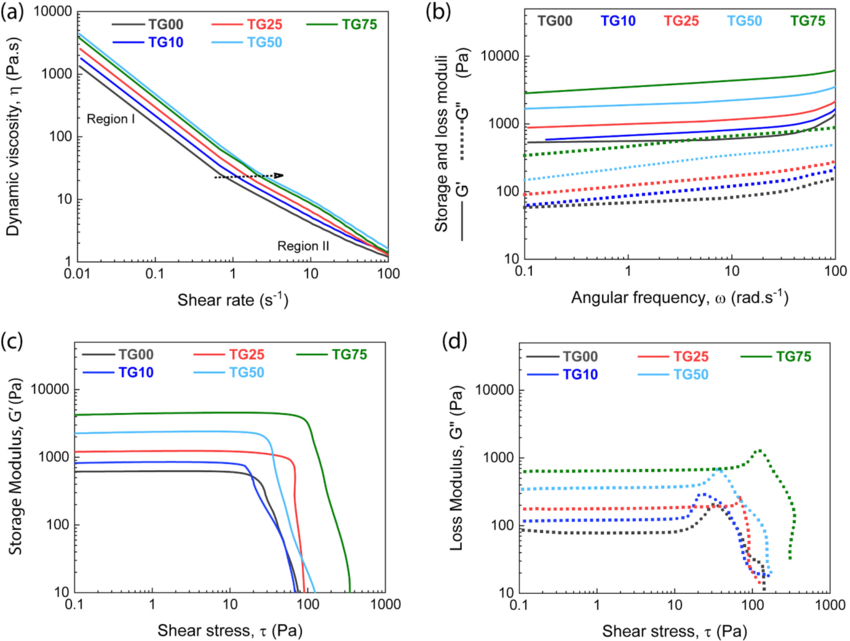
Polez RT. et al. Int J Biol Macromol. 2022.
Figure 1. Rheological properties of the hydrogels.
Services at MtoZ Biolabs
MtoZ Biolabs provides Rheology and Dynamic Viscosity Analysis Service to systematically evaluate the flow and deformation properties of liquid and semi-solid samples. Our service covers viscosity measurement, analysis of the relationship between shear stress and shear rate, characterization of viscoelastic parameters such as storage modulus (G′) and loss modulus (G″), as well as specialized tests including thixotropy, creep and recovery, and yield stress. This service is broadly applicable to systems such as ointments, gels, injectables, biomaterials, and polymers, helping clients understand material behavior under different stress conditions while also providing reliable data support for formulation optimization, material design, and quality control.
Our specific services include but are not limited to:
- Capillary Rheometer Analytical Service
- Rotational Viscometer Analytical Service
- Ubbelohde Viscometer Analytical Service
- Melt Flow Index Tester (MFI Tester) Analytical Service
- Rheometer Analytical Service
Service Advantages
Advanced Analysis Platform: MtoZ Biolabs established an advanced Rheology and Dynamic Viscosity Analysis Service platform, guaranteeing reliable, fast, and highly accurate analysis service.
Wide Applicability: Covers liquids, semi-solids, soft solids, and complex viscoelastic systems.
Multidimensional Parameter Acquisition: Provides not only viscosity measurement but also characterization of storage modulus, loss modulus, yield stress, and thixotropy.
Customized Service: Flexibly adjusts test conditions and analysis modes according to client needs.
Sample Submission Suggestions
Sample Types
A wide range of samples is acceptable, including ointments, gels, injectables, biomaterials, and polymers.
Storage and Transportation
Samples should be sealed to prevent evaporation or contamination. For temperature- or light-sensitive samples, transportation under low-temperature or light-protected conditions is recommended.
It is recommended to contact the MtoZ Biolabs technical team prior to sample submission to obtain detailed and tailored guidelines for sample preparation and submission.
Applications
Rheology and Dynamic Viscosity Analysis Service can provide essential data support for multiple fields, such as:
Pharmaceuticals and Biopharmaceuticals
Used to evaluate the flowability, stability, and structural recovery characteristics of injections, protein formulations, gels, and sustained-release carriers.
Polymers and Biomaterials
Analyzes the rheological behavior of polysaccharide solutions, nanogels, and medical polymers to guide material design.
Food and Cosmetics
Assesses the consistency, thixotropy, and spreadability of products such as creams, pastes, and beverages to ensure product uniformity and user experience.
Industry and Chemical Engineering
Measures the rheological properties of coatings, adhesives, and composite materials to optimize production and application performance.
How to order?




