



For quantitative proteomics method selection, choose tandem mass tag (TMT) when relative discovery can be frozen in one multiplex labeling kit and same-run reporter-ion ratios are the priority. Choose label-free quantification (LFQ) when samples must remain independent unlabeled injections, enrollment may continue, or amine labeling is impractical. Both are relative quantitative strategies for the same protein across conditions. Neither provides absolute concentration without matched standards. TMT labels peptides, pools channels, and reads reporter ions after fragmentation (Thompson et al. 2003). LFQ acquires each digest separately and rebuilds comparability by alignment and normalization, commonly with MaxLFQ or DIA fragment chromatograms (Cox et al. 2014). The better route is the one whose main constraint you can control.
Researchers who already have defined samples, comparison groups, or a specific project objective can also review the MtoZ Biolabs TMT Quantitative Proteomics Analysis Service and Label-Free Quantitative Proteomics Service for project-specific feasibility and analysis planning.
Quantitative Principles Side by Side
TMT quantitative proteomics
TMT reagents are isobaric tags with a reporter, mass balancer, and amine-reactive group. After digestion, each channel is labeled and pooled. At MS1 the labeled forms of a peptide co-elute as one precursor. Upon MS2 or MS3 fragmentation, distinct reporters carry relative channel intensities. Commercial kits support multiplex sets with different channel counts, including formats used as 6-plex through 18-plex depending on the reagent. The useful set is the one that holds planned groups without forcing unrelated samples into leftover channels.
Label-free quantitative proteomics
LFQ omits isotopic or isobaric tags. Each sample is an independent liquid chromatography-tandem mass spectrometry (LC-MS/MS) run under data-dependent acquisition (DDA) or data-independent acquisition (DIA). Peptide identities come from fragment evidence. Quantitative values usually come from MS1 peak areas in DDA-LFQ or from fragment chromatograms in unlabeled DIA. Comparability is reconstructed after acquisition.
Quantitative dimension |
TMT |
Label-free |
|---|---|---|
Mixing step |
Channels pooled after labeling |
No pooling of channels |
Drift control |
Shared chromatography and precursor selection |
Run-order, QC, and normalization |
Main quantitative risk |
Ratio compression from co-isolation |
Missing values and batch drift |
Enrollment |
Closed after mixing |
More flexible if the regime stays compatible |
Claim |
Relative ratios inside one plex |
Relative values inside one coherent plan |
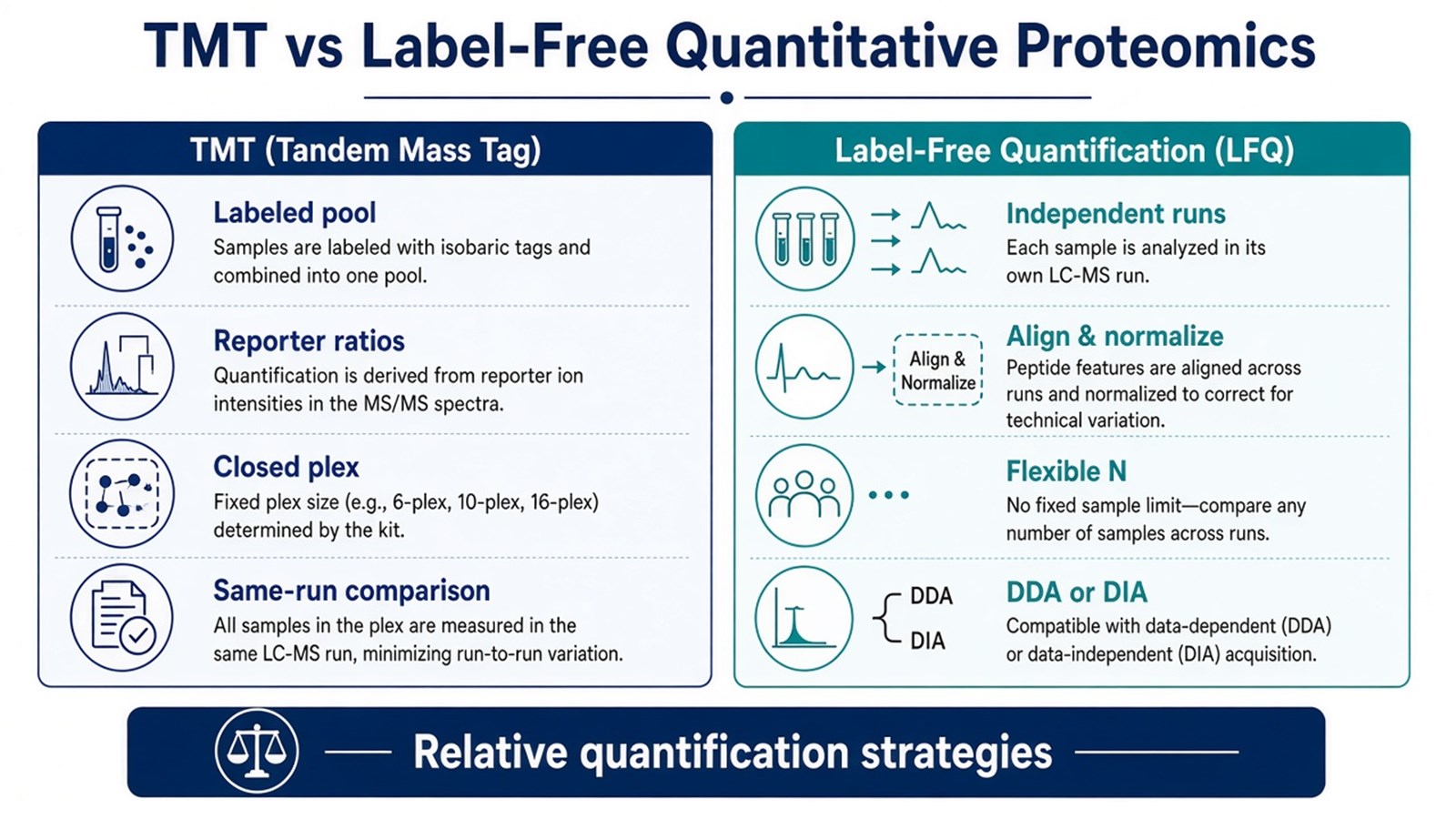
Figure 1. TMT and label-free are alternative relative quantitative strategies; they differ in whether samples share one labeled run or stay as independent injections.
Calling either route high precision without stating plex design, chromatography stability, and QC overstates method class alone.
Judgment Criteria for Quantitative Strategy Selection
Study need |
Prefer TMT quantitative proteomics |
Prefer label-free quantitative proteomics |
Reassess both |
|---|---|---|---|
Cohort structure |
Groups and replicates fit one kit |
Sample number or timing exceeds one plex |
Absolute concentration required |
Chemistry |
Clean amine labeling is feasible |
Labeling would fail or consume scarce material |
Closed peptide panel already decided |
Quantitative priority |
Same-run relative ratios |
Independent-run relative discovery |
Clinical diagnostic cutoff |
Risk tolerance |
Manage compression with fractionation or SPS-MS3 |
Manage drift with normalization and QC |
Neither discovery claim fits |
Acquisition note |
DDA methods that read TMT reporters |
DDA-LFQ or unlabeled DIA |
Targeted PRM/MRM with SIS needed |
Prefer TMT for multi-condition drug or genotype panels that can be labeled together. Prefer LFQ for evolving cohorts, archival material, or matrices that resist clean labeling. Prefer AQUA or other SIS absolute assays when defined units are required. Prefer PRM or MRM when targets are closed.
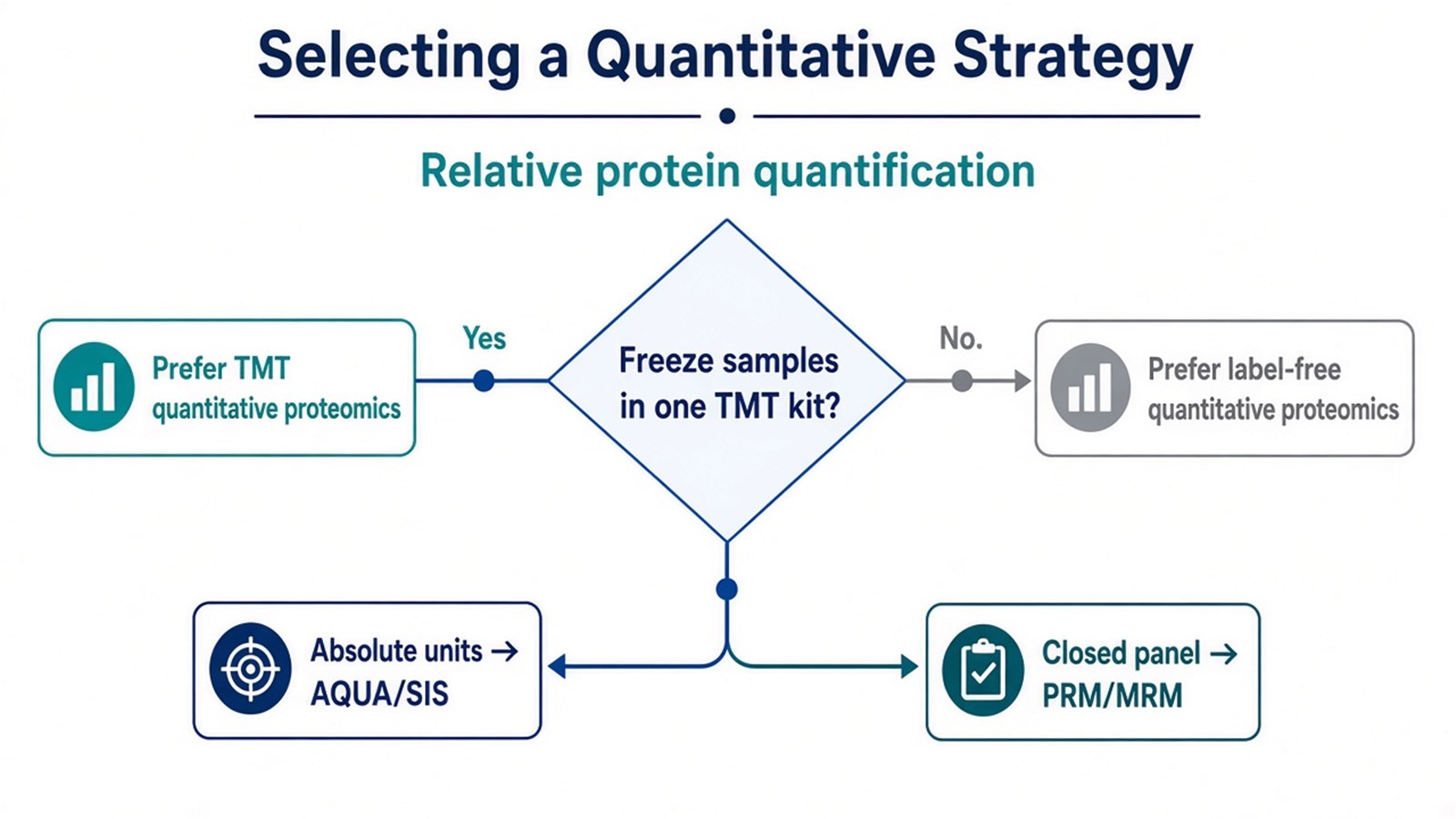
Figure 2. Quantitative strategy selection starts from whether the cohort can be frozen in one TMT kit; otherwise keep label-free, or change the claim to absolute or targeted methods.
For a shorter selection summary, researchers can also refer to TMT vs Label Free. For design-level advantage lists, see Advantages and Disadvantages of TMT-Based Quantitative Proteomics Analysis and Advantages and Disadvantages of Label-Free Quantitative Proteomics. For a broader isobaric framework, see Comparing LFQ and Isobaric Labeling Strategies in Proteomics Quantification.
Applications Matched to the Quantitative Claim
Application pattern |
Often better quantitative route |
Why |
|---|---|---|
Multi-condition drug or dose panel inside one kit |
TMT |
Same-run reporter comparison across closed channels |
Evolving clinical or preclinical cohort |
Label-free |
Independent enrollment without freezing a plex |
Precious but label-compatible digests needing a closed contrast |
TMT if chemistry succeeds |
Shared-run comparison can help when the plex fits |
Time-course with continuing sample arrival |
Label-free |
Later compatible injections can still enter the plan |
Concentration, ppm, or stoichiometric absolute units |
Neither alone |
Use SIS/AQUA or related absolute assays |
Closed biomarker shortlist confirmation |
Neither alone as discovery |
Use PRM or MRM, with SIS if absolute units are required |
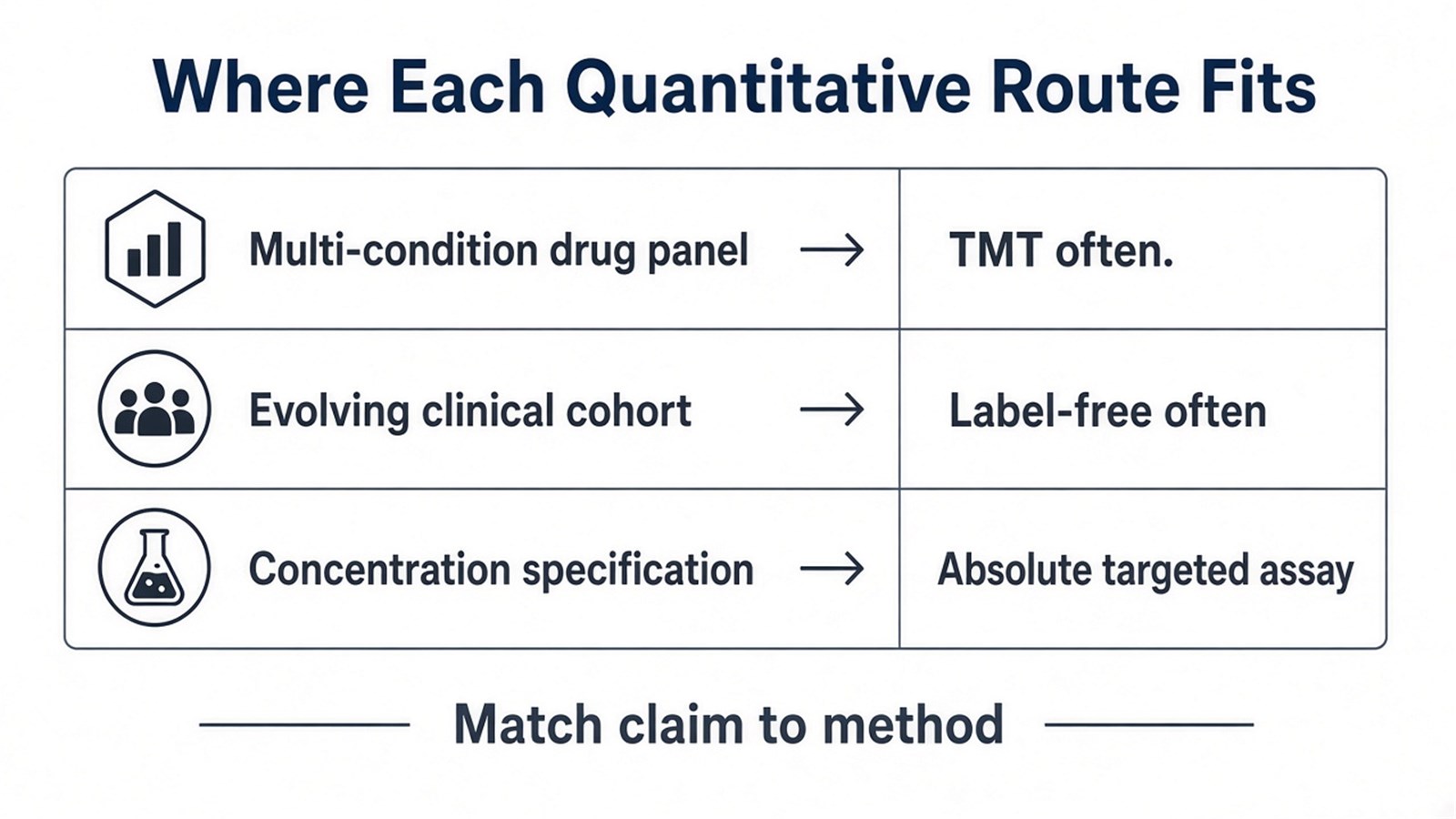
Figure 3. Match the quantitative claim to the route: TMT for closed multiplex contrasts, label-free for independent cohorts, and absolute or targeted assays when units or closed panels dominate.
TMT plex size is not the same claim as a multi-hundred clinical cohort. Large cohorts often need multiple plexes with bridging, or a label-free design. Ratio compression can still hide true fold changes in complex digests (Ting et al. 2011). LFQ depth claims depend on acquisition mode, gradient, and filters, not on the absence of a label alone.
Limits and Boundaries
Both strategies remain relative unless standards and calibration are added. TMT does not invent absolute amounts, and labels do not by themselves prove peptide identity. LFQ simplicity does not remove batch risk. Diagnostic cutoffs sit outside ordinary research TMT or LFQ reporting unless a separately validated assay framework is in place.
Once plex feasibility, labeling chemistry, enrollment rules, and the relative quantitative claim are defined, the project can be evaluated as a TMT or label-free quantitative proteomics study. Researchers can review the MtoZ Biolabs TMT Quantitative Proteomics Analysis Service and Label-Free Quantitative Proteomics Service for sample evaluation, feasibility assessment, and workflow planning.
Frequently Asked Questions
1. Is TMT more precise than label-free for every project?
No. TMT can reduce some injection drift inside one plex and can compress ratios. LFQ precision depends on chromatography stability, normalization, and missingness.
2. Does higher TMT plex always mean better quantitative proteomics?
No. Extra channels help only when they hold planned groups and replicates. Unused or forced channels do not improve the scientific claim.
3. Is label-free quantitative proteomics always DDA?
No. Label-free means no isotopic or isobaric tags. Acquisition may be DDA-LFQ or unlabeled DIA.
4. Can either method report absolute protein concentration?
Not from ordinary discovery tables. Absolute amount needs matched standards and a calibration model.
5. How does this page differ from a short TMT vs label-free summary?
This page expands quantitative principles and application matching. The shorter TMT vs Label Free page is a compact selection brief.
Reference
- A. Thompson, J. Schafer, K. Kuhn, S. Kienle, J. Schwarz, G. Schmidt, T. Neumann, C. Hamon (2003). Tandem mass tags: a novel quantification strategy for comparative analysis of complex protein mixtures by MS/MS. Anal. Chem., 75, 1895-1904. https://doi.org/10.1021/ac0262560
- J. Cox, M.Y. Hein, C.A. Luber, I. Paron, N. Nagaraj, M. Mann (2014). Accurate proteome-wide label-free quantification by delayed normalization and maximal peptide ratio extraction, termed MaxLFQ. Mol. Cell. Proteomics, 13, 2513-2526. https://doi.org/10.1074/mcp.M113.031591
- L. Ting, R. Rad, S.P. Gygi, W. Haas (2011). MS3 eliminates ratio distortion in isobaric multiplexed quantitative proteomics. Nat. Methods, 8, 937-940. https://doi.org/10.1038/nmeth.1714
