






TMT MS3 and SPS-MS3: Reducing Ratio Compression for Accurate Quantification
In tandem mass tag (TMT) multiplexed proteomics, ratio compression occurs when co-isolated peptides dilute reporter-ion intensities at the MS2 level, so measured fold changes underestimate the true abundance difference. TMT MS3 and synchronous precursor selection MS3 (SPS-MS3) reduce that interference by reading reporters after a second isolation and fragmentation step on compatible Orbitrap platforms. They improve relative quantitative accuracy inside a closed plex. They do not convert reporter ratios into absolute protein concentration, and they do not repair incomplete labeling or unmatched channel loads.
Researchers who already have defined samples, comparison groups, or a specific project objective can also review the MtoZ Biolabs TMT Quantitative Proteomics Analysis Service for project-specific feasibility and acquisition planning.
What Ratio Compression Means for a TMT Fold Change
Ratio compression is an acquisition and isolation problem, not a naming problem for TMT itself. When the true abundance ratio of a peptide between two channels is large, but the observed reporter-ion ratio is closer to one, the underestimated difference is called ratio compression (Ting et al. 2011). In complex digests, many precursors share similar retention time and m/z. A typical MS2 isolation window of about 0.7 to 1.2 Th therefore often co-isolates nontarget ions. Those ions also release reporter ions during collision-induced dissociation (CID) or higher-energy collisional dissociation (HCD), which mixes signals across channels.
The scientific consequence is directional underestimation of differential expression. Proteins with real changes may fall below a fold-change threshold, raise the false-negative rate in discovery lists, and bias downstream enrichment that depends on those magnitudes. The biological interpretation is only as strong as the reporter isolation path that produced the numbers.
A compressed TMT ratio is still a relative channel comparison; it is a weaker estimate of the true fold change, not a different quantification claim.
Why MS2 Reporter Ions Underestimate True Differences
In conventional MS2-based TMT quantification, reporter intensities are taken from the same MS2 spectrum used for peptide identification. Identification can remain correct while quantification is diluted, because sequence ions and reporter ions respond differently to co-isolation. Background peptides that enter the isolation window contribute reporters even when they contribute little usable sequence information for the target.
Two laboratory conditions make the problem severe. First, high peptide density in tissue, plasma, or other complex matrices increases the chance that unrelated precursors share the isolation window. Second, shallow fractionation leaves more co-eluting peptides in each liquid chromatography-tandem mass spectrometry (LC-MS/MS) run. Prefractionation can lower density and reduce compression risk, but it multiplies instrument time and does not remove the need to decide how reporters will be read.
When the study claim depends on whether a fold change is large enough to prioritize a pathway or a follow-up target, MS2 reporter mixing is not a cosmetic noise term. It is a design input that should be stated with the acquisition method.
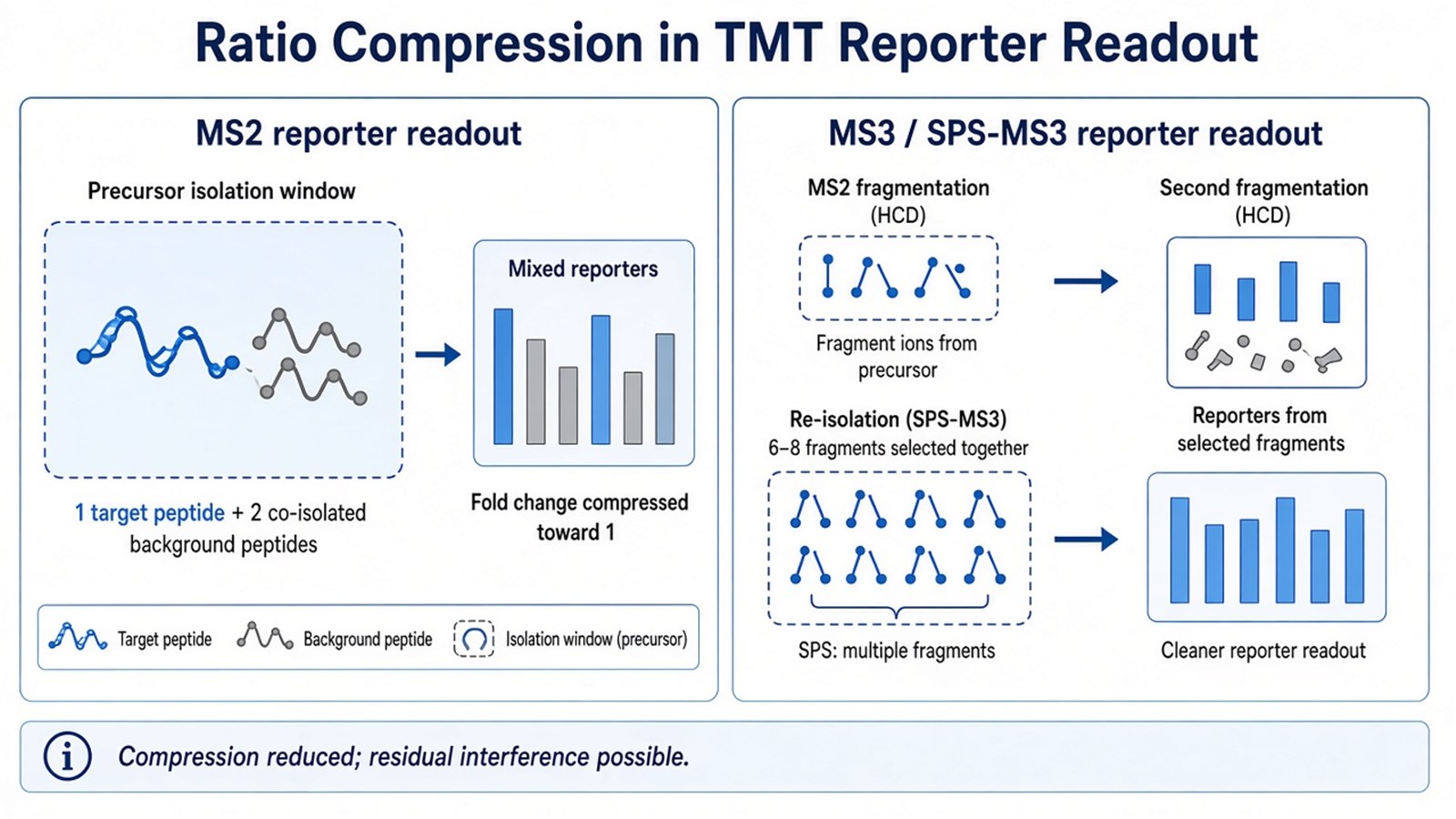
Figure 1. MS2 reporter ions can include co-isolated background; MS3 and SPS-MS3 read reporters after fragment re-isolation, which reduces compression but does not remove all residual interference.
How TMT MS3 Isolates a Cleaner Reporter Population
TMT MS3 changes where the quantitative signal is collected. After an MS2 spectrum is acquired, fragment ions that belong to the target peptide are isolated and fragmented again, commonly by HCD. Reporter ions measured at the MS3 level are generated from that selected fragment population rather than from every ion that entered the original precursor window (Ting et al. 2011). The intent is higher quantitative specificity: reporters should track the target peptide more closely than a mixed MS2 isolation.
The trade-off is throughput. Each MS3 event consumes additional isolation and fragmentation time, so the instrument cycles more slowly through precursors. In dense proteomes, that often reduces peptide and protein coverage relative to an MS2-only method under the same gradient and sample load. MS3 is therefore an accuracy-oriented acquisition choice inside a TMT workflow, not a free upgrade that preserves every identification.
MS3 also inherits upstream chemistry limits. Incomplete amine labeling, residual free tag, swapped channel maps, and unmatched protein loads still distort ratios. A cleaner reporter isolation cannot invent a biological difference that was never present in the labeled pool.
How SPS-MS3 Improves Reporter Signal Without Changing the Claim
SPS-MS3 extends the MS3 idea by selecting multiple MS2 fragment ions, typically several concurrent notches, and fragmenting them together in one MS3 scan (McAlister et al. 2014). Reporter signals from those fragments accumulate, which can raise reporter intensity and improve signal-to-noise relative to single-fragment MS3, especially for peptides that would otherwise yield weak MS3 reporters.
SPS-MS3 still reports relative channel ratios inside one multiplex set. It does not create an absolute amount, and it does not remove the need for matched loading, complete labeling, and a closed plex membership. Its practical value appears when the matrix is complex, low-abundance proteins matter, and the differential magnitude itself is part of the scientific claim, for example in biomarker discovery or drug-response studies where compressed fold changes would hide candidates.
Implementation requires an instrument and method package that supports synchronous precursor selection on an Orbitrap tribrid architecture, together with careful notch selection, isolation settings, and quality control. Method transfer without those controls can lose the intended accuracy gain while still paying the coverage cost.
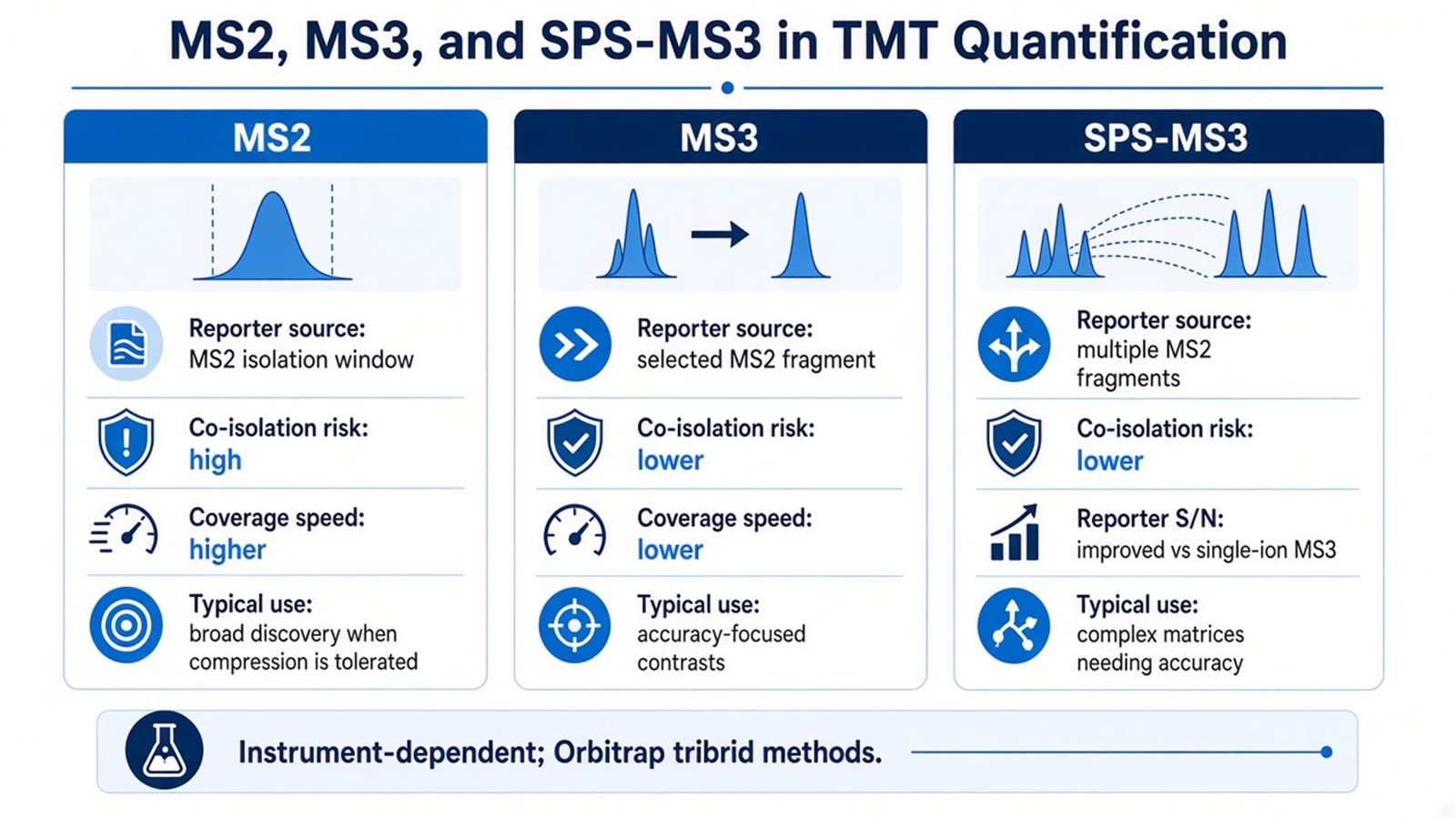
Figure 2. MS2, MS3, and SPS-MS3 differ mainly in reporter isolation, co-isolation risk, and the coverage versus accuracy trade-off on compatible Orbitrap methods.
MS2, MS3, and SPS-MS3: Accuracy, Coverage, and Instrument Limits
For relative accuracy in complex samples, SPS-MS3 generally outperforms single-notch MS3, which in turn outperforms conventional MS2 when co-isolation is severe (McAlister et al. 2014; Ting et al. 2011). Coverage usually moves in the opposite direction because MS3-family scans consume cycle time. SPS can partially recover sensitivity by summing multiple fragment reporters, but it does not restore an MS2-like identification rate in every matrix.
|
Dimension |
MS2 |
MS3 |
SPS-MS3 |
|---|---|---|---|
|
Reporter source |
Precursor isolation window |
Selected MS2 fragment |
Multiple MS2 fragments |
|
Co-isolation risk |
High in dense digests |
Lower |
Lower |
|
Quantitative accuracy vs compression |
Most vulnerable |
Improved |
Often further improved vs single-ion MS3 |
|
Coverage and speed |
Higher under matched run time |
Lower |
Lower than MS2; may improve reporter S/N vs MS3 |
|
Instrument need |
Broad Orbitrap or Q-Orbitrap TMT methods |
Orbitrap methods supporting MS3 |
Orbitrap tribrid methods supporting SPS |
These rows describe tendencies under comparable sample complexity. Exact performance depends on fractionation depth, isolation width, plex size, and gradient length. Naming SPS-MS3 in a methods section without those parameters does not specify the quantitative quality of the dataset.
Researchers comparing labeling trade-offs at the study-design level can also refer to Advantages and Disadvantages of TMT-Based Quantitative Proteomics Analysis for plex closure, labeling chemistry, and relative-ratio limits.
When SPS-MS3 Is the Better Next Acquisition Choice
SPS-MS3 is often the better next acquisition choice when three conditions hold together: the cohort already fits one TMT kit, the scientific claim depends on recovering true fold-change magnitude, and the digest is complex enough that MS2 co-isolation would compress differentials. Examples include multi-condition drug studies, clinical or preclinical biomarker screens in biofluids, and publication-oriented contrasts where underestimation would change candidate ranking.
MS2 remains a viable option when proteome coverage or instrument-hour cost dominates, when the matrix is simpler, or when differential calling will rely more on consistent direction across replicates than on the absolute size of each fold change. In those projects, fractionation and post-acquisition interference filters can still reduce, but not eliminate, compression. MS2 plus filtering is not the same experiment as SPS-MS3; both should be reported honestly.
SPS-MS3 is the wrong next step when samples cannot be labeled cleanly, when enrollment will continue after mixing, or when the endpoint is a calibrated protein amount. Those problems sit upstream of reporter isolation. Absolute quantification needs matched standards and a calibration model, usually outside ordinary discovery TMT tables.
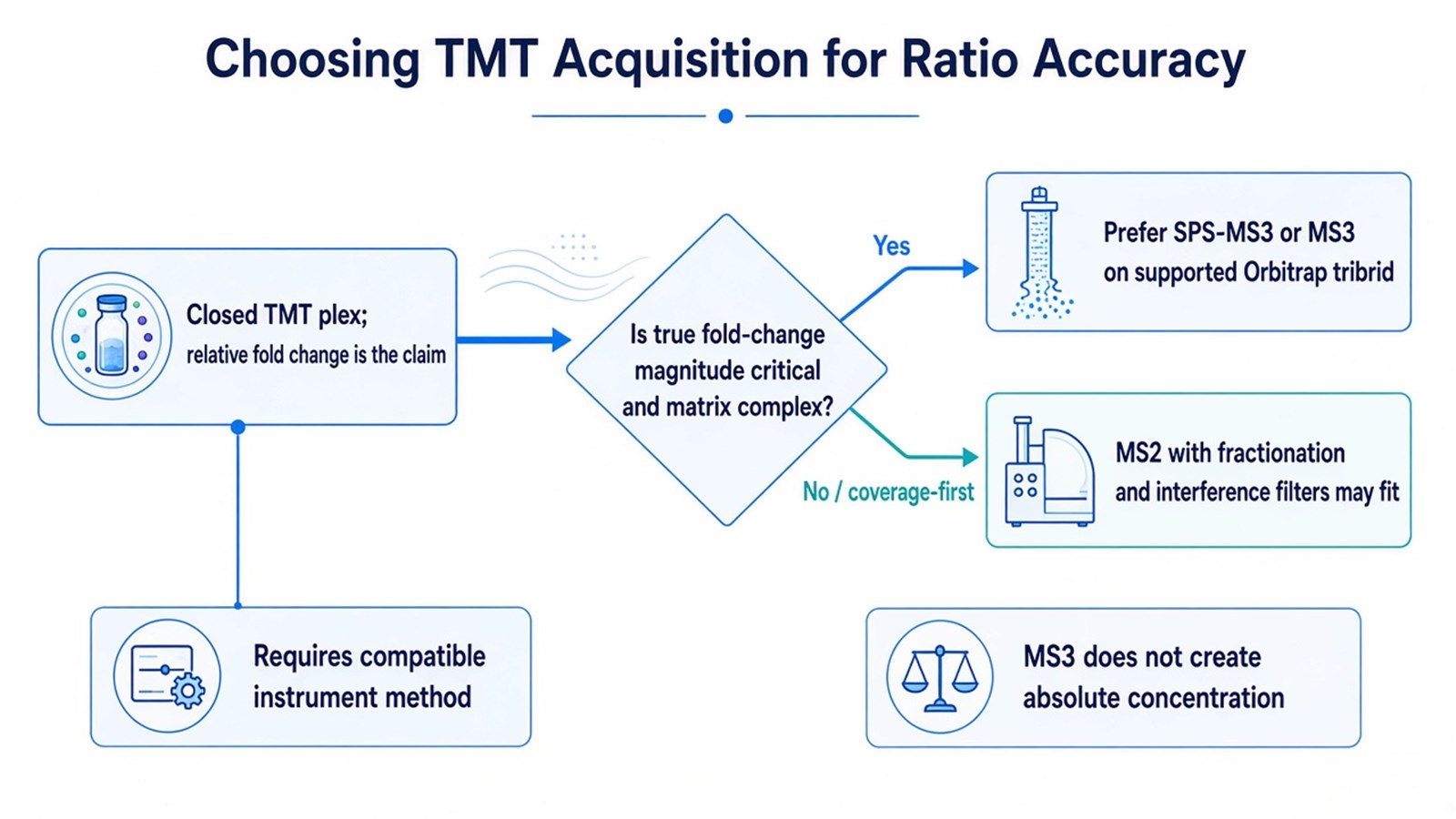
Figure 3. Acquisition choice follows the claim and matrix: SPS-MS3 or MS3 when true fold-change magnitude matters in complex samples; MS2 may fit when coverage is the priority.
SPS-MS3 reduces reporter mixing on supported instruments; it does not replace matched loading, complete labeling, or a closed multiplex design.
Experimental Limits That Remain After MS3
Even with SPS-MS3, residual interference can remain in crowded chromatographic regions. Isolation notches can still capture fragment ions that are not unique to the target, and very low reporter intensity can limit precision. Coverage loss may remove peptides that would have been quantified under MS2, which changes which proteins appear in the matrix. Cross-batch comparison still requires a bridging design if multiple plexes are used; MS3 does not merge separate kits into one ratio space.
Method records should therefore state acquisition mode, instrument class, fractionation, plex format, and the protein summarization rules. Without those details, a statement that the study used TMT MS3 or SPS-MS3 is incomplete for reviewers and for later reuse of the data.
For projects that need a full labeling-to-acquisition execution path, researchers can refer to A Detailed Workflow of TMT-Based Quantitative Proteomics for stage-level control points from load matching through reporter readout.
Frequently Asked Questions
1. Does MS3 completely remove ratio compression?
No. MS3 and SPS-MS3 reduce co-isolation contributions to reporters by re-isolating fragment ions before a second fragmentation. Compression can remain in dense regions, and fractionation, isolation settings, and sample complexity still belong in the method record (Ting et al. 2011; McAlister et al. 2014).
2. Is SPS-MS3 always better than MS2 for every TMT study?
No. SPS-MS3 is preferred when recovering fold-change magnitude in complex matrices is the priority and a compatible Orbitrap method is available. MS2 may still fit when identification depth or run-time efficiency is the dominant constraint and some compression is acceptable for the claim.
3. Do MS3 and SPS-MS3 provide absolute protein amounts?
No. Both methods still report relative reporter-ion ratios inside one multiplex set. Absolute concentration or copy-number claims require matched standards and a calibration model.
4. What instrument capability is required for SPS-MS3?
SPS-MS3 requires an Orbitrap platform and method package that support synchronous precursor selection for MS3 acquisition, typically on tribrid architectures. Naming a vendor instrument without confirming the SPS method does not guarantee that reporters were read that way.
5. Can prefractionation replace MS3?
Prefractionation lowers peptide density and can reduce co-isolation, but it does not perform the same isolation logic as MS3. The two approaches can be combined. Neither substitutes for matched channel loads or complete labeling.
Once group structure, labeling feasibility, and the need for fold-change fidelity are defined, the project can be evaluated as a TMT study with an explicit MS2, MS3, or SPS-MS3 acquisition plan. Researchers can review the MtoZ Biolabs TMT Quantitative Proteomics Analysis Service for sample evaluation, feasibility assessment, and workflow planning, including SPS-MS3-capable acquisition where the instrument method and study claim support it.
Reference
- A. Thompson, J. Schafer, K. Kuhn, S. Kienle, J. Schwarz, G. Schmidt, T. Neumann, R. Johnstone, A.K. Mohammed, C. Hamon (2003). Tandem mass tags: a novel quantification strategy for comparative analysis of complex protein mixtures by MS/MS. Anal. Chem., 75, 1895-1904. https://doi.org/10.1021/ac0262560
- L. Ting, R. Rad, S.P. Gygi, W. Haas (2011). MS3 eliminates ratio distortion in isobaric multiplexed quantitative proteomics. Nat. Methods, 8, 937-940. https://doi.org/10.1038/nmeth.1714
- G.C. McAlister, D.P. Nusinow, M.P. Jedrychowski, M. Wuhr, E.L. Huttlin, B.K. Erickson, R. Rad, W. Haas, S.P. Gygi (2014). MultiNotch MS3 enables accurate, sensitive, and multiplexed detection of differential expression across cancer cell line proteomes. Anal. Chem., 86, 7150-7158. https://doi.org/10.1021/ac502040v
How to order?




