






TMT-Based Biomarker Discovery
With the rapid advancement of precision medicine, biomarkers have become essential for early disease detection, prediction of therapeutic response, and the development of targeted therapies. Although significant progress has been made in genomic biomarker research, proteins, as the direct effectors of biological function, undergo dynamic changes that more accurately reflect disease states. As a result, proteomics-based biomarker discovery has emerged as a major focus of contemporary biomedical research. Among the various protein quantification strategies available, Tandem Mass Tag (TMT) labeling has been widely adopted for biomarker screening owing to its high throughput, multiplexing capacity, and robust quantitative performance.
What Is TMT? A Core Technology for Multiplexed Quantitative Mass Spectrometry
TMT is an isotopic labeling-based relative quantification strategy that enables the simultaneous analysis of 10-18 samples within a single experiment. Its key advantages include:
-
High throughput: Multiple samples can be analyzed in parallel, making TMT well suited for comparative studies of clinical cohorts.
-
Accurate quantification: Following MS/MS fragmentation, structurally defined tags release distinct reporter ions, enabling reliable peptide- and spectrum-level quantification.
-
High reproducibility: Multiplexed analysis reduces inter-batch variability and improves data consistency.
-
Low sample input: Particularly advantageous for limited clinical specimens or animal-derived tissues.
In practice, protein samples are enzymatically digested into peptides, labeled with channel-specific TMT reagents, and subsequently pooled for LC–MS/MS analysis. Within this workflow, MtoZ Biolabs employs optimized sample preparation protocols and high-resolution Orbitrap mass spectrometry platforms to ensure stringent data quality control, quantitative accuracy, and comprehensive proteome coverage.
Advantages of TMT in Biomarker Discovery
1. Cross-Omics Integration Enabling Pathway-Level Insights
When integrated with transcriptomic and metabolomic datasets, TMT-based quantitative proteomics facilitates the identification of disease-associated protein networks and signaling pathways, providing a solid foundation for downstream functional validation.
2. Suitability for Large-Scale Clinical Cohort Studies
The multiplexing capacity of TMT 16plex/18plex workflows enables efficient analysis of large sample cohorts, thereby improving the statistical power and robustness of biomarker discovery studies.
3. Enhanced Detection of Low-Abundance Proteins
Owing to its quantitative sensitivity, TMT-based analysis allows for the identification of low-abundance proteins-such as cytokines and transcription factors-that are often difficult to detect using conventional methods but play critical regulatory roles.
4. Applicability Across Diverse Tissues and Biofluids
TMT-based platforms are compatible with a wide range of sample types, including plasma, cerebrospinal fluid, urine, and exosomes, supporting biomarker discovery under diverse disease contexts.
TMT-Based Biomarker Discovery Solutions at MtoZ Biolabs
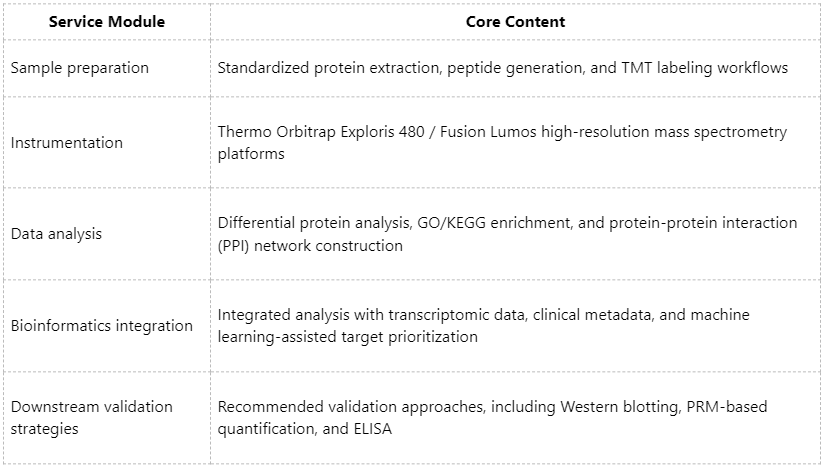
As a specialized provider of omics research services, MtoZ Biolabs integrates advanced TMT-based quantitative proteomics platforms with extensive experience in clinical translation. We offer end-to-end TMT proteomics solutions-from experimental design to comprehensive data analysis-to support efficient biomarker identification:
Expanded Applications: TMT Beyond Oncology
Beyond cancer research, TMT-based proteomics has been widely applied to biomarker discovery in multiple disease areas, including:
-
Neurodegenerative diseases: for example, quantitative analysis of cerebrospinal fluid proteins in early-stage Alzheimer’s disease.
-
Autoimmune disorders: identification of plasma protein biomarkers associated with systemic lupus erythematosus.
-
Metabolic diseases: screening of proteins related to pancreatic dysfunction in diabetes and non-alcoholic fatty liver disease.
-
Infectious diseases: characterization of immune response–associated biomarkers following emerging viral infections.
As a high-sensitivity, highly multiplexed protein quantification technology, TMT continues to advance biomarker research and demonstrates broad potential in biomedical research, disease diagnostics, and drug target discovery. MtoZ Biolabs is committed to integrating state-of-the-art TMT platforms with clinically relevant applications, providing reliable data and efficient research solutions for the scientific community. If you are currently at a critical stage of biomarker discovery, we welcome you to contact MtoZ Biolabs to develop a tailored TMT-based research strategy.
MtoZ Biolabs, an integrated chromatography and mass spectrometry (MS) services provider.
Related Services
How to order?




