






Techniques of LC-MS Molecular Weight Determination
-
LC component: Sample components are first separated chromatographically, thereby reducing matrix interference and enhancing analytical specificity.
-
MS component: The separated analytes are subsequently ionized and analyzed based on their mass-to-charge ratios (m/z), enabling the determination of molecular weight information for individual components.
-
Electrospray Ionization (ESI): Well suited for polar compounds, including proteins, peptides, and nucleotides.
-
Atmospheric Pressure Chemical Ionization (APCI): Primarily used for volatile small molecules.
-
Matrix-Assisted Laser Desorption/Ionization (MALDI): Frequently applied for rapid molecular weight profiling of proteins.
-
Comprehensive, one-stop analytical capability spanning small molecules to proteins.
-
Turnaround times of 3-5 working days are compatible with diverse sample types.
-
Support for extended analyses, including post-translational modification characterization and isomer discrimination.
-
Provision of raw data alongside professionally curated analytical reports to facilitate data archiving and publication.
In life science research and biopharmaceutical development, accurate molecular weight determination constitutes a fundamental basis for structural identification, quality control, and drug development. Whether assessing the completeness of protein expression or verifying the purity of synthesized small molecules, molecular weight information represents an essential analytical parameter. Among the available analytical approaches, liquid chromatography-mass spectrometry (LC-MS) has been extensively applied to molecular weight determination of proteins, peptides, small-molecule drugs, and metabolites owing to its high sensitivity, broad applicability, and inherent capacity for structural characterization.
Overview of LC-MS Technical Principles
LC-MS integrates liquid chromatography (LC) with mass spectrometry (MS) into a unified analytical system:
Commonly employed ionization techniques include:
At MtoZ Biolabs, high-resolution electrospray ionization mass spectrometry (HR-ESI-MS), combined with optimized chromatographic systems, is primarily employed to achieve accurate molecular weight determination across a wide molecular range, from small molecules to high-molecular-weight biological products.
Advantages of LC-MS in Molecular Weight Determination
1. High Sensitivity Combined with High Mass Accuracy
LC-MS systems enable the detection of analytes at picomolar (pmol) concentrations or lower, with mass measurement errors typically maintained within <5 ppm. This performance is particularly advantageous for resolving trace-level components in complex biological matrices.
2. Robust Compatibility with Complex Sample Matrices
Compared with conventional techniques such as SDS-PAGE or ultraviolet absorbance-based methods, LC-MS is minimally affected by sample impurities and can be directly applied to complex matrices, including cell lysates, serum, and fermentation supernatants.
3. Provision of Structural Information Beyond Molecular Weight
In addition to precise molecular weight determination, mass spectrometry provides valuable structural insights, including isotopic distribution patterns, fragment ion information, and post-translational modifications (e.g., phosphorylation and glycosylation), conferring a distinct advantage in molecular structure verification.
Typical Application Scenarios of LC-MS Molecular Weight Determination
1. Verification of Protein Molecular Weight
During recombinant protein expression and purification, confirmation of protein integrity - such as the absence of N-terminal truncation, C-terminal deletion, or incomplete signal peptide cleavage - constitutes a routine quality control step. Accurate molecular weights obtained by LC-MS allow rapid assessment of concordance with theoretical values and facilitate the identification of subtle molecular modifications.
2. Purity and Identity Confirmation of Small-Molecule Drugs
LC-MS is among the preferred analytical techniques for post-synthesis structural verification of drug candidates. Detection of ion species such as [M+H]+ and [M+Na]+ enables assessment of molecular weight consistency with the target structure while simultaneously monitoring potential synthetic byproducts or degradation products.
3. Quality Control of Synthetic Peptides
Synthetic peptides are susceptible to incomplete chain elongation or amino acid deletions. LC-MS provides an efficient means of evaluating peptide sequence integrity, thereby improving synthesis success rates and ensuring the reliability of downstream experimental applications.
4. Molecular Annotation in Metabolomics and Lipidomics
In metabolomic and lipidomic studies, LC-MS serves not only as a quantitative tool but also as a primary screening approach for molecular weight assignment of characteristic or differential compounds, laying the foundation for subsequent structural elucidation by tandem mass spectrometry (MS/MS).
Comparison with Other Molecular Weight Determination Techniques
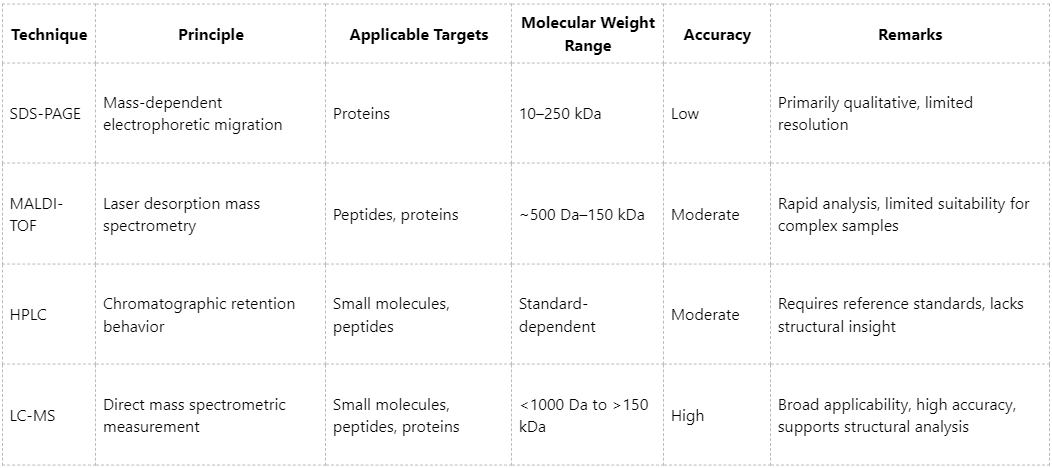
Conclusion: Each technique possesses distinct application strengths. Owing to its superior accuracy, broad applicability, and capacity for structural characterization, LC-MS is increasingly recognized as a mainstream approach for molecular weight determination in modern bioanalytical research.
Advantages of LC-MS Molecular Weight Determination Services at MtoZ Biolabs
At MtoZ Biolabs, an advanced LC-MS analytical platform has been established based on high-end instruments, including Thermo Orbitrap and Bruker QTOF systems, supported by dedicated sample preparation and data analysis workflows. Key advantages include:
As biological research continues to deepen and drug development accelerates, increasing emphasis is placed on both the accuracy and informational depth of molecular weight determination. Through its powerful analytical performance, LC-MS enables a transition from mere detection to precise characterization, and from quantitative measurement to qualitative insight. For protein identification, small-molecule validation, or peptide quality control, MtoZ Biolabs offers robust data support through its professional LC-MS technology platform.
MtoZ Biolabs, an integrated chromatography and mass spectrometry (MS) services provider.
Related Services
How to order?




