






Targeted Proteomics Data Analysis and Interpretation
Targeted proteomics data analysis focuses on the quantitative evaluation of predefined peptide targets. The workflow typically includes peptide signal review, quantitative processing, quality assessment, and interpretation of peptide- or protein-level results within the experimental design. Unlike discovery proteomics, targeted analysis does not identify new proteins from a broad dataset; instead, it evaluates whether the predefined targets show reliable quantitative differences between samples or groups.
Researchers who already have a named panel and need help judging what the report can support can also review the MtoZ Biolabs Targeted Proteomics Service for project-specific analysis planning.
What Data Are Generated From Targeted Proteomics?
Targeted proteomics generates quantitative data for predefined proteins or peptides. The main outputs include peptide-level measurements, protein-level summaries, and quality information supporting result interpretation. Theme-level context for what targeted studies can provide is covered in Targeted Quantitative Proteomics: Principles, Strategies, and Applications.
Peptide-Level Quantification
The primary numbers are peptide-ion responses over chromatographic time, after the intended fragments have been extracted. In MtoZ PRM offerings, that review is typically done in Skyline, with UniProt or a custom database as the sequence source. Other targeted-review tools exist in the field. The peptide table is the evidence layer that later protein numbers depend on.
Protein-Level Quantitative Information
Protein-level values are summaries of the peptides chosen to represent each protein. They are only as strong as those peptides. A protein entry in the table does not mean the whole protein sequence was observed.
How Are Targeted Proteomics Results Quantified?
Quantification logic follows the endpoint that was chosen before acquisition.
Relative Abundance Comparison
Relative results compare the same peptide across samples or groups, after a defined normalization. They support direction of change within the study. Exact fold-change language should stay cautious when no calibration curve was used, because peptide response is not automatically linear across the full range.
Absolute Amount Calculation
Absolute results convert a native-to-heavy ratio through a calibration curve into an amount for that peptide (Gerber et al. 2003). They still do not authorize ranking unrelated proteins on one scale unless each protein has its own curve. For details on isotope-labeled standards and calibration strategies, see Absolute Quantification in Targeted Proteomics.
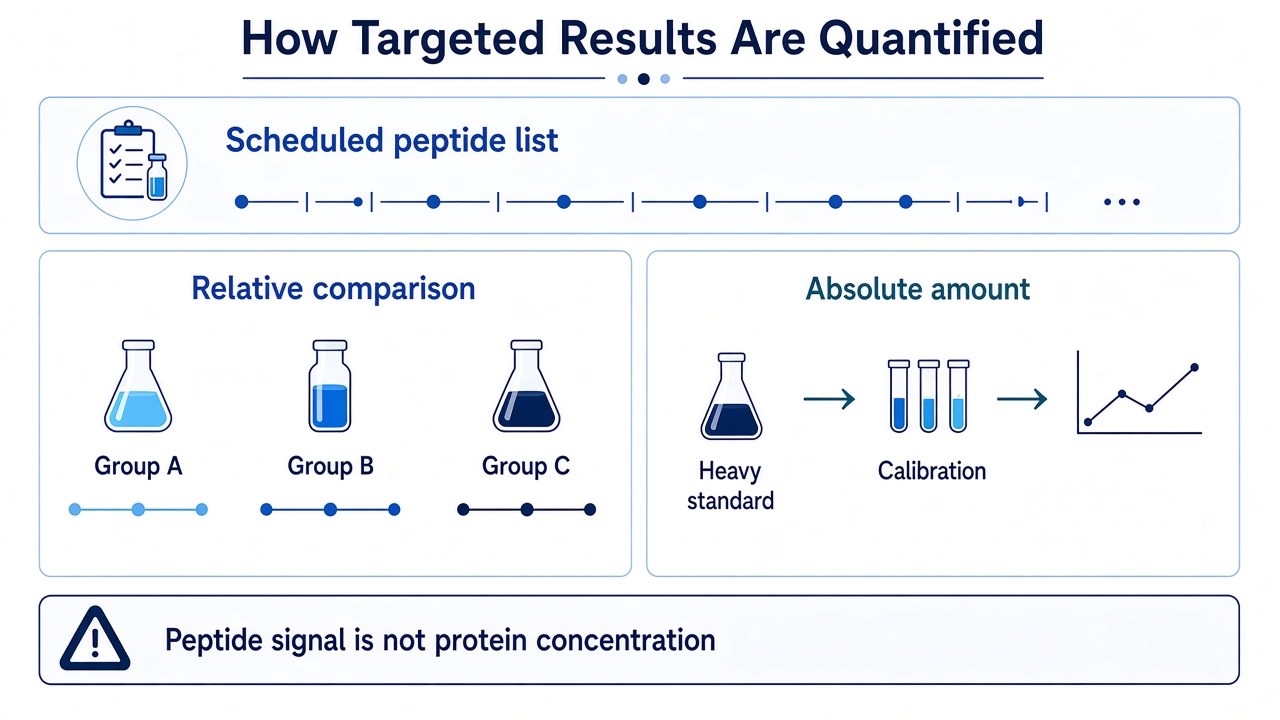
Figure 1. Targeted results are quantified as relative comparisons of the same peptide or as calibrated amounts when heavy standards and a curve were part of the design.
How Is Data Quality Evaluated?
Quality review asks whether the intended peptide is the peak being integrated, and whether that peak is stable enough to support the planned comparison.
Signal Quality and Reproducibility
Useful checks include:
- whether the expected fragments appear together;
- whether the peak is present in the samples that should contain it;
- whether replicate injections of the same digest agree well enough for the claim.
A missing peak may mean true low abundance, poor digestion, interference, or a peptide that was never a good choice. Switching recording method later does not automatically rescue a peptide that does not ionize.
Quantification Reliability
Reliability is higher when more than one suitable peptide agrees, when standards behave as expected, and when the calibration range covers the samples. Reliability is lower when the signal sits near noise, when fragments disagree, or when batches were acquired without shared controls. Shared quality-control samples help when later tubes are added after the first batch. Without them, a new batch should not be read as if it sat on the original relative scale. Housekeeping peptides, if included, need the same quality tests as the scientific targets. They do not automatically rescue a noisy panel.
How Are Targeted Proteomics Results Interpreted Biologically?
Targeted proteomics interpretation focuses on evaluating predefined proteins within the context of the original biological question. The goal is to determine whether selected targets show meaningful quantitative changes under specific experimental conditions, rather than to discover new proteins or pathways from a broad dataset.
Evaluate Target Changes in the Experimental Context
The first step in interpretation is to determine whether the measured targets change between predefined groups or conditions.
Key considerations include:
- Direction and magnitude of change: Evaluate whether target proteins or peptides increase or decrease under the tested conditions.
- Consistency across samples: Consider whether the observed changes are reproducible across biological replicates or sample cohorts.
- Statistical support: Combine quantitative differences with appropriate statistical analysis to determine whether the observed changes are supported by the study design.
The interpretation should remain focused on the predefined targets and the original comparison, such as treatment response, disease-related differences, or experimental perturbation effects.
Connect Quantitative Results With Biological Hypotheses
Targeted proteomics results are most informative when interpreted together with prior biological knowledge, previous discovery results, or existing research hypotheses.
Examples include:
- Evaluating whether candidate proteins identified from discovery studies remain altered in additional samples;
- Assessing whether proteins involved in a known pathway show consistent quantitative trends;
- Supporting follow-up studies by identifying targets that require further functional validation.
Targeted proteomics provides quantitative evidence for predefined targets within the studied context. Broader biological conclusions, such as mechanism confirmation or pathway-wide changes, typically require additional experimental evidence or complementary approaches.
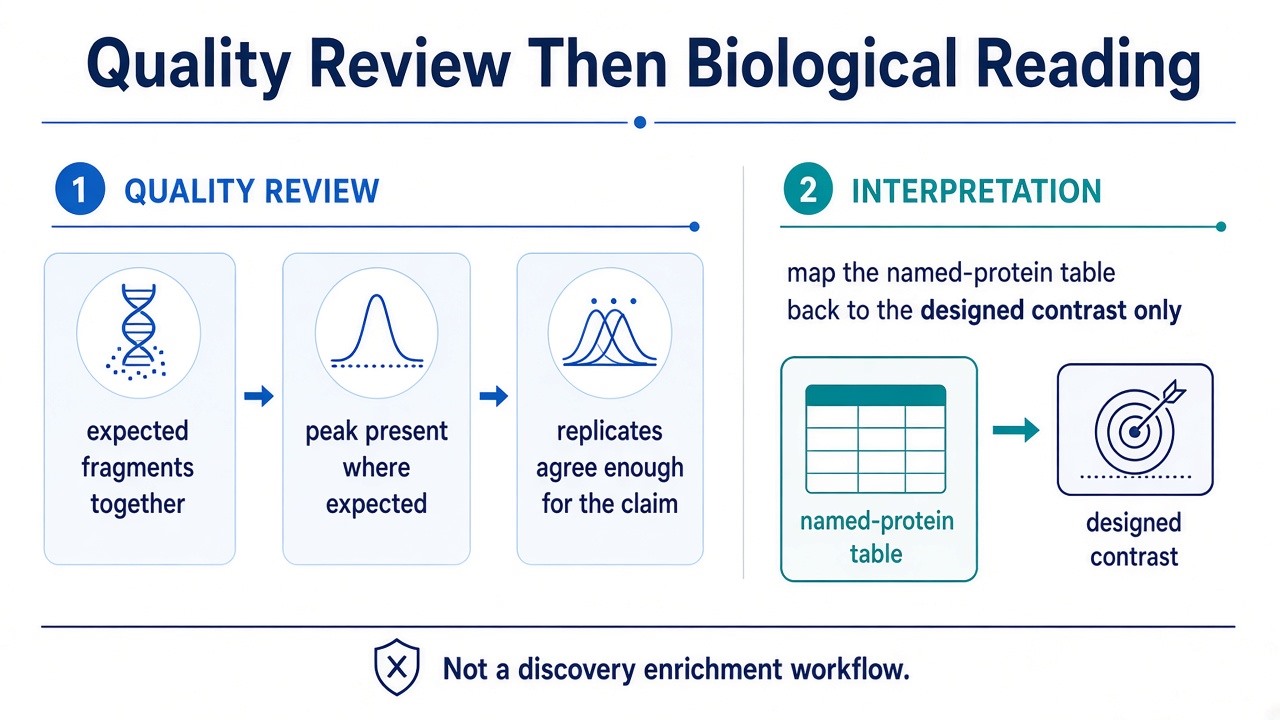
Figure 2. Data quality is judged at the peptide-signal level first; biological interpretation then returns to the original contrast for those named proteins only.
Frequently Asked Questions
1. Does a targeted report include GO, KEGG, or other discovery-style enrichment?
Usually not as a core targeted deliverable. Those analyses need a broad protein list. A short named panel is interpreted protein by protein against the designed contrast. If pathway-level analysis is required, discovery proteomics data are typically more suitable. Downstream bioinformatics can still be done in-house on whatever table is delivered.
2. If a peak is missing or very weak, can it be treated as zero expression?
No. A weak or missing peak can mean the peptide was not recovered, the protein is truly low, or interference hid the signal. Report it as not quantified or below a reliable range unless the assay was validated for that conclusion.
3. What files are typically returned for a targeted project?
In MtoZ targeted offerings, typical files include raw mass spectrometry data, a quantitative table, and a basic PDF report. Peak review and integration are performed during data analysis, so clients do not need to process raw files themselves. The final deliverables may vary depending on project requirements and are confirmed before the project starts.
Conclusion
Targeted data analysis stays inside the scheduled peptide list: quantify those traces, judge whether the signals are reliable, then read the result against the original biological contrast. Relative and absolute numbers mean different things and should not be mixed. When the panel, endpoint, and comparison groups are defined, researchers can review the MtoZ Biolabs Targeted Proteomics Service for project-specific analysis planning and result interpretation support.
Reference
- S.A. Gerber, J. Rush, O. Stemman, M.W. Kirschner, S.P. Gygi (2003). Absolute quantification of proteins and phosphoproteins from cell lysates by tandem MS. Proc. Natl. Acad. Sci. U.S.A., 100, 6940-6945. https://doi.org/10.1073/pnas.0832254100
How to order?




