






Targeted Phosphorylation Site Analysis Service
MtoZ Biolabs provides Targeted Phosphorylation Site Analysis Service dedicated to identifying and quantifying phosphorylation sites on specific phosphorylated proteins provided by the client. This service aims to help researchers precisely characterize phosphorylation patterns and determine the exact modified residues within target proteins. By integrating high-resolution LC-MS/MS with optimized phosphopeptide enrichment strategies, this approach enables detailed investigation of how phosphorylation modulates protein conformation, enzymatic activity, and regulatory functions across key molecules such as kinases, receptors, transcription factors, and signaling mediators.
Overview
Phosphorylation site analysis determines the exact amino acid residues on a protein that are modified by phosphate groups and quantifies their modification levels. Unlike global phosphorylation profiling, which provides an overview of modification patterns, site-specific analysis identifies which residues are phosphorylated, how frequently, and how these events regulate protein function.
Phosphorylation at specific residues often acts as a molecular switch that controls protein activity, localization, or interactions. For instance:
AKT (Ser473) phosphorylation activates downstream signaling that promotes cell survival and metabolism.
EGFR (Tyr1173) phosphorylation serves as a docking site for adaptor proteins, initiating MAPK and PI3K/AKT pathways.
STAT3 (Tyr705) phosphorylation induces dimerization and nuclear translocation, enabling transcriptional regulation of target genes.
Tau (Ser202/Thr205) phosphorylation modulates microtubule binding and is associated with neurodegenerative diseases such as Alzheimer’s.
By precisely identifying such phosphorylation sites, researchers can directly link biochemical modifications to functional outcomes such as kinase activation, signal propagation, or disease progression.
Targeted Phosphorylation Site Analysis Service at MtoZ Biolabs
MtoZ Biolabs offers tailored workflows for site-specific phosphorylation analysis of client-defined protein, delivering amino acid-level resolution for confident residue localization and quantitative evaluation. This approach emphasizes site mapping, positional isomer discrimination, and modification occupancy determination, ensuring accurate structural and regulatory insights into the phosphorylation state of each protein.
Our site-level analysis includes:
1. Selective phosphopeptide enrichment and purification using IMAC and MOAC (TiO₂ or ZrO₂) techniques to efficiently capture low-abundance phosphopeptides from purified target proteins or affinity-enriched complexes.
2. High-resolution LC-MS/MS acquisition with optimized fragmentation strategies including HCD and ETD/EThcD (applied according to peptide properties) to preserve phosphate groups and generate detailed fragment spectra.
3. Phosphorylation site mapping and localization, integrating advanced scoring algorithms such as Ascore and ptmRS to accurately identify modified residues and distinguish positional isomers occurring on adjacent amino acids.
4. Quantitative assessment of phosphorylation site occupancy, providing relative modification ratios under different conditions; absolute occupancy can be determined using phosphatase-paired or isotopic standard-based assays if required.
5. Targeted MS validation via MRM/PRM workflows to confirm specific phosphorylation sites and monitor modification frequency in follow-up experiments.
Workflow of Targeted Phosphorylation Site Analysis Service
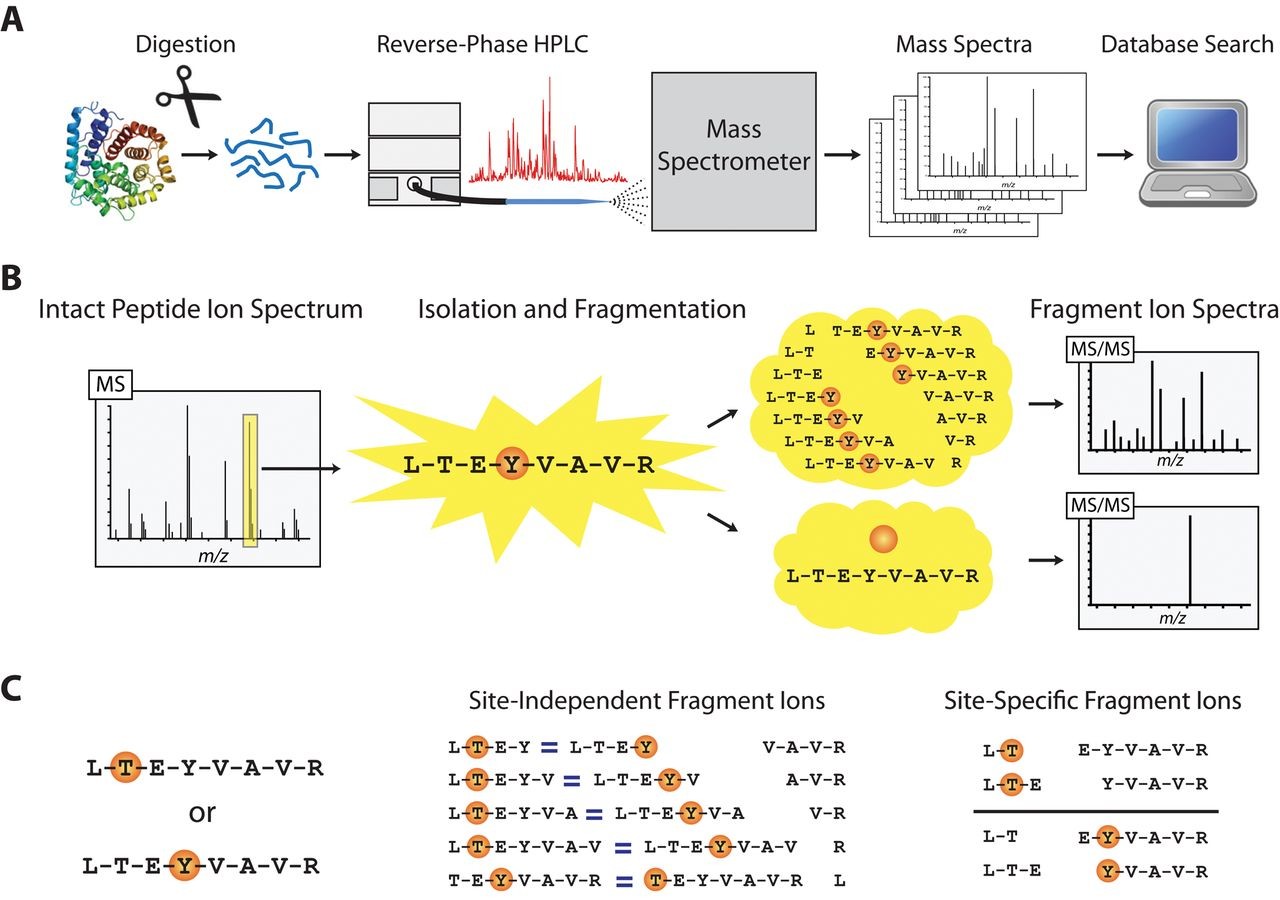
Dephoure, N. et al.Mol. Biol. Cell. 2017.
Figure 1. Workflow of LC-MS/MS-based Phosphorylation Site Analysis
Why Choose MtoZ Biolabs?
1. Advanced Analytical Platforms
MtoZ Biolabs operates Orbitrap Fusion Lumos and Q Exactive HF platforms, ensuring exceptional mass accuracy and sensitivity for confident identification of phosphorylation sites on targeted protein.
2. Site-Specific Precision
We apply optimized HCD and ETD/EThcD fragmentation techniques combined with robust localization algorithms (Ascore, ptmRS) to achieve residue-level accuracy and distinguish positional isomers.
3. Optimized Enrichment Strategy
Our IMAC and MOAC (TiO₂ or ZrO₂) enrichment workflows provide high phosphopeptide recovery and selectivity, ideal for limited or low-abundance protein samples.
4. Quantitative Reliability
Flexible quantification options including label-free, isotopic, or phosphatase-paired analysis support relative or absolute occupancy assessment with reproducible accuracy.
5. Tailored Experimental Design
Each project is customized based on the client’s specific protein, experimental conditions, and research objectives to ensure relevant, interpretable outcomes.
6. Transparent One-Time Pricing
All service costs are clearly communicated before project initiation. Our one-time charge model guarantees transparency and cost certainty without hidden fees.
Start Your Project with MtoZ Biolabs
Each phosphorylation site carries important biological information. MtoZ Biolabs combines advanced mass spectrometry technology with expert data interpretation to help you uncover how specific modifications influence your protein’s function.
Contact us to discuss your target protein and receive a customized analytical plan that supports your research goals.
FAQ
Q1: What types of samples are suitable?
This service is applicable to purified recombinant proteins, affinity-enriched target proteins, or lysates containing a specific protein of interest. Samples should have adequate concentration and minimal contamination to ensure high-quality data.
Q2: What is the service general workflow?

Q3: What data formats are provided?
Clients receive raw LC-MS/MS files, annotated phosphopeptide tables, localization scores, and quantitative reports in Excel and PDF formats. Annotated spectra and visualization files can be included for publication or regulatory submission.
Q4: How should I prepare my samples?
Samples should be dissolved in MS-compatible buffers containing phosphatase inhibitors and free from detergents or glycerol. For low-abundance targets, MtoZ Biolabs can assist with immunoprecipitation or affinity enrichment prior to analysis. Detailed procedures are available in our Sample Submission Guidelines for Proteomics.
Related Services
How to order?




