






Targeted Acetylation Analysis Service
MtoZ Biolabs offers Targeted Acetylation Analysis Service that provides a detailed examination of acetylation modifications on specific proteins provided by the client. This service allows for quantitative assessment of acetylation levels across multiple lysine residues, offering insights into how acetylation influences protein function, stability, and interactions.
Using advanced LC-MS/MS platforms, such as Thermo Fisher Orbitrap Fusion Lumos and Q Exactive HF, MtoZ Biolabs delivers high-resolution acetylation profiles, enabling the analysis of acetylation dynamics across different experimental conditions, treatments, or disease states. Our approach helps researchers understand how global acetylation changes impact protein regulation in various biological contexts.
What is Targeted Acetylation Analysis?
Targeted acetylation analysis focuses on the detailed examination of acetylation modifications on specific proteins provided by the client. This approach helps researchers gain insights into how acetylation at multiple lysine residues influences protein activity, stability, and functional state.
Acetylation is a key post-translational modification that regulates numerous cellular processes, including:
Gene regulation: Histone acetylation promotes transcriptional activation by relaxing chromatin structure.
Metabolic pathways: Acetyl-CoA synthetase acetylation modulates enzyme activity in response to cellular metabolic states.
Cell cycle and growth: Acetylation of tubulin, such as α-tubulin (Lys40), stabilizes microtubules and influences cell motility.
Targeted acetylation analysis identifies modifications at specific lysine residues and quantifies acetylation levels across those sites, providing insights into functional consequences such as gene regulation, protein activation, and cellular stress response.
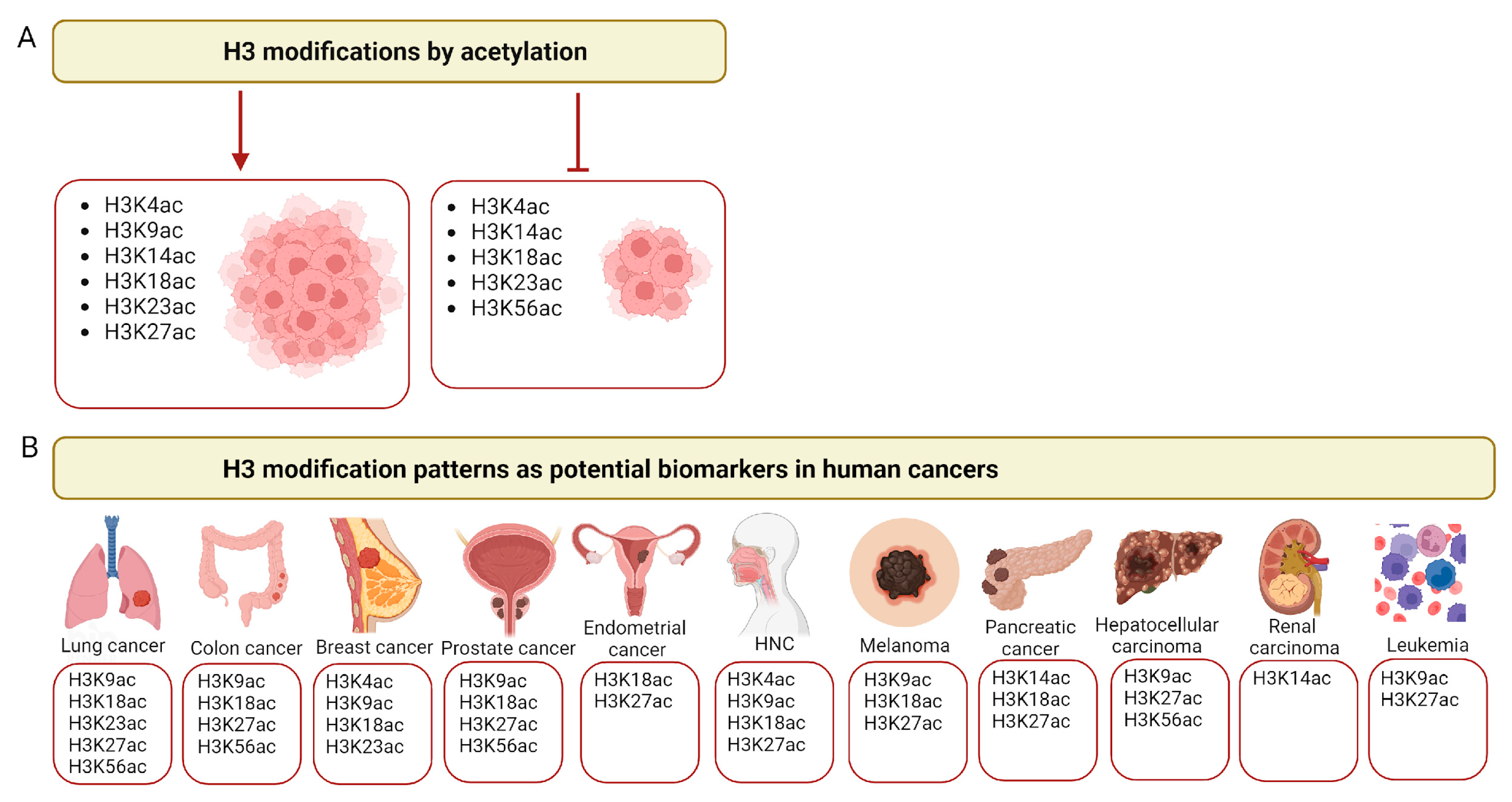
Miziak, P. et al. Int. J. Mol. Sci. 2024.
Figure 1. Histone H3 Acetylation in Cancer
Workflow of Targeted Acetylation Analysis Service
MtoZ Biolabs offers comprehensive targeted acetylation analysis of specific proteins, enabling detailed insights into how acetylation modifications affect protein function. Our Targeted Acetylation Analysis Service combines state-of-the-art MS technologies with specialized enrichment and quantification methods to deliver high-quality, reproducible data.
Our acetylation analysis includes:
1. Acetylated peptide enrichment using TiO₂ or ZrO₂ (metal oxide affinity chromatography) to selectively capture acetylated peptides from the protein(s) of interest.
2. High-resolution LC-MS/MS analysis to identify acetylation sites and obtain acetylation profiles across multiple lysine residues on the target protein(s).
3. Quantification of acetylation levels and site occupancy under different experimental conditions using label-free quantification, SILAC, or TMT methods.
4. Dynamic acetylation analysis to track modification changes over time, in response to treatments, or under disease conditions.
5. MRM/PRM validation to confirm the presence and quantity of acetylated sites with high reproducibility.

Why Choose MtoZ Biolabs?
1. Comprehensive Profiling
MtoZ Biolabs provides global acetylation analysis across multiple lysine residues, offering a complete view of acetylation changes on your target proteins.
2. Expertise in Dynamic Acetylation
We specialize in tracking dynamic acetylation changes, helping you understand how acetylation levels evolve in response to treatments, mutations, or time-course studies.
3. Advanced Quantification Methods
Our use of label-free quantification, SILAC, and TMT ensures reliable and reproducible measurement of acetylation levels and modification occupancy.
4. Custom Solutions
We customize each analysis to your target protein and research objectives, providing focused insights into acetylation modifications that matter to your study.
5. Transparent Pricing
We offer clear, upfront pricing with no hidden fees, ensuring that you can plan your project with confidence.
6. Expert Support
Our team of scientists and technical experts is here to assist you with experimental design, data interpretation, and ensuring that your research goals are met with precision.
Applications of Targeted Acetylation Analysis Service
● Epigenetic Regulation: Explore acetylation of histone proteins to study their role in gene expression and chromatin remodeling.
● Cancer Biology: Characterize acetylation changes in oncogenes and tumor suppressors, such as p53, to understand their impact on cancer progression and treatment response.
● Metabolic Regulation: Study the role of acetylation in metabolic enzymes to explore acetylation’s role in regulating cellular metabolism and energy production.
● Therapeutic Evaluation: Assess acetylation changes in response to drugs, especially in studies involving epigenetic modulators like HDAC inhibitors.
● Signal Transduction Studies: Investigate the impact of acetylation on key signaling proteins, including kinases, to understand how modifications influence cellular responses to stimuli.
Start Your Project with MtoZ Biolabs
Acetylation modifications are crucial for regulating protein function. MtoZ Biolabs combines advanced mass spectrometry with expert analysis to help you explore how acetylation impacts your target proteins.
Contact us today to discuss your project and receive a tailored analysis plan that supports your research goals.
FAQ
Q1: What is the service general workflow?

Q2: What types of samples are suitable for this service?
We accept a variety of sample types for targeted acetylation analysis, including:
Purified recombinant proteins: ≥ 50 µg
Immunoprecipitated protein complexes: ≥ 50 µg
Cell or tissue lysates: ≥ 100 µg total protein
Q3: What data formats are provided?
After completing the analysis, we provide the following formats:
Raw LC-MS/MS data files
Annotated acetylation tables containing acetylation sites, modification levels, and quantification data
Localization scores (if applicable), helping confirm the exact residues modified
Annotated spectra and visualization files for publication or regulatory submission (upon request)
The results are delivered in Excel and PDF formats, ensuring accessibility and ease of use for further analysis or reporting.
Q4: How should I prepare my samples for acetylation analysis?
To ensure the best results, please follow these sample preparation guidelines:
Buffer: Use MS-compatible buffers (e.g., PBS, Tris buffer).
Avoid contaminants: Ensure your samples are free from detergents, salts, or glycerol, as these can interfere with analysis.
Protease inhibitors: Add protease inhibitors to prevent protein degradation.
For low-abundance proteins: Perform immunoprecipitation or affinity enrichment before submitting the sample to concentrate the protein of interest.
For more information, please refer to Sample Submission Guidelines for Proteomics. If you are unsure about sample preparation, our team is available for consultation and can guide you through the process to ensure optimal results.
Related Services
How to order?




