






Protein Proline Hydroxylation Identification Service
Protein proline hydroxylation identification based on mass spectrometry is a powerful tool for studying protein post-translational modifications (PTMs). It enables accurate site-level analysis of hydroxylation patterns. This modification, catalyzed by prolyl hydroxylases (PHDs), introduces hydroxyl groups onto proline residues, altering protein stability, interactions, and activity. Proline hydroxylation is essential in collagen maturation, hypoxia response (HIF pathway), signal transduction, and metabolic regulation. Abnormal hydroxylation is linked to fibrosis, tumors, and hypoxia-related diseases.
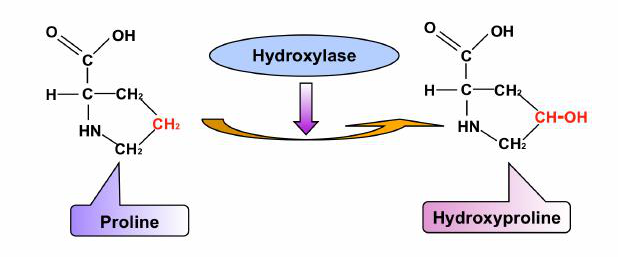
Xu, Y. et al. Int. J. Mol. Sci. 2014.
Figure 1. Proline Hydroxylation Reaction Mechanism
MtoZ Biolabs offers high-sensitivity Protein Proline Hydroxylation Identification Service using Thermo Fisher Q Exactive HF, Orbitrap Fusion, and Orbitrap Fusion Lumos mass spectrometers with Nano-LC systems. With optimized sample preparation, targeted enrichment, and advanced data workflows, we deliver reliable detection of low-abundance hydroxylation sites to support disease mechanism studies and drug discovery.
Analysis Workflow
1. Sample Preparation: Extraction, quantification, reduction, alkylation, and enzymatic digestion.
2. Peptide Enrichment: Optimized methods to enrich low-abundance hydroxylated peptides.
3. Mass Spectrometry Detection: Nano-LC with high-resolution LC-MS/MS and multi-stage fragmentation for precise site localization.
4. Data Analysis and Reporting: Database search and bioinformatics confirming hydroxylation sites with functional annotation and pathway insights.
Why Choose MtoZ Biolabs?
✅ High-resolution Platforms: Orbitrap-based MS with Nano-LC ensures accurate detection of low-abundance modifications.
✅ Advanced Enrichment Methods: Optimized strategies improve hydroxylation peptide capture.
✅ Experienced Specialists: A dedicated PTM team provides customized study designs and technical support.
✅ Research-driven Outcomes: Key data supporting cancer, hypoxia, and fibrosis studies.
✅ One-Time-Charge: Our pricing is transparent, no hidden fees or additional costs.
Sample Submission Suggestions
● Types: Cell lysates, tissue extracts, purified or recombinant proteins, serum, plasma, and other biofluids.
● Amount: ≥50 μg with ≥80% purity for target proteins; ≥1 mg with ≥1 μg/μL for mixtures.
● Storage: Store at –80°C, ship on dry ice, avoid freeze-thaw cycles.
Note: Provide details on sample collection and handling. If you need further details, our technical support team is happy to assist and provide comprehensive guidance on sample submission.
Applications
● Cancer and Angiogenesis: Study hydroxylation in tumor growth and blood vessel formation.
● Hypoxia Pathways: Investigate HIF signaling in hypoxia-related conditions.
● Connective Tissue and Fibrosis: Explore hydroxylation defects in collagen-related disorders.
● Plant Biology: Examine roles of hydroxylation in structure and adaptation.
● Biomarker and Drug Discovery: Identify disease-associated hydroxylation patterns for diagnostics and therapeutics.
What Could be Included in the Report?
1. Comprehensive Experimental Details
2. Materials, Instruments, and Methods
3. Total Ion Chromatogram & Quality Control Assessment
4. Data Analysis, Preprocessing, and Estimation
5. Bioinformatics Analysis
6. Raw Data Files
MtoZ Biolabs Protein Proline Hydroxylation Identification Service delivers high-confidence site data and functional analysis to support disease research, biomarker discovery, and drug target development. With advanced platforms and expert support, we help clients improve research efficiency and accelerate outcomes. We also offer identification services for other PTMs including phosphorylation, acetylation, methylation, ubiquitination, SUMOylation, and glycosylation, enabling comprehensive PTM profiling. Contact us today to advance your research.
How to order?




