






Protein Citrullination Identification Service
- Comprehensive Experimental Details
- Materials, Instruments, and Methods
- High-quality Spectra and Visualized Charts
- Site-specific Citrullination Identification with Detailed Annotation
- Bioinformatics Analysis
- Raw Data Files
Protein citrullination identification based on mass spectrometry is a critical approach for studying protein post-translational modifications, enabling precise site-level analysis of citrullination types and distributions. Citrullination, catalyzed by the Peptidylarginine Deiminase (PADs) family under calcium-dependent conditions, irreversibly converts arginine residues into citrulline. This charge loss can alter protein structure, function, and interactions. Citrullination is involved in immune regulation, gene expression, apoptosis, and inflammatory responses. Abnormal citrullination is strongly linked to diseases such as rheumatoid arthritis (RA), multiple sclerosis, Alzheimer’s disease, tumor immunology, and other neurodegenerative disorders. Detection is challenging because the mass shift is only +0.984 Da and the abundance is low, requiring high-resolution mass spectrometry and targeted enrichment strategies.
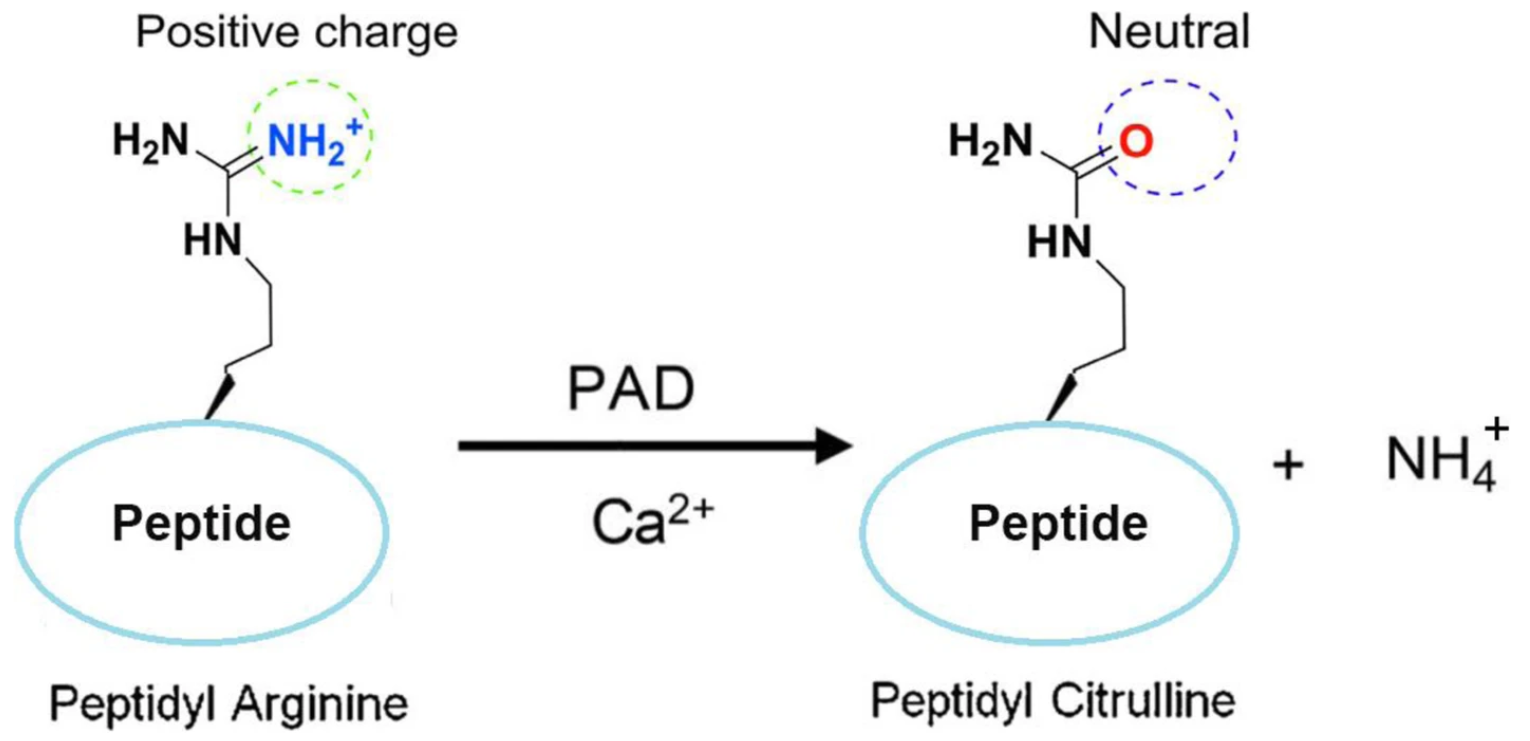
Zhu, D. et al. Mol Cancer. 2021.
Figure 1. PAD-Mediated Citrullination
MtoZ Biolabs offers high-sensitivity, high-resolution Protein Citrullination Identification Service utilizing Thermo Fisher Q Exactive HF, Orbitrap Fusion, and Orbitrap Fusion Lumos mass spectrometers with Nano-LC systems. By integrating advanced enrichment strategies with optimized data workflows, the Protein Citrullination Identification Service ensures reliable detection of citrullination events and provides functional insights at the site-specific level.
Analysis Workflow
1. Sample Preparation: Protein extraction, quantification, reduction, alkylation, and enzymatic digestion.
2. Citrullinated Peptide Enrichment: Selective capture using Citrulline Reactive Beads (CRB) or Biotin-Based Enrichment (BPG).
3. Mass Spectrometry Detection: Nano-LC with high-resolution LC-MS/MS using CID and HCD fragmentation.
4. Data Analysis and Reporting: Software-based confirmation of citrullination sites with functional annotation and pathway analysis.

Why Choose MtoZ Biolabs?
✅ High-Resolution Platforms: Advanced Orbitrap-based LC-MS/MS systems ensure accurate detection and confident identification of low-abundance citrullinated peptides.
✅ Advanced Enrichment Methods: CRB and BPG strategies maximize peptide capture efficiency, enhancing coverage and reliability of citrullination analysis.
✅ Comprehensive Data Support: Provides site-specific identification, detailed annotation, and pathway enrichment analysis for functional interpretation.
✅ Customized Solutions: Flexible service designs tailored to meet the needs of both basic research and clinical applications.
✅ Transparent Pricing: One-time-charge model with clear cost structure, ensuring no hidden fees and straightforward project planning.
Sample Submission Suggestions
● Types: Cell lysates, tissue extracts, purified or recombinant proteins, serum, plasma, synovial fluid.
● Amount: ≥50 μg with ≥80% purity for target proteins; ≥1 mg with ≥1 μg/μL for mixtures.
● Storage: Store at –80°C, ship on dry ice, avoid freeze-thaw cycles.
Provide concentration, volume, preparation time, source, and grouping details. For full submission guidance, contact the MtoZ Biolabs team.
What Could Be Included in the Report?
MtoZ Biolabs Protein Citrullination Identification Service delivers high-confidence site data and functional analysis to support disease research, biomarker discovery, and drug target validation. With advanced platforms and expert support, we help researchers achieve deeper insights and accelerate outcomes. Contact us today to move your PTM research forward.
Related Services
How to order?




