






Polysaccharide Molecular Weight Determination Service
Based on high-precision gel permeation chromatography (GPC) and multi-angle laser light scattering (MALS) analytical platforms, MtoZ Biolabs has launched the polysaccharide molecular weight determination service which enables systematic measurement of the molecular weight and distribution characteristics of natural or synthetic polysaccharide samples. Through chromatographic separation and light scattering signal acquisition, the service accurately calculates number-average molecular weight (Mn), weight-average molecular weight (Mw), and polydispersity index (Đ), while evaluating sample aggregation state and structural uniformity. The obtained data provide reliable support for polysaccharide quality control, structural characterization, and performance evaluation.
Overview
Polysaccharide molecular weight refers to the average mass or distribution characteristics of polysaccharide molecular chains and is a key parameter determining their physicochemical properties and biological activities. Different molecular weights significantly affect polysaccharide solubility, viscosity, gel properties, and interactions with biomolecules; therefore, molecular weight determination is essential in structural and functional studies. This analysis is widely applied in pharmaceutical research, biological materials, cosmetics, and fermentation engineering, serving as an important step in polysaccharide characterization and quality control.
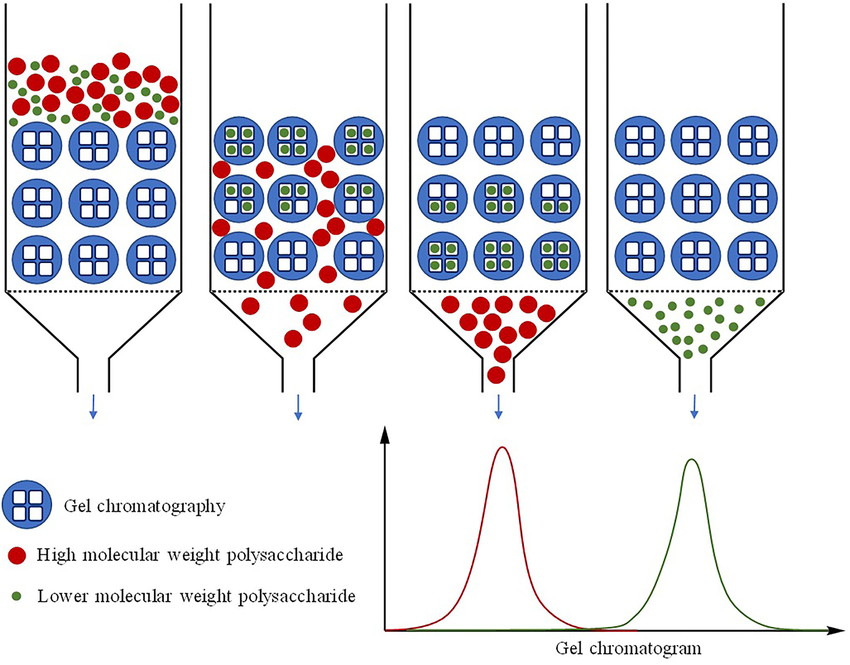
Wang, B. et al. Frontiers in Nutrition, 2022.
Figure 1. The Schematic Diagram of Mechanism for Determination of Molecular Weight of Herbal Polysaccharides.
Analysis Workflow
1. Sample Pretreatment
Polysaccharide samples are dissolved, degassed, and filtered to remove impurities and bubbles, ensuring testing stability.
2. Chromatographic Separation
Gel permeation chromatography (GPC) or size exclusion chromatography (SEC) systems are used to effectively separate polysaccharides based on molecular size differences.
3. Signal Detection
Multi-angle laser light scattering (MALS), refractive index (RI), or viscometer detectors are applied to obtain molecular weight–related signals.
4. Data Calculation and Analysis
Specialized software is used to calculate number-average molecular weight (Mn), weight-average molecular weight (Mw), and polydispersity index (Đ), generating molecular weight distribution curves.
5. Results Summary and Report Generation
Testing results are integrated to produce a standardized analytical report containing molecular weight data, distribution profiles, and structural assessment.
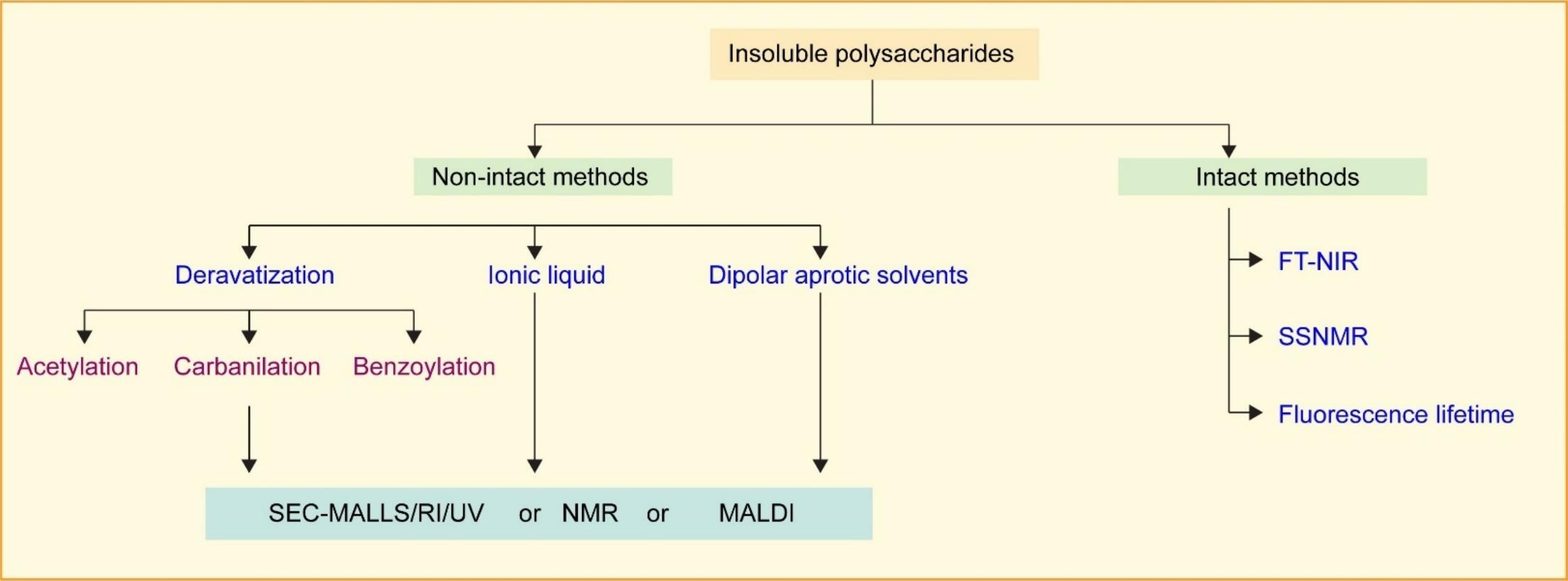
Tabani, H. et al. International Journal of Biological Macromolecules, 2025.
Figure 2. Strategies for Molecular Weight Determination of Insoluble Polysaccharides.
Sample Submission Suggestions
1. Sample Type
Plant extracts, microbial metabolites, medicinal polysaccharides, and purified samples are accepted in powder, lyophilized, or solution form.
Note: Samples should be free of impurities such as proteins, lipids, and inorganic salts to ensure analytical accuracy.
2. Sample Storage
Samples should be tightly sealed and stored in a dry, light-protected environment. For short-term storage, keep at -20°C; for long-term preservation, store at -80°C to prevent moisture absorption, oxidation, or degradation.
3. Sample Transportation
Lyophilized samples can be shipped at ambient temperature for short periods. Liquid samples should be transported under cold-chain conditions to avoid high temperatures and strong vibrations, ensuring sample stability and reliable analysis results.
Service Advantages
1. Multi-Technology Integrated Detection
Combining GPC, SEC, and MALS technologies enables high-precision determination of polysaccharide molecular weight.
2. High Sensitivity and Resolution
With advanced analytical platforms, different molecular weight fractions can be accurately distinguished, providing complete molecular weight distribution profiles.
3. Strict Quality Control
Standardized procedures are implemented from sample pretreatment to data analysis to ensure result reliability and reproducibility.
4. Customized Analytical Solutions
Analytical workflows can be flexibly tailored based on sample characteristics and research objectives to meet diverse experimental needs.
Applications
1. Medicinal Polysaccharide Research
Polysaccharide molecular weight determination service can be used to evaluate the molecular weight and distribution characteristics of medicinal polysaccharides, supporting studies on the relationship between structure and biological activity.
2. Natural Product Analysis
By characterizing polysaccharides derived from plants or microorganisms, the service reveals structural features and extraction process stability.
3. Polysaccharide Purification and Quality Control
Polysaccharide molecular weight determination service can be applied to verify purification efficiency and assess sample consistency and batch-to-batch stability.
4. Industrial Fermentation and Metabolic Analysis
By monitoring polysaccharide formation, degradation, and polymerization during fermentation, the service provides insights for process optimization and yield improvement.
FAQ
Q1: Does the sample need to be fully dissolved?
A1: Yes. Polysaccharides must be completely dissolved in an appropriate solvent; otherwise, detection bias or column clogging may occur.
Q2: What is the detectable molecular weight range?
A2: Depending on the analytical platform, the detectable molecular weight range typically covers from several thousand to several million Daltons, suitable for various types of polysaccharide samples.
Q3: Can this service be combined with other characterization techniques?
A3: Yes. It can be integrated with monosaccharide composition analysis, FTIR structural verification, or NMR analysis to obtain more comprehensive structural information on polysaccharides.
How to order?




