






Polygonatum Polysaccharide Analysis Service
- Sample Form: Acceptable forms include powder, lyophilized sample, extract, or semi-purified material.
- Sample Quantity: Provide at least 10 mg of dry sample or 1 mL of liquid sample (concentration ≥5 mg/mL).
- Purity: If the sample contains high levels of proteins or pigments, please specify so appropriate pretreatment can be applied.
- Storage and Transportation: Samples should be sealed, protected from light, and stored at low temperature. Dry ice or ice packs are recommended for shipment.
- Additional Information: Provide sample source, extraction method, and intended analysis goals for optimal experimental design.
- Qualitative and quantitative results of monosaccharide composition
- Molecular weight distribution and polydispersity data
- Structural characterization results and corresponding spectra
- Purity and impurity assessment report
- Comprehensive analytical summary and recommendations
Equipped with advanced multi-dimensional analytical platforms, MtoZ Biolabs offers a high-resolution and reproducible polygonatum polysaccharide analysis service that covers monosaccharide composition determination, molecular weight distribution, glycan structural characterization, purity assessment, and functional correlation analysis, delivering reliable and systematic analytical data for both research and industrial clients.
What Are Polygonatum Polysaccharides?
Polygonatum polysaccharides are important active components extracted from plants of the Polygonatum genus. They belong to the class of natural high-molecular-weight polysaccharides composed of various monosaccharides such as glucose, mannose, galactose, and rhamnose. These polysaccharides exhibit a wide range of biological activities, including antioxidant, immunomodulatory, hypoglycemic, and anti-fatigue effects. With the growing interest in natural product research and functional food development, qualitative, quantitative, and structural studies of Polygonatum polysaccharides have become increasingly important in pharmacology and food science.
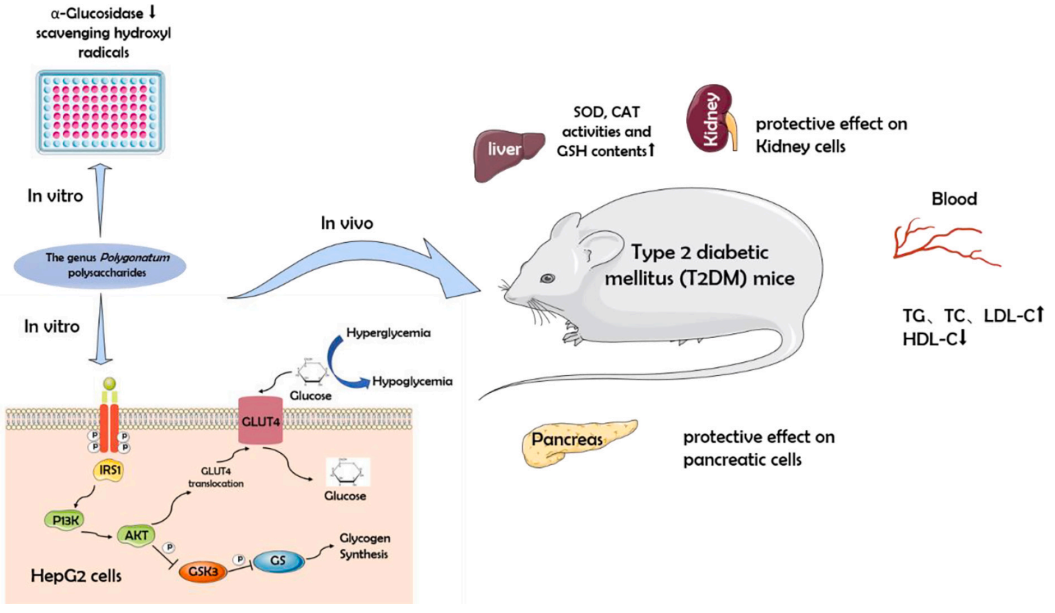
Gong, H. et al. Int J Biol Macromol. 2023.
Figure 1. Schematic Representation the Underlying Mechanism of Antidiabetic Activity of Polygonatum Polysaccharides
Services at MtoZ Biolabs
Systematic analysis of polygonatum polysaccharides helps to elucidate their structure–function relationships, clarify their pharmacological basis, and identify quality variations. This provides scientific evidence for product development and quality control. MtoZ Biolabs’ polygonatum polysaccharide analysis service is designed to provide clients with comprehensive insights into the composition, structure, and physicochemical properties of polysaccharides. Our main analytical services include:
1. Monosaccharide Composition Analysis
Using high-performance liquid chromatography (HPLC) or gas chromatography–mass spectrometry (GC–MS), hydrolyzed monosaccharides are identified and quantified to determine their relative proportions.
2. Molecular Weight and Distribution Determination
Gel permeation chromatography (GPC) or size-exclusion chromatography with multi-angle light scattering (SEC–MALS) is employed to measure average molecular weight, molecular weight distribution, and polydispersity.
3. Structural Characterization and Glycosidic Linkage Analysis
Fourier-transform infrared spectroscopy (FT–IR), 1D/2D nuclear magnetic resonance (NMR), and mass spectrometric fragmentation analysis are combined to elucidate linkage types, anomeric configurations (α/β), and branching patterns.
4. Purity and Impurity Analysis
HPLC-ELSD, UPLC-UV, or ion chromatography is used to assess sample purity and detect residual proteins, phenolics, or co-extracted impurities, ensuring data reliability.
MtoZ Biolabs follows standardized yet customizable workflows that can be adapted to different sample types and research purposes.
Analysis Workflow
1. Sample Pretreatment: Depending on the sample type (root, extract, or purified product), processes such as deproteinization, decolorization, dialysis, and lyophilization are performed.
2. Monosaccharide Hydrolysis or Derivatization: Acidic or enzymatic hydrolysis converts polysaccharides into monosaccharides, followed by derivatization to enhance detection sensitivity.
3. Chromatography/Mass Spectrometry Detection: Analytical platforms such as HPLC, GC–MS, or LC–MS/MS are used for composition and structural analysis.
4. Data Interpretation and Structural Deduction: Retention times, ion peaks, and spectral patterns are analyzed to deduce the structural features of the polysaccharide.
5. Result Compilation and Reporting: Data are reviewed by experienced analysts, and a structured technical report is generated.
Service Advantages
1. Multi-platform Integrated Analysis
MtoZ Biolabs is equipped with advanced analytical instruments including HPLC, GC–MS, LC–MS/MS, NMR, and FT–IR, enabling comprehensive and multi-angle characterization of Polygonatum polysaccharides. This ensures both high sensitivity and deep structural insight.
2. Customized Research Solutions
The polygonatum polysaccharide analysis service accommodates various extraction methods (hot water, enzymatic, ethanol precipitation) and sample types (plant tissues, herbal powders, fermentation liquids) through tailored analytical strategies that support the goals of research institutes, pharmaceutical companies, and food industries.
3. Experienced Technical Team
Our experts have extensive experience in natural product chemistry and polysaccharide structure elucidation, providing professional data interpretation and scientific recommendations to support publication or product development.
4. One-Time Charge
Our pricing is transparent, no hidden fees or additional costs.
Applications
☑️ Quality Evaluation and Standardization of Herbal Medicines: Assess differences in active components across Polygonatum samples from various origins or processing methods.
☑️ Functional Food and Health Product Development: Provide scientific data for the characterization of active ingredients, purity, and structural features.
☑️ Pharmacological Mechanism Studies: Assist in elucidating correlations between polysaccharide structures and biological functions such as immunomodulation, anti-inflammatory, or anti-aging effects.
☑️ Extraction Process Optimization and Quality Control: Compare yields and composition across extraction techniques to guide industrial production.
☑️ Comparative Natural Product Analysis: Differentiate and classify polysaccharides from diverse plant sources through structural fingerprinting.
Sample Submission Suggestions
MtoZ Biolabs offers detailed sample submission guidelines to help clients select the most suitable analytical mode for their research.
Deliverables
Get in touch now to learn more about our polygonatum polysaccharide analysis service.
How to order?




