






Plant Proteomics Workflow: From Sample Preparation to Data Interpretation
A plant proteomics service project moves from sample planning through protein extraction, digestion, LC-MS/MS, and data interpretation. The workflow is strongest when the biological contrast, tissue choice, and expected readout are defined before harvest rather than after the protein table is returned. Sample quality, group design, and analysis strategy together determine whether the results can support trait comparison, stress-response analysis, or candidate protein prioritization.
For most standard plant proteomics projects, the service path includes protein extraction or purification, enzymatic digestion, LC-MS/MS analysis, and bioinformatics reporting. Standalone gel imaging or similar preparation-only work is generally outside this workflow.
If you are planning a plant proteomics service project, share the species, tissue type, comparison design, and biological question with MtoZ Biolabs while sample collection can still be adjusted.
Step 1: Sample Planning and Collection
Workflow quality begins with sample design. Before collection, define:
-
The comparison sentence, such as stress versus control, tolerant versus sensitive line, or treated versus untreated tissue
-
The tissue that best represents the biological question, such as leaf, root, seed, flower, bark, or pollen
-
Independent biological replicates rather than repeated subsamples from one plant when the conclusion is intended at the plant level
-
Harvest stage, treatment duration, stress timing, and time of day at collection
Sample amount depends on tissue type, matrix complexity, sample condition, and the selected analysis strategy. Leaves and other high-moisture tissues may require different collection amounts from woody, pigment-rich, lipid-rich, or storage tissues. Pollen and other limited materials should be reviewed separately before collection.
These are project-planning considerations rather than performance guarantees. Degraded, contaminated, or repeatedly freeze-thawed material is not recommended. Samples involving pathogens, infectious agents, or quarantine risks require prior review and may be subject to acceptance restrictions.
Keep metadata with the sample list, including genotype, treatment, harvest date, tissue position, developmental stage, and any phenotype or stress score recorded at collection. This information supports later interpretation even though it is not part of the mass spectrometer run itself.
Step 2: Protein Extraction and Preparation
After samples arrive, the workflow typically moves into protein extraction and preparation within the plant proteomics service scope. The goal is to recover proteins suitable for digestion and LC-MS/MS from the submitted tissue type.
Practical preparation considerations include:
-
Using an extraction approach suited to the submitted tissue and matrix
-
Reducing compounds that may interfere with protein recovery, digestion, or LC-MS/MS
-
Keeping handling consistent across compared groups
-
Balancing or randomizing sample processing across groups to reduce batch–group confounding
-
Documenting which tissue batch entered extraction so group labels remain traceable
Complex plant matrices such as seeds, bark, woody tissue, or highly pigmented samples may require additional preparation attention. The service focus remains on generating a digestible protein sample for downstream analysis rather than on standalone gel-based preparation or image analysis.
If sample status is uncertain before shipment, review the tissue type, collection history, storage conditions, and group design with the laboratory first. Sample preparation cannot fully correct incompatible collection or storage conditions after the material has been harvested.
Step 3: Digestion and LC-MS/MS Analysis
Prepared proteins are digested into peptides for LC-MS/MS analysis. The analytical workflow should be selected according to the biological question and the required readout.
Identification-focused analysis may fit early characterization when the main goal is to determine which proteins can be detected in a tissue, line, or condition. Quantitative analysis is needed when the project depends on comparing protein abundance between groups.
DDA and DIA are data acquisition strategies rather than direct substitutes for identification and quantification. Label-free, TMT, DDA, and DIA workflows may be considered according to sample number, comparison structure, quantitative consistency requirements, and project scope.
DDA can support protein identification and quantitative workflows and is often used for flexible study designs or pilot projects. DIA can support consistent quantitative comparison across matched sample sets when reproducible measurement across multiple samples is important.
Data may be processed using software such as MaxQuant, Proteome Discoverer, Spectronaut, or DIA-NN, depending on the acquisition and quantification strategy. Instrument platforms such as Orbitrap Exploris 480, timsTOF Pro, and Orbitrap Astral may be discussed after the sample number, tissue type, and comparison design are clear.
The selected workflow should follow the research question rather than defaulting to the most complex analysis before the groups and samples are stable.
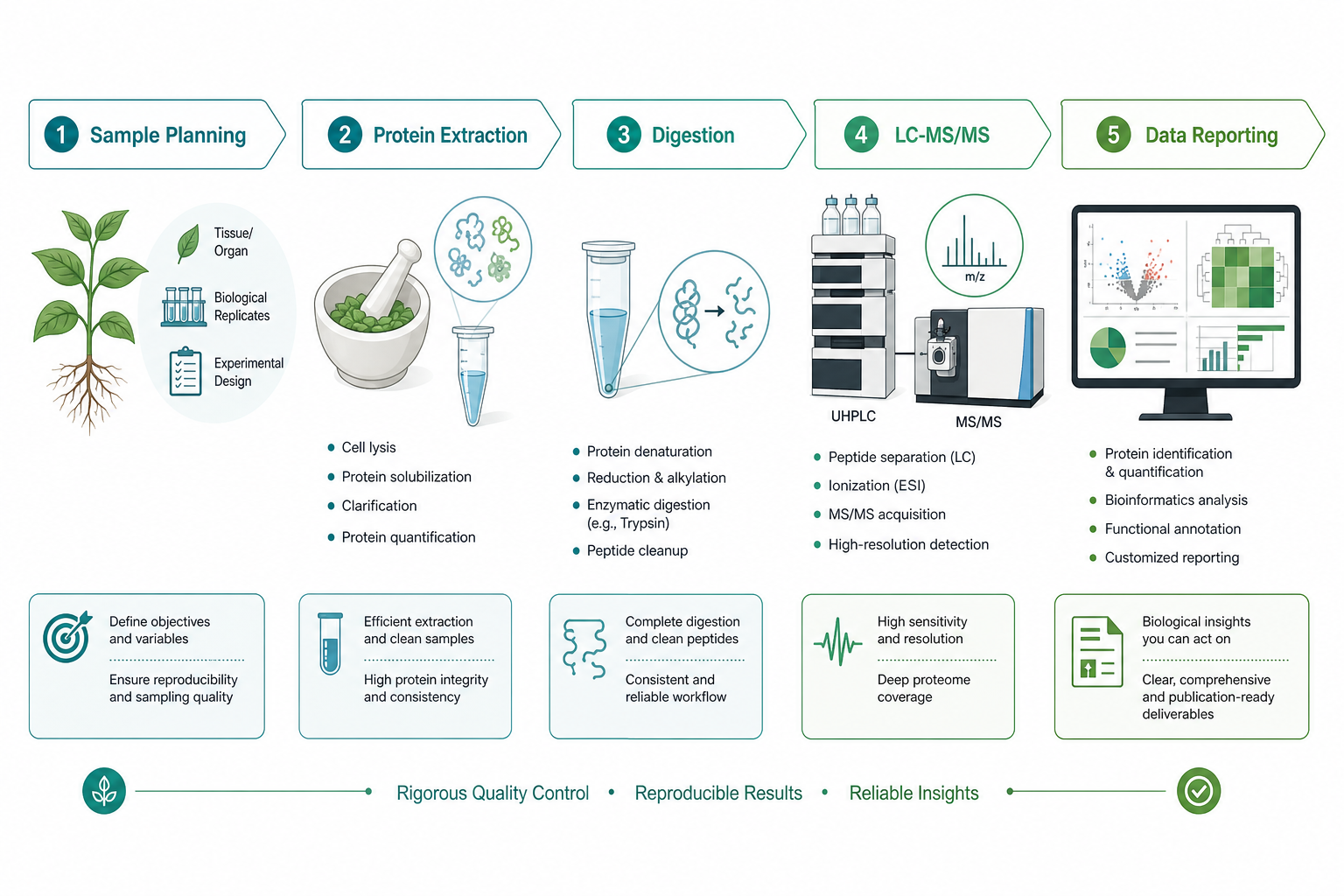
Figure 1. Sample planning, protein preparation, digestion, and LC-MS/MS form the core plant proteomics service workflow.
Step 4: Data Processing and Standard Bioinformatics
After LC-MS/MS, data processing converts raw spectra into protein identification results and, for quantitative projects, abundance matrices suitable for group comparison.
Standard reporting may include:
-
Protein identification tables
-
Quantitative protein abundance results
-
Differential protein screening between predefined groups
-
Functional annotation of identified proteins
-
GO and KEGG pathway analysis
-
Database-derived protein–protein interaction network analysis when applicable
-
Reactome analysis when supported by the species and available annotation resources
The exact report structure should be aligned with the comparison design agreed at project start. A stress-versus-control study, a genotype contrast, and a developmental comparison do not require the same grouping and statistical logic even when the same instrument platform is used.
At this stage, the results remain discovery-level. Functional annotation and pathway mapping organize biological themes and help prioritize candidates. They do not independently prove mechanism, direct protein interaction, trait control, or field performance.
| Workflow Stage | Main Output | Common Next Review Step |
| Sample planning | Defined groups, tissue, and replicate plan | Confirm comparison sentence and sample suitability |
| Extraction and digestion | Prepared peptide samples for LC-MS/MS | Check tissue consistency and group traceability |
| LC-MS/MS | Identification and/or quantification data | Confirm the acquisition strategy matches the question |
| Differential analysis | Proteins showing group-related changes | Review replicate behavior and possible outliers |
| Pathway annotation | Functional themes and database context | Prioritize candidates linked to the phenotype |
Database-derived interaction networks provide contextual information from existing resources. They do not demonstrate that two proteins physically interact in the submitted plant samples.
Step 5: Data Interpretation for Trait and Stress Questions
Interpretation connects the analytical workflow back to the original biological question. A differential protein list alone rarely supports a breeding, stress, or trait conclusion without disciplined sample-level review.
Use this order when reading the results:
-
Return to the comparison sentence defined at project start.
-
Check whether protein changes follow the group labels consistently across biological replicates.
-
Separate consistent abundance changes from results driven by individual samples or outliers.
-
Use pathway and network views to organize candidates by biological process or function.
-
Keep conclusions at the candidate level unless follow-up validation has been completed.
For trait-focused projects, prioritize proteins whose direction of change is consistent with the measured phenotype data collected at harvest. For stress projects, review treatment duration and harvest timing carefully so early acclimation responses are not interpreted together with late-stage damage unless the design intentionally includes both stages.
Pathway enrichment is a prioritization tool. It may highlight themes such as stress response, photosynthesis-related remodeling, transport, storage protein changes, or metabolic regulation. It does not replace replicate-level review, experimental validation, or functional testing.
When the biological question also depends on metabolite pools, hormone-related chemistry, or secondary metabolite changes, plant metabolomics or an integrated multi-omics analysis may be considered after the protein-level priorities and comparison design are clear.
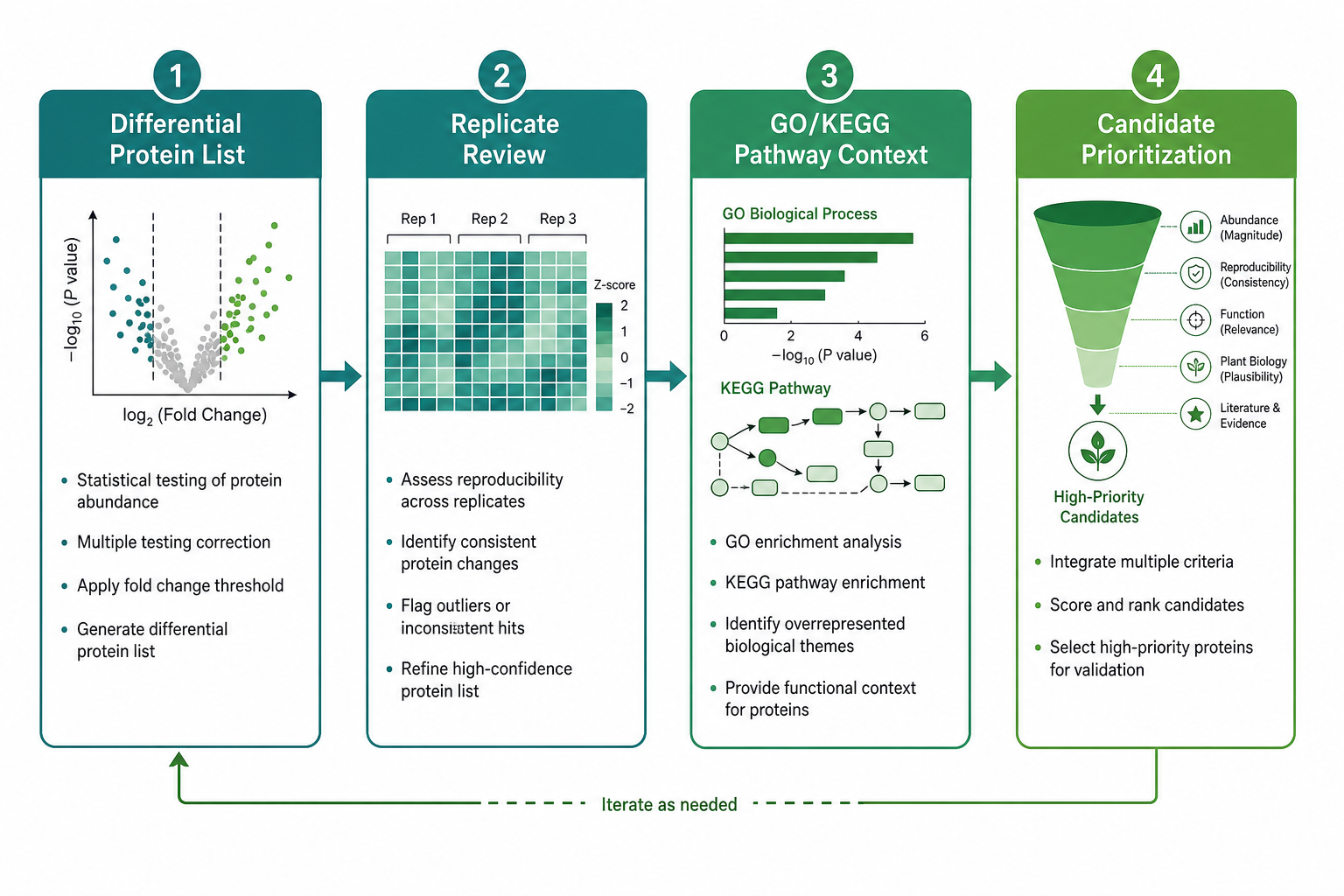
Figure 2. Interpretation should move from differential proteins to replicate review, pathway context, candidate prioritization, and follow-up validation.
Common Workflow Mistakes to Avoid
-
Starting sample collection before the comparison groups are clearly defined
-
Submitting mixed organs or unevenly treated samples under one group label
-
Confounding genotype, treatment, harvest batch, or processing batch
-
Expecting pathway enrichment to prove a biological mechanism
-
Treating every differential protein as a trait or stress marker
-
Choosing a large multi-time-point design before the main contrast has been evaluated
-
Assuming gel imaging or standalone preparation-only work is included in a workflow focused on extraction, LC-MS/MS, and reporting
Before You Start a Plant Proteomics Service Project
-
Write the comparison in one clear sentence.
-
Choose the tissue, developmental stage, and harvest timing.
-
Plan independent biological replicates for each group.
-
Confirm sample amount guidance for the tissue being collected.
-
Record phenotype, treatment, or stress information at harvest.
-
Decide whether protein identification or quantitative comparison is required.
-
Align the expected report with the biological question.
-
Consider whether phosphoproteomics, interaction proteomics, metabolomics, or another specialized workflow is needed.
When the study plan is ready, share the species, tissue type, group design, sample count, storage history, and analysis objective. This information can be used to evaluate whether a standard plant proteomics workflow fits the project or whether a pilot or specialized analytical layer should be discussed.
Related Services
Plant Phosphoproteomics Analysis Service
Frequently Asked Questions
1. What does a standard plant proteomics service workflow include?
It generally includes protein extraction or purification, digestion, LC-MS/MS analysis, protein identification or quantification, and bioinformatics reporting based on the agreed comparison design.
2. How should biological replicates be planned?
Replicates should represent independently collected biological samples. Repeated subsamples from one plant usually do not replace independent plants when the conclusion is intended at the plant or genotype level.
3. How are DDA and DIA selected?
DDA and DIA are acquisition strategies. Selection should consider the analysis objective, sample number, group structure, quantitative consistency requirements, and the planned data-processing workflow rather than sample number alone.
4. Can seeds, bark, and pigment-rich plant tissues be analyzed?
These tissues may be suitable, but their matrix composition can affect extraction and sample preparation. Tissue type and sample condition should be reviewed before collection or shipment.
5. What do pathway and interaction-network results show?
They organize identified or differential proteins using existing functional and interaction databases. They support candidate prioritization but do not independently prove mechanism or direct physical interaction.
6. When should a specialized workflow be considered?
Phosphoproteomics may be relevant for signaling questions, interaction proteomics for protein-complex studies, and plant metabolomics for questions involving metabolites, hormones, or secondary metabolism.
Conclusion
A plant proteomics service workflow moves from sample planning through extraction, digestion, LC-MS/MS, data processing, and interpretation linked to the original biological comparison. The most useful results come from clear group design, consistent sample handling, an analytical strategy matched to the research question, and cautious interpretation of differential proteins using replicate behavior and pathway context.
To evaluate a plant proteomics project, contact MtoZ Biolabs with the species, tissue type, sample condition, comparison design, and biological question. These details help determine whether the standard workflow is suitable or whether a pilot, phosphoproteomics, or multi-omics strategy should be considered.
How to order?




