






Plant Phosphoproteomics Analysis Service
MtoZ Biolabs provides the Plant Phosphoproteomics Analysis Service to systematically identify and quantitatively analyze protein phosphorylation events in plant samples by leveraging high-resolution mass spectrometry combined with phosphopeptide enrichment strategies. This service helps researchers elucidate signal transduction mechanisms, stress response processes, and key regulatory nodes, providing reliable data support for plant functional studies and molecular mechanism research.
What Is Plant Phosphoproteomics
Plant phosphoproteomics is a mass spectrometry-based research field focused on the systematic identification and quantitative analysis of phosphorylated proteins and their specific modification sites in plant systems. Protein phosphorylation mainly occurs on serine, threonine, and tyrosine residues and represents one of the most important and dynamic post-translational modifications in plants, enabling rapid regulation of protein activity, conformation, interactions, and subcellular localization without altering protein expression levels. Plant phosphoproteomics typically integrates protein extraction, enzymatic digestion, phosphopeptide enrichment, and high-resolution mass spectrometry to achieve deep coverage of phosphorylation events in complex plant samples.

Humphrey, SJ. et al. Trends Endocrinol Metab. 2015.
Figure 1. The Role of Protein Phosphorylation
From a functional perspective, plant phosphoproteomics provides critical insights into signal transduction and regulatory networks and plays an indispensable role in studies of plant growth and development, hormone signaling, immune responses, and abiotic stress adaptation. Compared with transcriptomic or total proteomic analyses, phosphoproteomics more directly reflects pathway activation states and regulatory intensity, facilitating the identification of key kinase-substrate relationships and core regulatory nodes. As such, it has become an essential analytical approach in plant functional genomics and mechanistic research.
Plant Phosphoproteomics Analysis Service at MtoZ Biolabs
The Plant Phosphoproteomics Analysis Service at MtoZ Biolabs is designed to support diverse plant tissues and experimental conditions, providing an integrated analytical solution from sample preparation to phosphorylation site interpretation.
1. Phosphopeptide Enrichment and Fractionation Services
By combining metal ion-based or metal oxide-based phosphopeptide enrichment strategies with ion-exchange or hydrophilic interaction-based fractionation methods, this service enables effective enrichment of both mono- and multi-phosphorylated peptides while significantly improving phosphoproteome coverage.
2. Global Plant Phosphoproteome Identification
Systematic identification of phosphorylated proteins and phosphopeptides in plant samples to characterize the global distribution of serine, threonine, and tyrosine phosphorylation events.
3. Precise Phosphorylation Site Identification and Localization
High-resolution mass spectrometry combined with multiple fragmentation strategies is applied to ensure confident identification and accurate localization of phosphorylation sites, providing site-level evidence for downstream functional studies.
4. Quantitative Comparative Phosphoproteomics
Supports quantitative comparison of phosphorylation levels across different treatments, time points, or genotypes to reveal dynamic regulatory changes.
5. Integrated Phosphoproteome and Protein Abundance Analysis
Phosphorylation data are interpreted alongside protein abundance information to help distinguish expression-driven effects from post-translational regulatory mechanisms, improving biological interpretability.
Workflow of Plant Phosphoproteomics Analysis Service
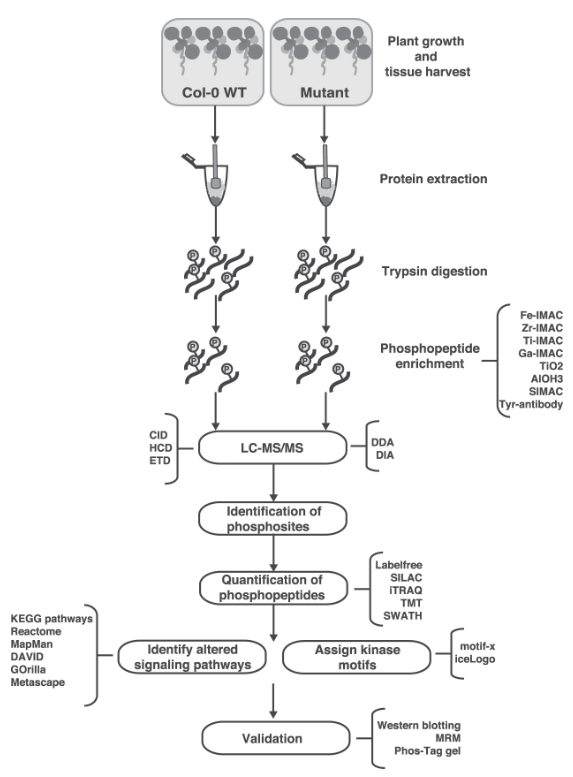
Subba, P. et al. OMICS. 2021.
Why Choose MtoZ Biolabs
1. Expertise in Plant Sample Processing
Extensive experience handling plant-specific challenges such as rigid cell walls, pigments, and secondary metabolites ensures stable and reproducible workflows.
2. Advanced Mass Spectrometry Platforms
Phosphoproteomic analyses are performed using high-resolution instruments, including the Thermo Fisher Q Exactive HF and Orbitrap Fusion Lumos, to achieve high site coverage and data consistency.
3. Multiple Quantitative Strategies
MtoZ Biolabs supports label-free quantification as well as isotope- or chemical-labeling strategies such as TMT and iTRAQ, enabling flexible experimental designs across different project scales and complexities.
4. Multiple Fragmentation Modes
The platform supports CID, HCD, and ETD or EThcD fragmentation modes, balancing phosphorylation site coverage with confident site localization.
5. One-Time Charge
Pricing is transparent, with no hidden fees or additional costs.
Applications of Plant Phosphoproteomics Analysis Service
☑️ Plant immune signaling and pathogen response studies
☑️ Signal transduction under abiotic stress conditions
☑️ Hormone-regulated and development-related phosphorylation research
☑️ Kinase-substrate relationship analysis
☑️ Dynamic phosphorylation profiling of key regulatory pathways
Start Your Project with MtoZ Biolabs
We welcome you to contact us to discuss your research objectives and experimental design. MtoZ Biolabs is committed to supporting efficient and reliable phosphoproteomics analysis for advancing plant signal regulation and functional mechanism studies.
FAQs
Q1: What types of samples are suitable?
This service is suitable for a wide range of plant samples, including leaves, roots, stems, seedlings, and plant-derived cell samples.
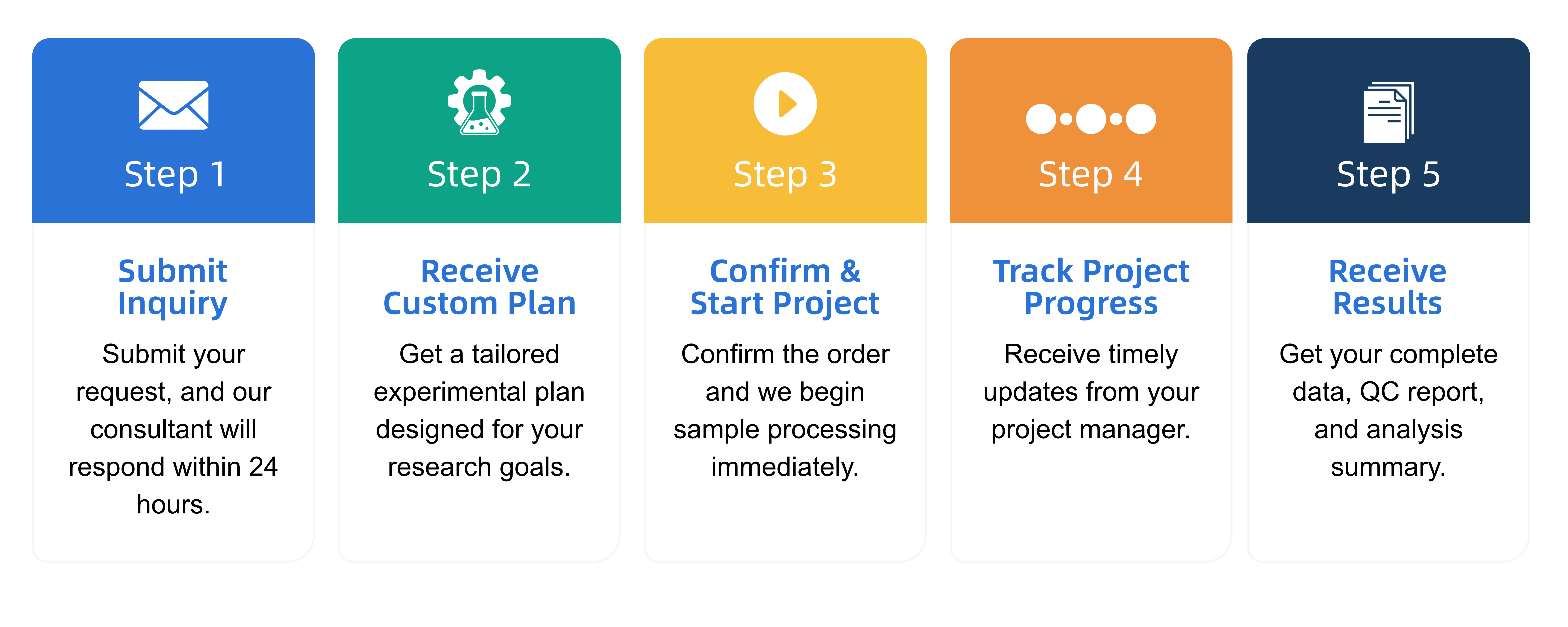
Q2: What is the service’s general workflow?
Q3: What data formats are provided?
MtoZ Biolabs provides plant phosphoproteomics results in multiple standardized formats to ensure compatibility with downstream analysis, interpretation, and publication requirements. Typical deliverables include:
● Raw LC-MS/MS data files
● Processed data tables
● Analysis summary report
● Visualization files
Additional data formats or customized data organization can be provided upon request to support specific research objectives or publication standards.
Q4: How should I prepare my samples?
To ensure reliable and reproducible results for the Plant Phosphoproteomics Analysis Service, MtoZ Biolabs recommends preparing samples according to the following general guidelines:
1. Sample Type: Suitable samples include plant tissues such as leaves, roots, stems, seedlings, or plant-derived cell samples.
2. Sample Quality: Samples should be fresh or properly frozen, with minimal degradation. Repeated freeze–thaw cycles should be avoided.
3. Contaminant Control: Samples should be free of excessive salts, detergents, pigments, or other compounds that may interfere with protein extraction or mass spectrometry analysis.
4. Storage and Shipping: Samples should be stored at −80°C and shipped on dry ice in sealed, leak-proof containers to preserve phosphorylation states.
5. Documentation: Please provide relevant information including species, tissue type, treatment conditions, experimental groups, and any special handling steps.
For more information, please refer to Sample Submission Guidelines for Proteomics and Sample Submission Guidelines for Metabolomics.
How to order?




