






Plant Proteomics for Salt Stress: From Protein Changes to Tolerance Pathways
Plant proteomics under salt stress can reveal which proteins change in abundance when NaCl or soil salinity rises, and which pathway themes those changes suggest for tolerance or damage. The same salt treatment does not produce the same protein profile in every organ. Leaf, root, stem, and seed each capture different parts of the salt response, so tissue choice often determines whether the results support ion exclusion, osmotic adjustment, photosynthesis remodeling, or seed-quality questions.
The useful output is a tissue-matched set of candidate proteins and pathway priorities linked to the salt contrast, not a generic list of salt marker proteins copied from another organ.
If you are planning plant proteomics for salt stress, share the species, salt protocol, sampled organ, harvest timing, and comparison design with MtoZ Biolabs while collection is still open.
What Salt Stress Proteomics Can Reveal
Quantitative plant proteomics under salinity can highlight:
-
Early signaling and transport-related protein shifts before visible damage appears
-
Later adjustment proteins linked to osmotic balance, antioxidant defense, or cell-wall remodeling
-
Genotype-dependent differences between salt-tolerant and salt-sensitive lines under matched NaCl exposure
-
Organ-specific responses when leaf, root, or seed is sampled deliberately rather than mixed
Standard analysis may include differential screening, functional annotation, GO and KEGG pathway views, protein interaction context, and Reactome analysis when the species is supported.
Salt stress proteomics does not by itself:
-
Prove that any one protein controls salt tolerance
-
Replace ion-content or osmolyte measurements when the claim depends on chemistry
-
Merge leaf and root biology into one contrast without a defined multi-organ design
-
Predict field salinity performance across soils and seasons from one greenhouse run alone
Discovery results should be read as organ-specific candidate proteins and pathway themes until phenotype linkage and follow-up work support stronger claims.
Why Tissue Choice Changes the Salt Story
Plants partition salt stress across organs. Roots encounter ion influx and exclusion first. Leaves face transpiration-driven ion accumulation and photosynthetic stress. Stems and sheaths can mediate transport and structural responses. Seeds and fruits reflect developmental or quality impacts that may lag shoot exposure.
If the research question is canopy injury after salinity, leaf proteomics is the natural fit. If the question is uptake control or root-zone adaptation, root proteomics is more direct. If the question is seed filling or storage-protein quality under saline irrigation, seed or fruit sampling may be required even when leaf symptoms look mild.
Mixing organs inside one salt-versus-control group is one of the most common reasons salt proteomics results become hard to defend. A protein enriched in root ion-transport pathways may never appear as the top hit in leaf tissue from the same plant, and that difference is biological rather than analytical failure.
| Sampled organ | Common salt-stress biology captured | Typical pathway themes in proteomics interpretation | Collection planning note |
| Leaf | Canopy ion load, photosynthesis stress, visible injury timing | Antioxidant defense, photosynthesis-related remodeling, transport, stress signaling | Confirm the required amount according to tissue type, protein content, and project design |
| Root | Uptake, exclusion, root-zone osmotic stress | Ion transport, cell-wall and membrane remodeling, stress signaling | Confirm the required amount according to tissue type, protein content, and project design |
| Stem or sheath | Structural and long-distance transport response | Cell wall, transport, lignification-related adjustment | Confirm the required amount according to tissue characteristics and project design |
| Seed or fruit | Developmental or storage-protein impact under salinity | Storage proteins, developmental metabolism, quality-related enzymes | Confirm the required amount according to tissue characteristics and project design |
| Pollen | Reproductive-stage salt sensitivity | Specialized reproductive proteins; limited mass | Limited samples should be evaluated before collection and submission |
Sample requirements should be confirmed before collection because protein content, tissue characteristics, and the planned analytical workflow can affect the amount required. Samples should be collected and handled consistently across comparison groups.
Define the Salt Contrast Before Harvest
Salt comparisons fail when treatment is described vaguely as salinity stress without a measurable protocol. Write the contrast in one sentence.
Examples include:
-
150 mM NaCl-treated versus control seedling root at 48 h
-
Salt-tolerant versus salt-sensitive rice leaf after seven days of matched soil salinity
-
Mature wheat grain from saline-irrigated versus control field plots at harvest
Then define the salt protocol elements that must stay matched across compared groups:
-
NaCl concentration, irrigation salinity level, or soil electrical conductivity target
-
Exposure duration and whether stress is acute or gradual
-
Developmental stage at treatment start and at harvest
-
Sampled organ, leaf rank, or root zone
-
Phenotype note at harvest, such as leaf score, growth reduction, or survival status
Choose the comparison type:
-
Salt-treated versus control within one genotype when treatment effect is the main claim
-
Tolerant versus sensitive genotype under the same salt protocol when variety contrast is the main claim
-
Optional recovery sampling when rehydration or salt removal is part of the question
When the goal is to distinguish genotype-dependent salt responses from constitutive genotype differences, include matched unstressed controls for each genotype.
Independent biological replicates should represent independently treated experimental units. If salinity is applied at the pot level, multiple plants or subsamples from the same pot should not automatically be treated as independent biological replicates.
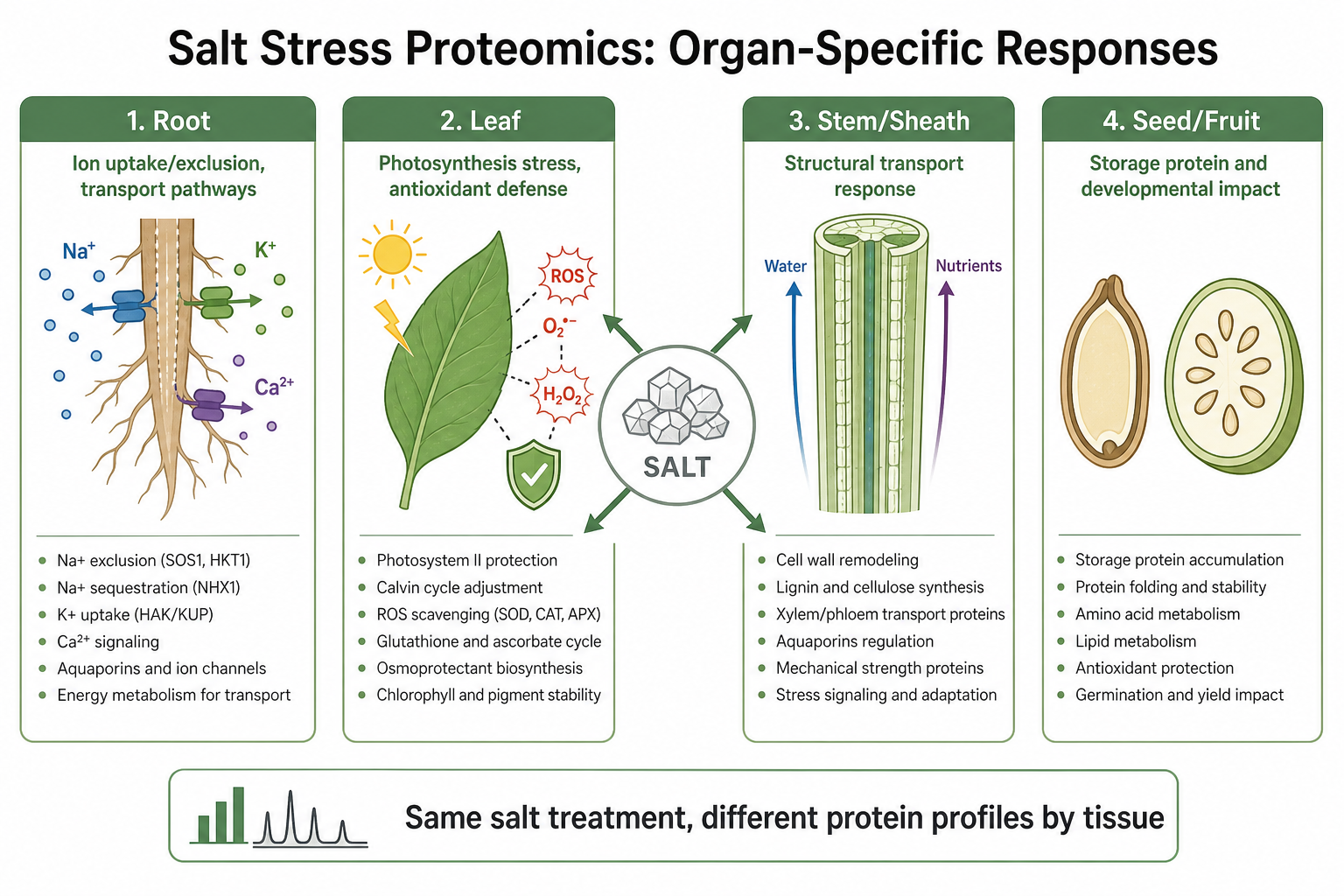
Figure 1. Leaf, root, stem, and seed proteomics under salt stress answer different biological questions and should not be merged without design intent.
Match Salt Conditions Across Compared Groups
The cleanest salt proteomics design applies the same salinity protocol to every compared group and records phenotype status at harvest.
Match non-salt factors whenever possible:
-
Genotype background, age, and developmental stage
-
Pot size, medium, and pre-stress watering history
-
Light cycle, temperature, and growth environment
-
Sampled organ and tissue position
-
Time of day at harvest
Avoid letting sensitive lines experience longer effective exposure because they show injury earlier. Harvest can be defined by a fixed treatment duration or by a predefined physiological threshold, depending on the biological question. These designs answer different questions and should not be interpreted interchangeably.
For multi-organ studies, treat each organ as its own comparison with matched salt and control arms rather than comparing leaf from treated plants with root from controls. Parallel organ sampling from the same replicate set is valid when the question explicitly compares organ responses under one protocol.
From Protein Changes to Tolerance Pathway Themes
After LC-MS/MS and quantitative comparison, interpret proteins in the context of the organ sampled and the salt stage harvested.
Prioritize proteins with:
-
Direction consistency across biological replicates within that organ
-
Clear linkage to salt phenotype notes collected at harvest
-
Pathway relevance to ion homeostasis, osmotic adjustment, antioxidant defense, photosynthesis, transport, or cell-wall remodeling
-
Stable detection across most samples in the group
Use GO, KEGG, PPI, and Reactome views to organize candidates when the species is supported. A transport or antioxidant pathway theme in root tissue may support hypotheses about exclusion or root-zone acclimation. A photosynthesis-related theme in leaf tissue may fit canopy injury interpretation. Neither enrichment result proves tolerance mechanism by itself.
Cross-check the differential list against organ and phenotype records:
-
Proteins that track lower injury scores or better growth under the same salt dose are stronger leads for breeding follow-up in that tissue context
-
Proteins appearing mainly in collapsed tissue may reflect damage rather than adaptive tolerance
-
Proteins significant in only one outlier replicate should not drive the main story
Pathway labels should stay organ-aware. A root-enriched transport theme should not be rewritten as a leaf tolerance claim without evidence from leaf data.
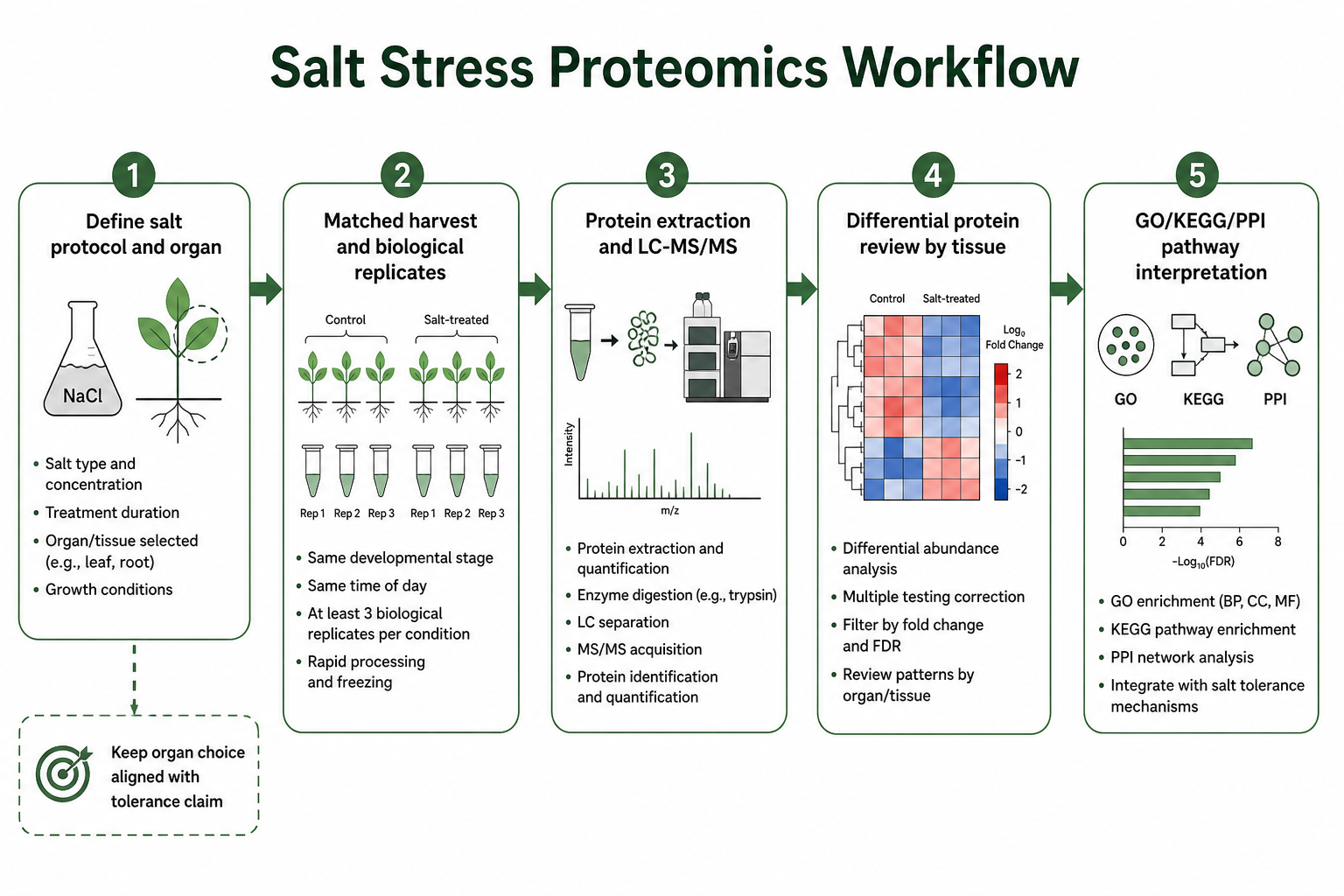
Figure 2. Define salt protocol and organ choice first, then link differential proteins to organ-appropriate tolerance pathway themes.
When moving from protein lists to pathway language, review each step against the organ that was actually sampled. Replicate consistency, phenotype notes, and annotation support should be checked before tolerance wording is applied to any candidate.
| Interpretation step | What to review | Why tissue context matters |
| Replicate consistency | Direction and detection across biological replicates | Organ-specific responses can be stable in root but absent in leaf |
| Phenotype linkage | Salt score, growth reduction, or survival note at harvest | Same protein change may mean acclimation in one organ and damage in another |
| Pathway grouping | GO, KEGG, PPI, Reactome views when supported | Transport themes may dominate root lists, while photosynthesis themes may be more prominent in leaf |
| Claim wording | Candidate protein versus tolerance marker | Tolerance language requires matched organ, protocol, and follow-up |
Treat pathway enrichment as a prioritization tool for the sampled organ, not as final proof of whole-plant salt tolerance.
Analytical Choices After the Organ and Contrast Are Fixed
Once tissue, salt protocol, and group design are stable, choose the workflow from the comparison goal.
Protein identification alone fits early screening when the need is to see whether a new organ or genotype yields usable salt-response profiles. Quantitative comparison is required when the project depends on abundance differences between salt and control groups or between tolerant and sensitive lines.
After the organ, salt contrast, and sampling design are fixed, the quantitative proteomics workflow and appropriate mass spectrometry strategy can be selected according to the comparison goal, sample characteristics, and required data depth.
A practical salt proteomics path is:
-
Quantitative comparison in one organ under a defined salt-versus-control or tolerant-versus-sensitive design
-
Optional parallel organ sampling from the same replicate set when multi-organ biology is an explicit goal
-
Follow-up with metabolomics, phosphoproteomics, or expanded genotype panels after organ-specific candidates are prioritized
The specific analytical workflow should be selected according to the project objective and sample characteristics rather than applying one acquisition strategy to every salt-stress study.
Common Mistakes in Salt Stress Plant Proteomics
-
Sampling leaf for a root uptake question, or root for a canopy injury question
-
Mixing organs or developmental stages inside one salt group
-
Comparing genotypes at different effective salt severity because sensitive lines injure earlier
-
Treating every differential protein as a salt tolerance marker without organ and replicate review
-
Reading pathway enrichment from one organ as proof of whole-plant tolerance
-
Scaling to many time points or organs before the salt protocol and phenotype rule are stable
-
Treating multiple plants from the same experimental unit as independent biological replicates
-
Interpreting salt-treated tolerant-versus-sensitive differences as salt-specific responses without considering baseline genotype differences
A Practical Planning Checklist
-
Write the salt contrast and organ choice in one sentence.
-
Define NaCl dose, exposure duration, and harvest window.
-
Choose whether the main claim is treatment effect, genotype contrast, or multi-organ comparison.
-
Match pots, medium, watering history, and environment across groups.
-
Define independent experimental units before assigning biological replicates.
-
Record salt phenotype notes for every replicate at harvest.
-
Confirm tissue-specific sample requirements before collection and keep handling matched across salt and control arms.
-
Choose quantitative comparison when abundance differences drive the tolerance or mechanism question.
When the design is ready, species, salt protocol, organ type, group plan, and harvest strategy can be reviewed together before sample collection.
Related Services
Plant Phosphoproteomics Analysis Service
Frequently Asked Questions
1. Why does tissue choice matter so much in salt stress plant proteomics?
Roots, leaves, stems, and seeds experience different ion loads and physiological roles under salinity. Proteomics reflects the biology of the organ sampled, so the same salt treatment can produce different protein and pathway patterns in each tissue.
2. Can leaf and root samples be combined into one salt proteomics group?
Not when the goal is a single treatment-versus-control contrast. Multi-organ questions need parallel organ sampling with separate comparisons or an explicit integrative design.
3. What pathway themes commonly appear in salt proteomics results?
Interpretation often involves ion transport, osmotic adjustment, antioxidant defense, photosynthesis-related remodeling, cell-wall changes, and stress signaling, but the dominant themes depend on the organ and harvest stage sampled.
4. Do differential proteins prove a salt tolerance gene or marker?
No. They are organ-specific candidate proteins until phenotype linkage, replicate consistency, and follow-up validation support stronger claims.
5. How much tissue is needed for salt stress proteomics?
Sample requirements depend on tissue type, protein content, and the planned analytical workflow. Confirm the required amount before collection, especially for limited or specialized plant tissues.
6. What should be shared before starting a salt proteomics project?
Share species, salt protocol, organ choice, group design, harvest timing, phenotype scoring rule, and planned replicate number. For genotype comparisons, also clarify whether matched unstressed controls are included.
Conclusion
Plant proteomics for salt stress supports interpretation of protein changes and tolerance pathway themes when salinity dose, harvest timing, and sampled organ are matched to the biological question. Leaf, root, stem, and seed each tell a different part of the salt story, and results are most useful when organ choice, replicate behavior, and pathway wording stay aligned.
To plan salt stress proteomics with the right tissue focus, contact MtoZ Biolabs with the species, salt protocol, organ type, and comparison the study must support.
How to order?




