






PhIP-Seq for Autoantibody Profiling
Introduction
Autoantibody profiling often starts with a short list of known antigens and expands slowly as new targets are validated one assay at a time. A rheumatology program may need to scan citrullinated peptide reactivity across many patient sera. A neurology cohort may need to compare CSF and blood reactivity without committing to dozens of separate ELISA plates. A translational team may need quantitative enrichment data across case and control groups rather than single positive or negative calls from predefined panels.
PhIP-Seq (phage immunoprecipitation sequencing) supports autoantibody profiling by combining phage-displayed peptide libraries, antibody immunoprecipitation, and next-generation sequencing. Serum, plasma, or CSF antibodies bind displayed peptides, captured phage are sequenced, and read counts reveal which peptide targets are enriched relative to input library representation and background controls. The output is a parallel serological profile across the peptide library rather than a one-antigen-at-a-time result.
This article explains what PhIP-Seq autoantibody profiling involves, how the workflow operates, where it adds value in autoimmune and neuroimmunology research, and how enrichment data should be interpreted before validation begins.
What PhIP-Seq Autoantibody Profiling Involves
PhIP-Seq autoantibody profiling measures antibody reactivity against many peptide targets in pooled library format. Each phage particle displays a peptide on its surface while carrying the DNA sequence that encodes it. Autoantibodies in the sample bind displayed peptides during incubation. Immunoprecipitation captures antibody-phage complexes, and sequencing maps read counts back to peptide identity.
The result is a library-defined reactivity profile. Peptides enriched above input and control thresholds are interpreted as candidate autoantigen regions within the peptide space represented in the library. The method reports peptide-level enrichment, not direct confirmation that a full-length protein is the in vivo autoantigen until orthogonal validation is performed.
PhIP-Seq is therefore a discovery and profiling platform at peptide scale. It supports broad screening, quantitative comparison across samples, and candidate generation for follow-up array, ELISA, or protein-level assays.
Core Workflow Steps
A standard PhIP-Seq autoantibody profiling workflow follows a linked sequence of steps.
Sample intake defines whether serum, plasma, or CSF is used and whether case-control, longitudinal, or paired-matrix design is required. Library incubation mixes sample antibodies with a phage display peptide library under conditions matched to the profiling goal. Immunoprecipitation captures antibody-bound phage using protein A/G beads or an equivalent strategy with defined wash stringency. Sequencing quantifies peptide-encoding DNA in captured and input libraries. Enrichment analysis compares read counts across samples, applies normalization against library representation, and ranks candidate peptides relative to controls.
Expert review remains important because enrichment alone does not distinguish disease-specific autoantibody biology from background binding, clone abundance effects, or matrix-specific artifacts without appropriate controls.
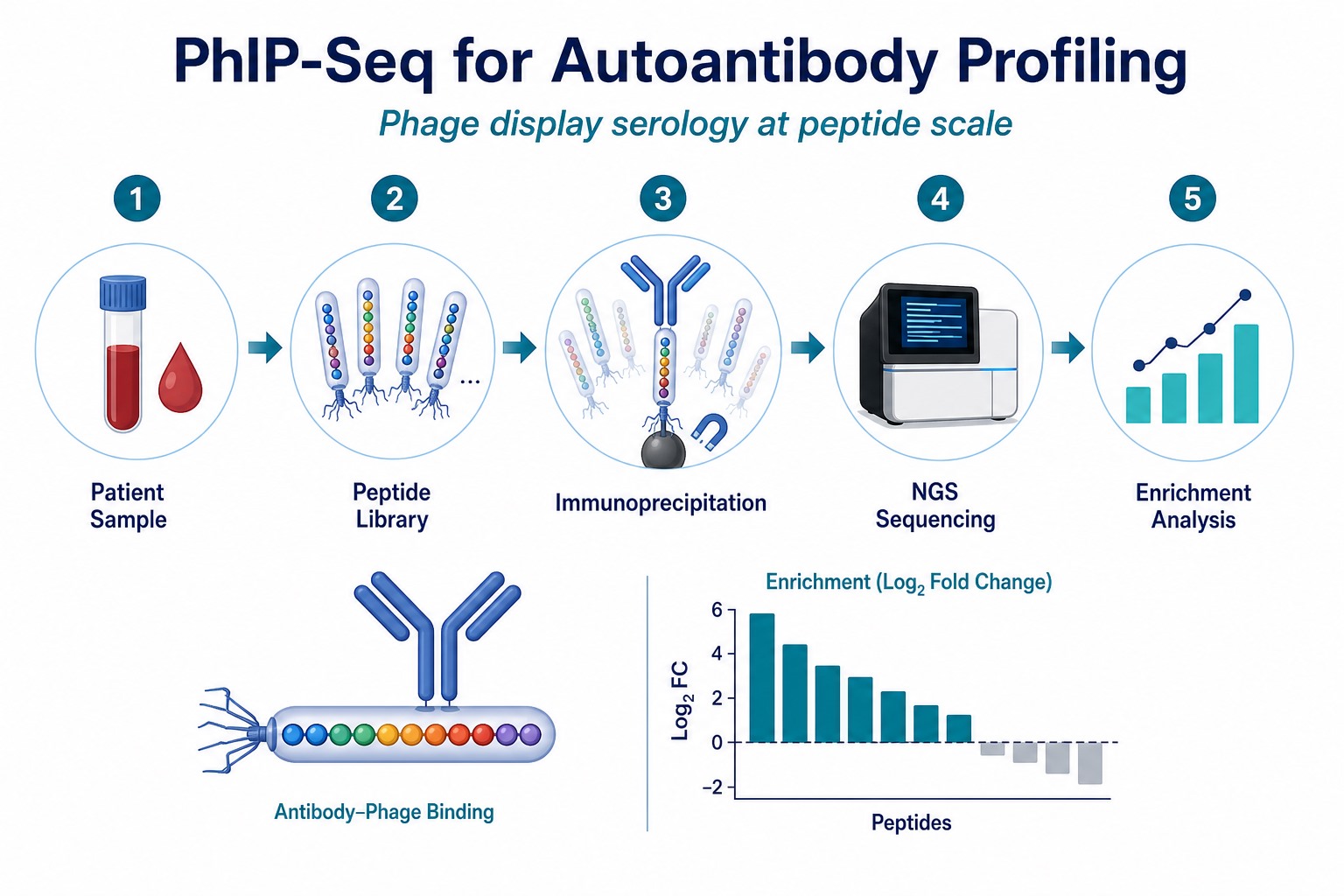
Figure 1. PhIP-Seq autoantibody profiling links sample antibodies to peptide library enrichment and ranked candidate peptide output.
Why PhIP-Seq Is Used for Autoantibody Profiling
PhIP-Seq is chosen when breadth, quantitation, and parallel comparison matter more than testing one predefined antigen at a time.
The method can screen many peptide targets in one experiment rather than running separate immunoassays for each candidate antigen. Sequencing read counts support normalization and comparison across case and control groups, time points, or treatment arms. Tiled libraries can localize reactivity to protein regions before protein-level follow-up. Modified peptide libraries can test PTM variant reactivity when citrullinated, phosphorylated, or other defined forms are encoded in the library. Discovery programs can convert large enrichment lists into tiered candidate sets for validation rather than stopping at single-target screening.
PhIP-Seq does not replace clinical diagnostic reporting by itself. It generates candidate peptide evidence that requires filtering, biological review, and orthogonal confirmation for translational use.
Library Types Relevant to Autoantibody Profiling
Autoantibody profiling outcomes depend strongly on library design.
Proteome-wide or tiled peptide libraries map reactivity across many proteins and are used for unbiased discovery. Focused disease libraries concentrate on antigens or pathways relevant to a specific condition. Modified peptide libraries include PTM variant clones paired with unmodified controls for neo-epitope screening. Custom libraries can target known autoantigen regions when the project goal is refinement rather than open discovery.
Library choice should be fixed before samples are run because the library defines what reactivity can be detected at all.
Related Services
PhIP-Seq Antibody Analysis Service
Identification of Peptide Biomarkers Service
Antibody Epitope Mapping Analysis Service
Peptide Array-Based Epitope Mapping Service
Researchers planning autoantibody profiling can consult MtoZ Biolabs to review library scope, sample matrix requirements, and the analysis workflow best matched to the cohort design.
Sample Matrix and Study Design Considerations
PhIP-Seq can profile serum, plasma, or CSF, but matrix choice affects input amount, background, and interpretation.
Serum and plasma provide higher immunoglobulin abundance and are common in large autoimmune cohort screens. CSF supports CNS-focused questions but requires matrix-specific thresholds because total IgG is lower and sample volume is limited. Case-control design strengthens specificity when matched controls are included. Longitudinal sampling supports treatment or progression studies when the same library framework is applied across time points. Paired blood and CSF samples can help separate systemic from compartment-associated reactivity when both are available.
Study design should be defined before enrichment thresholds are applied so matrix and cohort logic remain consistent across the project.
Data Outputs and Interpretation
A useful PhIP-Seq autoantibody profiling report should contain more than raw read tables.
Typical outputs include an enriched peptide list with fold change and control contrast metrics. Protein or tiled-region mapping links peptides to source proteins when annotation supports coordinate assignment. Modified versus unmodified comparison summaries appear when PTM variant libraries are used. A tiered candidate list separates high-priority peptides for validation from exploratory hits. Method and control summaries document bead-only, no-antibody, and healthy donor background handling.
Interpretation should treat enrichment as discovery-stage evidence. Peptide reactivity supports candidate generation, not confirmed autoantigen status, until orthogonal assays and independent cohort testing are complete.
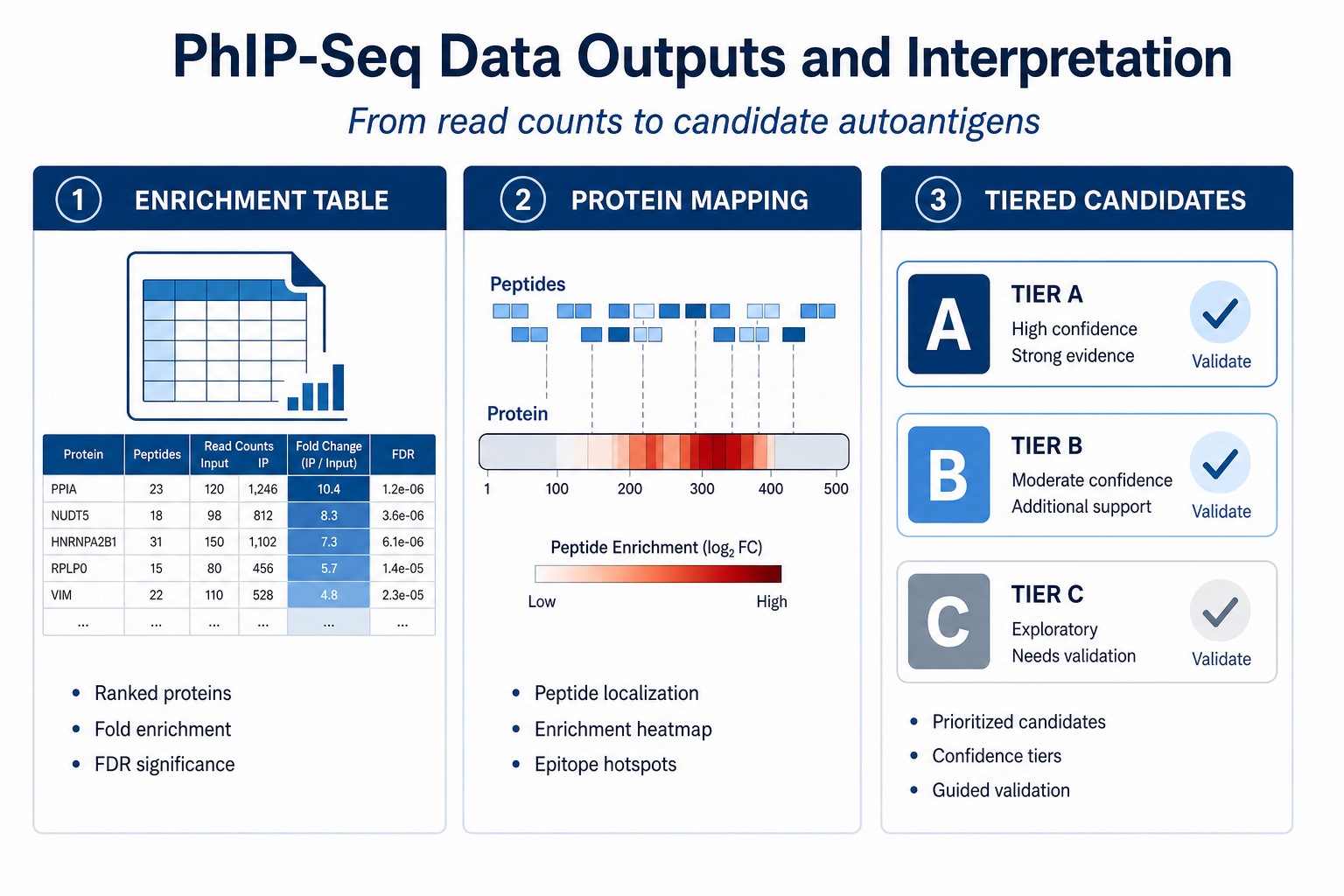
Figure 2. PhIP-Seq autoantibody profiling outputs move from enrichment tables and protein mapping to tiered candidate lists for validation planning.
Workflow Selection by Study Goal
Different autoantibody profiling goals favor different PhIP-Seq emphasis.
|
Study Goal |
Preferred Library Emphasis |
Typical Deliverable |
|---|---|---|
|
Unbiased autoantigen discovery |
Proteome-wide or tiled library |
Ranked enriched peptide list |
|
Modified neo-epitope screening |
PTM variant library with paired controls |
Modified peptide enrichment profile |
|
Neurology or CSF profiling |
Matrix-adjusted tiled or focused library |
CSF-specific candidate set |
|
Treatment or progression monitoring |
Same library across longitudinal samples |
Time-point comparison table |
|
Validation preparation |
Shortlist from prior discovery run |
Tier A peptide set for array or ELISA |
Library and matrix choices should align with the decision the profiling data must support.
Core Technical Advantages and Current Limitations
Core Technical Advantages
Parallel peptide-level serology at scale.
Many peptide targets can be profiled in one workflow instead of repeated single-antigen assays.
Quantitative enrichment for group comparison.
Read counts support case-control, longitudinal, and cohort ranking when controls are well designed.
Regional mapping through tiled libraries.
Reactivity can be localized to protein domains or sequence windows before protein validation.
PTM variant testing when libraries include modified peptides.
Modified and unmodified clone pairs support defined neo-epitope screening.
Efficient candidate generation for follow-up assays.
Enriched peptides provide a structured input for array, ELISA, or mass spectrometry-supported confirmation.
Current Limitations
Library-defined detection boundary.
Only peptides represented in the library can generate signal.
Linear display bias.
Standard peptide display does not fully reconstruct all conformational or glycan-dependent epitopes.
Enrichment is not autoantigen confirmation.
Peptide binding under library conditions must be validated independently.
Background and matrix sensitivity.
Nonspecific binding, hemolysis, and blood contamination in CSF can distort profiles if QC is weak.
Modified epitope coverage depends on library design.
Untargeted PTM discovery is not inherent to standard peptide libraries.
Applications in Autoimmune and Serology Research
PhIP-Seq autoantibody profiling supports several research applications.
Autoimmune discovery compares enrichment across patient and control sera to identify candidate antigen regions. Modified epitope programs screen citrullinated, phosphorylated, or other PTM peptide sets in diseases where neo-epitopes are hypothesized. Neurology and neuroimmunology studies profile CSF or paired blood and CSF samples for compartment-relevant reactivity. Longitudinal monitoring tracks peptide enrichment before and after treatment or during disease progression. Validation pipelines convert discovery hits into peptide array, ELISA, or protein-level confirmation workflows.
Application fit still depends on cohort design, library composition, and whether conformational or modified autoantigen hypotheses are encoded before screening begins.
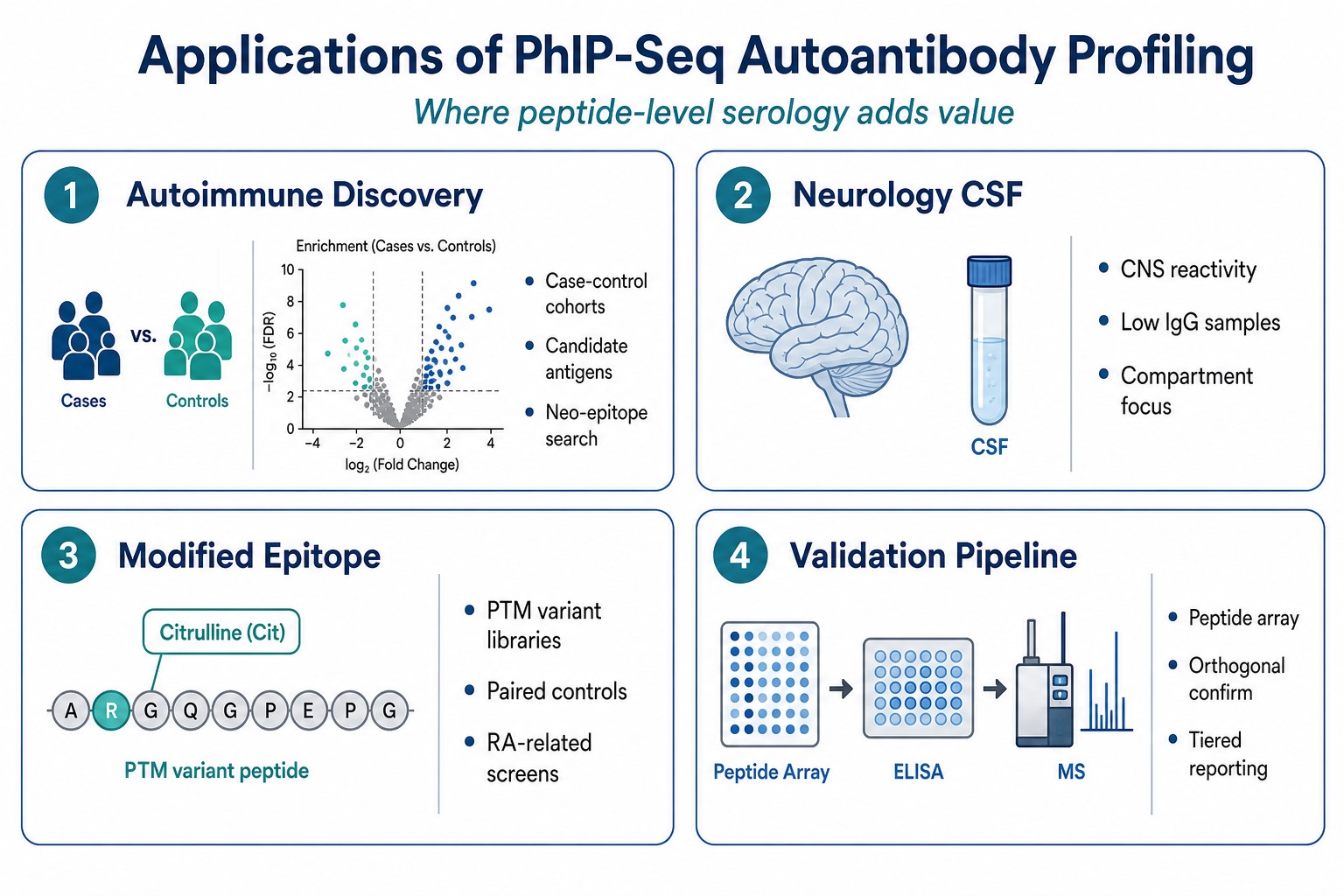
Figure 3. PhIP-Seq autoantibody profiling supports autoimmune discovery, modified epitope screening, neurology-focused profiling, and tiered validation planning.
Expected Deliverables and Validation Path
A complete autoantibody profiling project usually moves from discovery enrichment to phased validation.
Phase 1 deliverables include filtered enrichment tables, mapping summaries, and a tiered candidate list. Phase 2 validation may use peptide array confirmation, ELISA with synthesized peptides, recombinant domain binding, or PTM-specific follow-up when modified hits are involved. Independent cohort testing should support Tier A candidates before they are reported as confirmed autoantigen-associated reactivity.
Reporting should clearly separate confirmed, provisional, and exploratory peptide targets.
Frequently Asked Questions
1. What is PhIP-Seq autoantibody profiling?
It is a phage display and sequencing workflow that profiles antibody reactivity against many peptides in pooled library format and reports enrichment relative to input and control samples.
2. Which sample types can be profiled?
Serum, plasma, and CSF can be used. Matrix choice affects input amount, background, and interpretation thresholds.
3. Does PhIP-Seq replace ELISA or peptide arrays?
No. PhIP-Seq supports broad discovery and profiling. ELISA and arrays are often used to validate shortlisted peptides from enrichment output.
4. Can PhIP-Seq detect modified autoantigens?
Yes, when modified peptide variants are included in the library and compared against appropriate unmodified controls.
5. How should enriched peptides be prioritized?
Use filtering, case-control contrast, replicate support, biological mapping, and tiered validation planning rather than fold change alone.
Conclusion
PhIP-Seq supports autoantibody profiling by converting serum, plasma, or CSF samples into quantitative peptide-level enrichment profiles across large libraries. The method is strong for parallel discovery, cohort comparison, regional mapping, and modified epitope screening when library design and controls match the study question. Enrichment output remains discovery-stage evidence until candidates are filtered, reviewed, and validated by orthogonal assays.
Programs that define library scope, sample matrix, and reporting tiers before screening obtain more actionable profiling data and move more efficiently into validation. Researchers planning PhIP-Seq for autoantibody profiling can contact MtoZ Biolabs to review cohort design, library options, and the analysis workflow suited to their project. For teams advancing from enrichment lists to confirmed epitope or PTM evidence, MtoZ Biolabs can also help connect profiling output with epitope mapping and validation follow-up.
How to order?




