






Peptide Sequencing: Techniques and Applications
Introduction
Researchers often need to determine the amino acid sequence of a peptide when no reliable reference database entry exists. A synthetic peptide may arrive without complete documentation. A purified peptide fraction from a proteomics experiment may contain an unknown sequence. A biopharmaceutical impurity peak may require residue-level identification before the source can be traced. In each case, the practical question is not only what mass the peptide carries, but what sequence it encodes.
Peptide sequencing addresses that need by reading amino acid order directly from analytical evidence. LC-MS/MS can assign sequences through database searching or de novo interpretation of fragment ions. Edman degradation can read N-terminal residues cycle by cycle for suitable peptide formats. Nano LC-MS/MS improves sensitivity for low-abundance or complex mixtures. For proteomics, biopharmaceutical analysis, and synthetic peptide verification, this workflow provides primary structure evidence that complements intact mass measurement and chromatographic profiling alone.
Peptide sequencing is not interchangeable with full protein sequencing or routine peptide mapping against a known biologic reference. It is a focused workflow for peptide-level identity. Understanding the available techniques, sample constraints, and reporting limits helps teams choose the route that matches the sample type and the decision the sequence must support.
What Peptide Sequencing Means in Analytical Workflows
In analytical workflows, this approach answers a direct question: what is the amino acid sequence of this peptide?
Intact mass analysis reports molecular weight but cannot define residue order when the sequence is unknown. Peptide mapping matches digested fragments to an expected protein sequence and is most efficient when a reference is already available. Sequence determination is used when the amino acid order itself must be recovered or independently confirmed from the measured peptide.
The recovered information may include full or partial peptide sequence, N-terminal sequence from Edman cycles, confidence scores for individual residue assignments, modification sites when present, and supporting spectral evidence such as MS/MS fragment ladders or chromatographic trace files. Project scope should define whether complete sequence coverage, N-terminal confirmation, or identification within a complex mixture is required.
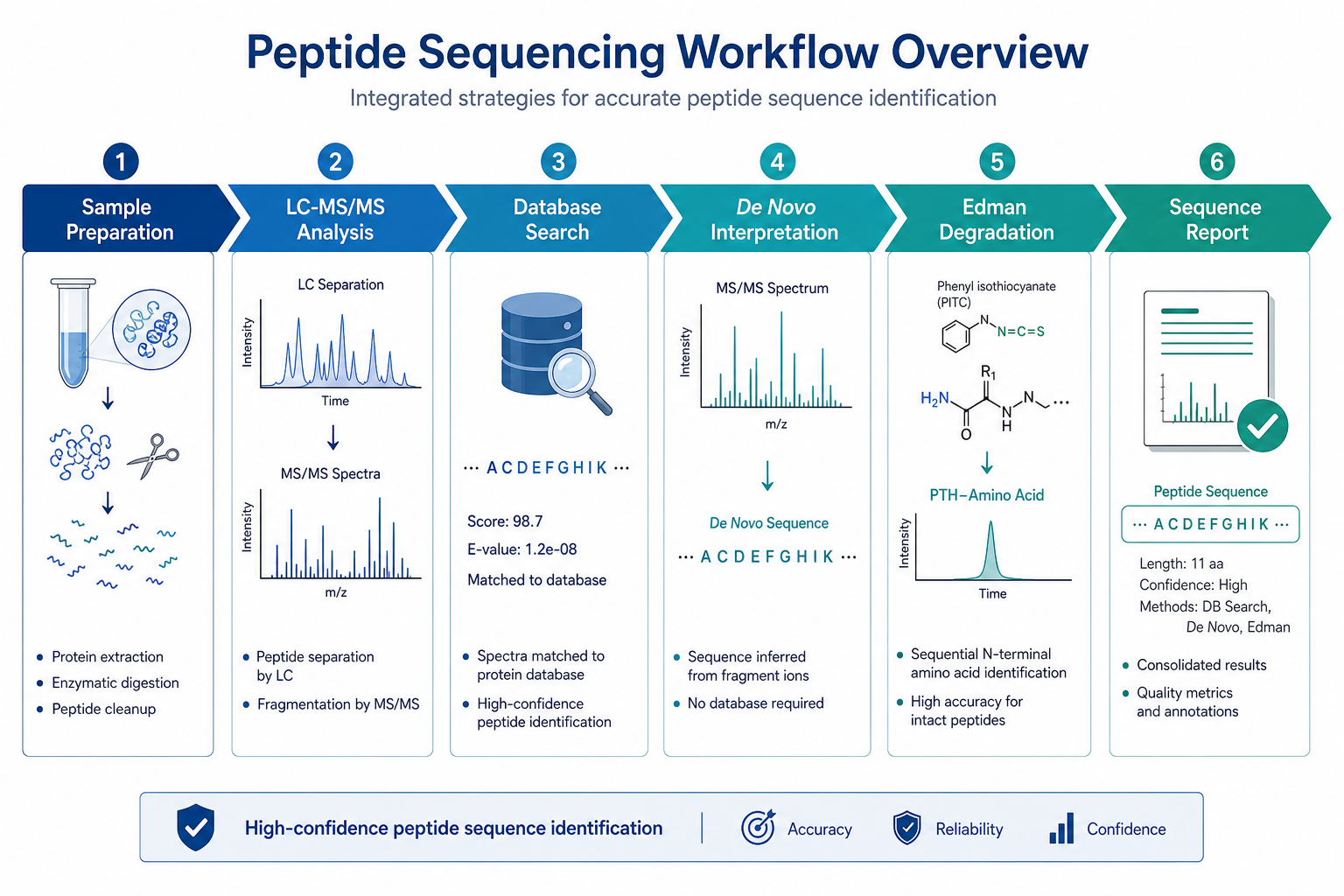
Figure 1. Peptide sequencing workflows combine LC-MS/MS and Edman-based routes to determine amino acid order from purified or chromatographically resolved peptide samples.
Core Principles of Peptide Sequencing
These methods rely on different evidence types depending on whether a searchable database exists and whether the peptide can be analyzed as an intact short sequence or as an LC-MS/MS fragment ladder.
LC-MS/MS database search
When a relevant protein database is available, peptide MS/MS spectra can be matched to in silico fragment predictions. This route is efficient for proteome-derived peptides where the parent protein is likely represented in the search database. Confidence depends on spectral quality, mass accuracy, enzyme specificity, and database completeness. Modified residues, rare sequence variants, or peptides from organisms with incomplete databases may remain ambiguous after searching alone.
De novo peptide sequencing
De novo peptide sequencing interprets MS/MS fragment ion patterns without relying on a prior sequence entry. B-type and Y-type ions support residue-by-residue inference from the fragmentation spectrum. This route is valuable for novel peptides, synthetic sequence verification, and proteins from poorly annotated sources. Success depends on spectrum quality, peptide length, presence of labile modifications, and signal-to-noise across the fragment ladder. Manual or expert-assisted review is often required when automated de novo confidence is borderline.
Edman degradation sequencing
Edman degradation removes and identifies one N-terminal amino acid per cycle. It remains useful for short peptides, blocked-terminus checks, and workflows where stepwise N-terminal readout is preferred over MS/MS interpretation. Sample purity is critical because mixed sequences produce overlapping cycle signals. C-terminal sequence, internal segments, and some modified termini are not resolved by Edman chemistry alone.
Nano LC-MS/MS for low-abundance peptides
Nano LC-MS/MS improves peptide detection when sample amount is limited or when the target peptide is one component among many in a digest or fraction. Higher sensitivity can make the difference between a usable MS/MS spectrum and no assignable fragments, but matrix complexity still increases the risk of chimeric spectra or co-eluting interferences.
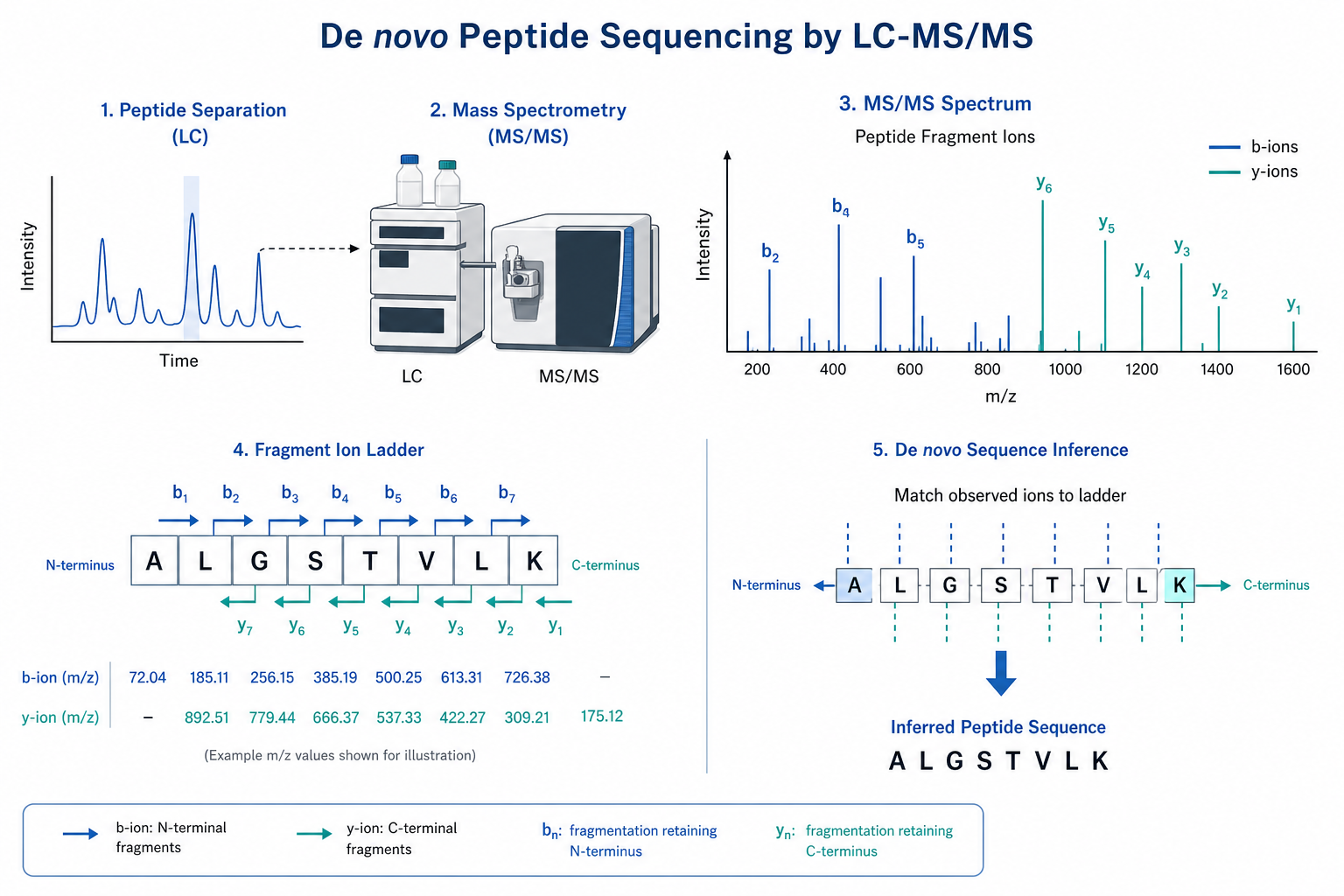
Figure 2. De novo peptide sequencing uses MS/MS fragment ladders to infer residue order when database searching cannot assign the peptide with sufficient confidence.
Standard Peptide Sequencing Workflow
A robust sequencing project follows a defined sequence of steps from feasibility review through report delivery.
Project scoping defines whether the goal is unknown sequence determination, synthetic peptide confirmation, impurity identification, or N-terminal readout. Sample feasibility review assesses purity, peptide length, estimated amount, buffer composition, and whether the peptide is free or part of a mixture. Sample preparation may include desalting, fractionation, enzymatic digestion, or chromatographic isolation before analysis. LC-MS/MS acquisition generates precursor and fragment ion data under conditions suited to peptide length and modification state. Sequence interpretation applies database searching, de novo analysis, or both, followed by expert review of residue confidence. Edman sequencing, when included, proceeds on purified material with cycle-by-cycle amino acid identification. Report delivery documents the assigned sequence, supporting spectra or chromatograms, ambiguous regions, and recommended follow-up when coverage is partial.
Sample type strongly affects the first viable route. Synthetic peptides with high purity are often suitable for direct LC-MS/MS or Edman analysis. Complex biological digests may require fractionation before reliable sequencing. Low-input samples may depend on nano LC-MS/MS and careful matrix reduction.
Related Services
When a project moves from intact mass screening to peptide-level sequence confirmation, peptide sequencing is often paired with adjacent primary structure services. Relevant options include:
De Novo Peptide Sequencing Service
Peptide Sequencing Service by Mass Spectrometry
Edman Degradation-Based Peptide Sequencing Service
Primary Structure Analysis Service
Researchers planning peptide sequencing can consult MtoZ Biolabs to review sample purity, peptide length, and the reporting format required before samples are submitted.
Sample and Input Considerations
Sample quality often determines whether sequence assignment succeeds on the first attempt. Common starting materials include:
- Synthetic peptide. High-purity material supports direct LC-MS/MS or Edman sequencing; salt additives may suppress ionization.
- Purified peptide fraction. Single-component peptides are preferred; co-eluting contaminants can distort MS/MS interpretation.
- Proteolytic digest. Requires database search or de novo analysis with attention to missed cleavages and chimeric spectra.
- Biopharmaceutical impurity peptide. Low abundance may require enrichment or nano LC-MS/MS before usable fragment data are obtained.
- N-terminally blocked peptide. Edman chemistry may fail unless blocking group and sample history are reviewed during feasibility assessment.
- Modified peptide. Labile modifications can shift fragment patterns and reduce automated assignment confidence.
These considerations support planning but do not replace sample-specific feasibility review before analysis begins.
Technique and Platform Comparison
Sequencing projects may use different analytical routes depending on sample purity, database availability, and reporting needs.
|
Technique |
Typical Use |
Main Technical Strength |
Main Technical Limitation |
|---|---|---|---|
|
LC-MS/MS database search |
Proteome-derived peptides with searchable parent proteins |
Fast assignment when database coverage is strong |
Weak for novel or poorly annotated sequences |
|
De novo peptide sequencing |
Unknown peptides, synthetic verification, novel proteins |
Sequence inference without prior database entry |
Requires high-quality spectra and expert review |
|
Edman degradation |
Short peptides and N-terminal confirmation |
Direct stepwise N-terminal readout |
Mixed samples and blocked termini reduce success |
|
Nano LC-MS/MS |
Low-abundance or limited-input peptides |
Improved sensitivity for trace components |
Complex matrices increase interference risk |
|
Combined MS plus Edman |
Borderline MS/MS assignments |
Orthogonal confirmation of N-terminal residues |
Higher sample consumption and handling steps |
Core Technical Advantages and Current Limitations
Core Technical Advantages
Residue-level identity for unknown peptides.
Sequence analysis provides direct amino acid order evidence when a reference sequence is absent or unverified.
Flexible route selection.
Database search, de novo MS/MS, Edman degradation, and nano LC-MS/MS can be matched to sample type and confidence needs.
Support for synthetic and impurity verification.
Sequence confirmation helps validate custom peptides and identify unexpected biopharmaceutical-related fragments.
Spectral evidence for documentation.
MS/MS spectra, search scores, and Edman cycle data support internal QC and publication needs when reporting scope is defined appropriately.
Current Limitations
Spectral quality sets the ceiling.
Low signal, chimeric MS/MS spectra, or poor fragmentation can leave sequence regions unresolved.
Mixtures reduce assignment confidence.
Co-purified peptides or incomplete chromatographic separation can produce ambiguous composite results.
Modified peptides complicate interpretation.
Mass shifts and labile PTMs may prevent confident automated assignment without manual review.
Not a substitute for full protein sequencing.
This approach defines short sequence segments and may not recover complete protein coverage without additional workflows.
The workflow is valuable when the reporting goal, sample preparation route, and interpretation standard are matched to the intended use.
Applications in Proteomics and Biopharmaceutical Analysis
These techniques support multiple analytical scenarios across discovery research, synthetic peptide QC, and biopharmaceutical investigation. Teams may need sequence confirmation for a custom peptide order, identification of an unknown gel band, or characterization of a process-related impurity before root-cause analysis can proceed.
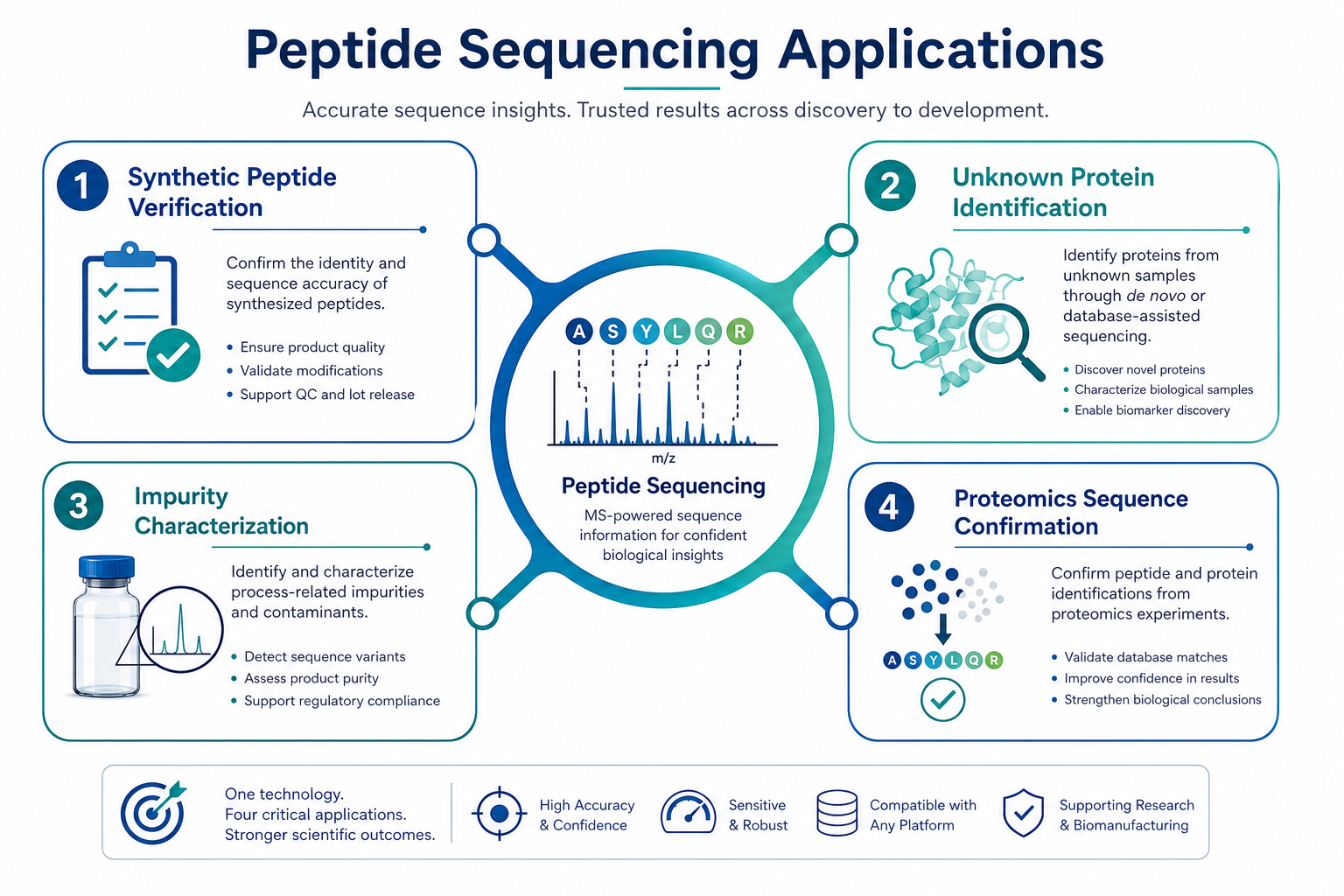
Figure 3. Peptide sequencing supports synthetic peptide QC, unknown sequence identification, impurity characterization, and proteomics confirmation workflows.
The table below links common application scenarios to typical sequencing outputs and complementary evidence that may still be required.
|
Application Scenario |
What Peptide Sequencing Provides |
Complementary Evidence Often Still Needed |
|---|---|---|
|
Synthetic peptide lot release |
Confirmed sequence against the ordered peptide |
Purity profiling and impurity assessment |
|
Unknown gel or band identification |
Peptide sequences pointing to protein candidates |
Full protein coverage or orthogonal proteomics |
|
Biopharmaceutical impurity tracing |
Sequence of a peptide-related impurity |
Source protein mapping and process review |
|
Novel peptide discovery |
De novo sequence from MS/MS data |
Replicate analysis and biological validation |
|
N-terminal confirmation |
Stepwise Edman readout for short peptides |
Intact mass and modification review |
|
Database-limited organism studies |
Sequence tags when genomic annotation is incomplete |
Additional peptides or transcript support |
These applications show why sequence determination is often used as a targeted identity step rather than a standalone proteomics endpoint. Sequence assignment defines molecular identity at the peptide level. Broader protein context, functional relevance, and regulatory documentation may still require additional assays.
Expected Deliverables and Validation
A useful sequencing report should include more than a single sequence string. Common deliverables include:
- assigned peptide sequence with confidence notes
- MS/MS spectra or peak lists supporting residue assignments
- database search results or de novo scoring summary when applicable
- Edman cycle data for N-terminal sequencing projects
- modification annotations when present
- QC comments on ambiguous residues, incomplete coverage, or sample limitations
Validation should match the intended use. A synthetic peptide QC report may require exact sequence agreement with the purchase order. A discovery project may accept partial sequence tags when the goal is protein candidate nomination. Useful validation steps may include replicate LC-MS/MS analysis, alternative digestion or fractionation, independent Edman confirmation for uncertain N-termini, and comparison with intact mass or retention time when additional orthogonality is needed.
Researchers should treat low-confidence residue calls cautiously, especially when the sequence will be used for regulatory documentation, peptide resynthesis, or mechanistic claims about impurity origin.
Future Outlook
Peptide sequencing continues to benefit from higher-resolution LC-MS/MS platforms, improved de novo algorithms, and more integrated workflows that combine fractionation, spectral acquisition, and expert review. Laboratories are increasingly applying these methods for unknown identification, routine synthetic peptide verification, and impurity characterization in biopharmaceutical development. Expert interpretation remains important because peptide spectra are sensitive to modifications, matrix effects, and sample-specific preparation constraints.
For many teams, outsourcing peptide sequencing provides access to feasibility review, optimized LC-MS/MS or Edman workflows, and reporting formats suited to QC, publication, or process investigation without building every capability internally.
Frequently Asked Questions
1. What is peptide sequencing?
Peptide sequencing is the analytical process of determining the amino acid order of a peptide using methods such as LC-MS/MS, de novo MS/MS interpretation, or Edman degradation.
2. When is de novo peptide sequencing needed?
De novo peptide sequencing is used when database searching cannot assign the peptide with sufficient confidence, such as for novel sequences, synthetic verification, or proteins from poorly annotated sources.
3. How does peptide sequencing differ from peptide mapping?
Peptide mapping matches digested peptides to a known reference protein sequence. Peptide sequencing determines or confirms the sequence of a peptide when that information is unknown or must be independently verified.
4. Can Edman degradation sequence any peptide?
Edman degradation is most suitable for short, relatively pure peptides with unblocked N-termini. Mixed samples, long peptides, and some modified termini are difficult to resolve by Edman chemistry alone.
5. What sample information is most important before peptide sequencing?
Peptide source, estimated purity, peptide length, buffer composition, known modifications, and the intended use of the sequence report are the most important inputs for selecting the right workflow.
Conclusion
Peptide sequencing provides a practical route to amino acid-level identity when intact mass or chromatographic data alone cannot define residue order. By combining LC-MS/MS database searching, de novo interpretation, Edman degradation, and nano LC-MS/MS where appropriate, the workflow supports synthetic peptide verification, unknown sequence identification, impurity characterization, and proteomics confirmation. It does not replace full protein sequencing, and spectral quality or sample complexity can limit confidence when project scope is not defined early. Reliable outcomes come from matching the technique to sample type, preparing material for the chosen route, and validating assigned sequences for the intended analytical use. Researchers planning peptide sequencing can contact MtoZ Biolabs to review sample status, project goals, and the most suitable confirmation path before sample submission.
How to order?




