






Peptide Sequencing: Methods, Applications, and Advances in Proteomics
Introduction
Modern proteomics experiments generate large numbers of peptide ions, yet many projects still stall when a critical fraction cannot be assigned confidently to a database entry. A discovery dataset may contain spectra from proteins absent in the reference proteome. A PTM-focused study may require residue-level confirmation for modified peptides near the detection limit. A metaproteomics or immunopeptidomics project may depend on sequence tags from peptides that do not map cleanly to standard search databases. In each case, the analytical bottleneck is peptide-level sequence evidence rather than instrument acquisition alone.
Peptide sequencing in proteomics refers to the set of methods used to determine or confirm amino acid order from peptide-centric data. Database-driven LC-MS/MS identification is the most common route in bottom-up proteomics, but de novo sequencing, targeted spectral matching, and Edman-based readout remain important when references are incomplete or when orthogonal confirmation is required. For protein identification, modification mapping, neoantigen discovery, and sequence validation, peptide sequencing provides the primary structure layer that links mass spectrometry signals to biological interpretation.
Peptide sequencing is not the same as reporting a full assembled proteome. It is the residue-level assignment step that supports protein inference, site localization, and downstream validation. Understanding the main methods, proteomics applications, and recent advances helps laboratories design workflows that fail less often when sample complexity, database gaps, or modification heterogeneity increase.
What Peptide Sequencing Means in Proteomics
In proteomics workflows, peptide sequencing answers a practical question: which amino acid sequence best explains the observed peptide MS/MS spectrum?
Bottom-up proteomics begins with protein digestion, LC separation, and tandem mass spectrometry. Peptide identification software then matches experimental spectra to predicted fragment patterns from reference protein sequences. When the reference is incomplete or the peptide is genuinely novel, de novo interpretation infers sequence directly from fragment ions. The output may be a high-confidence peptide-spectrum match (PSM), a partial sequence tag, a localized PTM assignment, or an Edman-confirmed N-terminal segment.
The information recovered at the peptide level supports protein grouping, pathway analysis, modification site mapping, antigen prediction, and cross-study comparison. Project design should define whether the priority is broad proteome coverage, confident identification of low-abundance peptides, modification site assignment, or sequence confirmation for a narrow set of targets.
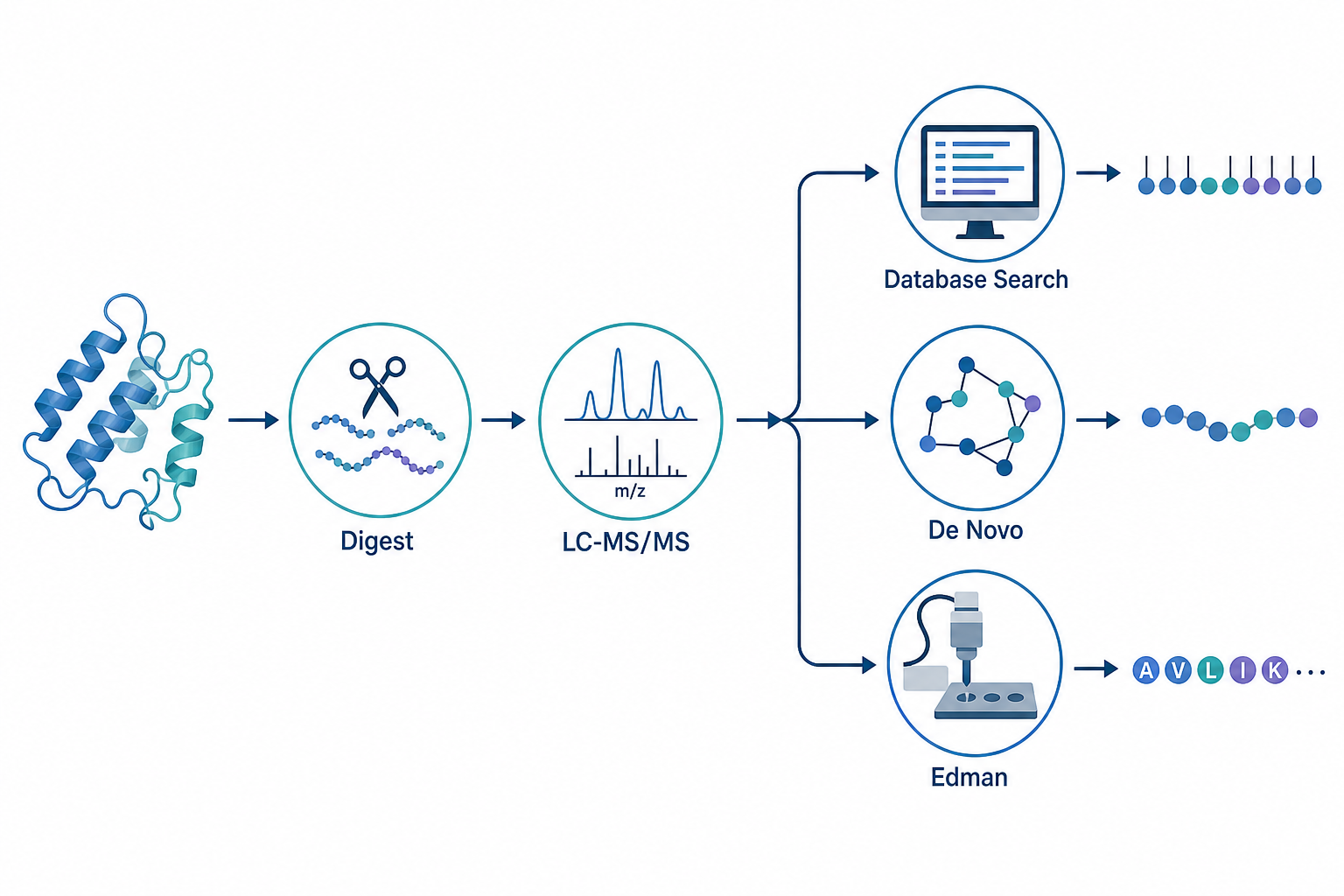
Figure 1. Peptide sequencing in proteomics combines database-driven LC-MS/MS identification with de novo and Edman routes when reference matching is insufficient.
Core Methods Used in Proteomics Peptide Sequencing
Proteomics laboratories usually combine multiple sequence assignment strategies because no single method performs equally well across all sample types and database contexts.
Database-driven LC-MS/MS identification
In standard bottom-up proteomics, acquired MS/MS spectra are searched against a protein sequence database with enzyme specificity rules and modification parameters. Search engines score peptide-spectrum matches using fragment ion agreement, precursor mass accuracy, and false discovery rate controls. This route is efficient for model organisms and well-annotated proteomes. Performance declines when databases are incomplete, when unsuspected modifications are present, or when splice variants and sequence differences are not represented.
De novo sequencing from MS/MS spectra
De novo sequencing interprets fragment ion ladders without requiring a prior database match. In proteomics, it is used for unmatched spectra, species with limited annotation, metaproteomics samples, and sequence variant discovery. Confidence depends on spectrum completeness, peptide length, isoleucine/leucine ambiguity, and the presence of labile modifications. Automated de novo results often require expert review before they are used for biological claims or follow-up targeted analysis.
Edman degradation for orthogonal confirmation
Edman chemistry provides stepwise N-terminal amino acid identification for purified peptides. In proteomics, it is less common than LC-MS/MS for large-scale studies but remains useful for confirming short peptides, resolving blocked termini, or validating uncertain N-terminal assignments from mass spectrometry data. Sample purity requirements are strict because mixed sequences produce overlapping cycle signals.
Enrichment and fractionation before sequencing
Many proteomics sequencing challenges are sample problems rather than search problems. Phosphopeptide enrichment, glycopeptide enrichment, immunoprecipitation, or prefractionation can increase the proportion of spectra with usable sequencing evidence. Low-input workflows may require nano LC-MS/MS or longer acquisition times to obtain sufficient fragment coverage for confident assignment.
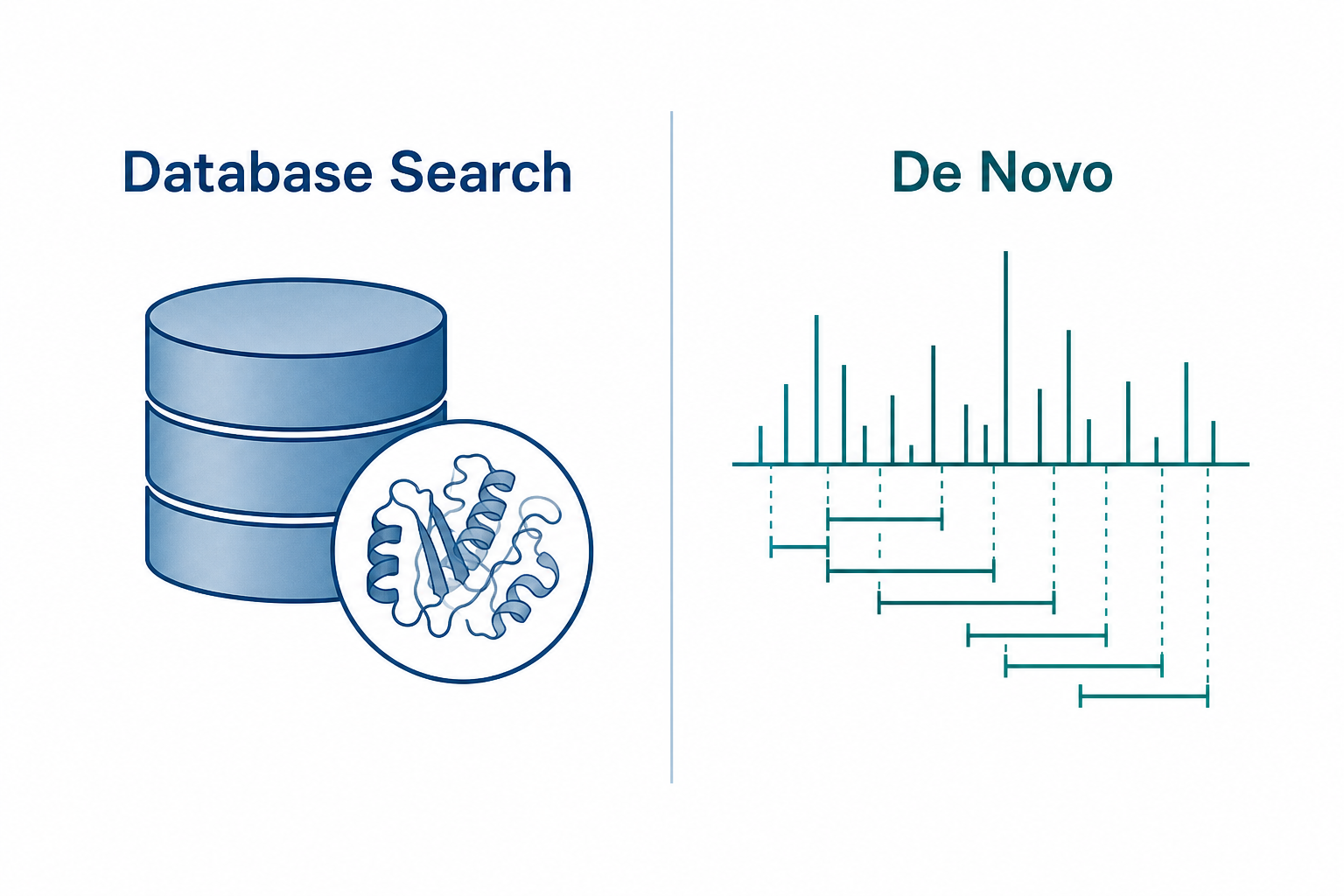
Figure 2. Proteomics peptide sequencing alternates between database search for annotated proteins and de novo interpretation for unmatched or poorly annotated spectra.
Standard Proteomics Peptide Sequencing Workflow
A robust proteomics sequencing workflow links sample preparation, acquisition, and interpretation decisions from the start.
Project scoping defines whether the study requires global protein identification, targeted PTM site mapping, unmatched spectrum characterization, or sequence confirmation for selected features. Sample preparation includes digestion strategy, enrichment when needed, and cleanup steps that support stable LC-MS/MS performance. LC-MS/MS acquisition selects gradient length, data-dependent or data-independent acquisition mode, and replicate depth suited to sample complexity. Database searching applies protein reference sets, modification parameters, and false discovery rate thresholds matched to the biological question. De novo analysis is applied to unmatched or borderline spectra when novel sequence information may be biologically relevant. Expert review validates PSM quality, modification localization, and any de novo tags before reporting. Biological interpretation connects peptide sequences to protein inference, pathway context, or antigen prediction as appropriate for the study design.
Sample matrix and database quality strongly influence the first viable route. Complex clinical or environmental samples often produce many spectra that require fractionation or advanced acquisition strategies before sequencing confidence improves.
Related Services
Proteomics teams building peptide sequencing capability often pair core identification with adjacent sequence and structure services. Relevant options include:
De Novo Peptide Sequencing Service
Peptide Sequencing Service by Mass Spectrometry
De Novo Peptide Sequencing Services
Primary Structure Analysis Service
Researchers planning proteomics peptide sequencing can consult MtoZ Biolabs to review sample complexity, database strategy, and the reporting depth required for the study goal.
Sample and Study Design Considerations
Peptide sequencing success in proteomics depends as much on study design as on search software. Common starting contexts include:
- Cell or tissue lysate digest. Broad dynamic range and high complexity may require fractionation or longer LC gradients.
- Immunopeptidomics sample. Low-abundance MHC-associated peptides may need specialized acquisition and conservative false discovery controls.
- Metaproteomics sample. Database limitations often increase reliance on de novo tags and cautious protein inference.
- PTM-enriched digest. Enrichment improves modified peptide detection but requires correct modification parameters during searching.
- Purified peptide fraction. Higher purity supports de novo sequencing or Edman confirmation with fewer ambiguous assignments.
- Cross-species or variant-focused study. Custom database construction may be required before standard searching is sufficient.
These considerations support planning but do not replace project-specific feasibility review before large-scale acquisition begins.
Method Comparison for Proteomics Use Cases
Different sequencing routes fit different proteomics questions. The table below summarizes common method choices without replacing sample-specific workflow design.
|
Method |
Typical Proteomics Use |
Main Technical Strength |
Main Technical Limitation |
|---|---|---|---|
|
Database search |
Model organism or well-annotated proteome studies |
High throughput PSM assignment |
Weak when references are incomplete |
|
De novo sequencing |
Unmatched spectra and poorly annotated systems |
Sequence inference without prior entry |
Requires strong spectra and manual review |
|
DIA spectral library matching |
Reproducible quantitative proteomics |
Consistent peptide querying across runs |
Depends on library representativeness |
|
PTM enrichment plus search |
Phosphorylation or glycosylation site mapping |
Improved modified peptide detection |
Parameter mismatch can create false assignments |
|
Edman degradation |
Short peptide confirmation |
Direct N-terminal readout |
Low throughput for complex mixtures |
Core Technical Advantages and Current Limitations
Core Technical Advantages
Direct link between spectra and biological sequence evidence.
Peptide sequencing converts MS/MS signals into interpretable amino acid sequences that support protein identification and site-level claims.
Compatibility with diverse proteomics study designs.
The same core methods can support discovery profiling, PTM mapping, immunopeptidomics, and targeted confirmation when scope is defined appropriately.
Orthogonal routes for uncertain assignments.
Database search, de novo interpretation, and Edman confirmation can be combined when a single route does not provide enough confidence.
Scalable reporting for both broad and focused studies.
Outputs can range from large PSM tables to narrow sequence confirmation packages depending on the project goal.
Current Limitations
Database dependence in many workflows.
Standard searching cannot assign peptides confidently when the relevant protein sequence is absent from the reference set.
Chimeric and low-quality spectra reduce confidence.
Co-isolated precursors and incomplete fragmentation remain common causes of ambiguous assignments.
Modification complexity increases interpretation burden.
Unsearched or labile PTMs can produce false negatives or uncertain localization even when acquisition quality is acceptable.
Protein inference is not automatic proof of function.
Peptide sequencing identifies sequence evidence; biological mechanism still requires additional validation.
Applications Across Proteomics Research Areas
Peptide sequencing supports multiple proteomics applications beyond routine protein lists. Research groups may need confident PSMs for pathway modeling, sequence tags for neoantigen prediction, modified peptide evidence for signaling studies, or confirmed sequences for biomarker follow-up.
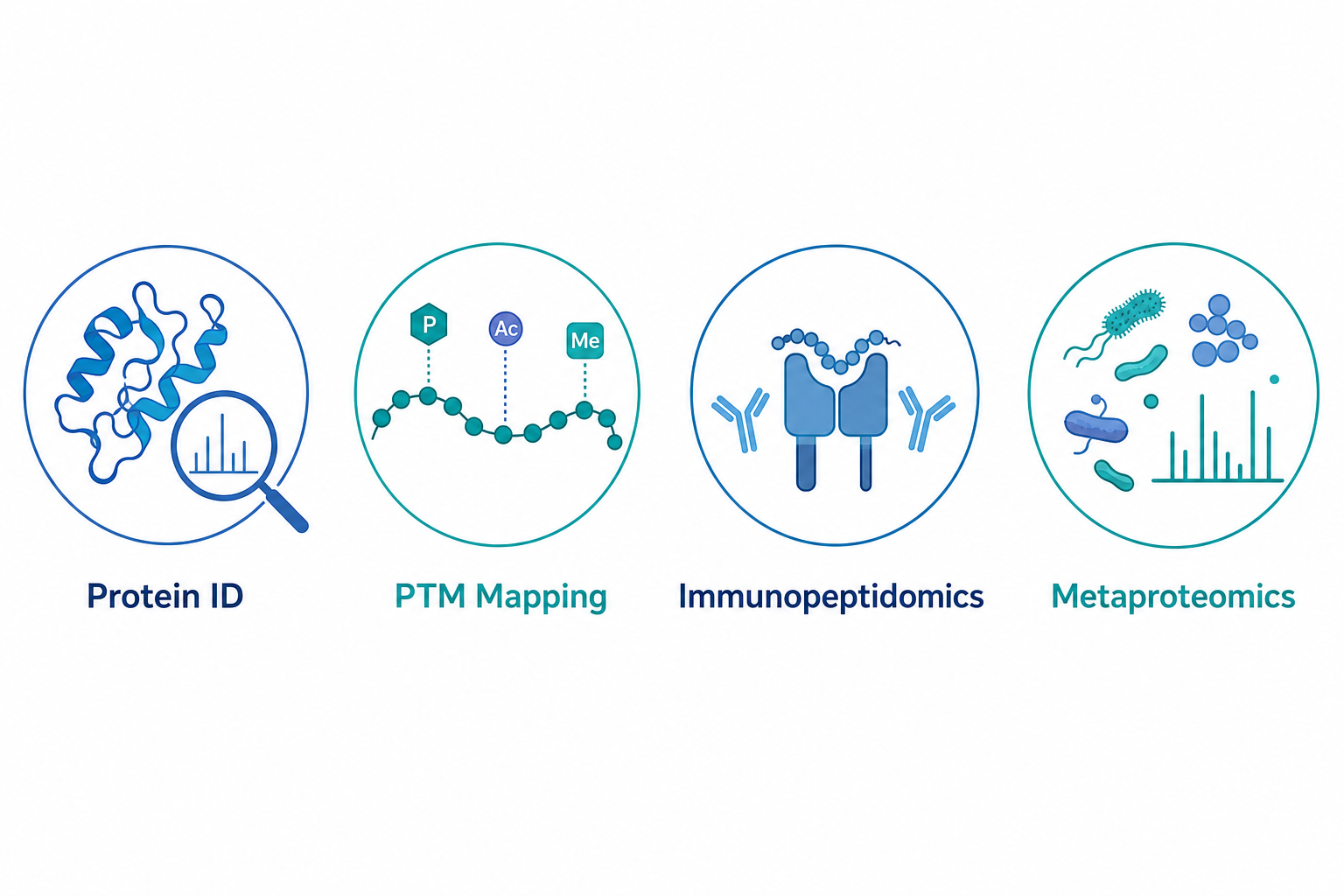
Figure 3. Peptide sequencing underpins protein identification, modification mapping, immunopeptidomics, and metaproteomics interpretation in modern proteomics workflows.
|
Proteomics Application |
What Peptide Sequencing Enables |
Complementary Evidence Often Still Needed |
|---|---|---|
|
Protein identification in discovery studies |
PSM-supported peptide evidence for protein inference |
Replicate runs and orthogonal proteome coverage |
|
PTM site mapping |
Localized modification assignments on specific residues |
Enrichment QC and biological perturbation validation |
|
Immunopeptidomics |
MHC peptide sequence identification |
Binding prediction and functional immune validation |
|
Metaproteomics |
Sequence tags from environmental or microbiome samples |
Custom databases and taxonomic context |
|
Biomarker peptide confirmation |
Confirmed sequence for selected candidate peptides |
Quantitative reproducibility across cohorts |
|
Variant and mutation detection |
Peptide evidence for amino acid changes |
Genomic or transcriptomic corroboration |
These applications show why peptide sequencing remains central to proteomics even as acquisition platforms and software tools continue to evolve. Sequence assignment is the step that determines whether downstream biological interpretation is built on confident primary structure evidence.
Advances Shaping Proteomics Peptide Sequencing
Several technical advances are changing how proteomics laboratories obtain and use peptide sequence information.
Higher-resolution mass spectrometers improve precursor and fragment mass accuracy, which strengthens PSM confidence and helps distinguish isobaric residues in some contexts. Data-independent acquisition workflows increasingly rely on spectral libraries that extend peptide sequencing evidence across large sample cohorts with improved reproducibility. Ion mobility separation adds an extra dimension that can reduce interference and improve identification rates in complex digests. Machine learning-supported de novo and rescoring tools are improving interpretation of difficult spectra, although expert review remains important for high-stakes assignments. Immunopeptidomics and single-cell proteomics are pushing sequencing workflows toward lower sample amounts, specialized acquisition strategies, and more conservative reporting standards.
These advances expand capability, but they do not remove the need for careful database design, enrichment strategy, and validation planning. The strongest proteomics programs match new technology to a defined biological question rather than assuming more acquisition depth alone will solve sequence ambiguity.
Expected Deliverables and Validation
A useful proteomics peptide sequencing output should include more than a protein name list. Common deliverables include:
- PSM tables with scores, modifications, and retention time information
- protein inference summary with grouping rules clearly described
- unmatched or de novo peptide reports when novel sequence analysis is in scope
- modification localization summaries with confidence notes
- QC metrics on search false discovery rate, missed cleavage rate, and replicate overlap
- interpretation notes on database limitations or ambiguous regions
Validation should match the biological claim. A pathway study may require replicate overlap and conservative false discovery controls. A PTM site publication may require manual review of diagnostic fragment ions. An immunopeptidomics claim may require additional prediction and functional support before therapeutic relevance is inferred. Useful validation steps may include replicate LC-MS/MS runs, synthetic peptide standards, independent fragmentation experiments, or orthogonal confirmation for selected sequence calls.
Researchers should treat low-confidence de novo tags and borderline modification assignments cautiously, especially when they will drive biomarker nomination, epitope prediction, or mechanistic conclusions.
Frequently Asked Questions
1. How does peptide sequencing support proteomics?
Peptide sequencing assigns amino acid sequences to MS/MS spectra. Those assignments support protein identification, modification mapping, and targeted biological interpretation in bottom-up proteomics workflows.
2. When should a proteomics project use de novo sequencing?
De novo sequencing is most useful for unmatched spectra, poorly annotated organisms, metaproteomics samples, and cases where database searching alone does not explain observed peptide evidence.
3. How is peptide sequencing different from protein inference?
Peptide sequencing identifies specific peptide sequences from spectral evidence. Protein inference groups those peptides into protein-level conclusions using statistical rules and sequence database context.
4. What advances are most relevant to proteomics peptide sequencing today?
Higher-resolution MS, DIA library workflows, ion mobility separation, machine learning-supported rescoring, and low-input acquisition strategies are among the most influential current advances.
5. What validation is needed after peptide sequencing in proteomics?
Validation depends on the study goal. Common approaches include replicate analysis, false discovery rate control, manual review of key PSMs, synthetic peptide confirmation, and orthogonal follow-up for biological claims.
Conclusion
Peptide sequencing remains the residue-level foundation of modern proteomics. Database-driven LC-MS/MS identification, de novo interpretation, enrichment-supported modification mapping, and orthogonal Edman confirmation each address different bottlenecks in protein identification and site-level reporting. Applications span discovery proteomics, PTM research, immunopeptidomics, metaproteomics, and biomarker confirmation, while recent advances in acquisition technology and interpretation software continue to expand what can be assigned confidently. Reliable outcomes still depend on database quality, sample preparation, and validation standards matched to the biological question. Researchers planning proteomics peptide sequencing can contact MtoZ Biolabs to review sample complexity, search strategy, and the reporting format required for the next study phase.
How to order?




