






Native MS: How Non-Denaturing Mass Spectrometry Reveals Protein Complexes, Stoichiometry, and Binding States
Introduction
Protein function often depends on more than a single polypeptide chain. Multi-subunit enzymes, receptor complexes, antibody assemblies, and ligand-bound states can change activity, stability, and product quality even when the primary sequence remains unchanged. A structural biology team may need to confirm that a purified complex is still assembled after buffer exchange. A biologics group may need to know whether an intact product exists mainly as the intended oligomer. A biochemistry team may need rapid mass evidence that a cofactor or small-molecule partner remains bound under native-like conditions.
Native MS, also described as non-denaturing mass spectrometry, is designed for these intact-architecture questions. By analyzing proteins under conditions that preserve non-covalent interactions, native MS reports mass distributions for whole complexes, stoichiometric assemblies, and binding-related mass shifts. This article explains how non-denaturing mass spectrometry reveals protein complexes, stoichiometry, and binding states, and where the method fits among complementary intact and peptide-level workflows.
What Non-Denaturing Mass Spectrometry Means
Non-denaturing mass spectrometry is intact protein analysis performed under native-like solution conditions. Samples are typically exchanged into volatile aqueous buffers such as ammonium acetate. Soft electrospray ionization transfers folded proteins and non-covalent assemblies into the gas phase with limited unfolding. The mass spectrometer records charge-state envelopes at relatively high m/z, and deconvolution converts those envelopes into neutral mass values.
The key distinction from denaturing intact mass analysis is experimental intent. Denaturing conditions disrupt non-covalent contacts so covalent subunit mass can be measured more directly. Non-denaturing conditions aim to keep those contacts available for measurement. As a result, native MS can report assembled species that would dissociate under organic solvent or acid-based denaturation.
Native MS does not replace residue-level sequencing. It reveals architecture-level mass evidence for complexes, stoichiometry, and binding states at the intact molecule level.
Why Complexes, Stoichiometry, and Binding States Matter
These three readouts answer related but distinct questions.
Protein complexes tell teams whether subunits remain associated as an intact assembly under the tested conditions.
Stoichiometry tells teams how many copies of each subunit are present in the observed assembly and whether the measured mass matches an expected model.
Binding states tell teams whether ligands, cofactors, metals, or other partners contribute measurable mass shifts consistent with occupancy.
Without these readouts, a project may confirm sequence and covalent mass while still missing whether the functional assembled form is present. Native MS connects molecular weight data to assembly architecture.
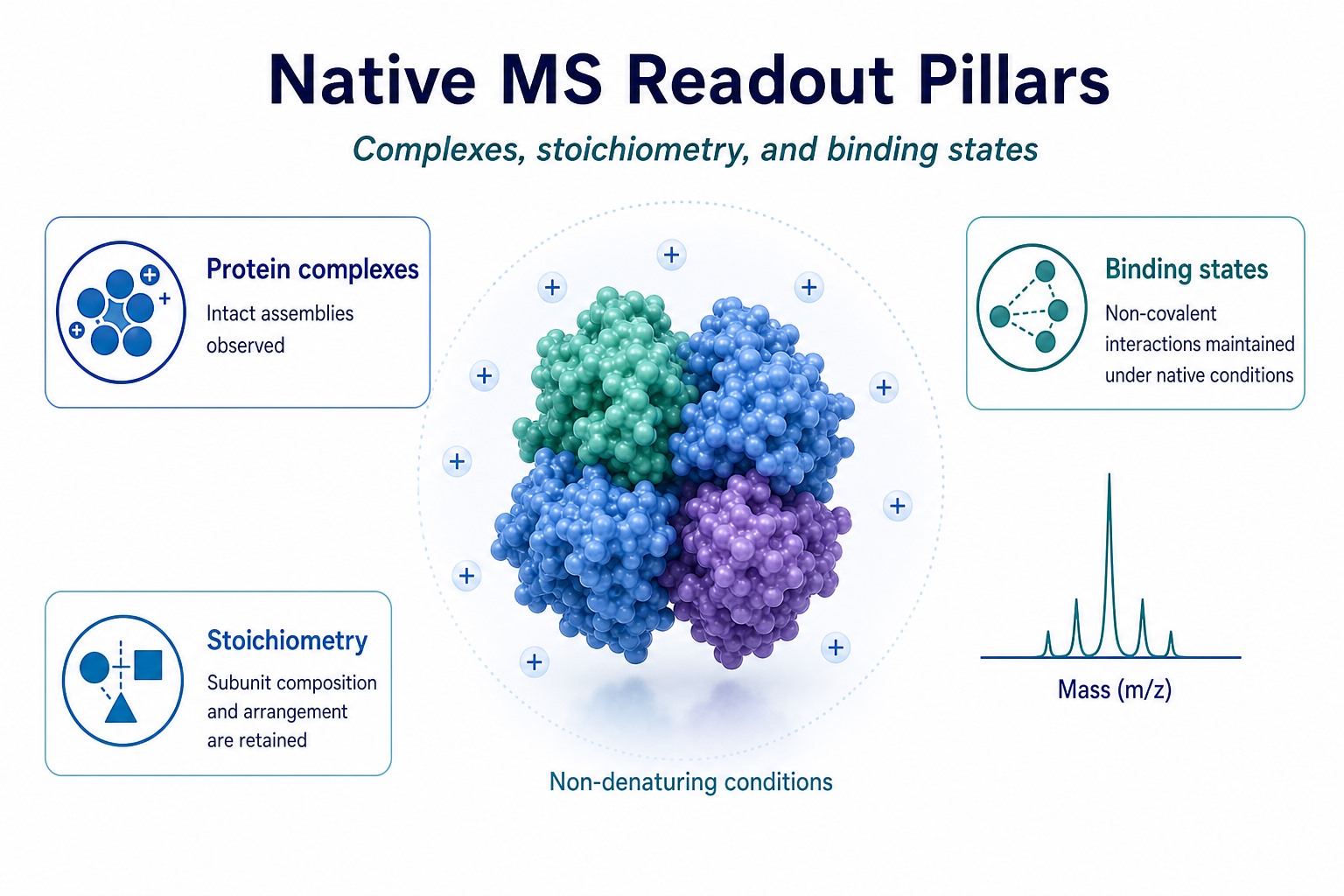
Figure 1. Non-denaturing MS is used to reveal protein complexes, stoichiometry, and binding-related mass states at the intact level.
How Native MS Reveals Protein Complexes
Native MS reveals protein complexes by preserving non-covalent subunit associations long enough for intact complex ions to be detected.
When a multi-subunit assembly survives buffer exchange and soft ionization, the observed mass corresponds to the assembled complex rather than only free subunits. Charge-state envelopes for the complex appear at higher m/z than typical denatured subunit ions. After deconvolution, the neutral mass can be compared with the sum of expected subunit masses.
Complex detection is strongest when the sample is sufficiently pure, the buffer is volatile and compatible, and instrument settings limit unintended gas-phase dissociation. Partial dissociation can still occur. In those cases, spectra may show both intact complex ions and released subunit ions, which can itself help confirm that the complex was present and then partially disrupted.
Native MS therefore reports which assembled species are observable under defined non-denaturing conditions, not a guarantee that every solution interaction survives transfer into the mass spectrometer.
How Native MS Reveals Stoichiometry
Stoichiometry assignment begins with accurate intact complex mass and a clear subunit mass baseline.
Teams usually calculate theoretical masses for candidate models such as 1:1, 2:1, or higher-order oligomers. The deconvoluted native mass is then matched to the model that best fits the observed value. When denatured or reduced subunit masses are available from a paired aliquot, stoichiometry assignment becomes more robust because covalent subunit masses and assembled complex masses can be compared directly.
Native MS can also distinguish monomer, dimer, and higher-order oligomer distributions when those forms produce separable envelopes. Relative intensities of different oligomer envelopes can support qualitative comparison across purification fractions or formulation conditions, although absolute population quantitation depends on response factors and method design.
Stoichiometry evidence is mass-model evidence. It is strongest when sequence masses, modification models, and sample homogeneity are well defined.
How Native MS Reveals Binding States
Binding-state analysis uses mass shifts between unbound and bound forms under non-denaturing conditions.
If a protein or complex binds a ligand, cofactor, or metal ion and that interaction survives native sample handling, the observed mass increases by approximately the bound partner mass. Comparing apo and holo forms, or comparing expected unbound mass with measured occupied mass, supports occupancy interpretation.
Binding-state readouts are especially useful when the bound partner is difficult to confirm by denaturing methods because denaturation releases the interaction before measurement. Native MS keeps the occupied form available for direct mass comparison.
Interpretation still requires care. Adducts, residual buffer components, and overlapping proteoforms can mimic small mass shifts. Controlled buffer exchange, careful blank review, and comparison with theoretical ligand masses improve assignment confidence.
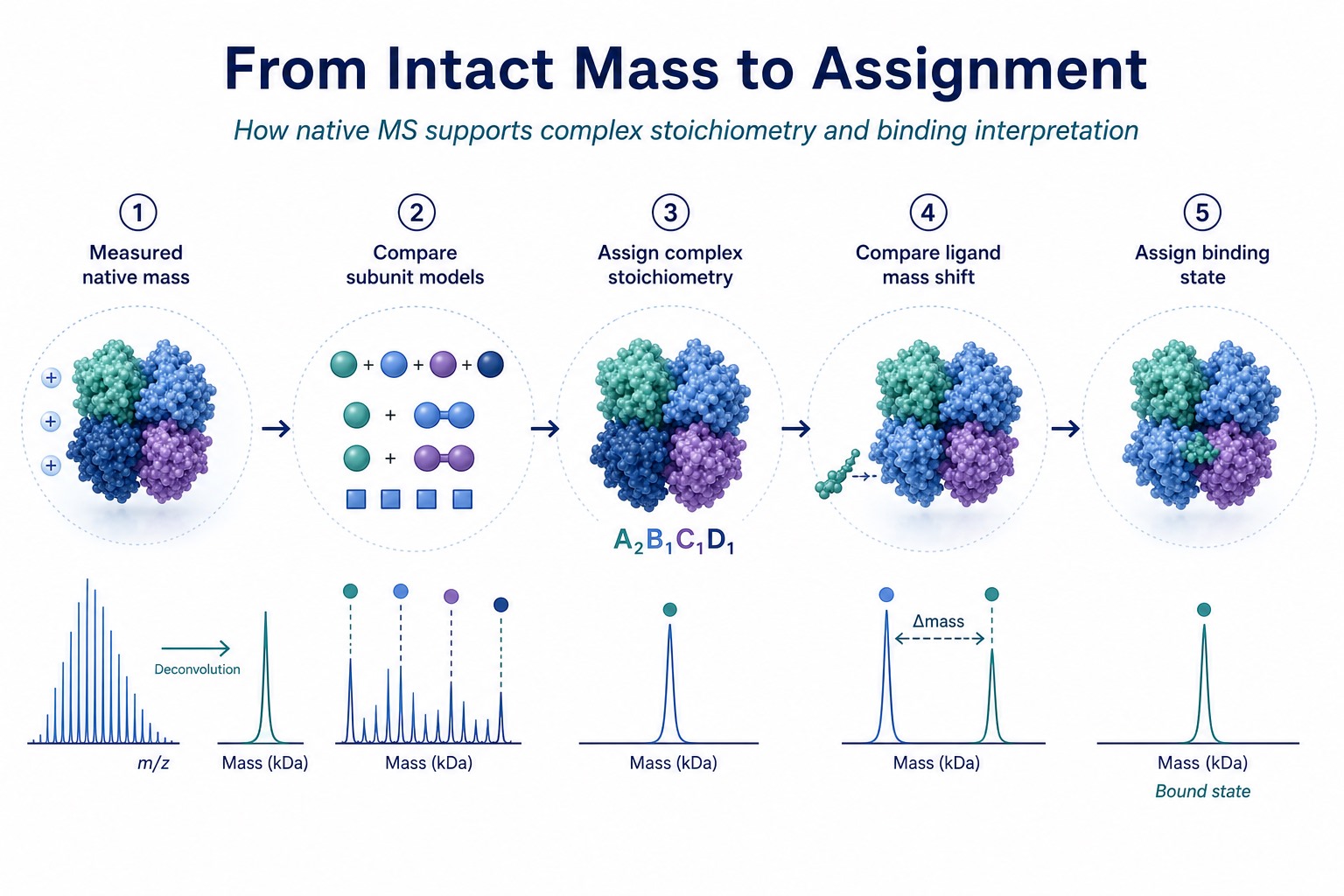
Figure 2. Intact native masses are compared with subunit and ligand models to assign complexes, stoichiometry, and binding states.
Technical Advantages of Native MS for These Readouts
The technical value of native MS for complexes, stoichiometry, and binding states comes from direct intact-level measurement under non-denaturing conditions.
Native MS reports assembled complex masses without requiring digestion or crosslinking for basic stoichiometry questions.
Native MS can compare oligomer states across related samples when envelopes are resolved and sample quality is suitable.
Native MS can detect binding-related mass shifts that are lost under denaturing intact mass conditions.
Native MS provides a rapid architecture check that can guide whether deeper structural methods are warranted for a given assembly.
Native MS can be paired with denaturing intact mass analysis so covalent subunit baselines and assembled forms are interpreted together.
These are technical capabilities. They do not mean native MS alone resolves every structural or sequence question.
Current Limitations
Native MS has clear boundaries that affect complex and binding interpretation.
Sample purity and desalting quality strongly influence spectral clarity. Salts, detergents, and complex matrices can suppress ionization or broaden peaks.
Gas-phase dissociation may reduce apparent complex abundance or complicate stoichiometry if settings are not controlled.
Heterogeneous assemblies and overlapping proteoforms can congest spectra and make unique model assignment difficult.
Small ligand mass shifts may be hard to distinguish from adducts without careful controls.
Residue-level sequence and site-specific modification mapping still require peptide-level methods.
Recognizing these limits helps place native MS in the correct phase of a characterization plan.
Related Services
Therapeutics Characterization Service | Advanced Structure
Protein Molecular Weight Determination Service
Antibody Drug Analysis Service
Teams evaluating non-denaturing MS for complex stoichiometry or binding-state questions can consult MtoZ Biolabs to review sample readiness, expected assembly models, and the analytical depth required for the project phase.
Typical Application Scenarios
Native MS is applied when intact architecture is central to the scientific or product question.
Multi-subunit complex confirmation
Purified complexes are checked for intact assembly after chromatography or buffer exchange by matching observed native masses to expected complex models.
Oligomer distribution review
Proteins that can exist as monomers and higher-order oligomers are compared across process intermediates or formulation conditions when envelopes are separable.
Ligand and cofactor occupancy screening
Apo and bound forms are compared under native-like conditions to assess whether measurable occupancy is retained after sample handling.
Biotherapeutic assembly and intact heterogeneity support
Antibody-related and other biologic assemblies are reviewed for intact oligomer state and global mass heterogeneity before or alongside peptide mapping.
Pre-structural screening support
Native MS can provide rapid stoichiometry and binding evidence that helps decide whether a sample is ready for more resource-intensive structural experiments.
For programs that need native complex analysis together with covalent mass confirmation, MtoZ Biolabs can help sequence denaturing and non-denaturing intact measurements within the same characterization phase.
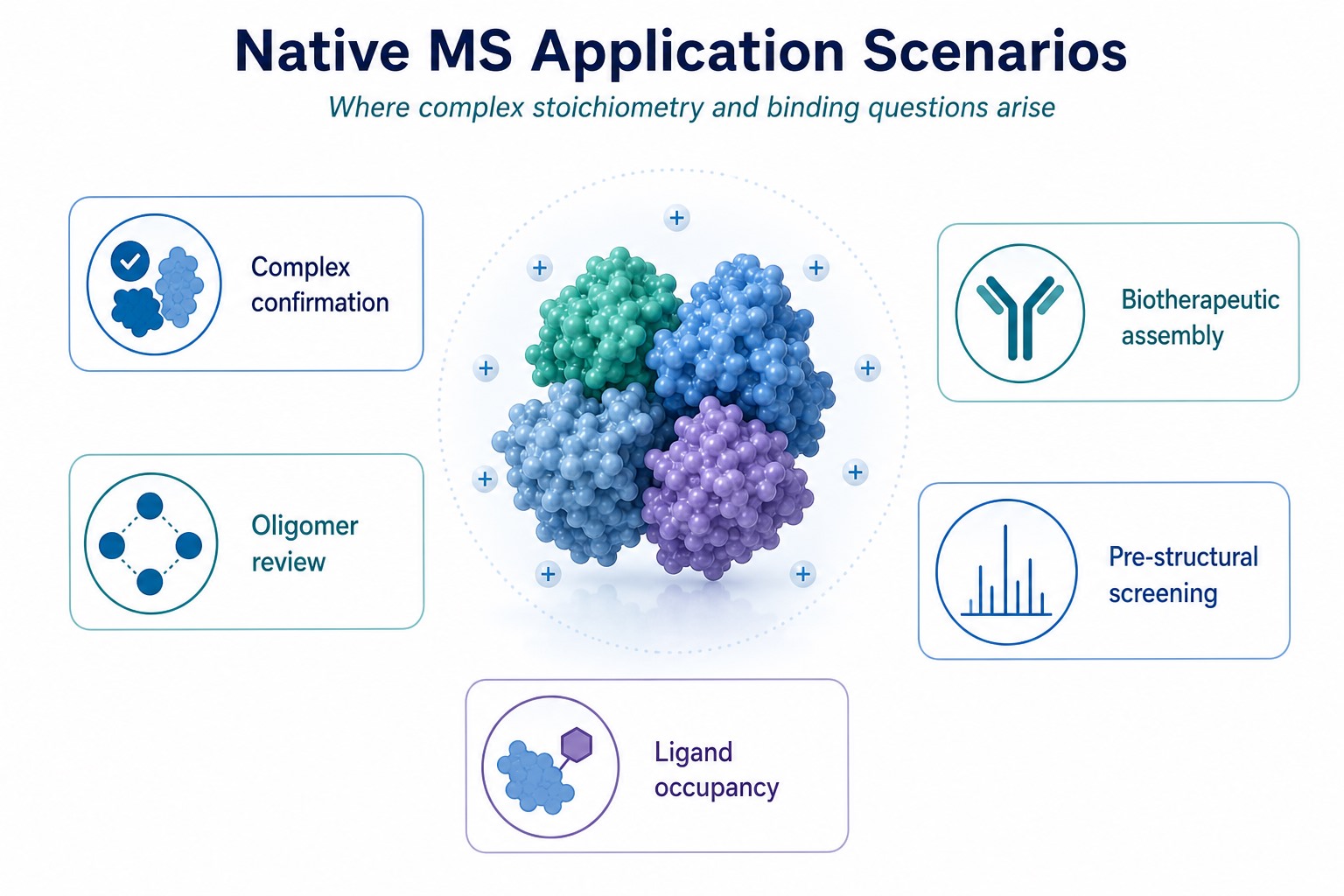
Figure 3. Native MS is commonly applied to complex confirmation, oligomer review, ligand occupancy, and biotherapeutic assembly questions.
Outlook
Non-denaturing mass spectrometry continues to expand as high-mass transmission, improved resolving power, and native-compatible separations make congested assemblies easier to interpret. The most practical progress is integrative. Native MS supplies complex, stoichiometry, and binding-state evidence. Denaturing intact mass and peptide mapping supply covalent baselines. Structural methods supply spatial models when needed.
For research and biologics teams, the lasting value of native MS is question matching. When the missing evidence is assembly architecture rather than sequence alone, non-denaturing mass spectrometry provides direct mass-based answers.
Frequently Asked Questions
1. What does native MS reveal about protein complexes?
Native MS can report whether an intact assembled complex is detectable under non-denaturing conditions by matching observed masses to expected complex models.
2. How does native MS determine stoichiometry?
Stoichiometry is assigned by comparing deconvoluted complex mass with theoretical models built from subunit masses and candidate copy numbers.
3. Can native MS detect ligand binding?
Yes, when the bound form survives native sample handling and produces a measurable mass shift relative to the unbound protein or complex.
4. Is native MS the same as non-denaturing mass spectrometry?
Yes. The terms are commonly used for the same intact-protein approach performed under native-like conditions.
5. Why pair native MS with denaturing intact mass analysis?
Denaturing intact mass provides covalent subunit baselines. Native MS then shows whether those subunits assemble and bind as expected.
6. What limits binding-state interpretation in native MS?
Adducts, residual salts, overlapping proteoforms, and partial dissociation can complicate small mass-shift assignments without careful controls.
Conclusion
Native MS reveals protein complexes, stoichiometry, and binding states by measuring intact masses under non-denaturing conditions that preserve non-covalent architecture. Complex detection shows whether assemblies remain associated. Stoichiometry assignment matches observed masses to subunit copy-number models. Binding-state analysis interprets mass shifts linked to retained ligands or cofactors.
Used with clear models and, when needed, denaturing covalent baselines, non-denaturing mass spectrometry provides architecture-level evidence that sequence-only workflows cannot supply. Researchers planning native MS for complex, stoichiometry, or binding questions can contact MtoZ Biolabs to review sample status and the analytical approach matched to the current project phase.
How to order?




