






Native Mass Spectrometry (MS) Overview
Introduction
Many protein characterization workflows focus on sequence, peptides, or denatured subunit mass. These methods answer important questions about primary structure and covalent modifications, but they do not always reveal how proteins exist as intact assemblies in solution. A monoclonal antibody may be confirmed by peptide mapping yet still require evidence that the expected IgG assembly is preserved. A protein complex may dissociate during harsh sample handling and appear intact only after gentler analysis. A biologics QC program may need fast confirmation of oligomeric state without launching a full structural study.
Native mass spectrometry (native MS) addresses this gap by measuring intact proteins and non-covalent complexes under native-like conditions. Samples are prepared in volatile aqueous buffers and ionized gently so folded proteins, subunits, and bound assemblies can be transferred into the mass spectrometer with minimal disruption. The resulting spectra provide mass and stoichiometry evidence for what species are present before digestion or denaturation.
This article provides an overview of native mass spectrometry, including what it measures, how it differs from other MS workflows, typical outputs, and where it fits in protein and biotherapeutic characterization.
What Native Mass Spectrometry Is
Native mass spectrometry is the analysis of intact protein ions generated under conditions intended to preserve non-covalent interactions and overall folded architecture. Unlike bottom-up proteomics, it does not rely on full enzymatic digestion to peptides for sequence identification. Unlike denaturing intact mass analysis, it avoids harsh solvents or reduction steps that disrupt assemblies before measurement.
In practice, native MS uses native-compatible buffers such as ammonium acetate, soft electrospray ionization, and instrument settings tuned for high-m/z detection. The mass spectrometer records charge-state envelopes for intact proteins or complexes. Software deconvolution converts these envelopes into neutral mass values. When subunits remain associated, the observed complex mass supports stoichiometry assignment and binding assessment.
Native MS is therefore an intact-molecule method focused on assembly state, complex mass, and global heterogeneity rather than residue-level sequencing.
What Native MS Measures
Native MS reports several types of information at the whole-protein level.
Intact protein mass confirms the molecular weight of folded proteins or individual subunits under native-like conditions. Complex mass reveals whether non-covalent assemblies form and whether observed mass matches expected stoichiometry. Subunit composition shows which chains remain associated during ionization. Mass heterogeneity captures glycoform distributions, ligand occupancy, or other global mass variation. Assembly stability can be compared across buffer, formulation, or stress conditions when repeat measurements are made under controlled native MS settings.
These outputs help teams answer whether the protein exists in the expected form in solution, not only whether the sequence is correct.
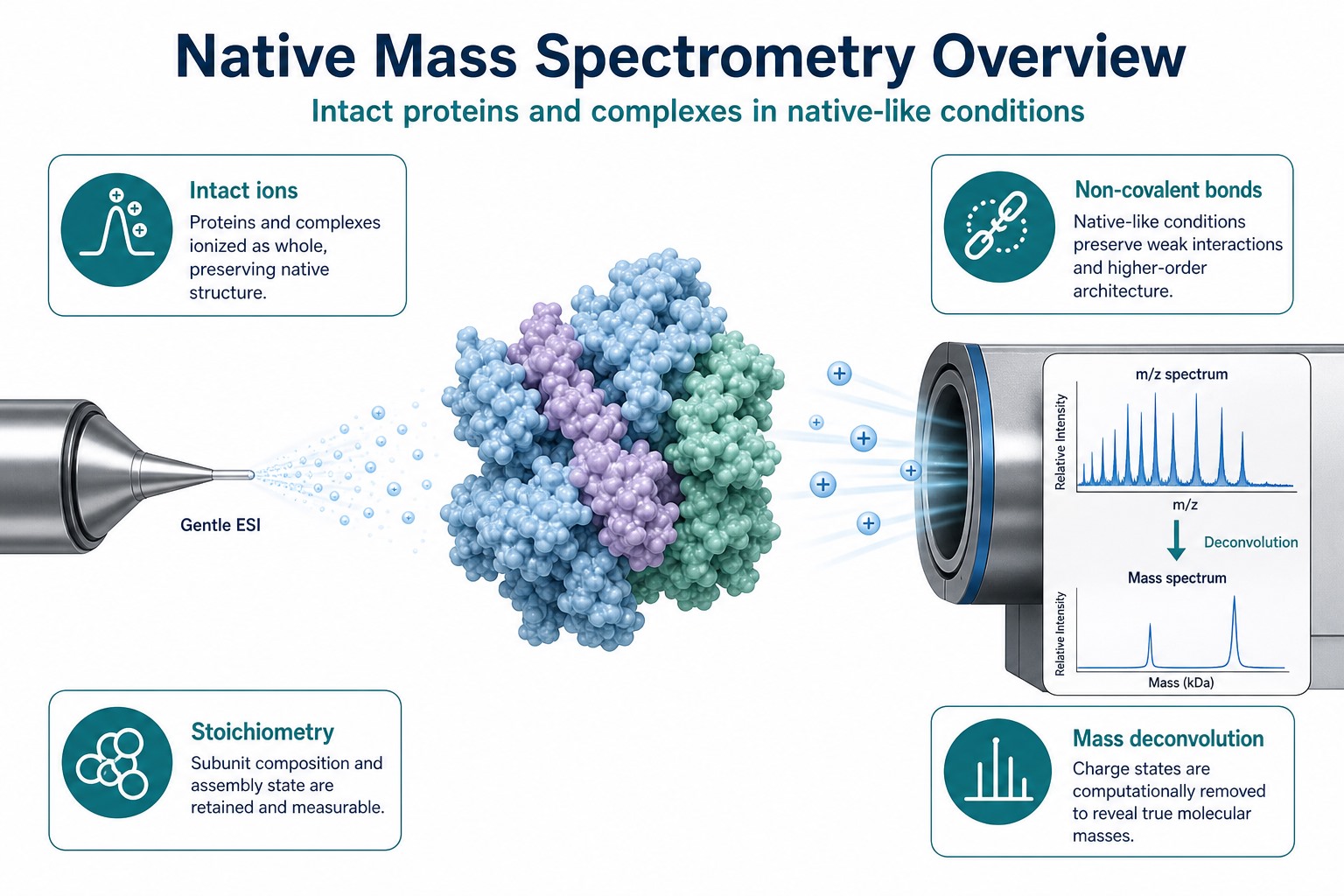
Figure 1. Native mass spectrometry provides an overview-level view of intact proteins, subunits, and non-covalent complexes in native-like conditions.
How Native MS Differs from Other MS Workflows
Native MS is often compared with bottom-up proteomics, denaturing intact mass analysis, and top-down proteomics. Each workflow answers a different question.
Bottom-up LC-MS/MS digests proteins into peptides and prioritizes sequence identification and PTM localization. Native MS preserves intact architecture and does not provide comprehensive residue-level coverage by itself.
Denaturing intact mass analysis simplifies ionization by unfolding proteins or separating chains and is widely used for subunit molecular weight confirmation. Native MS avoids conditions that disrupt non-covalent assemblies and is chosen when complex formation matters.
Top-down proteomics fragments intact proteins inside the mass spectrometer to map proteoforms and modifications. Native MS emphasizes non-covalent assembly and complex mass rather than extensive gas-phase fragmentation of folded proteins.
Many complete characterization programs use native MS alongside one or more of these methods rather than treating native MS as a standalone replacement.
Related Services
Native Mass Spectrometry Analysis Service
Protein Molecular Weight Determination Service
Intact Mass Analysis of Antibodies Service
Researchers evaluating native MS for a protein or biologics project can consult MtoZ Biolabs to review sample format, expected assembly state, and the workflow best matched to the analytical goal.
Typical Native MS Workflow at a Glance
A standard native MS workflow follows a short linked sequence.
Sample qualification confirms purity, concentration, and compatibility with native buffer exchange. Buffer optimization removes salts, detergents, or non-volatile additives that suppress native ionization. Gentle MS acquisition collects high-m/z spectra with source and transfer settings tuned to preserve assemblies. Mass deconvolution converts charge-state distributions into neutral mass values. Data interpretation assigns observed masses to expected proteins, subunits, or complexes and documents heterogeneity.
The workflow is conceptually simple, but result quality depends on sample cleanliness, buffer choice, and expert interpretation of charge-state overlap or partial dissociation.
Key Instrument and Method Considerations
Native MS performance depends on instrument capability and sample type.
High-m/z transmission supports detection of large complexes and low-charge native ions. Soft ionization and desolvation preserve non-covalent interactions during transfer into the vacuum system. Direct-infusion native ESI-MS is common for purified proteins and complexes. Online desalting or buffer exchange improves spectral quality when salts or additives are present. Dedicated native MS platforms extend range and transfer optimization for demanding biologics or large assembly work.
Not every mass spectrometer is configured for high-quality native MS. Method feasibility should be reviewed before sample submission.
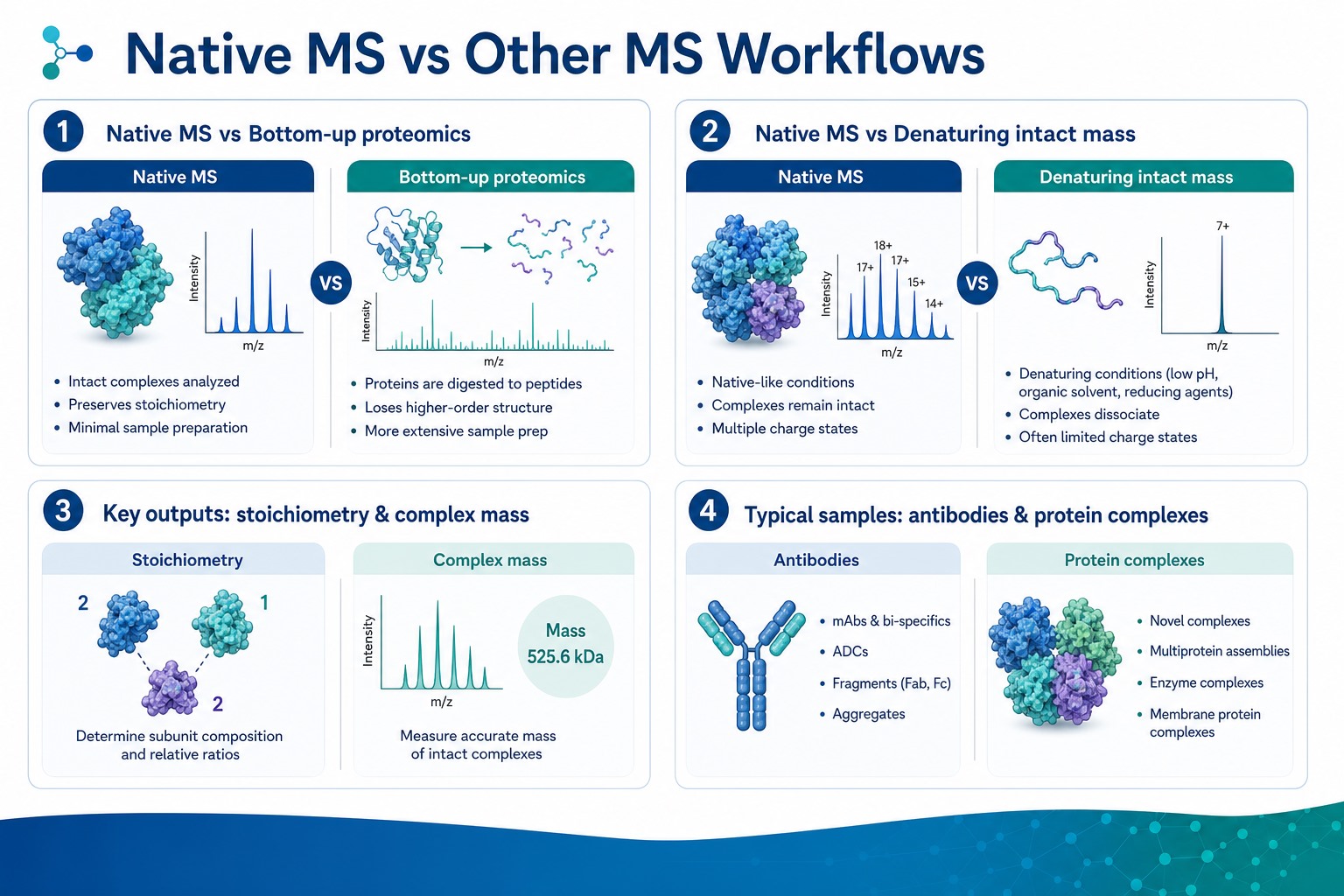
Figure 2. Native MS differs from bottom-up proteomics and denaturing intact mass analysis in sample handling, output type, and analytical focus.
When to Choose Native MS
Native MS is most useful when intact assembly information is required.
Choose native MS when confirming oligomeric state or non-covalent complex formation. Choose it when comparing assembly before and after formulation, stress, or buffer change. Choose it when supporting structural biology with solution mass evidence for stoichiometry. Choose it when biotherapeutic QC requires confirmation that a product remains in the intended assembled form. Choose it when peptide mapping or denaturing intact mass alone cannot answer whether the functional complex is present.
Native MS is less suitable as the primary method when comprehensive sequence coverage, residue-level PTM mapping, or atomic-resolution structure is the main deliverable.
Native MS Output Summary
|
Output Type |
What It Tells You |
Common Use |
|---|---|---|
|
Intact protein mass |
Molecular weight of folded protein or subunit |
Identity and heterogeneity screening |
|
Complex mass |
Whether non-covalent assembly forms |
Stoichiometry review |
|
Subunit association |
Which chains remain bound |
Antibody and multi-chain QC |
|
Glycoform distribution |
Global mass variation from glycosylation |
Biologics comparability |
|
Ligand-bound mass shift |
Evidence for cofactor or ligand association |
Interaction screening |
Native MS outputs should be interpreted with the expected assembly architecture defined in advance.
Core Technical Advantages and Current Limitations
Core Technical Advantages
Direct evidence for intact assemblies in solution-relevant conditions.
Native MS reports whole-protein and complex mass without requiring digestion or denaturation.
Fast screening compared with high-resolution structural methods.
Assembly and stoichiometry questions can often be addressed quickly on purified samples.
Complementary to sequence-level MS methods.
Native MS adds an architecture layer to peptide mapping and denaturing intact mass data.
Useful for biologics and protein complex workflows.
Antibodies, multi-subunit enzymes, and ligand-bound complexes are common application areas.
Current Limitations
No residue-level sequence by native MS alone.
Peptide mapping or top-down methods remain necessary for sequence confirmation.
Sample quality and buffer sensitivity.
Salts, detergents, and aggregation reduce native ionization quality.
Not a full structural method.
Native MS does not provide atomic coordinates or detailed conformational models.
Partial dissociation can complicate interpretation.
Source conditions may disrupt weak assemblies if not carefully controlled.
Applications Across Research and Biopharma
Native MS supports several broad application areas.
Structural biology programs use native MS to validate complex stoichiometry before or alongside cryo-EM and other structural methods. Biotherapeutic development uses native MS for assembly QC, comparability review, and stress testing of intact biologics. Antibody characterization applies native MS to confirm IgG assembly and review mass heterogeneity at the intact level. Protein interaction studies use native MS to detect non-covalent binding and estimate complex composition. Enzyme and multiprotein complex research uses native MS to monitor assembly state across purification or formulation steps.
The overview application fit is broad, but each project still requires sample-specific method review.
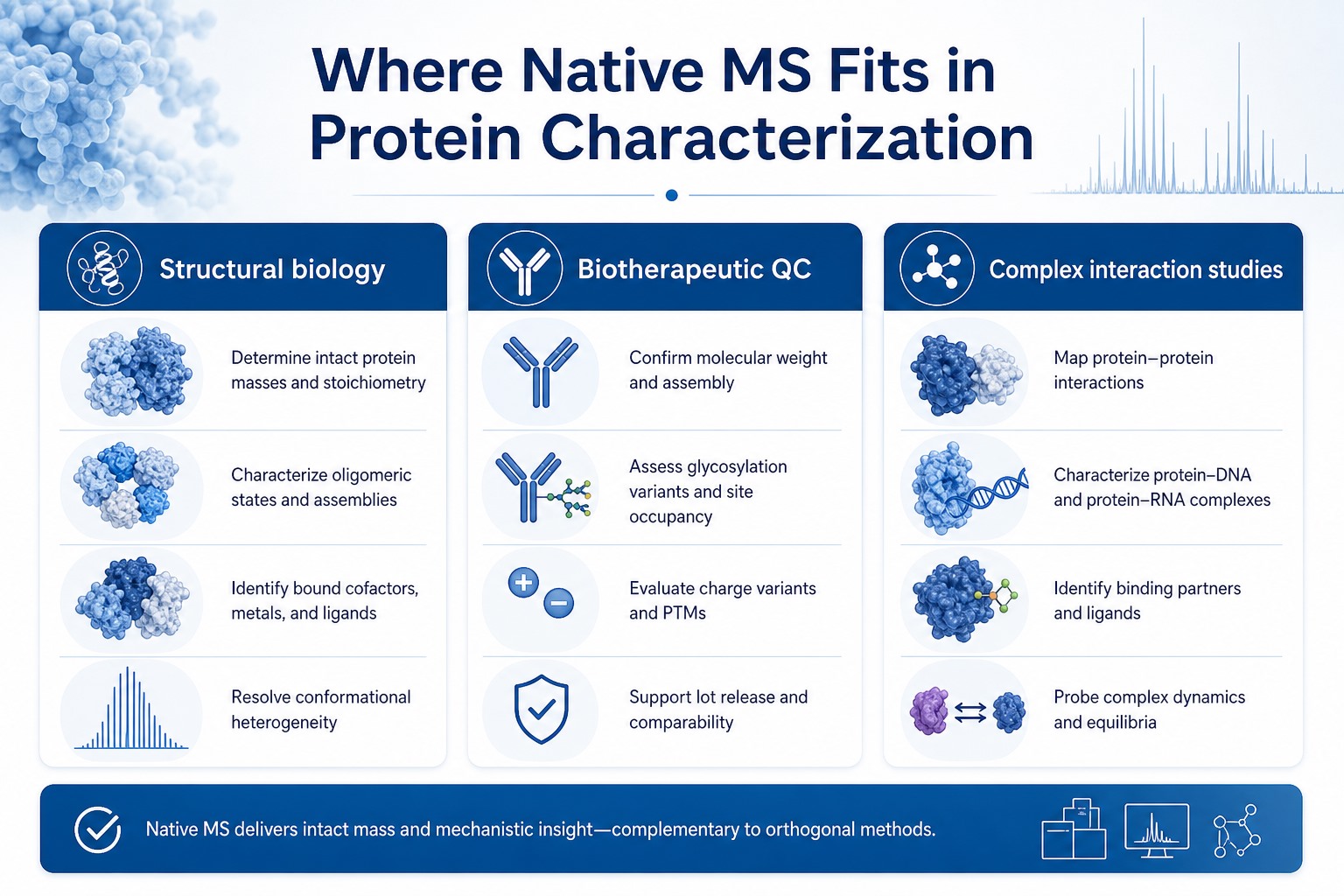
Figure 3. Native MS supports structural biology, biotherapeutic QC, and protein interaction studies across research and development workflows.
Frequently Asked Questions
1. What is native mass spectrometry in simple terms?
It is mass spectrometry of intact proteins and complexes under conditions designed to preserve non-covalent structure and assembly.
2. How is native MS different from regular proteomics?
Regular bottom-up proteomics measures peptides after digestion. Native MS measures intact proteins and assemblies without full digestion.
3. Can native MS determine protein sequence?
Not comprehensively by itself. It provides mass and assembly information. Sequence confirmation requires complementary methods.
4. What samples work best for native MS?
Purified proteins, antibodies, and defined complexes in native-compatible buffers generally give the strongest results.
5. When should native MS be combined with other methods?
Combine native MS with peptide mapping or denaturing intact mass when both sequence-level and assembly-level evidence are required.
Conclusion
Native mass spectrometry provides an overview-level entry point into intact protein analysis under native-like conditions. It measures whole-protein and complex masses, reports stoichiometry and non-covalent assembly, and complements sequence-focused MS workflows rather than replacing them. For biologics, antibodies, and protein complexes, native MS is often the fastest way to obtain direct mass evidence for how a protein exists in solution.
Programs that define expected assembly architecture and sample requirements early obtain clearer native MS results and better integration with downstream characterization. Researchers exploring native mass spectrometry for a project can contact MtoZ Biolabs to review feasibility, sample preparation, and reporting options. For teams building a broader protein characterization package, MtoZ Biolabs can also help align native MS with intact mass, peptide mapping, and structural follow-up.
How to order?




