






Mitochondrial Protein Mass Spectrometry: What Data Can You Get?
Mitochondrial protein mass spectrometry gives you protein-level evidence from mitochondrial or mitochondria-enriched material: which proteins are identified, how their abundances compare across samples when the study is quantitative, and a report package that documents those results. In practical terms, mitochondrial proteomics data usually means identification outputs, quantification matrices when designed, differential candidate lists for group comparisons, and the supporting raw files needed for review.
What it does not automatically give you is a finished functional diagnosis of mitochondria. Membrane potential, ROS, respiration, enzyme activity, and imaging readouts are separate assay classes. Teams confirming whether the expected data package matches their question can contact MtoZ Biolabs and share study design and sample type with us before mitochondrial protein analysis begins.
What "Data" Means in Mitochondrial Proteomics
Mitochondrial protein mass spectrometry analyzes mitochondrial-enriched material prepared from supported cell or tissue samples, or a qualified client-prepared mitochondrial fraction or extracted mitochondrial protein, depending on the confirmed workflow. The core data products answer three linked questions:
- Identification: which proteins and peptides were detected.
- Quantification: how those proteins compare across the cohort when a quantitative design is used.
- Reporting: how the results are organized for interpretation and follow-up.
Acquisition can follow a DDA path processed with MaxQuant or Proteome Discoverer, or a DIA path processed with Spectronaut or DIA-NN. Platform options for this service line include Orbitrap Exploris 480, timsTOF Pro, and Orbitrap Astral. Software versions are not part of the external description, so project communication should focus on mode and deliverables rather than version numbers.
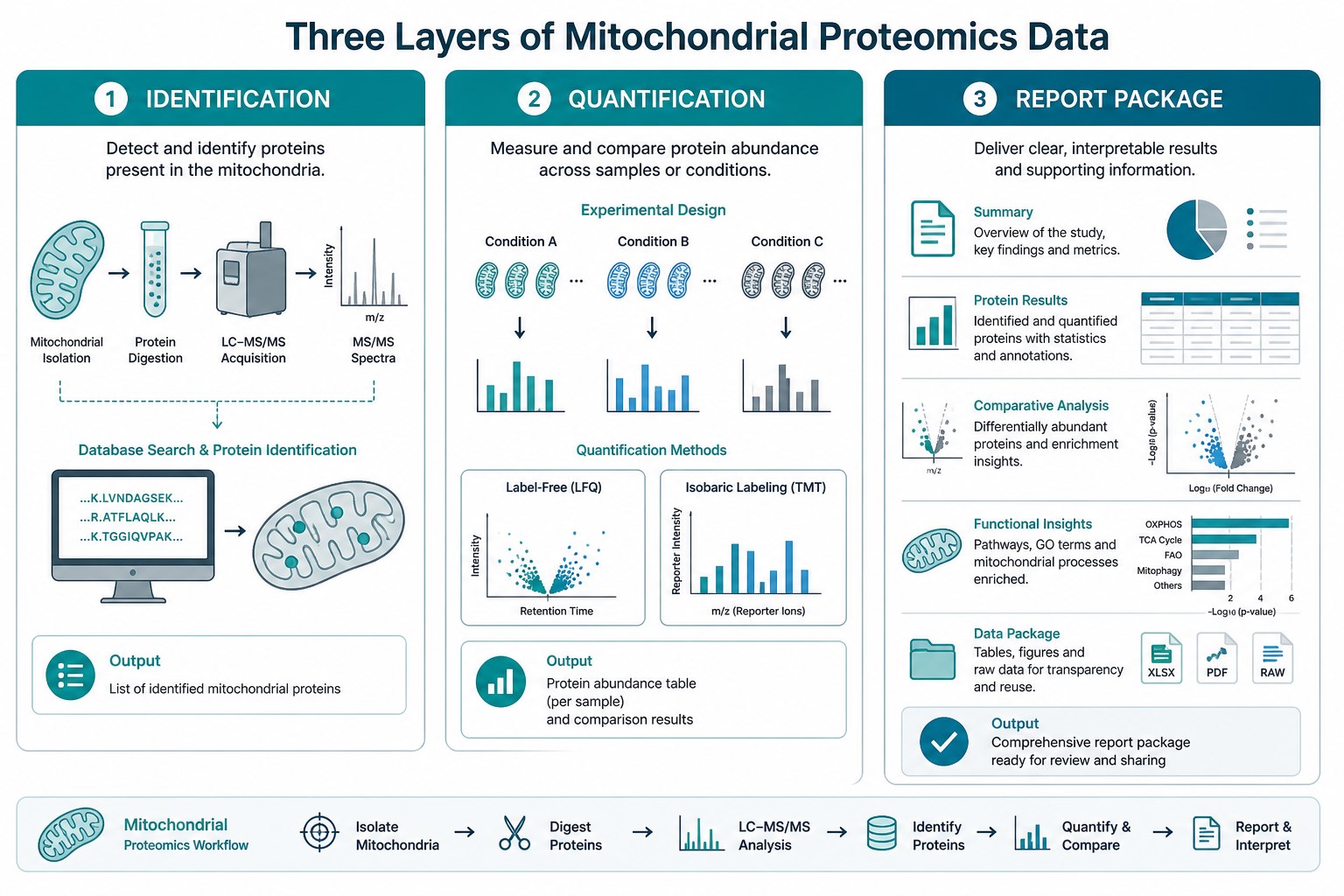
Figure 1. Mitochondrial proteomics data centers on identification, quantification, and a documented report package.
Identification Data: The Protein and Peptide Evidence
The first data layer is the identification table. It typically lists protein accessions, peptide support, and related search metadata from the chosen DDA or DIA pipeline.
Identification data is useful when you need to know:
- Which proteins are detectable in your mitochondrial preparation.
- Whether expected mitochondrial-associated proteins appear in the recovered set.
- Which unexpected proteins travel with the preparation and may need scrutiny.
It is not, by itself, proof that every identified protein is exclusively mitochondrial. Presence in a mitochondrial or mitochondria-enriched preparation supports association with that material. Exclusive localization still needs orthogonal evidence when the claim is critical.
Identification depth depends on sample quality, amount, and design. Current planning references are about 5×10^7 cells, about 200 mg animal tissue, or extracted mitochondrial protein of at least about 50 µg with about 80-100 µg commonly planned. These are input planning anchors, not promised protein counts. No fixed identification number should be assumed for every project.
Quantification Data: Comparisons Across Samples and Groups
When the study is built for comparison, mitochondrial protein analysis adds quantification matrices and, where designed, differential results.
Quantification data can include:
- Relative abundance values across samples.
- Group contrasts for treatment, genotype, or condition comparisons.
- Ranked candidate lists for follow-up prioritization.
Choose the mode from the question. DDA-oriented workflows suit flexible discovery settings. DIA-oriented workflows suit consistent cohort-wide quantification when the sample set is defined early. Neither mode converts a poorly matched cohort into a clean biological contrast. Biological replicates, matched handling, and balanced acquisition still decide whether the numbers are interpretable.
If the project is inventory-only, quantification matrices may be limited or unnecessary. If the project claims remodeling between conditions, quantification is the data layer that carries the decision.
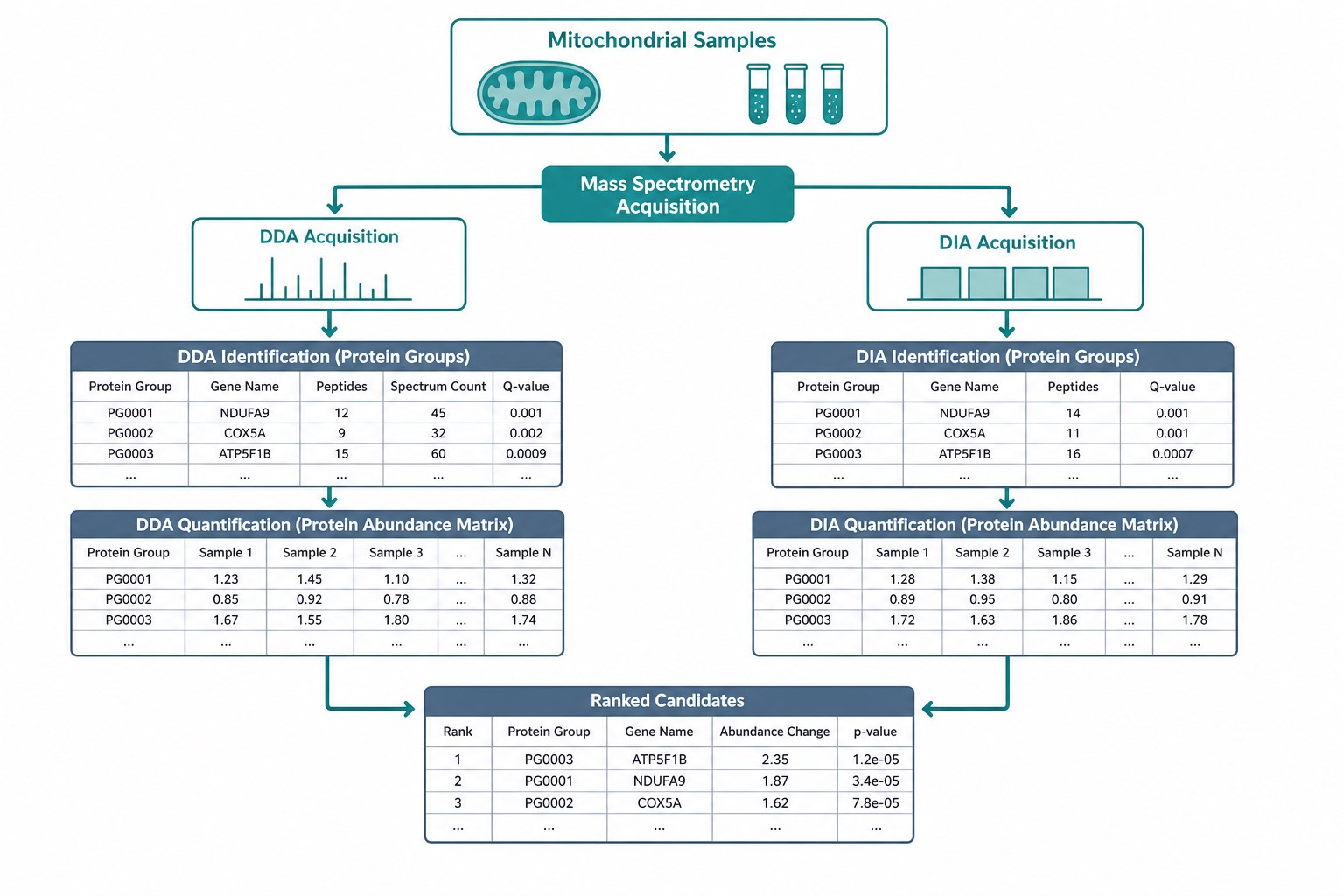
Figure 2. Samples move through DDA or DIA acquisition into identification tables, quantification matrices, and ranked candidates.
Report Package and Supporting Files
A complete mitochondrial proteomics data handoff should make the result reviewable without guesswork.
Expect a package that can include:
- Raw mass spectrometry files.
- Identification outputs from the stated DDA or DIA software path.
- Quantification matrices when the design is quantitative.
- Differential tables when groups were defined.
- A project report summarizing methods and main result files.
Annotation or pathway add-ons should be confirmed project by project rather than assumed as a fixed universal module. If your decision depends on a specific annotation view, state that requirement at kickoff so the report package matches the intended use.
Planning guidance for turnaround is about 4 weeks, with final timing still dependent on sample condition and project complexity. Use that figure for scheduling, not as an unconditional guarantee for every custom request.
What These Data Cannot Replace
Clear exclusions make the data package easier to use.
Mitochondrial protein mass spectrometry does not replace:
- Oxidative phosphorylation or respiration panels
- Membrane-potential assays
- ROS assays
- Respiratory-chain enzyme activity tests
- Calcium or permeability-transition assays
- Mitochondrial injury, toxicity, or autophagy phenotype assays
- Electron microscopy or high-content imaging
Those measurements can complement proteomics in a broader mitochondrial study, but they are not generated by the proteomics data files themselves. Keep proteomics conclusions at the protein-evidence level: identified proteins, abundance changes, and candidate shortlists.
|
Data type |
What you can get |
What it does not prove alone |
|---|---|---|
|
Identification |
Proteins and peptides detected in the preparation |
Exclusive mitochondrial residence for every protein |
|
Quantification |
Relative or cohort-wide abundance comparisons |
Absolute functional impairment |
|
Differential list |
Ranked candidates between designed groups |
Causal mechanism of a phenotype |
|
Report and raw files |
Traceable methods and result tables |
Bundled phenotype assay readouts |
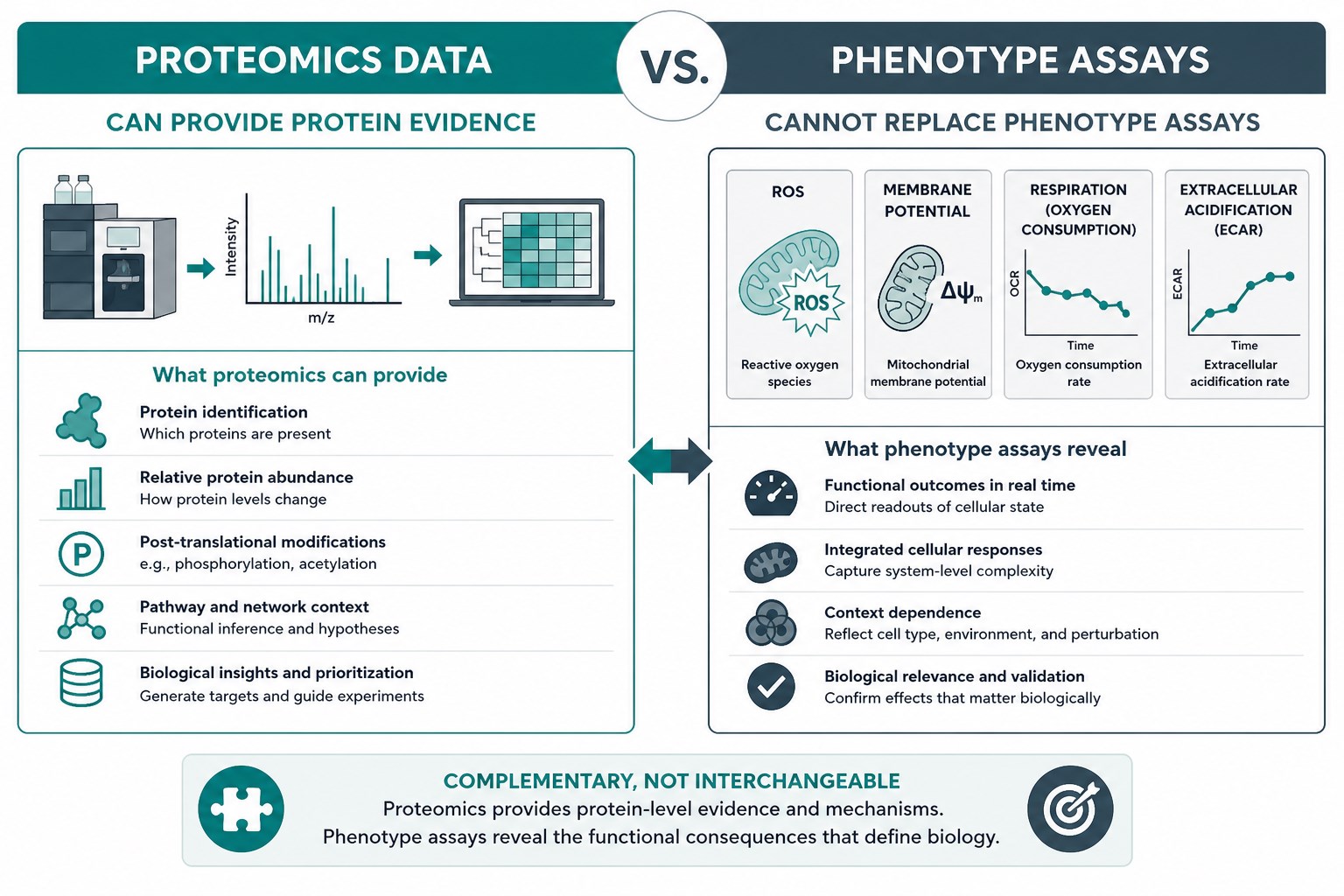
Figure 3. Use identification and quantification data for protein evidence; keep functional phenotype claims for dedicated assays.
When requesting a data-scope review, send whether the project is identification-focused or requires an integrated quantitative comparison across defined groups, sample type and approximate amounts, preferred DDA or DIA path if known, and which report files are required for your downstream decision. MtoZ Biolabs can confirm whether that mitochondrial proteomics data package fits the study before work starts.
Related Services
Teams matching data needs to organelle proteomics options can review the services below while scope is still open.
Mitochondrial Proteomics Service
The main route for mitochondrial protein mass spectrometry when identification and quantitative proteomics data are the required outputs.
Subcellular Proteomics Service
Use this when the required data span multiple subcellular fractions rather than a mitochondria-focused package alone.
Subcellular Structure and Organelle Proteomics Service
A broader organelle proteomics option when mitochondrial data sit inside a multi-compartment analysis plan.
Frequently Asked Questions
1. What data can you get from mitochondrial protein mass spectrometry?
Identification outputs, quantification matrices when designed, differential candidates for group comparisons, raw files, and a project report.
2. Does the data include membrane potential or ROS results?
No. Those are separate functional assays and are not part of the proteomics data package.
3. What is the difference between DDA and DIA data in this context?
DDA paths are commonly used for flexible discovery identification with MaxQuant or Proteome Discoverer. DIA paths are commonly used for consistent cohort quantification with Spectronaut or DIA-NN.
4. Will I receive a guaranteed number of identified proteins?
No fixed identification count should be assumed. Coverage depends on sample type, amount, and design; planning amounts guide input, not promised protein totals.
5. Are pathway annotation results always included?
The included annotation and downstream analysis items depend on the selected workflow and confirmed delivery package. Any required database, pathway view, visualization, or file format should be specified before the project begins.
6. What Should I Provide When Confirming the Data Package?
Provide the sample type and preparation status, available amount, group design, independent biological replicate plan, primary comparisons, required outputs, and any downstream file-format or method constraints.
Conclusion
Mitochondrial protein mass spectrometry data are strongest when read as protein evidence: what was identified, how abundances compare, and which candidates rise to the top of a designed contrast. That package supports mitochondrial proteomics decisions without being mistaken for a full functional mitochondrial workup.
If the report files you need are clear before kickoff, the dataset is much easier to interpret and to hand to collaborators. Teams ready to confirm data scope can review the intended outputs with MtoZ Biolabs before mitochondrial protein analysis is scheduled.
How to order?




