






Membrane Proteomics in Cell Communication
In multicellular organisms, intercellular communication gives rise to complex signaling networks that regulate essential biological processes, including proliferation, differentiation, and immune responses. Membrane proteins residing on the plasma membrane serve as central nodes within these networks by mediating extracellular signal reception, ligand recognition, and activation of downstream signaling pathways. Membrane proteins encompass a wide range of functional classes, such as G protein-coupled receptors (GPCRs), ion channels, receptor tyrosine kinases, and integrins, and represent major targets in drug discovery and studies of disease mechanisms. However, the systematic investigation of membrane proteins has long been constrained by their low abundance, high hydrophobicity, and propensity for aggregation. As a mass spectrometry-driven systems biology approach, membrane proteomics is overcoming these technical challenges and enabling unprecedented analytical depth and breadth in the study of cell communication.
The Central Roles of Membrane Proteins in Cell Communication
1. Signal Perception: Mechanisms of Extracellular Signal Reception
Cellular communication is typically initiated by the recognition of extracellular cues by membrane proteins. Representative examples include:
-
GPCRs: detect hormones, neurotransmitters, and other ligands, thereby activating second messenger systems such as cAMP and Ca²⁺ signaling.
-
RTKs (receptor tyrosine kinases): undergo activation upon growth factor binding, leading to the regulation of cell proliferation and migration.
-
Integrins: sense alterations in the extracellular matrix (ECM) and modulate cell adhesion and motility.
2. Signal Transduction: Membrane Proteins as Signaling Mediators
Certain membrane proteins possess intrinsic enzymatic activity or interact with adaptor proteins, allowing them to directly participate in downstream signal transduction:
-
RTK phosphorylation → activation of signaling pathways such as PI3K/Akt and MAPK.
-
Fas receptor oligomerization → recruitment of FADD, initiation of caspase cascades, and induction of apoptosis.
3. Cell Recognition and Communication Interfaces
Intercellular interactions within the immune system are highly dependent on membrane proteins, including:
-
MHC-TCR recognition mechanisms.
-
PD-1/PD-L1 immune checkpoint pathways.
-
Formation of immunological synapses mediated by CD molecules.
These communication processes are critically involved in immune evasion and have profound implications for cancer immunotherapy research.
Mechanistic Insights from Membrane Proteomics
1. Technical Advantages of Membrane Proteomics
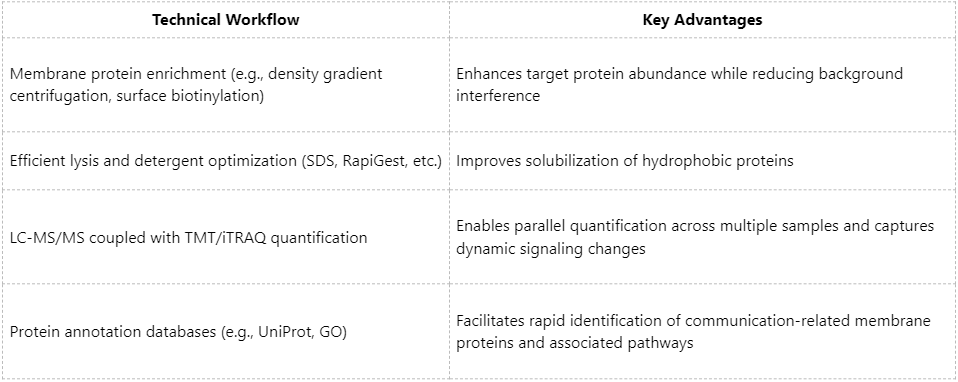
Membrane proteomics enables comprehensive characterization of membrane proteins through high-sensitivity mass spectrometry platforms, integrated with protein enrichment, detergent optimization, and quantitative analytical strategies:
2. Applications in Cell Communication Research
(1) Tumor Immune Evasion Mechanisms
Membrane proteomics allows comparative analysis of membrane protein profiles between cell lines exhibiting high versus low PD-L1 expression, thereby identifying co-expressed molecules such as B7-H3 and CD47. These findings support the rational design of multi-target combinatorial immunotherapeutic strategies.
(2) Stem Cell Microenvironmental Responses
By profiling membrane protein expression changes in stem cells under different extrinsic stimuli, membrane proteomics elucidates the activation states of key signaling pathways, including Notch and Wnt, thereby advancing tissue engineering and regenerative medicine research.
(3) Neuronal Axon Guidance
Membrane proteomics analyses enable the identification of critical guidance receptors, such as Ephrin and Netrin receptors, providing mechanistic insights into how neurons interpret directional cues and establish synaptic networks.
Membrane Proteomics Solutions Provided by MtoZ Biolabs
At MtoZ Biolabs, we have developed a customized platform for in-depth membrane protein analysis, encompassing:
-
High-efficiency membrane protein enrichment workflows (biotinylation labeling combined with membrane fractionation).
-
Optimized lysis systems for hydrophobic proteins compatible with mass spectrometry.
-
High-resolution Orbitrap mass spectrometry with extensive coverage and accurate quantification.
-
Multiplex labeling strategies, including TMT and iTRAQ, tailored for dynamic communication studies.
-
Dedicated bioinformatics support, offering GO, KEGG, and protein-protein interaction (PPI) network analyses.
Across immunology, oncology, and stem cell research, MtoZ Biolabs enables rapid construction of membrane protein-mediated communication networks, thereby accelerating mechanistic studies and therapeutic target discovery.
Membrane proteins function not only as cellular sensors and effectors but also as critical nodes in the organization of intercellular communication networks. Through membrane proteomics, researchers can achieve systematic, quantitative, and dynamic insights into how cells communicate and coordinate their functions. With ongoing advances in mass spectrometry and increasingly sophisticated data analysis methodologies, membrane proteomics is poised to play an expanding role in immunotherapy, targeted drug development, tissue engineering, and related disciplines. MtoZ Biolabs looks forward to collaborating in the exploration of cell communication mechanisms and advancing life science research to new frontiers.
How to order?




