






Mechanism and Advantages of Tandem Mass Tag (TMT) Technology
In modern proteomics research, achieving accurate quantitative comparisons across multiple samples while maintaining high throughput and sensitivity remains a central challenge. Tandem Mass Tag (TMT) technology, with its multiplex labeling capability and precise quantitation, has emerged as one of the most widely adopted strategies in relative quantitative proteomics.
Principle of TMT Technology: Achieving Accurate Multi-Sample Quantitation
TMT is an isotope-coded chemical tag that labels peptides derived from different samples after proteolytic digestion, enabling simultaneous quantitation in a single mass spectrometry workflow. The tag consists of three functional components:
-
Reporter Group: Releases ions of distinct masses during the MS2 stage for quantitation.
-
Balance Group: Compensates for mass differences, rendering all tags isobaric at the MS1 stage.
-
Reactive Group: Covalently binds to the peptide N-terminus or lysine residues.
This architecture ensures that all labeled peptides are indistinguishable in first-stage mass spectrometry (MS1), while differentiation and quantitation are achieved in MS2 via the released reporter ions.
Common TMT Plexes
-
TMT 6plex / 10plex / 11plex: Early versions suitable for medium-throughput experiments.
-
TMTpro 16plex / 18plex: Next-generation tags offering higher throughput, ideal for large-scale cohort studies.
Technical Advantages: Why TMT Excels in Quantitative Proteomics
1. Parallel Analysis of Multiple Samples Enhances Throughput and Consistency
TMT enables the concurrent analysis of up to 18 samples in a single mass spectrometry run, significantly reducing errors from technical replicates. Additionally, co-processing of samples minimizes batch effects, resulting in improved data consistency.
2. High Sensitivity and Coverage through High-Resolution Mass Spectrometry
When combined with high-resolution instruments such as Orbitrap Exploris or Fusion Lumos, TMT achieves excellent quantitative linearity and peptide coverage. This is particularly crucial for detecting low-abundance proteins, a common requirement in studies of tumor microenvironments, neurodegenerative diseases, and other biological contexts.
3. Strong Scalability and Integrative Capability
TMT is compatible with diverse sample types, including cells, tissues, and bodily fluids, and can be integrated with analyses of phosphorylation, ubiquitination, and other post-translational modifications, providing a comprehensive systems biology perspective.
TMT vs Other Quantitative Strategies: Advantages and Limitations
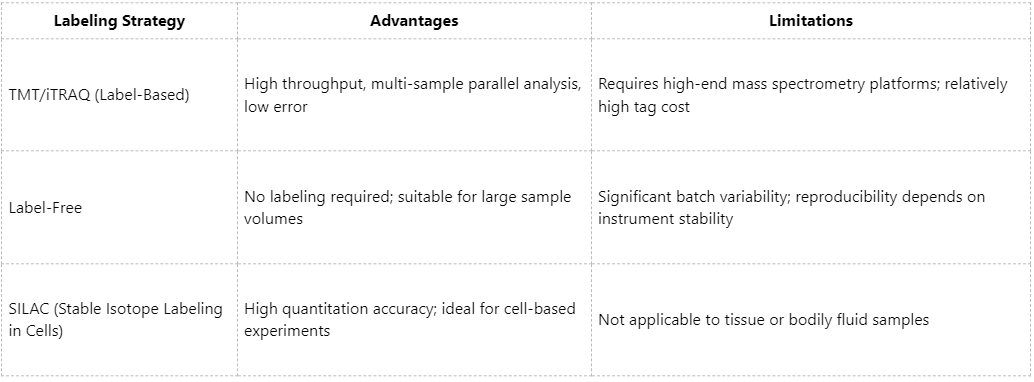
Thus, when budget permits and sample numbers are manageable, TMT represents the preferred approach for achieving high-consistency quantitation and inter-group comparisons.
Applications: Demonstrated Value of TMT in Proteomics Research
1. Cancer Research: Compare protein expression between tumor and adjacent normal tissues to identify potential therapeutic targets.
2. Metabolic Disorders: Characterize protein profiles in liver or serum from model animals of obesity, diabetes, and related conditions to elucidate metabolic regulation mechanisms.
3. Neuroscience: Analyze differential protein expression in brain tissue from Alzheimer's patients and controls to investigate proteins associated with disease pathology.
4. Pharmacology and Toxicology: Assess protein expression changes before and after drug treatment in model systems, supporting drug development efforts.
MtoZ Biolabs: Delivering High-Standard TMT Proteomics Solutions
At MtoZ Biolabs, we combine advanced Orbitrap mass spectrometry platforms with optimized TMT workflows to provide researchers with:
-
Standardized TMT 6/10/18plex proteome quantitation services.
-
Rigorous quality control to ensure consistency and reproducibility across samples.
-
Support for diverse sample types, including tissues, bodily fluids, and cells.
-
Comprehensive solutions spanning experimental design to bioinformatics analysis.
We have supported numerous research teams and pharmaceutical companies with TMT-based services, facilitating publications and project advancement in oncology, cardiovascular, immunology, metabolism, and other fields.
As life sciences research advances, demands for comparability, throughput, and accuracy of proteomic data continue to grow. With multiplex labeling, precise quantitation, and high throughput, TMT is progressively becoming a mainstream strategy in proteomics research. Researchers are encouraged to select proteomics technologies based on their study objectives, sample types, and budget. For projects seeking TMT-based strategies, MtoZ Biolabs offers professional technical support and reliable, high-quality proteomics solutions.
MtoZ Biolabs, an integrated chromatography and mass spectrometry (MS) services provider.
Related Services
How to order?




