






Mannan Analysis Service
Mannan is a class of polysaccharides composed mainly of mannose as the principal monosaccharide unit. It is widely present in plant seed cell walls, yeast cell walls, fungal outer membranes, and certain bacterial extracellular polysaccharides. According to the types of glycosidic linkages and branching structures, mannans can be divided into linear mannan, galactomannan, glucomannan, and acetylated derivatives. These polysaccharides not only play structural roles in organisms but also participate in key processes such as cell signal transduction, stress response, immune regulation, and energy metabolism.
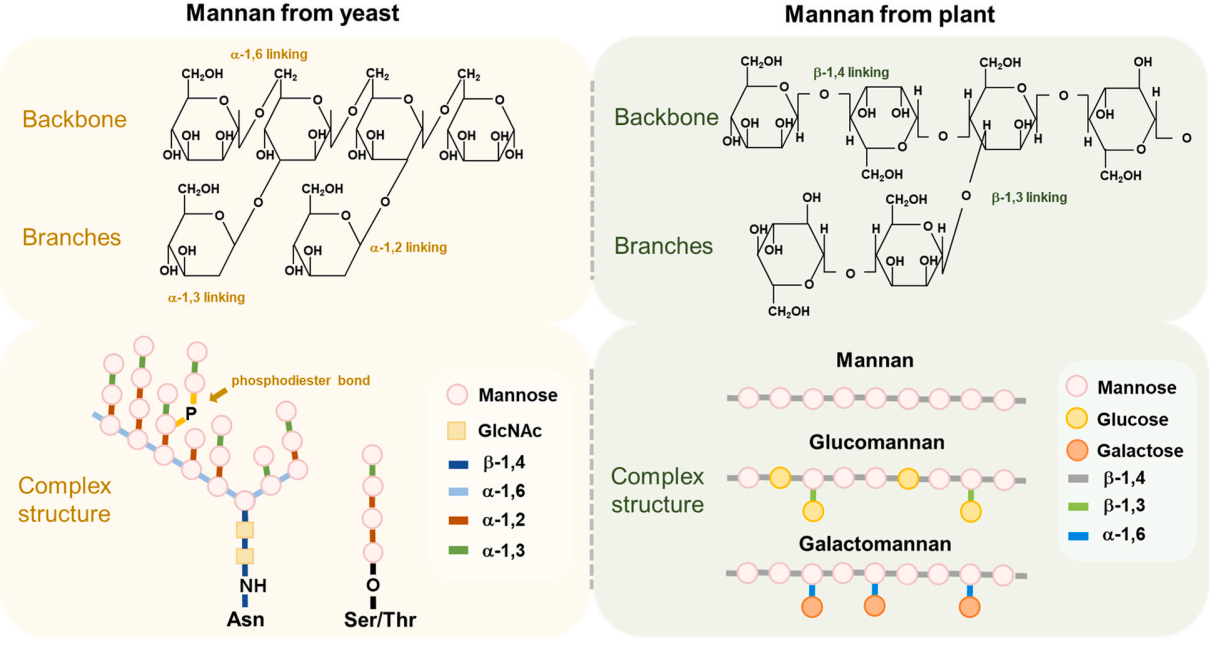
Baek, KR. et al. Heliyon. 2024.
Figure 1. Yeast Mannan and Other Cell Wall Polysaccharide Structures
In both industrial and scientific research fields, the detection and characterization of mannans are of great importance. In the food industry, they are important components of emulsifiers, stabilizers, and soluble dietary fibers. In pharmaceutical and nutraceutical development, mannans are often used as natural immune enhancers or drug carriers. In microbiology and glycomics studies, structural changes in mannans can reflect the physiological state and metabolic differences of cell walls.
Relying on advanced chromatographic, mass spectrometric, and spectroscopic platforms, MtoZ Biolabs provides a high-resolution and high-sensitivity mannan analysis service that covers comprehensive analysis from qualitative identification and molecular structural elucidation to quantitative determination. Our service is applicable to research institutions, food enterprises, biopharmaceuticals, and agricultural sciences, providing customers with reliable and traceable glycomics data solutions.
Services at MtoZ Biolabs
1. High-Performance Liquid Chromatography (HPLC)
HPLC is one of the most commonly used techniques for the separation and quantification of mannans. MtoZ Biolabs is equipped with high-performance liquid chromatography systems with RID, ELSD, and PAD detectors, enabling separation, quantification, and detection of hydrolysis products and derivatized components. Through derivatization methods such as PMP, ABEE, and 2-AB, we can achieve high-resolution separation of mannose and other neutral sugars in complex samples and perform accurate quantification using external standards.
2. Gas Chromatography–Mass Spectrometry (GC–MS)
GC–MS plays an important role in methylation analysis and glycosidic bond type determination of polysaccharides. Mannans are fully methylated, hydrolyzed, and reduced to form partially methylated alditol acetate (PMAA) derivatives. MtoZ Biolabs uses GC–MS to precisely analyze retention times and fragment ions of these derivatives, thus deducing linkage types and branching sites of sugar chains. This technique is particularly suitable for structurally complex plant and fungal mannans and serves as a core method for revealing polysaccharide microstructures.
3. Liquid Chromatography–Tandem Mass Spectrometry (LC–MS/MS)
LC–MS/MS combines efficient separation with high-resolution detection and enables sensitive detection of mannans and their degradation fragments in complex systems. MtoZ Biolabs is equipped with advanced Orbitrap and TripleTOF mass spectrometers that can identify polysaccharide fragments of different chain lengths and modification states. Through ion fragmentation modes such as CID and HCD, glycosidic linkages and branching patterns can be confirmed, supporting structural elucidation and modification analysis. This method offers high sensitivity and rich structural information and is suitable for detailed analysis of both natural and chemically modified samples.
4. Nuclear Magnetic Resonance (NMR) Spectroscopy
NMR is an essential tool for elucidating the advanced structure and spatial configuration of mannans. MtoZ Biolabs employs one-dimensional and two-dimensional NMR techniques (1H NMR, 13C NMR, COSY, HSQC, HMBC, etc.) to determine glycosidic bond types, branching sites, and substitution distributions. Combined with chromatographic and mass spectrometric results, NMR can build complete structural models of sugar chains, accurately characterizing the conformational features of mannans. This technique is particularly suitable for structural confirmation and standard preparation of high-purity samples.
5. Gel Permeation Chromatography–Multi-Angle Light Scattering (GPC–MALS)
To evaluate the molecular weight and distribution of mannans, MtoZ Biolabs uses the GPC–MALS platform for calibration-free analysis. By combining multi-angle light scattering with refractive index detection, the number-average molecular weight (Mn), weight-average molecular weight (Mw), and polydispersity index (PDI) can be directly measured. This technique intuitively reflects the degree of polymerization and uniformity of samples and is valuable for quality control and process optimization.
Analysis Workflow
1. Sample pretreatment: desalting, impurity removal, dissolution, or purification according to sample type to ensure a clean matrix
2. Chemical or enzymatic hydrolysis: optimized hydrolysis conditions to release monosaccharides or oligosaccharide fragments
3. Derivatization: use of reagents such as PMP and ABEE to enhance detection sensitivity
4. Multi-platform analysis: integrated analysis using HPLC, LC–MS/MS, GC–MS, GPC–MALS, and NMR
5. Data integration and report generation: cross-validation of spectral data to produce qualitative and quantitative conclusions and generate visualized reports
Service Advantages
1. Multi-Platform Integration
MtoZ Biolabs integrates HPLC, GC–MS, LC–MS/MS, GPC–MALS, and NMR into one analytical system, forming a closed-loop workflow from quantitative detection to structural elucidation. This ensures scientific rigor and mutual validation of results.
2. High Sensitivity and High Resolution
Using advanced Orbitrap and TripleTOF mass spectrometers, MtoZ Biolabs accurately identifies trace mannan fragments or complex mixtures with a high signal-to-noise ratio and reliable results.
3. Customized Analytical Solutions
For samples from plants, fungi, food, or fermentation systems, MtoZ Biolabs provides customized pretreatment strategies and analytical routes to meet the diverse needs of complex polysaccharide analysis.
Applications
✔️ Plant cell wall structure research: identifying polysaccharide composition and biosynthetic mechanisms
✔️ Fungal and microbial glycomics: elucidating structural diversity and biological function of cell walls
✔️ Food and nutritional science: evaluating the structure and content of mannans as functional dietary fibers
✔️ Pharmaceutical polysaccharide development: analyzing active components, structural modifications, and efficacy validation
✔️ Industrial fermentation process monitoring: tracking polysaccharide synthesis efficiency and product consistency
Sample Submission Suggestions
1. Sample types: solid powders, lyophilized materials, or liquid solutions
2. Sample purity: ≥85%; if crude extracts, please provide the extraction method description
3. Sample quantity: solid ≥5 mg; liquid ≥500 μL (concentration ≥1 mg/mL)
4. Storage conditions: store at low temperature and avoid light; use dry ice or cold-chain transportation
5. Additional information: indicate the sample source, treatment, and analysis purpose to customize the testing plan
MtoZ Biolabs will provide detailed confirmation and sample preparation guidelines after receiving samples.
Deliverables
1. Qualitative and quantitative mannan analysis report
2. Complete chromatograms and raw data files
3. Molecular weight distribution curves and structural models
4. Method description and result interpretation suggestions
5. Optional data mining and scientific consultation support
MtoZ Biolabs provides a one-stop mannan analysis service to help you obtain reliable and reproducible structural and quantitative information from complex samples.
How to order?




