






Lipid Nanodiscs Assembly Technology Service
Lipid nanodiscs assembly technology is a specialized technique that constructs a phospholipid bilayer system to embed membrane proteins in a native-like conformation. These nanodiscs are composed of a phospholipid bilayer stabilized by amphipathic membrane scaffold proteins (MSPs), forming water-soluble nanoscale structures approximately 8–16 nm in diameter.
This method effectively mitigates issues of conformational instability and activity loss that commonly occur when membrane proteins are solubilized in detergents. It provides an ideal platform for membrane protein structural analysis, functional validation, and drug mechanism studies. Lipid nanodiscs are particularly well-suited for studying GPCRs, ion channels, transporters, and are compatible with cryo-EM and biophysical techniques.
MtoZ Biolabs offers high-quality, customizable Lipid Nanodiscs Assembly Technology Service that is supported by an advanced membrane protein expression platform and extensive experience in nanodisc-based reconstitution and cryo-EM applications.
Technical Principles
The core principle of lipid nanodiscs assembly lies in co-assembling phospholipids and MSPs to form disc-shaped bilayer structures that mimic native membranes. MSPs adopt amphipathic alpha-helical conformations, interacting via their hydrophobic faces with lipid tails while exposing hydrophilic surfaces to the aqueous environment—resulting in highly soluble and stable nanodiscs.
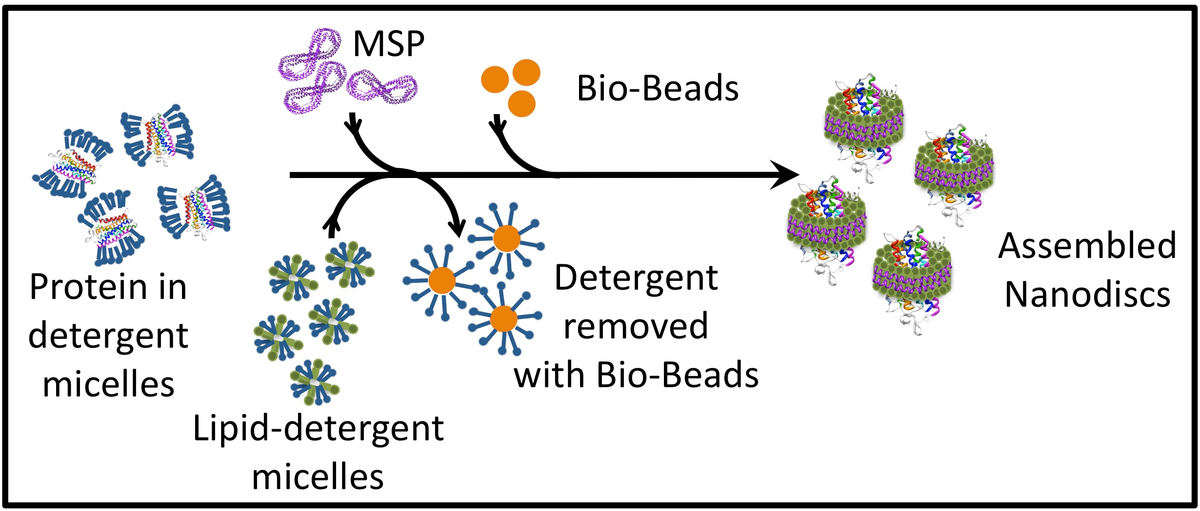
The standard assembly workflow involves dissolving the target membrane protein and phospholipids in detergent to form micelles, then mixing with MSPs in an optimized molar ratio. Detergent is gradually removed by Bio-Beads, driving the self-assembly of monodisperse nanodiscs. The nanodisc diameter and bilayer thickness can be precisely tuned by modulating MSP length and lipid composition, making this method widely adopted for cryo-EM sample preparation and functional assays.
Mitra. N. et al. Mater Methods. 2013.
Figure 1. A Cartoon Representation of the Process of Nanodisc Assembly
Why Choose MtoZ Biolabs?
MtoZ Biolabs provides a reliable Lipid Nanodiscs Assembly Technology Service with the following strengths:
✅ Native-like membrane reconstitution: Supports proper folding and functional maintenance of membrane proteins for downstream bioactivity studies.
✅ Optimized molar ratio ensures monodispersity: Fine control over MSP and lipid ratios ensures nanodisc uniformity, enhancing cryo-EM image quality.
✅ Broad compatibility with diverse membrane proteins: Suitable for proteins of various origins, sizes, and tags across multiple experimental systems.
✅ High solubility and structural stability: Nanodiscs maintain long-term solubility and sample integrity for batch experiments.
✅ Full-service workflow: Covers expression, purification, nanodisc assembly, cryo-EM preparation, and structural analysis—streamlining your research.
✅ One-time-charge: Our pricing is transparent, no hidden fees or additional costs.
Applications
Lipid Nanodiscs Assembly Technology is a critical preparative tool across membrane protein research, including:
· Cryo-EM structural reconstruction: Provides stable, homogeneous particles for single-particle cryo-EM imaging.
· Membrane protein–ligand interaction studies and drug screening: Facilitates SPR, ITC, and HDX-MS experiments under near-native conditions.
· Functional activity assays: Supports ATPase activity, ion channel conductance, and other functional measurements.
· Antibody screening and epitope mapping: Presents conformationally native antigens for neutralizing antibody discovery.
· Membrane protein engineering and mutagenesis: Enables structure–function studies of targeted mutations.
Case Study
Case 1: Lipid Nanodiscs Facilitate Structural and Functional Characterization of ChRmine
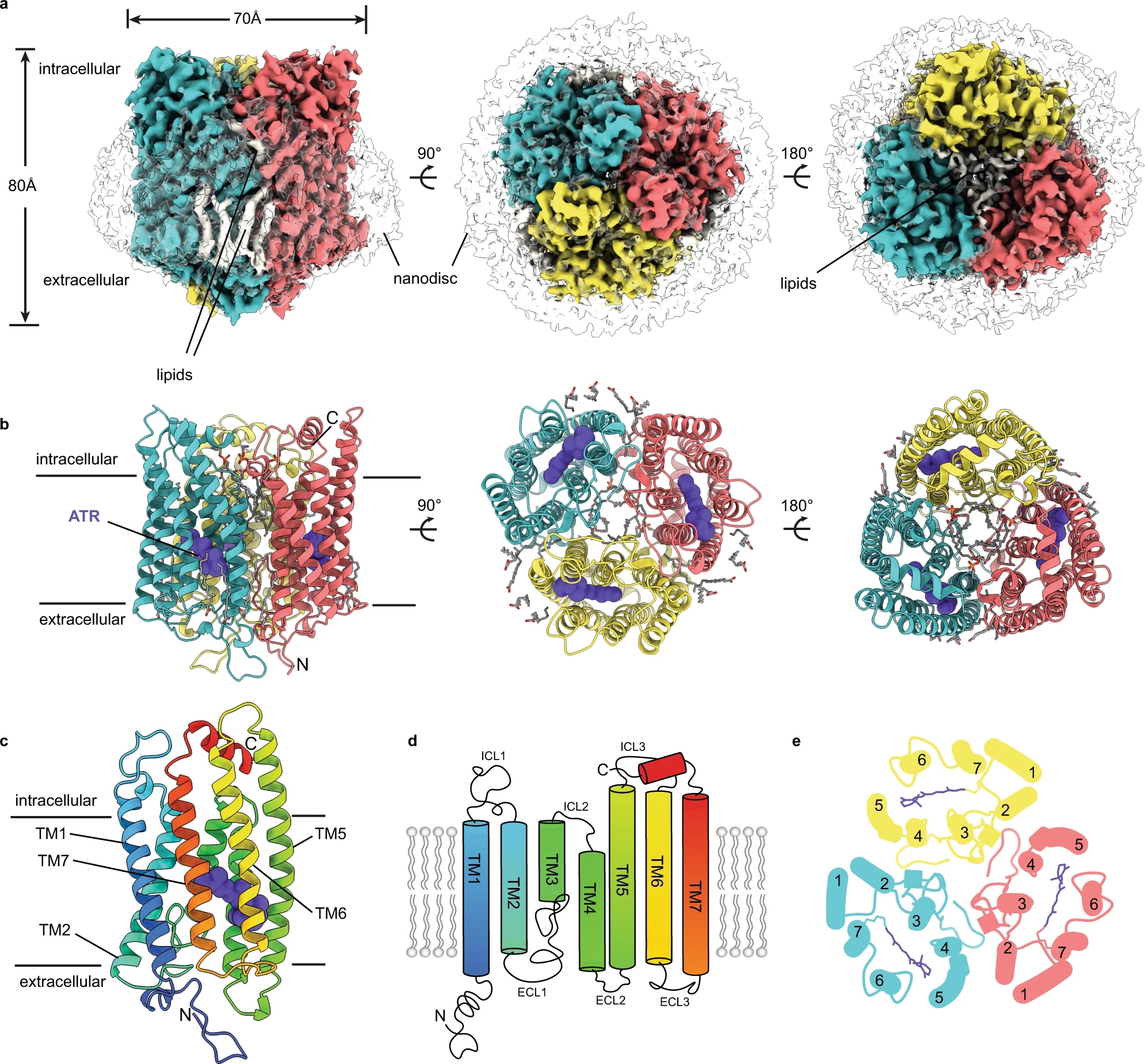
ChRmine is a light-activated cation channel protein with exceptional photosensitivity, red-shifted activation spectrum, and large ionic conductance—widely used in optogenetics. Researchers used lipid nanodiscs to reconstitute ChRmine and resolved its apo and retinal-bound structures using cryo-EM. Results revealed a unique trimeric configuration with a lipid-filled central cavity critical for conformational stability and ion conductance. Key gating residues were identified, and kinetic-enhancing mutations were engineered. This study highlights lipid nanodiscs as a robust physiological mimic, significantly improving structural fidelity and functional insight.
Tucker, K. et al. Nat. Commun. 2022.
MtoZ Biolabs offers professional Lipid Nanodiscs Assembly Technology Service to support membrane protein reconstitution, cryo-EM analysis, and ligand screening across diverse applications.
FAQ
Q1: How do I know if my membrane protein is suitable for nanodisc reconstitution?
Nanodiscs are particularly suited for membrane proteins >25 kDa with defined transmembrane domains, especially those prone to aggregation or functional loss in detergent. If your protein shows instability or heterogeneity, nanodiscs can significantly improve structural fidelity and activity. MtoZ Biolabs offers pre-assessment to guide strategy selection.
Q2: Is the MSP-to-lipid ratio fixed during nanodisc assembly?
No, this ratio depends on the protein’s size, hydrophobicity, and desired nanodisc diameter. MtoZ Biolabs will optimize the MSP-to-lipid molar ratio to generate monodisperse, structurally consistent nanodiscs.
Q3: Are nanodiscs suitable for functional assays?
Yes. Nanodisc-reconstituted proteins are compatible with SPR, ITC, HDX-MS, enzymatic assays, and more. MtoZ Biolabs can advise on downstream compatibility and assay design.
Stable reconstitution in native-like environments is critical for successful membrane protein studies. MtoZ Biolabs’ Lipid Nanodiscs Assembly Technology Service offers standardized workflows, customizable formats, and platform integration to support structural biology and drug development.
Contact us to receive tailored membrane protein reconstitution strategies and explore the frontiers of structure-based discovery.
How to order?




