






Is MS/MS the same as MS2?
Introduction
Method sections, instrument software, and proteomics quotes often switch between the terms MS/MS and MS2 without explanation. A collaborator may write MS/MS in a manuscript while an acquisition method lists MS2 scans. A service description may say tandem MS, MS/MS, or MS2 and appear to describe different experiments. Researchers new to mass spectrometry reasonably ask whether these labels mean the same thing.
In most proteomics and small-molecule identification contexts, MS/MS and MS2 refer to the same analytical idea: a second mass analysis stage after precursor ion selection and fragmentation. The terms are largely interchangeable in everyday scientific language. They are not always used in identical positions in a sentence, because MS/MS often names the technique, while MS2 often names the scan stage inside an acquisition method.
This article clarifies what MS/MS and MS2 mean, where the wording overlaps, where naming conventions differ, and how to choose clear language when planning an LC-MS project.
Why the Terminology Question Comes Up
Confusion usually starts when documents mix historical notation with modern software labels.
Older literature and many textbooks use MS/MS for tandem mass spectrometry. Newer instrument methods, especially in Thermo-style acquisition editors and related software environments, commonly label the product ion scan as MS2. Reviewers may also see MS1 for the precursor survey scan and MS3 for an additional fragmentation stage. When these labels appear together, it can look as if MS/MS and MS2 are different methods rather than related names for the same second-stage measurement.
The practical risk is communication error. A request for MS only may be interpreted as precursor measurement without fragmentation. A request for MS2 may be interpreted as product ion spectra required for identification. Clear terminology prevents mismatched quotes, incomplete sequence evidence, and avoidable rework.
What MS/MS Means
MS/MS stands for tandem mass spectrometry. In a typical MS/MS experiment, the instrument first measures or selects a precursor ion, then fragments that ion, and then measures the resulting product ions.
The slash notation historically indicated two linked mass analysis events. In proteomics, MS/MS spectra provide fragment ion patterns used for peptide sequence assignment, modification localization, and targeted transition monitoring. The same concept appears in phrases such as LC-MS/MS, tandem MS, and product ion scanning.
MS/MS therefore usually names the technique or experiment class: precursor selection plus fragmentation plus product ion analysis.
What MS2 Means
MS2 usually names the second stage of an MSn acquisition sequence.
MS1 refers to the first-stage survey or precursor scan. MS2 refers to the product ion scan generated after isolation and fragmentation of a selected precursor. If another fragmentation stage is performed on a product ion, that stage may be called MS3. In this numbering system, MS2 is the operational label for the second-stage spectrum.
In practice, an MS2 spectrum is the same class of data that many papers call an MS/MS spectrum. The difference is mostly naming convention, not a separate physical principle.
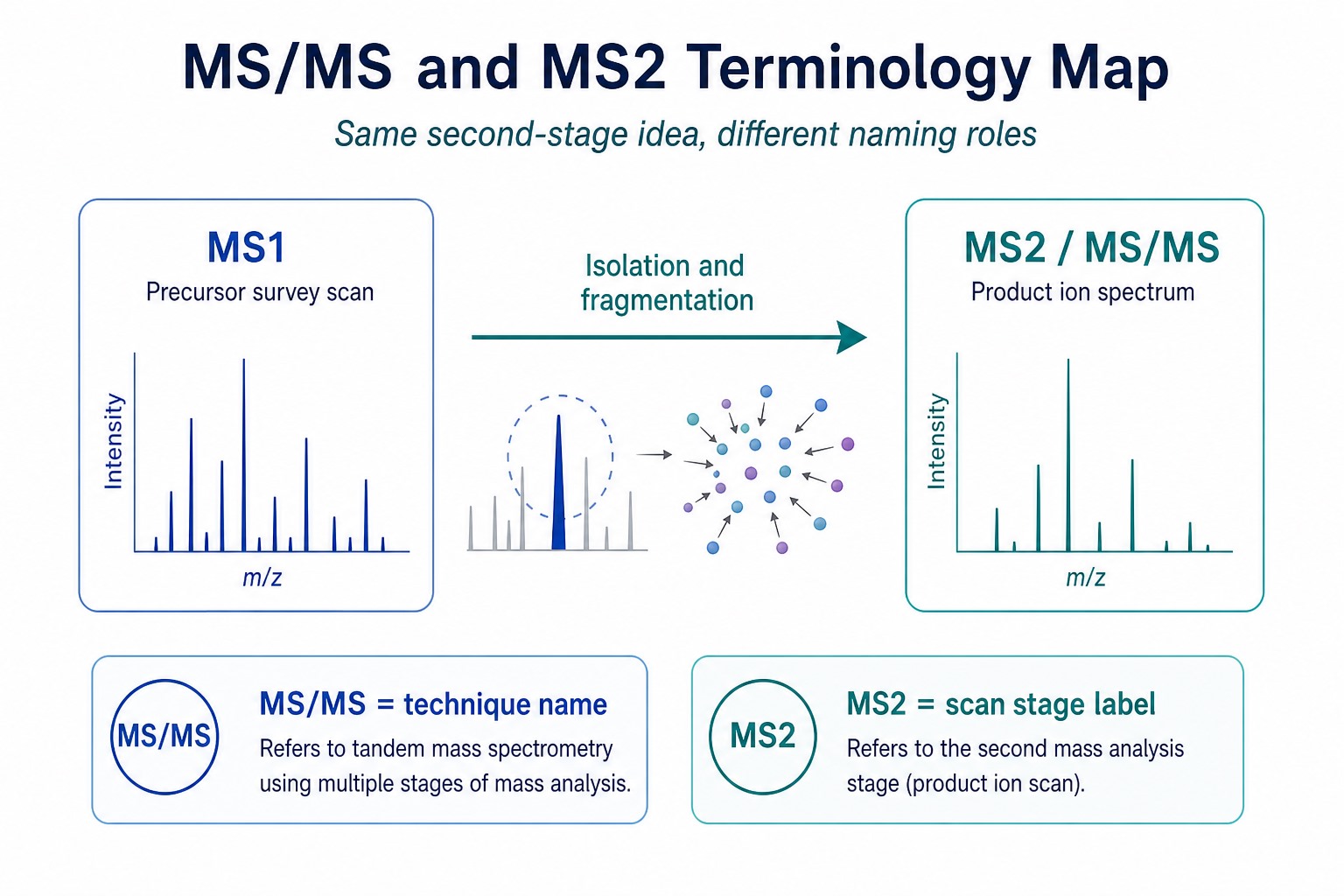
Figure 1. MS1 measures precursor ions, while MS2 and MS/MS both refer to the product ion stage after fragmentation.
Are MS/MS and MS2 the Same?
For most proteomics and identification projects, yes. MS/MS and MS2 describe the same second-stage measurement concept.
When a paper says peptide MS/MS spectra were acquired, it generally means product ion spectra after fragmentation. When software exports MS2 scans, those files usually contain the same type of fragment ion spectra. In LC-MS/MS proteomics, the identification engine reads those spectra to assign peptide-spectrum matches.
The terms are not always stylistically identical. MS/MS is common in manuscripts, reviews, and service descriptions as the technique name. MS2 is common in method editors, scan headers, and data-processing vocabulary as the stage name. Saying "we acquired MS2 scans" and "we acquired MS/MS spectra" usually points to the same experimental intent.
A useful short rule is:
- Use MS/MS when naming the technique in proposals, papers, and client discussions
- Use MS2 when referring to the second-stage scan type inside an acquisition or processing workflow
- Treat both as tandem product ion analysis unless a document clearly defines a special local meaning
Key Comparison Dimensions
Comparing the labels across a few practical dimensions makes the overlap clearer.
Naming role
MS/MS usually functions as a technique name. MS2 usually functions as a scan-stage label.
Analytical meaning
Both point to product ion measurement after precursor fragmentation in standard tandem MS workflows.
Relationship to MS1
MS1 is the precursor stage. MS2 or MS/MS is the fragmented product ion stage that follows selected precursors.
Communication context
Manuscripts and quotes often prefer MS/MS. Instrument methods and raw-file browsers often prefer MS2.
|
Dimension |
MS/MS |
MS2 |
|---|---|---|
|
Typical usage |
Technique or experiment name |
Second-stage scan label |
|
Analytical meaning |
Tandem MS with product ions |
Product ion stage after fragmentation |
|
Common context |
Papers, reviews, service descriptions |
Method editors, scan headers, processing tools |
|
Relation to MS1 |
Contrasted with precursor-only MS |
Numbered stage after MS1 |
|
Relation to MS3 |
Broader tandem MS family term |
Next fragmentation stage in MSn numbering |
|
Everyday equivalence |
Usually interchangeable with MS2 |
Usually interchangeable with MS/MS |
The comparison shows wording differences, not two unrelated analytical technologies.
Related Services
Protein Identification Service
Label-Free Quantitative Proteomics Service, MS Based
Multi Reaction Monitoring MRM Service
Teams clarifying whether a project needs precursor-only MS or tandem MS2 and MS/MS acquisition can consult MtoZ Biolabs to align terminology with the required identification or quantitation output.
How the Measurement Chain Works
Understanding the scan sequence helps keep the vocabulary straight.
In a common data-dependent proteomics method, the instrument collects an MS1 survey scan of precursor ions. Selected precursors are isolated and fragmented. The instrument then records an MS2 or MS/MS product ion spectrum for each selected precursor. Database search or spectral library tools compare those fragment patterns with expected peptide fragments.
Targeted methods such as PRM follow the same logic with preselected precursors. The monitored transitions or full product ion spectra still come from the second-stage measurement. Whether the method file labels those scans MS2 or the paper calls them MS/MS, the measurement chain is precursor selection, fragmentation, and product ion detection.
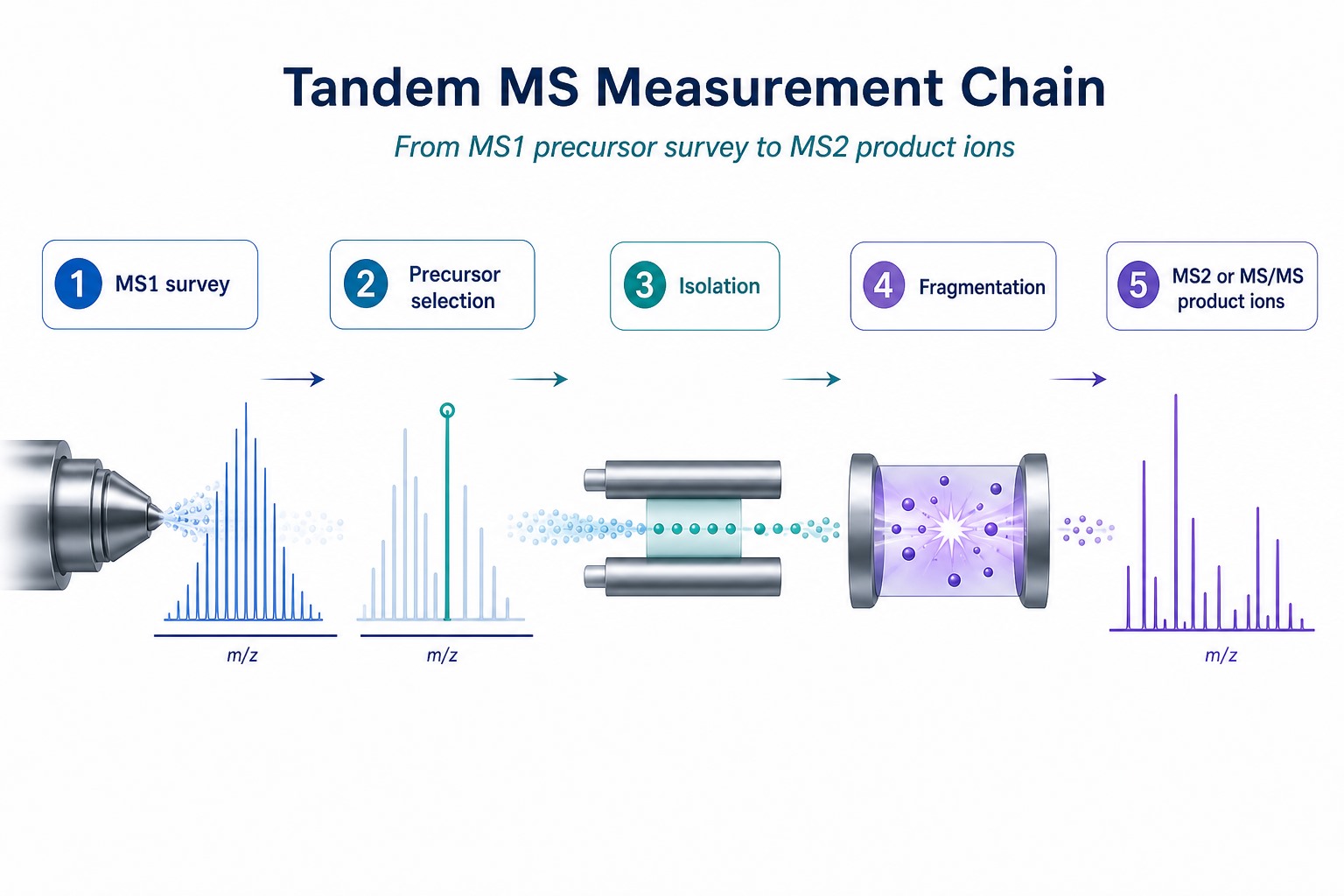
Figure 2. A tandem MS measurement chain moves from MS1 precursor survey to isolation, fragmentation, and MS2 or MS/MS product ion detection.
Decision Guidance for Project Language
Clear wording should follow the project goal.
If the goal is peptide or protein identification
State that MS/MS or MS2 product ion spectra are required. Precursor-only MS1 data are usually insufficient for sequence assignment in discovery proteomics.
If the goal is targeted quantitation of known peptides
Specify whether the assay needs MS2 fragment transitions, full MS2 spectra, or precursor-only monitoring. PRM and MRM-style methods commonly rely on fragment ions even when daily speech still says tandem MS or MS/MS.
If the goal is intact mass without sequence fragments
Ask for MS1 or intact MS and avoid requesting MS2 unless fragmentation is intentionally part of the plan.
If documents mix terms
Define them once in the method note. A short line such as "MS2 scans refer to MS/MS product ion spectra" prevents ambiguity between collaborators, vendors, and reviewers.
For teams drafting method language for identification or targeted workflows, MtoZ Biolabs can help translate project goals into consistent MS1 and MS2 acquisition terms.
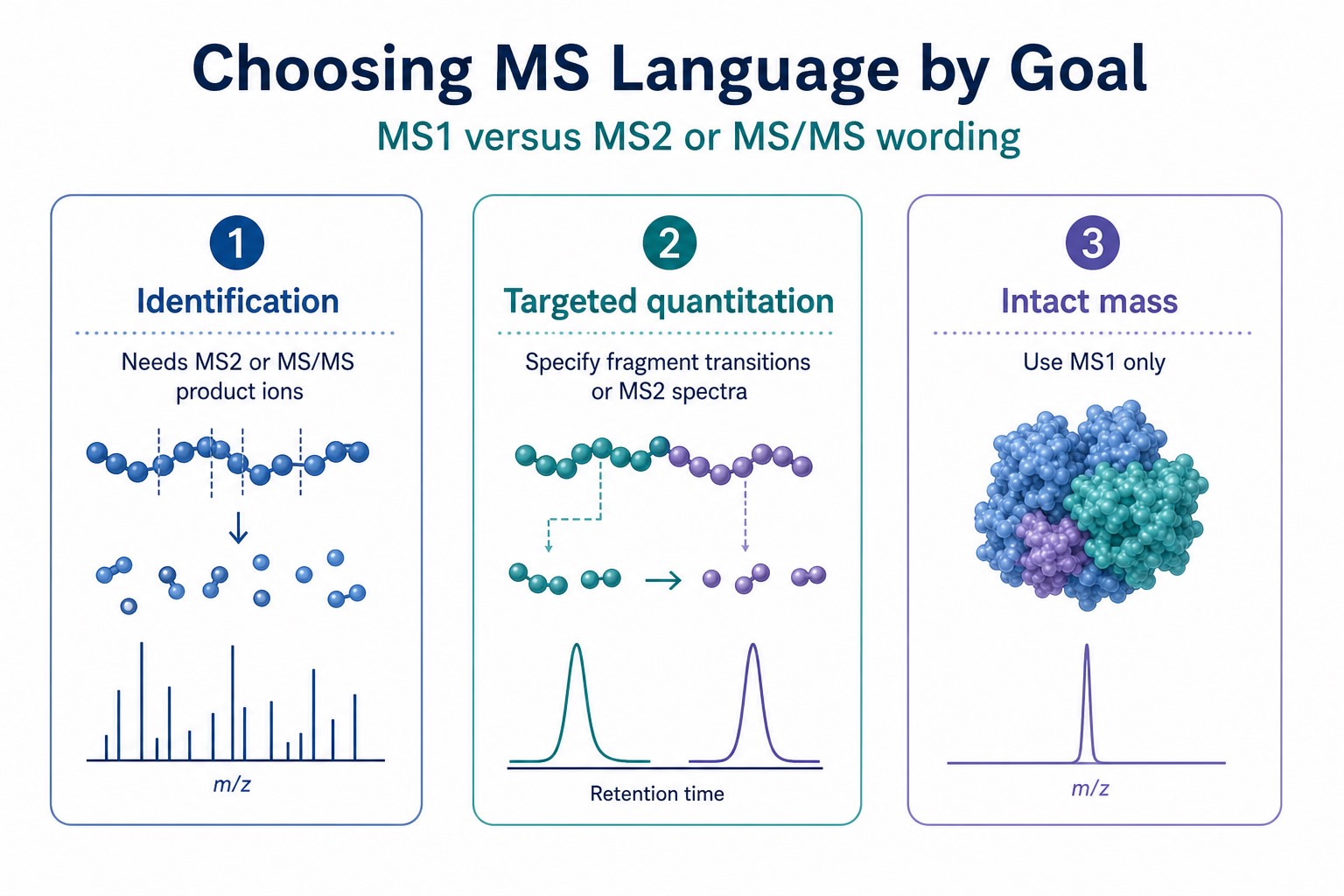
Figure 3. Use MS2 or MS/MS language when product ions are required, and reserve MS1 language for precursor-only intact or survey measurements.
Common Misunderstandings to Avoid
Several recurring misunderstandings create unnecessary project friction.
MS/MS is not a different ionization mode from MS2. Both names describe tandem product ion analysis after fragmentation.
MS2 is not automatically higher quality than MS/MS. The labels do not rank data quality by themselves. Quality depends on method design, sample preparation, and instrument settings.
Requesting MS without specifying MS2 or MS/MS can be ambiguous. Some readers will assume precursor-only measurement. Others will assume tandem acquisition is implied. Explicit wording is safer.
MS3 is not the same as MS2. MS3 adds another fragmentation stage and is used only when the project specifically needs that deeper scan structure.
Frequently Asked Questions
1. Is MS/MS the same as MS2?
In most proteomics and identification contexts, yes. Both refer to the second-stage product ion measurement after precursor fragmentation.
2. What is the difference in wording between MS/MS and MS2?
MS/MS is commonly used as the technique name. MS2 is commonly used as the scan-stage label in methods and data files.
3. What does MS1 mean compared with MS2?
MS1 is the precursor or survey stage. MS2 is the product ion stage after isolation and fragmentation.
4. Do I need MS2 for protein identification?
Yes, in typical bottom-up proteomics. Sequence assignment usually depends on fragment ion spectra from MS2 or MS/MS acquisition.
5. Is LC-MS/MS the same as collecting MS2 scans?
In practice, yes for most proteomics methods. LC-MS/MS workflows collect chromatographic separations plus MS2 product ion spectra for selected precursors.
6. Should a quote say MS/MS or MS2?
Either can be clear if defined. Many client-facing documents use MS/MS, while method details may list MS2 scan settings for the same experiment.
Conclusion
MS/MS and MS2 are largely the same analytical concept expressed through different naming conventions. MS/MS typically names tandem mass spectrometry as a technique. MS2 typically names the second-stage product ion scan within an acquisition sequence. Both describe precursor selection, fragmentation, and product ion measurement.
For project planning, the important distinction is not MS/MS versus MS2. The important distinction is precursor-only MS1 measurement versus tandem product ion acquisition. When identification or fragment-based targeted quantitation is required, state clearly that MS2 or MS/MS spectra are needed. Researchers preparing proteomics or protein identification projects can contact MtoZ Biolabs to confirm terminology, acquisition depth, and the reporting format matched to the current project phase.
How to order?




