






How to Improve Peptide Sequence Analysis Confidence in LC-MS/MS Workflows
Introduction
LC-MS/MS can generate large peptide datasets quickly, yet many projects still end with borderline assignments that cannot support a QC, comparability, or publication decision. A peptide-spectrum match may look acceptable in software output while fragment evidence remains incomplete. A modified peptide may receive a high score without residue-level localization support. A de novo assignment may appear plausible but fail manual review under project validation standards. In each case, the issue is not only identification rate but assignment confidence.
Peptide sequence analysis confidence depends on decisions made across sample preparation, digestion, acquisition, search parameters, and expert review. Weak spectra, chimeric precursors, incorrect database setup, missed modifications, and insufficient replicate depth all reduce the reliability of sequence calls. Teams that focus only on increasing identifications often report more peptides while leaving critical assignments unresolved. A confidence-first workflow prioritizes evidence quality over list length.
Improving confidence in LC-MS/MS peptide sequence analysis helps protein research, proteomics, and biologics teams produce sequence evidence that can withstand internal review, comparability assessment, and documentation needs. The sections below outline where confidence is most often lost and which workflow changes produce the strongest improvement.
Why Peptide Sequence Confidence Drops in LC-MS/MS Workflows
Most confidence problems trace back to a limited set of workflow weaknesses rather than instrument failure alone.
Weak or incomplete MS/MS fragmentation.
Low signal, poor precursor selection, or insufficient acquisition time can leave fragment ladders too sparse for confident residue assignment.
Sample and digestion issues.
Inefficient digestion, matrix interference, low purity, or incompatible buffers can reduce peptide recovery and produce noisy spectra.
Incorrect or incomplete reference setup.
Missing sequence entries, wrong enzyme specificity, or outdated construct files can create false negatives and misleading search results.
Modification parameter mismatch.
Unsearched PTMs, variable modification overuse, or missing labile modifications can produce false matches or missed true peptides.
Automated acceptance without review.
Software scores alone may not distinguish confident assignments from borderline matches, especially for modified peptides and low-abundance features.
Insufficient replicate or orthogonal support.
Single-run evidence may be inadequate when the sequence call must support a high-stakes decision.
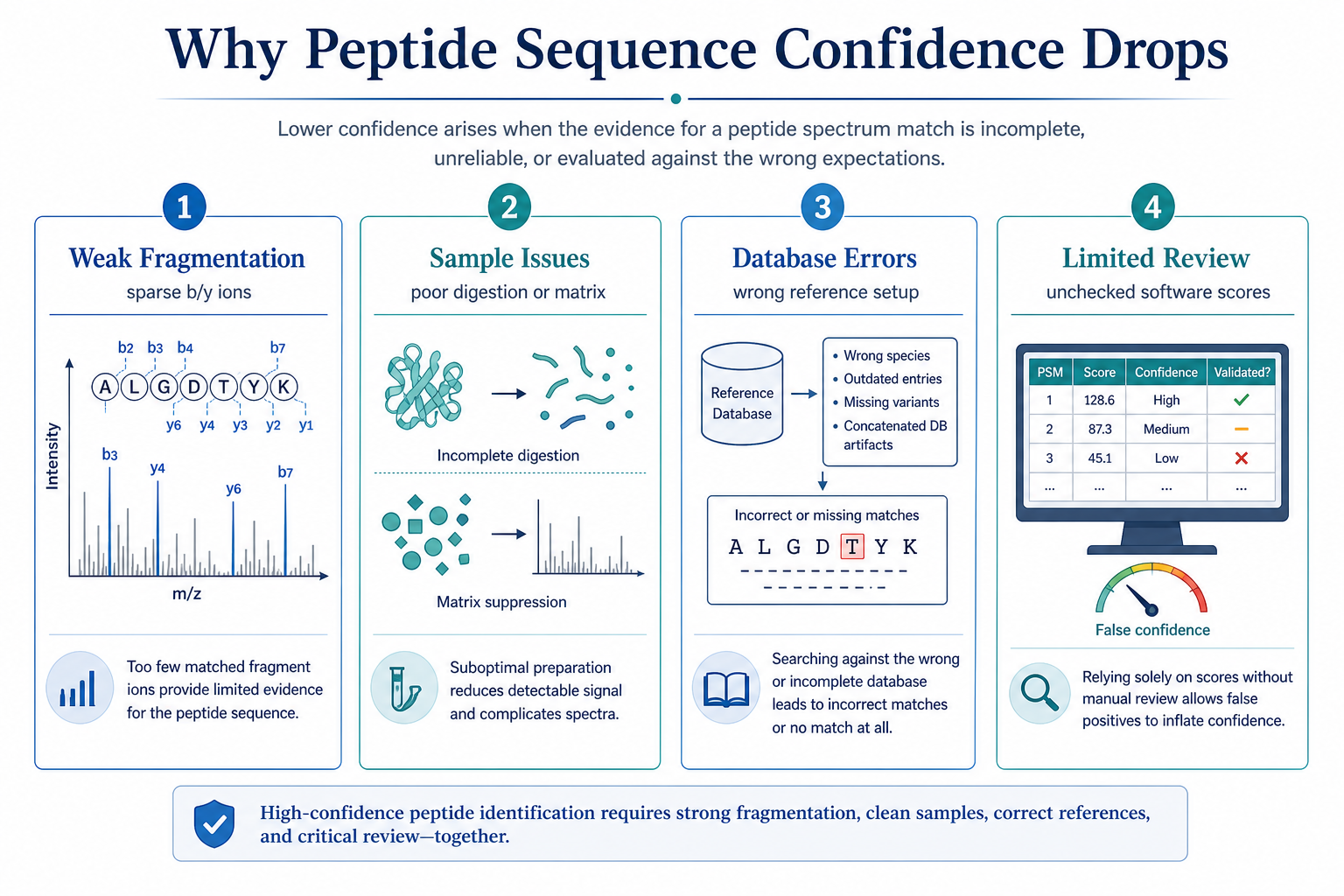
Figure 1. Peptide sequence confidence in LC-MS/MS workflows is most often reduced by weak fragmentation, sample preparation problems, database setup errors, and insufficient expert review.
Practical Ways to Improve Confidence Across the Workflow
Confidence improves when upstream sample quality, acquisition depth, and review standards are planned together rather than corrected after the first report.
Strengthen sample preparation and digestion quality
Use representative material, confirm protein concentration accurately, and remove salts, detergents, or excipients that suppress peptide ionization when possible. Select digestion conditions matched to protein architecture, including reduction and alkylation when disulfide-linked regions must be covered. A cleaner digest with more complete cleavage often improves confidence more than aggressive search stringency alone.
Optimize LC-MS/MS acquisition for fragment evidence
Increase gradient length, acquisition time, or replicate injections when low-abundance peptides or difficult modified forms are central to the project. Use resolution and mass accuracy settings suited to the peptide set and modification scope. Confidence rises when spectra contain clear y-ion and b-ion series rather than only precursor-rich but fragment-poor data.
Build an accurate search environment
Provide complete reference sequences, correct enzyme rules, appropriate fixed and variable modifications, and realistic mass tolerances. Custom databases are often necessary for recombinant constructs, fusion proteins, sequence variants, or species with incomplete annotation. A well-built search space reduces both missed identifications and false positives.
Apply conservative scoring and manual review
Set false discovery rate controls appropriate to the study and inspect critical peptides manually. Review modified peptide assignments for diagnostic fragment support. Reject borderline PSMs that cannot support the intended claim, even if they increase total identification counts.
Add replicate and orthogonal confirmation
Repeat LC-MS/MS analysis, use alternative digestion routes for difficult regions, or confirm selected sequences with synthetic peptide standards or Edman readout when the decision standard requires it. Confidence increases when independent evidence converges on the same sequence call.
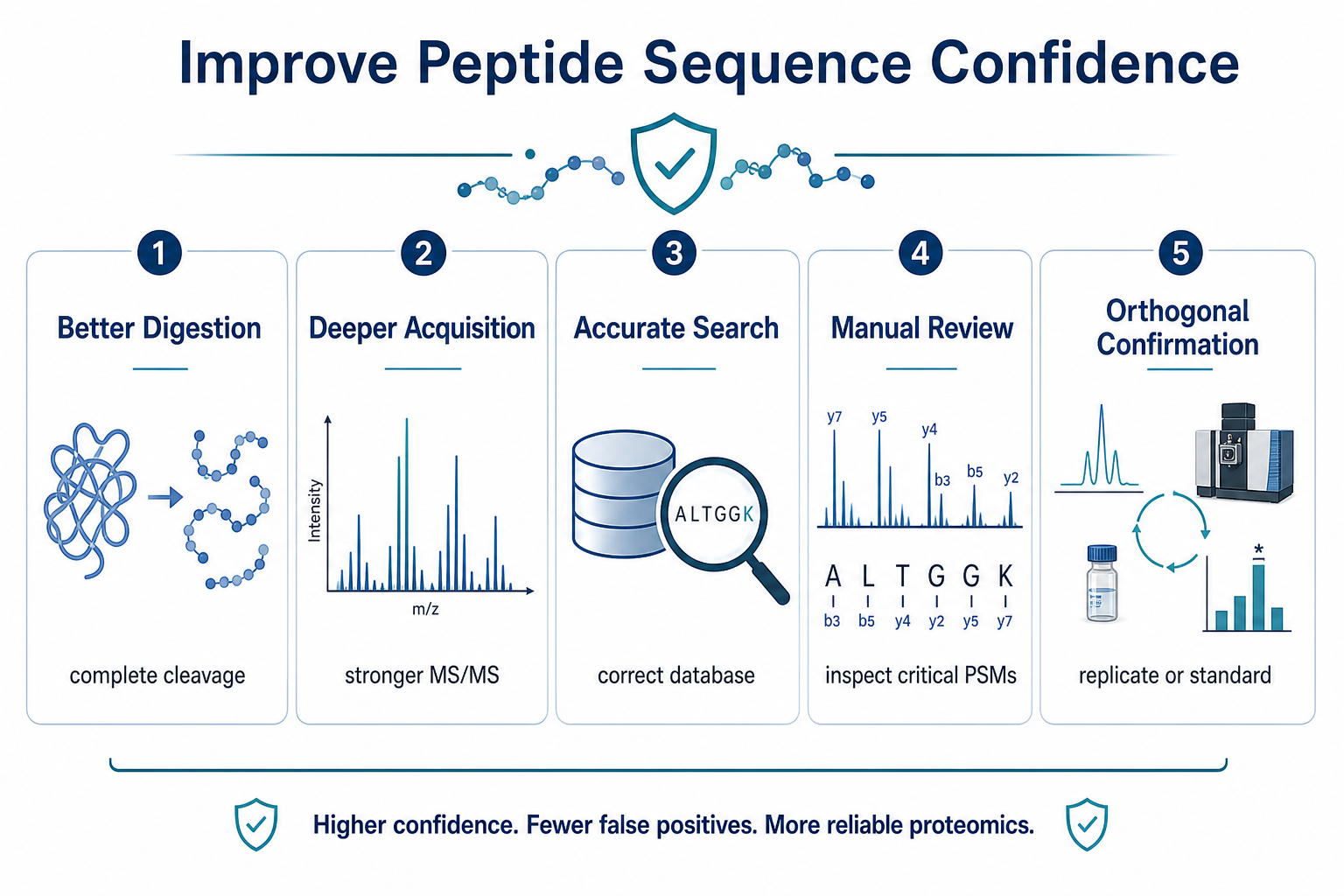
Figure 2. Confidence in peptide sequence analysis improves when sample preparation, LC-MS/MS acquisition, database setup, manual review, and orthogonal confirmation are aligned.
Related Services
Teams working to improve peptide sequence confidence often need validated workflows or expert interpretation beyond internal software capacity. Relevant options include:
Peptide Identification Service
Peptide Coverage/Peptide Spectrum Match (PSM) Analysis Service
Mass Spectrometry-Based Peptide Identification Service
Primary Structure Analysis Service
Researchers seeking higher-confidence peptide sequence evidence can consult MtoZ Biolabs to review sample type, acquisition strategy, and validation requirements before analysis begins.
Confidence Factors to Review Before Reporting
The table below summarizes workflow factors that most strongly affect peptide sequence confidence. It supports project review but does not replace sample-specific feasibility assessment.
|
Workflow Factor |
What to Check |
Confidence Impact |
|---|---|---|
|
Digestion completeness |
Missed cleavages and recovery |
Better cleavage improves identifiable peptides and coverage |
|
Spectrum quality |
Fragment ion series and signal-to-noise |
Stronger spectra support residue-level calls |
|
Reference database |
Sequence completeness and enzyme rules |
Accurate setup reduces false assignments |
|
Modification settings |
Expected and allowed PTMs |
Correct parameters improve modified peptide confidence |
|
Acquisition depth |
Gradient length, replicates, enrichment |
More evidence supports low-abundance peptides |
|
Review standard |
Manual inspection and acceptance criteria |
Expert review filters borderline PSMs |
If one or more factors above are weak, the report should distinguish high-confidence assignments from tentative calls rather than presenting all identifications at the same evidence level.
Expected Results After a Confidence-Focused Workflow
A confidence-focused LC-MS/MS peptide sequence analysis project should produce fewer ambiguous calls and stronger support for the assignments that matter most. Expected improvements often include clearer fragment evidence for critical peptides, better-supported modification localizations, reduced false discovery risk, more stable replicate overlap, and QC commentary that explains why some regions remain tentative.
Validation should be defined before analysis begins. A biologics project may require tracked critical peptides with predefined acceptance criteria. A proteomics discovery project may accept broader lists but still need manual review for candidate biomarkers. A synthetic peptide QC project may require exact sequence agreement with spectral evidence for every residue in scope. Useful validation steps include replicate run comparison, synthetic peptide matching, alternative enzyme digestion, independent de novo review, and Edman confirmation for uncertain N-terminal segments.
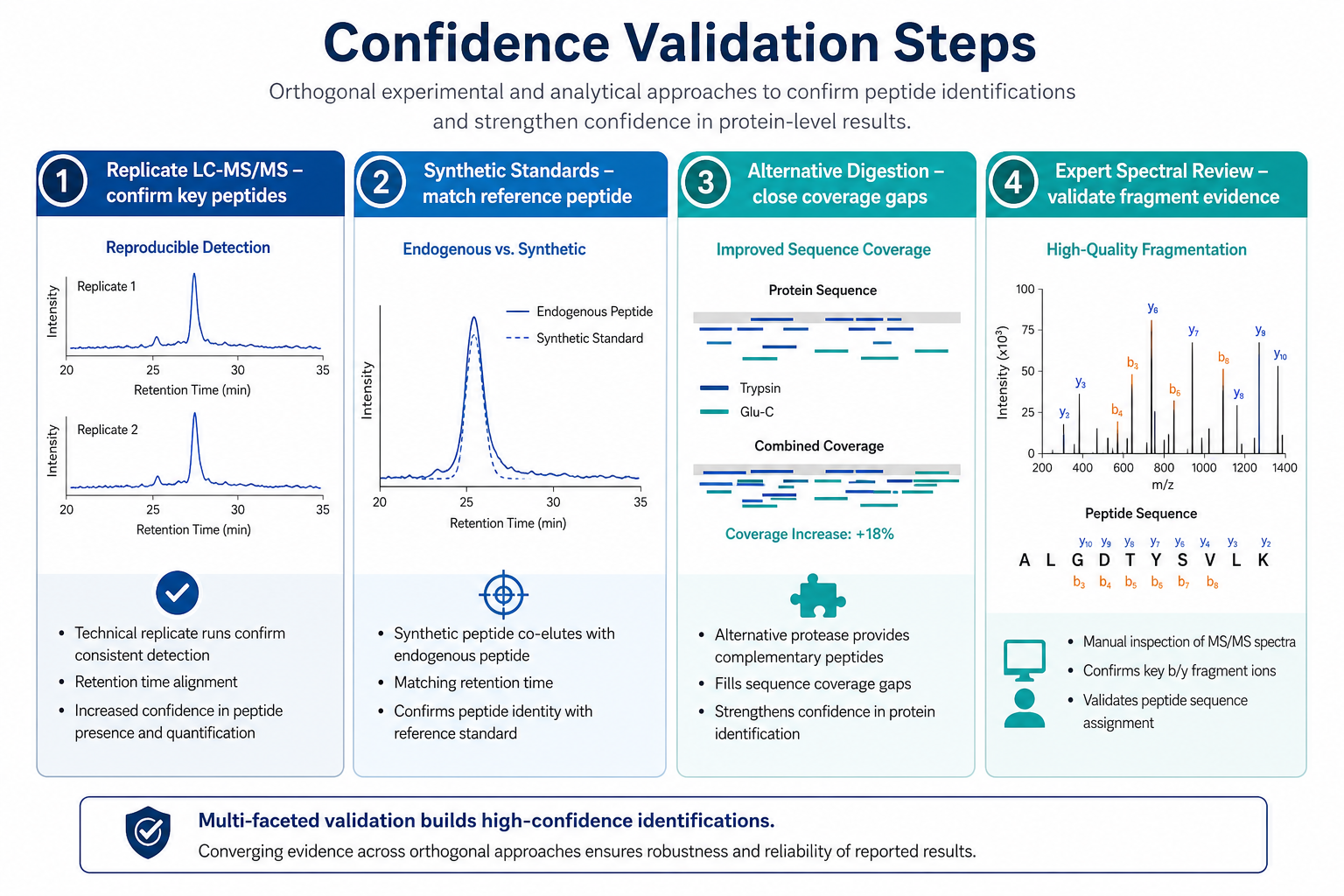
Figure 3. High-confidence peptide sequence analysis often requires replicate LC-MS/MS, synthetic standards, alternative digestion, and expert spectral review.
Useful post-analysis questions include:
- Do critical peptides have sufficient fragment evidence for the project standard?
- Are modified peptides supported by diagnostic ions rather than mass shift alone?
- Do replicate runs agree on the same key assignments?
- Are tentative calls clearly separated from reportable sequence evidence?
Key Considerations Before the Next Run
Several confidence gains are easier to achieve before acquisition than after data review is complete.
Define the confidence standard early.
Exploratory identification and release-support documentation require different acceptance thresholds.
Do not equate more identifications with better analysis.
Long peptide lists with weak spectra can reduce overall report quality.
Treat chimeric spectra cautiously.
Co-isolated precursors can create convincing but incorrect assignments.
Reserve sample for confirmatory work.
Alternative digestion or replicate analysis may be needed to resolve borderline regions.
Document unsupported or ambiguous regions transparently.
Clear QC notes improve trust more than overstated sequence claims.
Match software output to the biological or QC decision.
A score useful for discovery may be insufficient for comparability or regulatory support.
Frequently Asked Questions
1. What most often lowers peptide sequence analysis confidence in LC-MS/MS?
Weak fragmentation, poor digestion, incorrect database setup, modification parameter mismatch, and lack of manual review are the most common causes.
2. Can better search software alone solve low-confidence assignments?
Better software helps, but confidence still depends on sample quality, acquisition design, reference accuracy, and expert review of critical peptides.
3. How many replicates are needed for confident peptide sequence analysis?
Replicate need depends on project standard. High-stakes QC or comparability projects often require repeat evidence for critical assignments, while exploratory studies may use fewer runs with more conservative reporting.
4. When is de novo review useful for improving confidence?
De novo review is useful for unmatched spectra, poorly annotated systems, and follow-up analysis of unexpected peptides that database searching does not explain confidently.
5. When should a team seek external peptide analysis support?
External support is often valuable when report-ready confidence documentation is required, internal review bandwidth is limited, or difficult modified peptides and low-abundance features need specialized interpretation.
Conclusion
Peptide sequence analysis confidence in LC-MS/MS workflows depends on evidence quality across the full path from sample preparation to expert review. Weak spectra, poor digestion, database errors, and unchecked automation are the most common reasons sequence calls fail to support real project decisions. Confidence improves when teams optimize digestion and acquisition for fragment evidence, build accurate search parameters, review critical PSMs manually, and add replicate or orthogonal confirmation where needed. The strongest reports distinguish high-confidence assignments from tentative calls and document limitations clearly. Researchers aiming to improve peptide sequence analysis confidence can contact MtoZ Biolabs to review sample status, LC-MS/MS strategy, and the validation standard required for the next protein research or biologics milestone.
How to order?




