






ICP-OES Analytical Service
- Multi-Element Simultaneous Detection: ICP-OES Analytical Service can cover a wide range of elements from major to trace levels in a single analysis, providing high efficiency.
- Wide Dynamic Range: The method maintains reliable quantitative performance across several orders of magnitude, making it suitable for simultaneous determination of elements at different concentrations in complex systems.
- High Sensitivity and Accuracy: The use of advanced plasma platforms and optimized sample introduction systems ensures precision and reliability of the data.
- Flexible Sample Compatibility: Capable of analyzing solids, liquids, and suspensions, accommodating various types of samples.
- Flexible and Customizable Methods: The service can follow international standard methods or be tailored to client-specific requirements for method development and validation.
- Pharmaceutical Development and Quality Control: Detect the elemental composition and impurity levels in formulations, excipients, and raw materials.
- Food and Agriculture: Monitor nutritional elements, additives, and potentially harmful elements in food and agricultural products.
- Environmental Science: Analyze heavy metals and trace elements in water, soil, and atmospheric deposits.
- Life Science Research: Measure trace metal ions in biological samples to support studies on metabolism and function.
ICP-OES Analytical Service is a high-sensitivity multi-element quantitative analysis service designed to detect the overall chemical composition of a wide range of sample types, including solids, powders, liquids, and suspensions. Its core advantage lies in the use of inductively coupled plasma to generate a high-temperature environment that fully atomizes and excites the elements in the sample, leading them to emit light at characteristic wavelengths. This allows for accurate elemental identification and quantification. With its broad elemental coverage, ranging from major to trace elements, and detection limits at the ppb level, ICP-OES is widely applied in pharmaceutical development, food and agriculture, environmental science, materials characterization, and quality control. It has become an indispensable analytical technique in both scientific research and industrial applications.
Technical Principles
The core principle of Inductively Coupled Plasma Optical Emission Spectroscopy (ICP-OES) is to excite the elements in a sample using high-temperature argon plasma and then detect their characteristic light emissions. Before analysis, samples usually undergo acid digestion or dissolution to be converted into a homogeneous solution, which is then nebulized and introduced into the core region of the plasma. At a temperature of approximately 9000 K, the sample components are fully vaporized, atomized, and ionized, with some atoms or ions transitioning to excited states. As they return to their ground states, they emit light at specific wavelengths. The optical emission spectrometer measures the intensity of these radiations, and by comparing them with standards, the concentrations of the elements are quantified. Since each element has unique emission lines, ICP-OES can simultaneously detect multiple elements in a single analysis, offering a wide dynamic range and high quantitative accuracy.
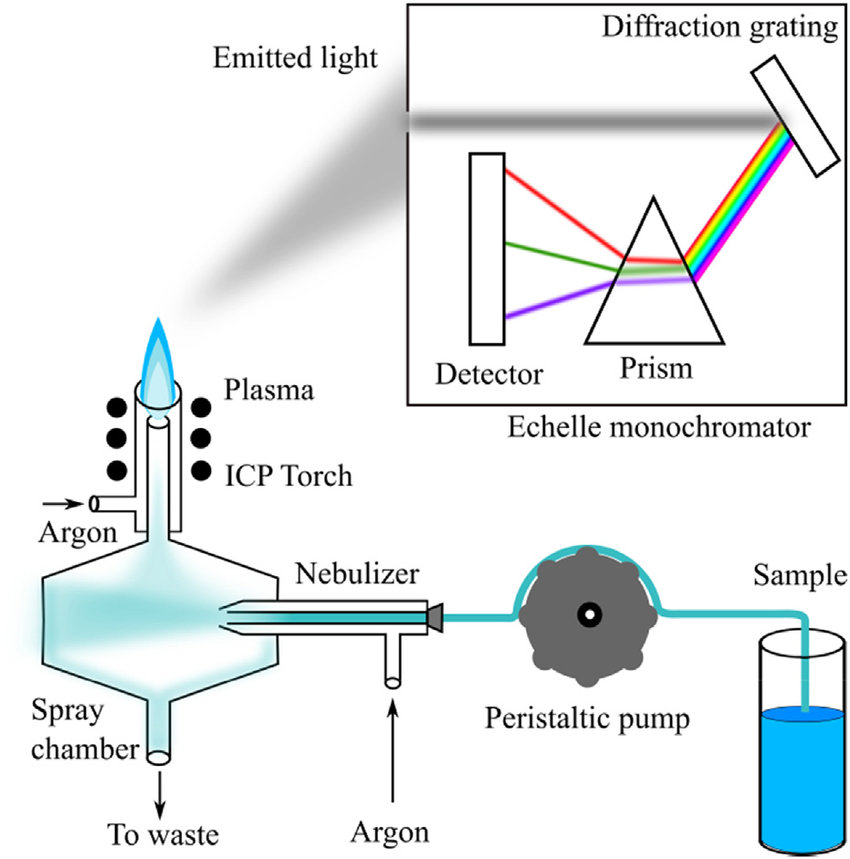
Cherevko S. Mayrhofer K. Encyclopedia of Interfacial Chemistry. 2018.
Figure 1. A Simplified Scheme Showing the Basic Operational Principles of ICP-OES
Analysis Workflow
The general workflow of the ICP-OES Analytical Service is as follows:
1. Sample Pretreatment
Solid or powdered samples are digested with acids or dissolved to obtain a homogeneous solution, while liquid or suspension samples are analyzed directly or after appropriate treatment.
2. Nebulization and Sample Introduction
The prepared solution is nebulized into an aerosol and introduced into the high-temperature argon plasma.
3. Atomization and Excitation
Within the plasma, the sample components are vaporized, atomized, ionized, and excited to high-energy states.
4. Spectral Detection
The optical emission spectrometer captures radiation signals emitted by target elements at their characteristic wavelengths.
5. Quantitative Analysis
Element concentrations are calculated by comparing the emission intensities with those of calibration standards.
6. Result Reporting
A complete standardized report is generated that includes elemental concentrations, spectral data, and relevant statistical analysis.
Service Advantages
Services at MtoZ Biolabs
MtoZ Biolabs provides ICP-OES Analytical Service for rapid multi-element quantitative analysis that is applicable to a wide range of sample types, including solids, powders, liquids, and suspensions. In a single analysis, we can simultaneously determine major, minor, and trace elements. By combining standardized methods with customized solutions, we deliver high-precision and traceable data to support pharmaceutical development, food testing, environmental monitoring, and materials characterization.
Sample Submission Suggestions
1. Sample Types
Acceptable sample types include solids, powders, liquids, and suspensions. Solids and powders must be completely digestible, while liquids and suspensions should be homogeneous and free of sediment.
2. Additional Notes
Samples should be free of visible particles or impurities to prevent interference with nebulization and plasma stability. For complex matrices, please provide background information or details of the digestion method used.
It is recommended to contact our technical support team before submitting samples to confirm their suitability and to receive tailored submission guidance.
Applications
How to order?




