






How to Prioritize Candidate Autoantigens after PhIP-Seq
Introduction
A PhIP-Seq screen can return hundreds or thousands of enriched peptides after a single cohort run. The raw output is rarely the final answer. A rheumatology project may show many citrullinated peptide hits, yet only a subset map to proteins with plausible synovial expression. A neurology cohort may produce broad reactivity across unrelated antigens when background control is weak. A translational team may need five validated candidates for follow-up assays, not a spreadsheet of every peptide above an arbitrary fold-change cutoff.
Prioritizing candidate autoantigens after PhIP-Seq means converting enrichment lists into a ranked, reviewable shortlist supported by signal quality, specificity, biological context, and validation feasibility. Without a defined prioritization framework, teams often overinvest in weak hits, miss reproducible targets buried in noise, or delay phase 2 validation because the first candidate list was not structured for decision-making.
This article explains why prioritization is needed after PhIP-Seq, how to rank candidates using four practical criteria, and how to move from discovery enrichment to validated autoantigen targets.
When Prioritization Becomes the Bottleneck
Prioritization usually becomes urgent after the first sequencing run is complete and stakeholders ask which hits matter.
Common scenarios include case-control autoimmune discovery, where many peptides are enriched in patients but few survive control comparison after review. Modified autoantigen screening may produce separate unmodified and PTM variant hits that require paired ranking logic. Longitudinal treatment studies may show peptide signals that change over time and need ranking by consistency rather than single-timepoint fold change. Translational programs may require a short validated list for peptide array, ELISA, or protein-level follow-up within a fixed assay budget.
In each case, the challenge is not lack of data. The challenge is deciding which enriched peptides deserve experimental follow-up and which should remain provisional.
Why Enrichment Alone Is Not Enough
PhIP-Seq reports peptide-level enrichment, not confirmed autoantigen status. A peptide can rank highly for reasons unrelated to disease-specific autoantibody biology.
Clone abundance bias can inflate read counts for peptides represented at high frequency in the input library. Nonspecific immunoprecipitation background can create apparent enrichment when bead-only or isotype controls are insufficient. Single-replicate runs can elevate unstable signals that do not repeat across technical or biological replicates. Promiscuous antibody binding can enrich unrelated peptide motifs in serum with high total immunoglobulin reactivity. Weak biological linkage can occur when an enriched peptide maps to a protein with no plausible connection to the disease tissue or mechanism under study.
Prioritization therefore requires more than sorting by fold change. It requires filtering, ranking, biological review, and a validation plan matched to project stage.
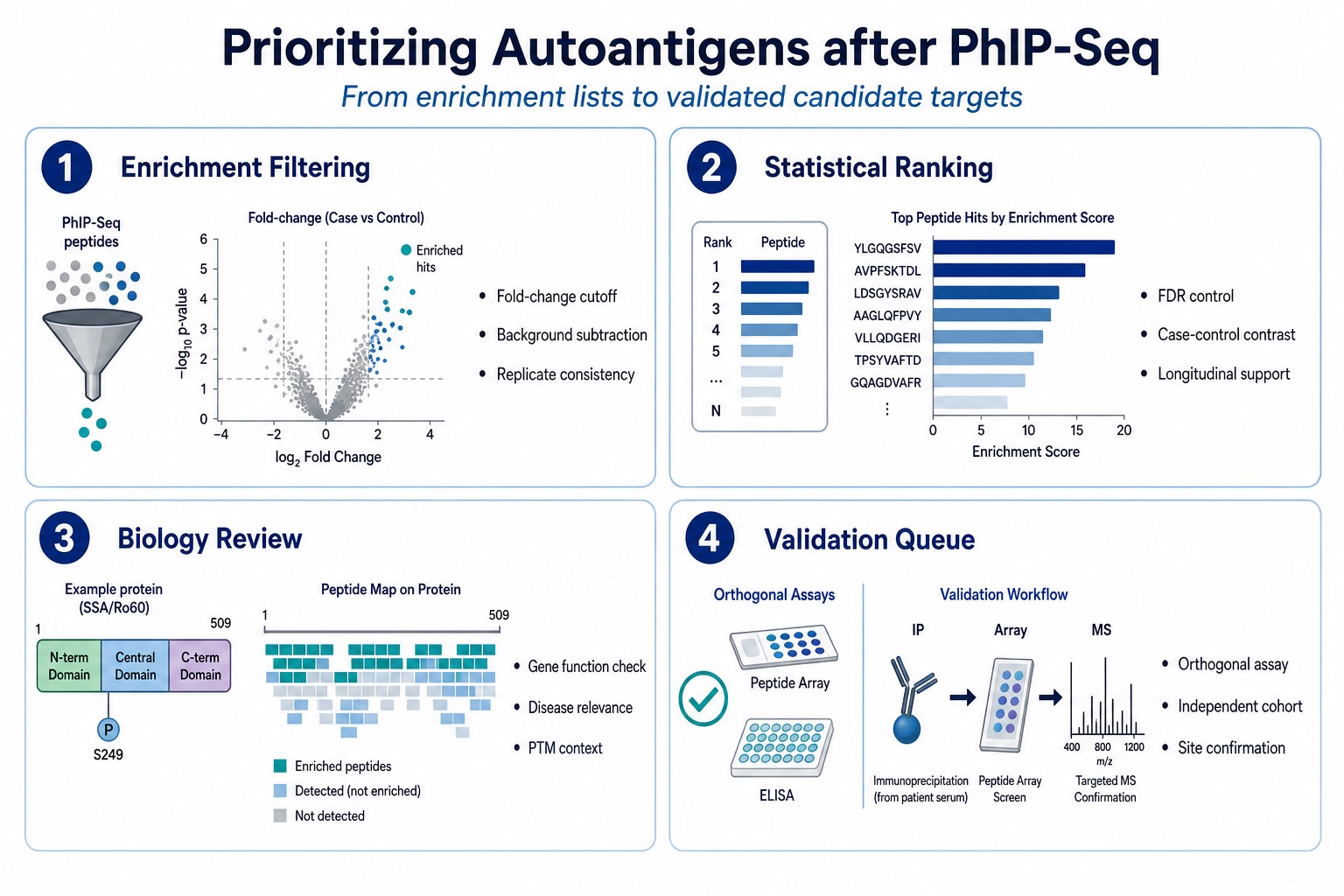
Figure 1. Candidate prioritization after PhIP-Seq moves from enrichment filtering and statistical ranking through biology review to a structured validation queue.
Step 1: Apply Enrichment and Quality Filters
The first prioritization step removes low-confidence enrichment before ranking begins.
Normalize peptide read counts against input library representation so clone frequency bias does not dominate the shortlist. Apply fold-change and significance thresholds using case-control or longitudinal contrast rather than absolute read count alone. Require replicate consistency where sample number allows, and downgrade peptides enriched in only one run. Remove peptides with high background in bead-only, no-antibody, or healthy control samples. Flag modified peptide hits only when paired unmodified controls support PTM-specific enrichment rather than generic motif reactivity.
This step produces a filtered candidate set small enough for manual review but still broad enough to avoid premature exclusion of true signals.
Step 2: Rank by Signal Quality and Specificity
After filtering, rank remaining peptides using signal quality and disease specificity together.
Signal quality review asks whether enrichment repeats across replicates, survives input normalization, and shows clear separation from background. Specificity review asks whether enrichment is stronger in case sera than in matched controls, weaker in isotype controls, and absent in irrelevant cohorts when available. Longitudinal support adds value when the same peptide rises or falls consistently across treatment or disease progression time points.
Peptides with strong case specificity and replicate support should rank above peptides with high fold change but weak control contrast.
Related Services
PhIP-Seq Antibody Analysis Service
Identification of Peptide Biomarkers Service
Antibody Epitope Mapping Analysis Service
Peptide Array-Based Epitope Mapping Service
Teams with long enrichment lists after PhIP-Seq can consult MtoZ Biolabs to review filtering thresholds, ranking logic, and the validation path best matched to the cohort design.
Step 3: Review Biological Plausibility and PTM Context
Statistical ranking still does not prove biological relevance. The next step maps enriched peptides to protein context and disease logic.
Annotate each shortlisted peptide to source protein, tiled region, and modification state when PTM variant libraries are used. Review whether the parent protein is expressed in relevant tissue, reported in prior autoimmunity literature, or linked to the mechanism under study. For modified peptide hits, confirm that the PTM form is biologically plausible in the disease setting and not merely a library artifact. Downgrade peptides mapping to highly abundant or nonspecific autoantigen classes unless specificity evidence remains strong.
Biological review converts a ranked peptide list into a candidate autoantigen list with interpretable context.
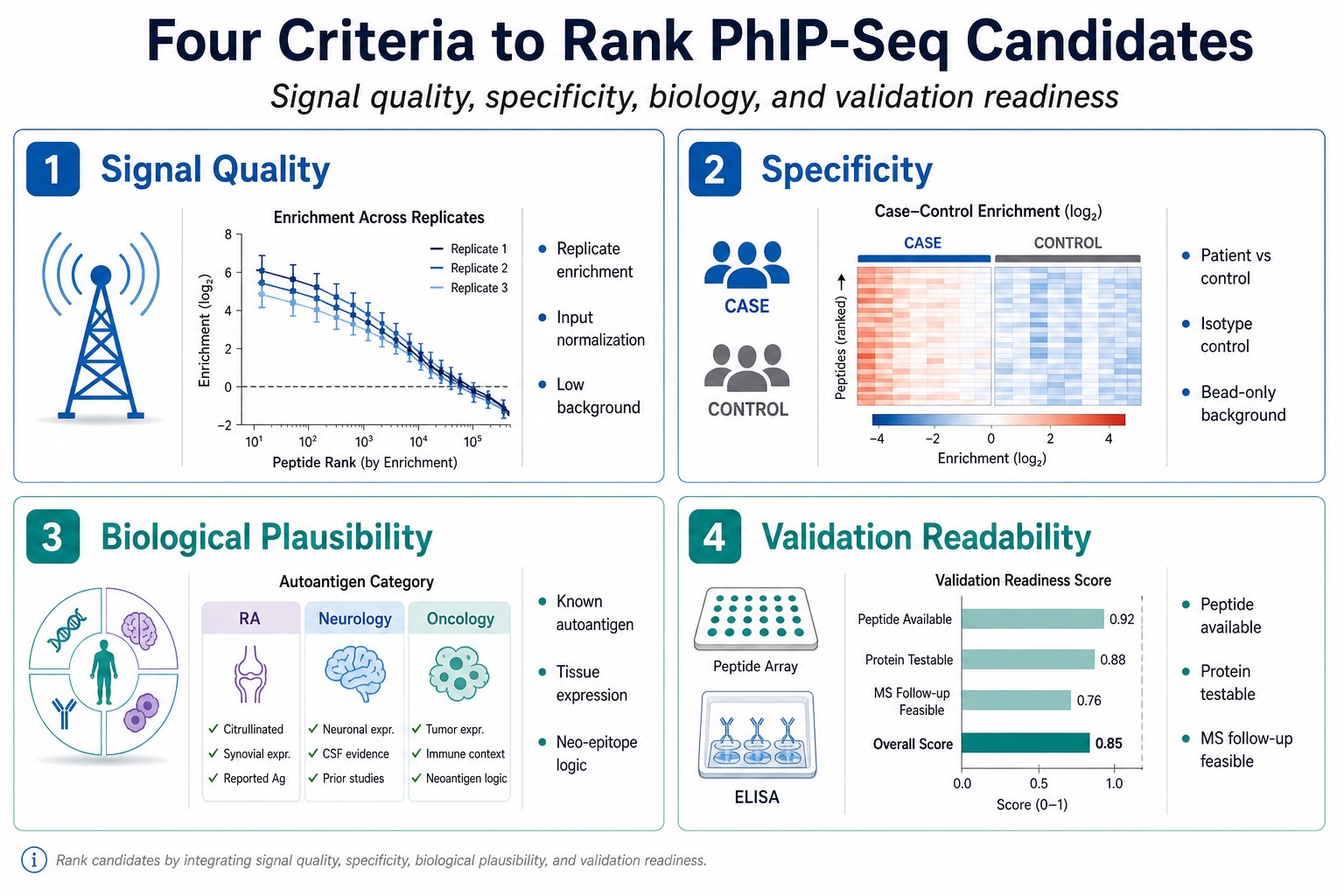
Figure 2. Candidate ranking integrates signal quality, specificity, biological plausibility, and validation readiness rather than fold change alone.
Step 4: Build a Tiered Validation Queue
The final prioritization step assigns each candidate to a validation tier based on readiness and project priority.
Tier A candidates show strong enrichment, robust case-control contrast, biological plausibility, and immediate feasibility for orthogonal testing. Tier B candidates show promising signal but need replicate expansion, modified peptide confirmation, or clearer protein mapping before full validation. Tier C candidates remain exploratory and should not receive major assay investment unless new data elevate them.
Orthogonal validation may include peptide array confirmation, ELISA with synthesized peptides, recombinant domain binding, or mass spectrometry-supported PTM review when modified epitopes are involved. Independent cohort testing should be planned for Tier A targets before they are reported as confirmed autoantigens.
Prioritization Criteria at a Glance
The table below summarizes how candidates are commonly ranked after PhIP-Seq.
|
Review Layer |
Primary Question |
Action if Weak |
|---|---|---|
|
Enrichment filter |
Is the signal above background and normalized? |
Remove from shortlist |
|
Replicate support |
Does enrichment repeat across runs or samples? |
Downgrade to Tier B or C |
|
Case specificity |
Is signal stronger in case than control sera? |
Hold for re-screen |
|
Biological mapping |
Does the parent protein fit disease context? |
Require literature or expression support |
|
PTM pairing |
Does modified enrichment exceed unmodified control? |
Do not call modified autoantigen yet |
|
Validation readiness |
Can peptide, protein, or MS follow-up be run now? |
Keep provisional until assay ready |
This layered review prevents a single metric from dominating prioritization.
Expected Outputs After Prioritization
A useful post-PhIP-Seq prioritization package should contain more than a sorted spreadsheet.
Typical outputs include a filtered enrichment table with fold change, control contrast, and replicate notes. A tiered candidate list with Tier A, B, and C assignments should define follow-up order. A mapping summary should link peptides to protein, domain, and PTM state where applicable. A validation plan should list orthogonal assays planned for each Tier A candidate. A reporting section should separate confirmed, provisional, and exploratory targets so stakeholders know which hits are decision-ready.
Prioritization is successful when the team can explain why the top candidates were selected and what evidence is still missing for lower tiers.
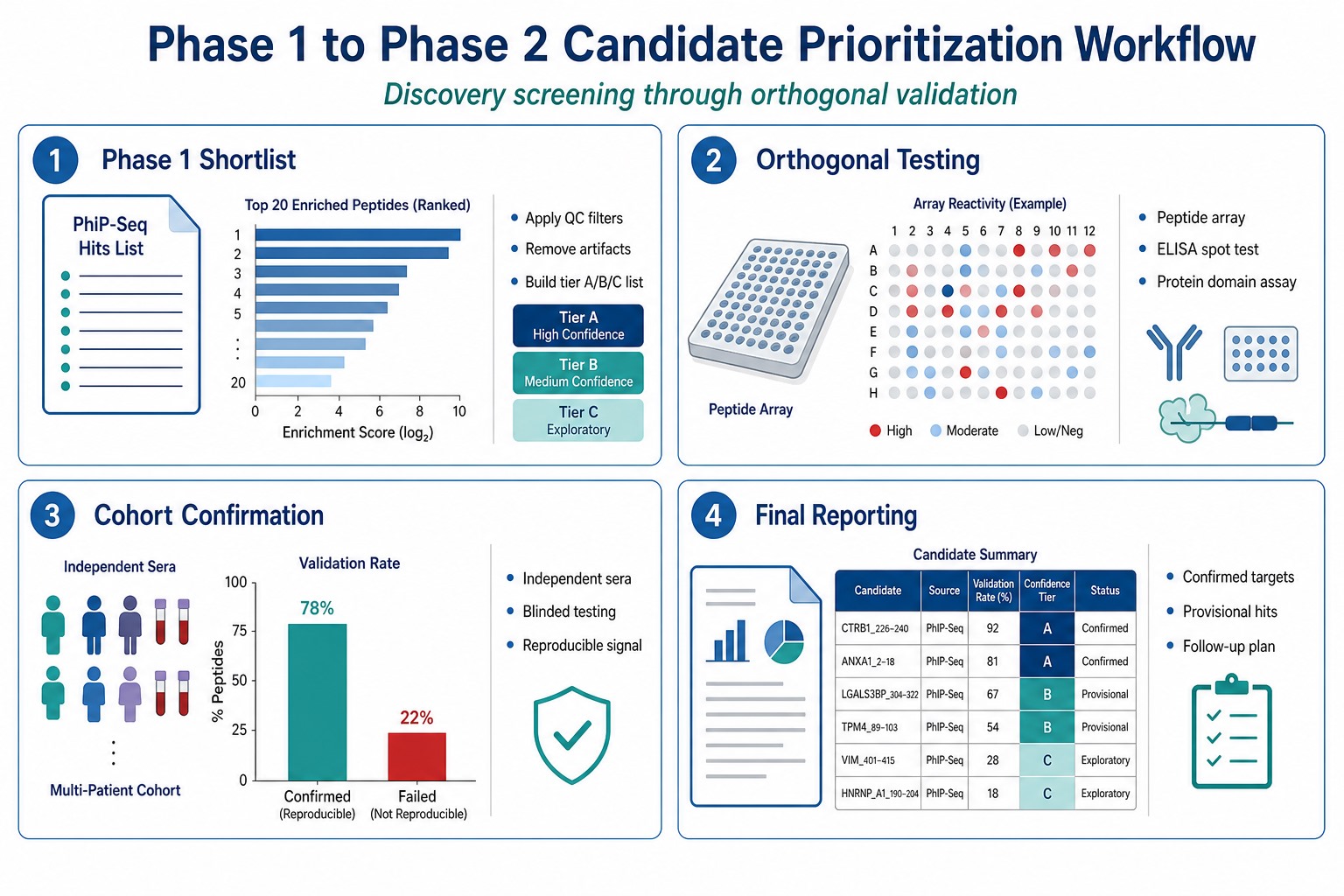
Figure 3. Phase 1 shortlist refinement leads in phase 2 to orthogonal testing, cohort confirmation, and tiered final reporting.
Applications Where Tiered Prioritization Adds Value
Tiered prioritization supports several autoimmune and serology programs.
Rheumatology discovery uses ranked citrullinated or modified peptide hits to select neo-epitope candidates for array validation. Neurology cohort studies prioritize peptides mapping to brain-enriched proteins before expensive protein-level assays begin. Oncology autoantibody screens separate tumor-associated reactivity from background using control-aware ranking. Treatment-response studies rank peptides by longitudinal consistency to identify biomarkers that track clinical change. Multi-center collaborations use common tier definitions so partner labs interpret candidate status consistently.
In each setting, prioritization reduces wasted validation effort and improves confidence in the final candidate set.
Key Considerations and Common Mistakes
Several mistakes recur when teams move directly from enrichment to validation without ranking discipline.
Sorting by fold change alone ignores control contrast and replicate stability. Treating every enriched peptide as a confirmed autoantigen overstates discovery findings. Skipping paired modified versus unmodified review can misclassify PTM neo-epitopes. Validating too many Tier C candidates consumes budget before Tier A targets are tested. Failing to document provisional status creates confusion when downstream assays do not confirm initial enrichment.
A practical rule is to validate in order of tier rank, not in order of spreadsheet appearance.
Frequently Asked Questions
1. How many candidates should be prioritized after PhIP-Seq?
There is no fixed number. Many projects start with 10 to 30 filtered peptides for review and advance 3 to 10 Tier A candidates to orthogonal validation, depending on assay capacity and cohort size.
2. What is the most important ranking metric?
No single metric is sufficient. Fold change, control contrast, replicate consistency, and biological plausibility should be reviewed together.
3. Should modified peptide hits be ranked separately?
Yes. Modified hits should be ranked using paired unmodified controls and PTM-specific validation plans rather than merged directly with unmodified peptide rankings.
4. When is peptide array validation needed?
Peptide array validation is useful when several Tier A peptides need parallel confirmation before ELISA or protein assays are scaled.
5. Can prioritization be outsourced with the initial PhIP-Seq analysis?
Yes. A service provider can apply filtering, tier assignment, and validation planning if cohort design, control samples, and reporting standards are defined at project intake.
Conclusion
Prioritizing candidate autoantigens after PhIP-Seq turns enrichment output into a decision-ready shortlist by combining filtering, statistical ranking, biological review, and tiered validation planning. Fold change alone is not enough. Strong candidates show replicate support, case specificity, plausible protein context, and a clear path to orthogonal confirmation.
The most efficient programs rank candidates before assay budgets are committed, validate Tier A targets first, and report provisional hits separately from confirmed autoantigens. Researchers with post-PhIP-Seq enrichment lists can contact MtoZ Biolabs to review filtering logic, tier assignment, and the validation workflow suited to their cohort and disease question. For projects advancing from ranked peptides to site-level confirmation, MtoZ Biolabs can also help connect prioritization output with epitope mapping and PTM analysis follow-up.
How to order?




