






How to Interpret Enriched Peptides in Autoantibody Studies
Introduction
Enriched peptide lists are common output from PhIP-Seq and related autoantibody screening workflows, yet the lists are easy to misread. A rheumatology cohort may show dozens of citrullinated peptides above a fold-change cutoff, but only a fraction show clear case-control separation. A neurology study may report CSF enrichment that reflects matrix background rather than disease-specific reactivity. A translational team may treat every high-ranking peptide as a confirmed autoantigen before orthogonal testing is complete.
Interpreting enriched peptides in autoantibody studies means converting read-count enrichment into biologically meaningful evidence. That requires understanding normalization, control contrast, protein mapping, modified peptide context, and the difference between discovery signal and confirmed autoantibody reactivity.
This article explains why enriched peptides need structured interpretation, how to read key metrics, and how to assign confidence before validation begins.
When Enriched Peptide Lists Create Confusion
Interpretation becomes urgent once stakeholders receive the first enrichment table and ask what the hits mean.
Common scenarios include case-control autoimmune discovery, where many peptides are enriched in patients but few remain credible after control review. Modified autoantigen screening may produce separate unmodified and PTM variant hits that require paired interpretation rather than independent ranking. Longitudinal studies may show peptide signals that change across time points and need consistency review rather than single-sample emphasis. Multi-matrix projects may compare serum and CSF enrichment and require matrix-specific thresholds to avoid overcalling compartment-specific reactivity.
In each case, the challenge is not absence of data. The challenge is deciding what enrichment actually indicates about autoantibody biology.
Why Raw Enrichment Is Not a Final Answer
PhIP-Seq and similar peptide library workflows report peptide-level enrichment, not confirmed autoantigen status. A peptide can rank highly for reasons unrelated to disease-specific autoantibody binding.
Clone abundance bias can inflate read counts for peptides overrepresented in the input library. Nonspecific immunoprecipitation background can create apparent enrichment when bead-only or isotype controls are insufficient. Single-replicate runs can elevate unstable signals that do not repeat across technical or biological replicates. Promiscuous antibody binding can enrich unrelated peptide motifs in samples with high total immunoglobulin reactivity. Weak biological linkage can occur when an enriched peptide maps to a protein with no plausible connection to the disease tissue or mechanism under study.
Interpretation therefore requires more than sorting by fold change. It requires normalization review, control contrast, mapping context, and explicit confidence assignment.
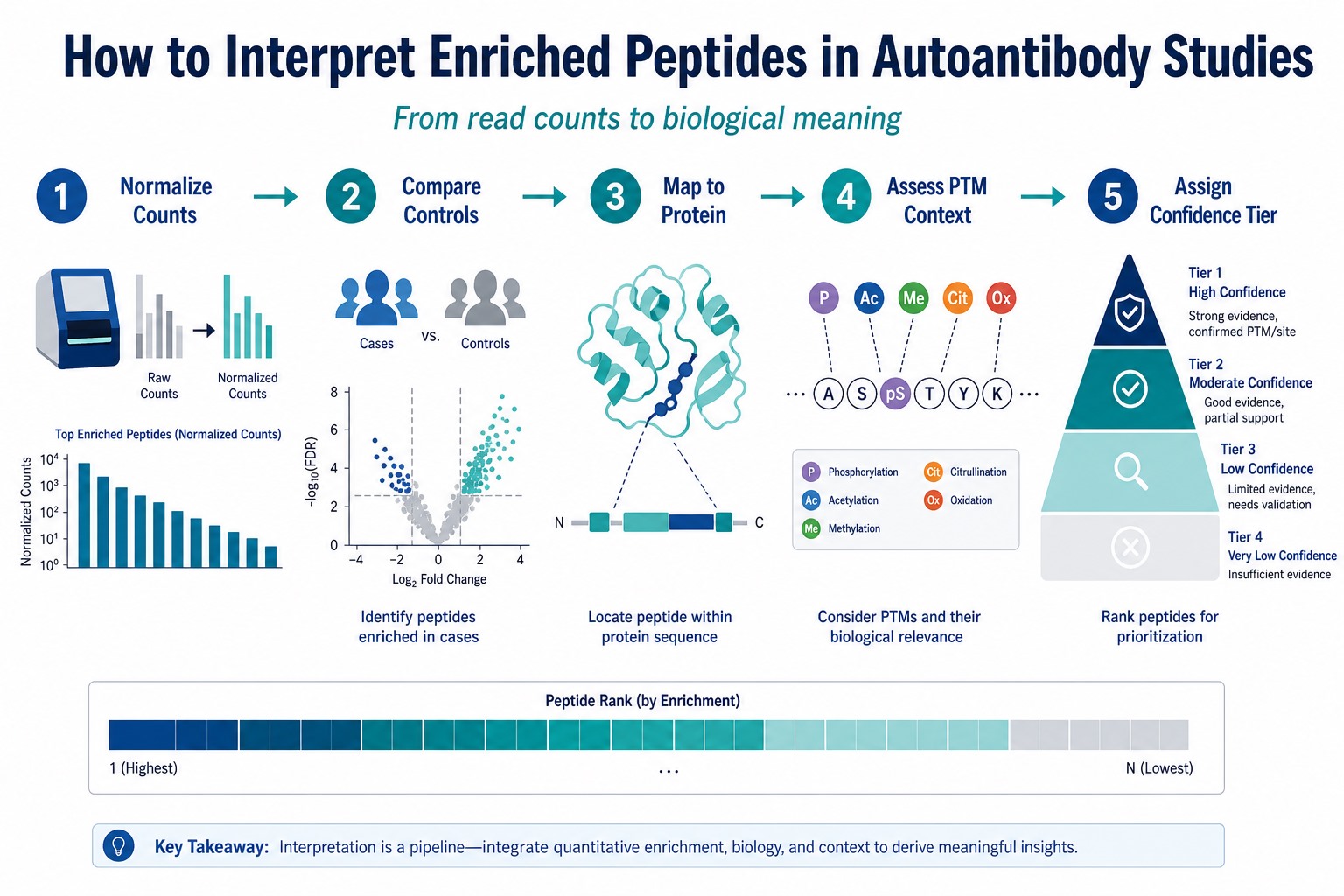
Figure 1. Interpreting enriched peptides moves from count normalization and control comparison through protein mapping and PTM context to confidence tier assignment.
Step 1: Normalize Read Counts Against Library Representation
The first interpretation step checks whether enrichment reflects antibody binding or library composition bias.
Compare captured read counts to input library representation for each peptide. Peptides enriched only because they are abundant clones in the library should be downgraded unless case-control contrast remains strong after normalization. Review whether normalization method matches the analysis plan defined before sequencing. Flag peptides with very low absolute read support that pass fold-change thresholds only because denominator counts are small.
Normalized enrichment provides a fairer basis for comparison across peptides and samples than raw read counts alone.
Step 2: Evaluate Control Contrast and Background
The second step asks whether enrichment is disease-associated or background-driven.
Compare case sera to matched healthy or disease-irrelevant controls using the same library and workflow. Review bead-only, no-antibody, and isotype controls to estimate nonspecific immunoprecipitation background. Downgrade peptides enriched similarly in cases and controls. Flag peptides with high background in healthy donor samples unless case specificity remains clear. For CSF studies, apply matrix-adjusted thresholds because total immunoglobulin abundance and sample volume differ from serum or plasma.
Control contrast is often the strongest single indicator of interpretable autoantibody enrichment.
Related Services
PhIP-Seq Antibody Analysis Service
Identification of Peptide Biomarkers Service
Antibody Epitope Mapping Analysis Service
Peptide Array-Based Epitope Mapping Service
Researchers interpreting enrichment output from autoantibody screens can consult MtoZ Biolabs to review normalization logic, control design, and reporting tiers matched to the cohort.
Step 3: Map Peptides to Protein and Regional Context
The third step converts peptide hits into interpretable autoantigen regions.
Annotate each enriched peptide to source protein, sequence coordinates, and tiled region when library design supports mapping. Review whether the parent protein is expressed in relevant tissue or reported in prior autoimmunity literature. For clustered hits on one protein, consider whether multiple enriched peptides support a coherent epitope region rather than isolated noise. Downgrade peptides mapping to highly abundant or nonspecific autoantigen classes unless specificity evidence remains strong.
Mapping context helps distinguish biologically plausible enrichment from statistically elevated but mechanistically weak hits.
Step 4: Interpret Modified Peptide Hits with Paired Controls
When PTM variant libraries are used, modified peptide enrichment requires paired interpretation.
Compare modified peptide enrichment to the corresponding unmodified peptide from the same clone pair. Interpret PTM-specific reactivity only when modified enrichment exceeds unmodified background under the same conditions. Flag generic motif reactivity that enriches many modified peptides without protein-specific pattern. Review whether the PTM form is biologically plausible in the disease setting and encoded intentionally in library design.
Modified peptide hits should not be reported as neo-epitope evidence until paired control logic and mapping review are complete.
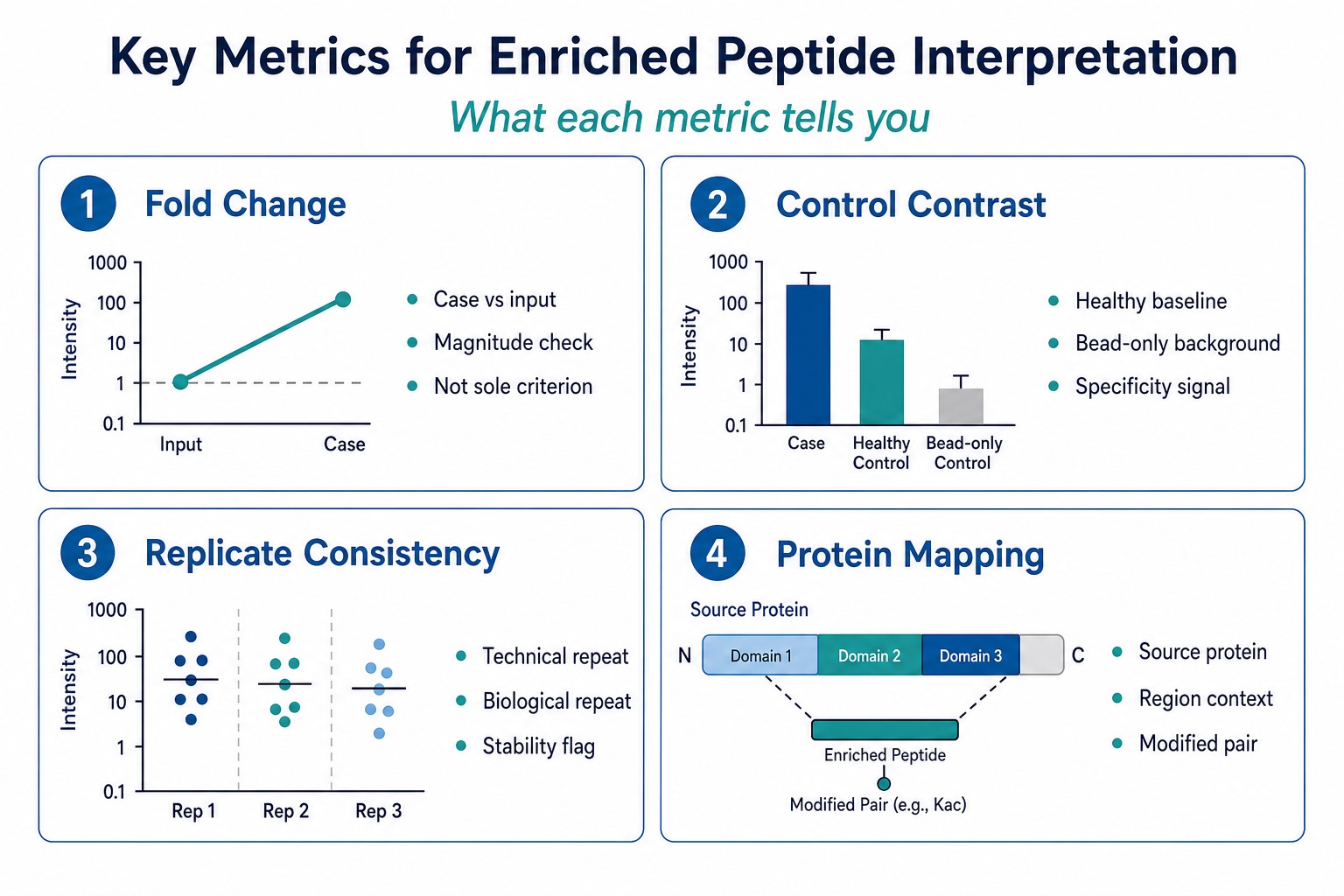
Figure 2. Enriched peptide interpretation integrates fold change, control contrast, replicate consistency, and protein mapping rather than any single metric alone.
Step 5: Assign Confidence Tiers Before Validation
The final interpretation step separates discovery evidence from confirmed autoantibody reactivity.
High-confidence peptides show strong normalized enrichment, clear case-control contrast, replicate support where available, plausible protein mapping, and appropriate modified peptide context when relevant. Provisional peptides show promising signal but need replicate expansion, stronger control separation, or clearer mapping before major follow-up investment. Exploratory peptides may pass initial thresholds but lack specificity, consistency, or biological linkage sufficient for validation planning.
Reporting should label each peptide by confidence tier so validation teams know which hits are ready for orthogonal testing and which remain under review.
Key Metrics and What They Mean
Different metrics answer different interpretation questions.
|
Metric or Review Step |
What It Indicates |
Common Misinterpretation |
|---|---|---|
|
Fold change vs input |
Binding enrichment relative to library representation |
Treating fold change alone as proof of autoantigen status |
|
Case-control contrast |
Disease-associated specificity |
Ignoring healthy donor background |
|
Replicate consistency |
Signal stability across runs |
Overcalling single-replicate hits |
|
Protein mapping |
Biological context of the peptide hit |
Assuming peptide reactivity confirms full protein autoantigen |
|
Modified vs unmodified pair |
PTM-specific reactivity |
Reporting PTM hits without paired control review |
No single metric is sufficient. Interpretation quality depends on reading these elements together.
Common Interpretation Pitfalls
Several mistakes recur when enrichment tables are reviewed without a structured framework.
Overreliance on fold-change ranking ignores control contrast and clone abundance effects. Treating every enriched peptide as a confirmed autoantigen skips the distinction between discovery signal and validated reactivity. Ignoring matrix effects can mislabel serum background as CSF-specific enrichment. Reporting modified peptide hits without unmodified comparison can inflate neo-epitope claims. Mixing exploratory and high-confidence peptides in one validation list wastes assay budget on weak targets.
A structured interpretation workflow reduces these errors and produces clearer handoff to validation.
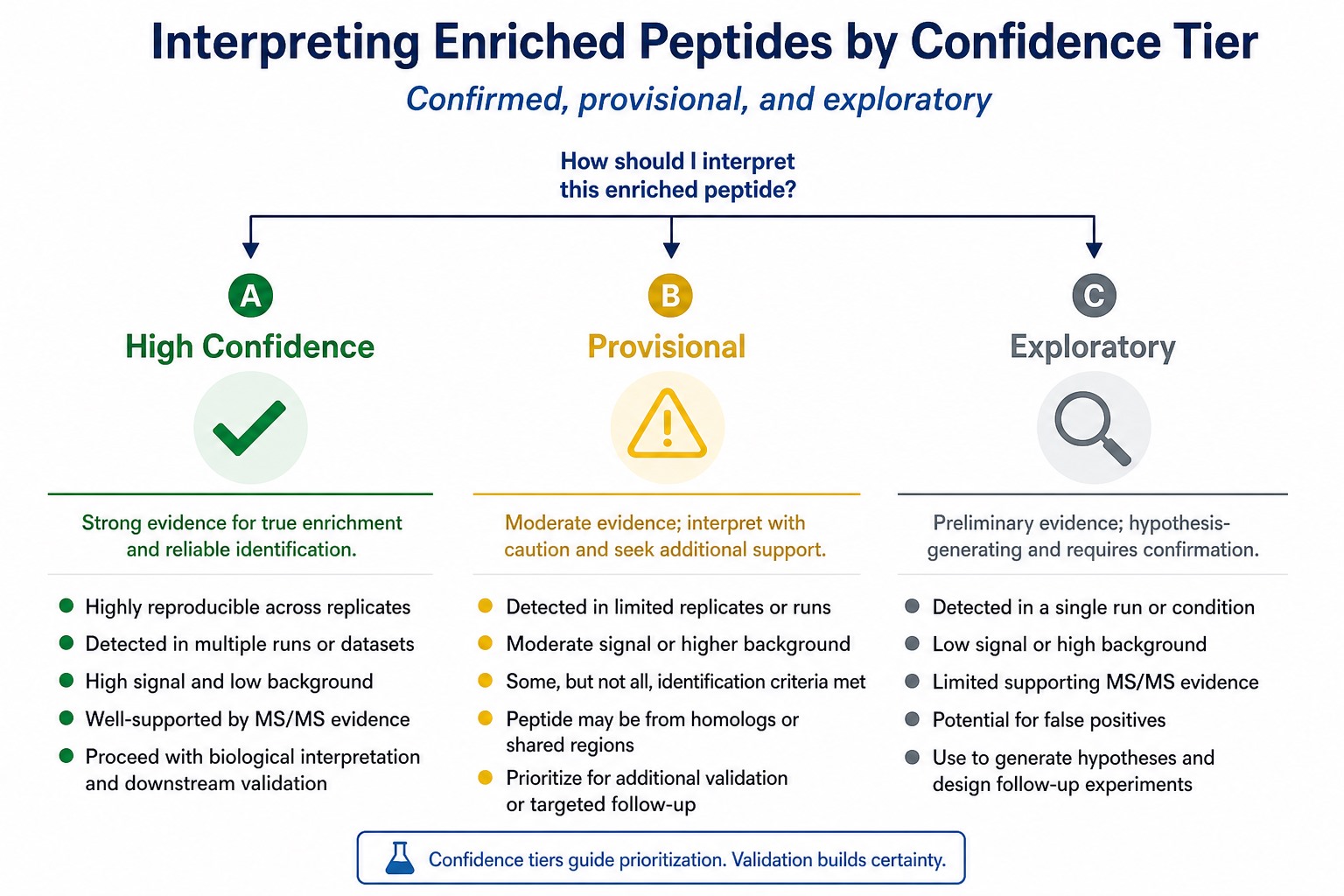
Figure 3. Enriched peptide interpretation assigns high-confidence, provisional, and exploratory tiers before validation planning.
Expected Outcomes After Interpretation
A well-interpreted enrichment report should support decision-making rather than merely list peptides.
Expected outputs include a normalized enrichment table with control contrast annotations. A mapped peptide summary linking hits to proteins, regions, and modification state. A confidence-tiered candidate list separating high-confidence, provisional, and exploratory peptides. A short interpretation note documenting control handling, matrix considerations, and validation recommendations.
These outputs allow project teams to move from raw enrichment to phased validation without re-analyzing the same ambiguity repeatedly.
Frequently Asked Questions
1. What does an enriched peptide mean in an autoantibody study?
It means the peptide was captured above input library representation and may indicate antibody reactivity under the assay conditions used. It does not by itself confirm a disease autoantigen.
2. Is fold change enough to interpret a hit?
No. Fold change should be read together with normalization, control contrast, replicate support, and protein mapping.
3. How should modified peptide enrichment be interpreted?
Compare modified enrichment to the paired unmodified peptide and review whether PTM-specific reactivity is supported before reporting a neo-epitope hit.
4. Can enriched peptides from CSF be interpreted like serum hits?
CSF requires matrix-adjusted thresholds and careful background review because immunoglobulin abundance and sample volume differ from blood matrices.
5. When should enriched peptides move to validation?
High-confidence peptides with strong specificity and mapping support should move first. Provisional and exploratory peptides need additional review or replicate data before major assay investment.
Conclusion
Interpreting enriched peptides in autoantibody studies requires more than ranking by fold change. Normalization against library representation, control contrast, protein mapping, modified peptide context, and confidence tier assignment together determine what enrichment actually means. Peptide-level signal supports discovery and candidate generation, not confirmed autoantigen status, until orthogonal validation is complete.
Programs that define interpretation criteria before screening obtain clearer reports and move more efficiently into validation. Researchers reviewing PhIP-Seq or related enrichment output can contact MtoZ Biolabs to align normalization, control strategy, and tiered reporting with their cohort design. For teams advancing from interpreted peptide lists to confirmed epitope or PTM evidence, MtoZ Biolabs can also support epitope mapping and validation follow-up.
How to order?




