






How to Ensure High Purity in Long Peptide Synthesis?
Long peptides containing more than 30 amino acid residues often suffer from reduced coupling efficiency, sequence deletions, incomplete side-chain deprotection, and the formation of secondary structures that interfere with chain elongation. These issues significantly compromise the purity and biological activity of the final product. Therefore, achieving high-purity long peptide synthesis requires an integrated optimization across sequence design, solid-phase synthesis, purification, and quality control.
Sequence Design and Synthesis Strategy Optimization
1. Prevent Consecutive Hydrophobic Residues
Clusters of hydrophobic amino acids (e.g., Val, Leu, Ile, Phe) promote chain folding and aggregation, thereby reducing coupling efficiency. Hydrophobicity should be evaluated using tools such as ProtParam or PepCalc, and if needed, temporary hydrophilic residues or specialized solvents should be incorporated.
2. Predict and Avoid Secondary-Structure-Induced Hindrance
Segments with strong α-helix or β-sheet propensity may block coupling reactions. Tools including PSIPRED and JPred help identify such motifs, enabling strategies such as incorporating D-amino acids or proline to disrupt local structure.
3. Fragment Condensation Strategy
Long sequences may be divided into two or more fragments (15–25 aa), synthesized separately, and subsequently ligated by in situ coupling or chemical ligation methods such as native chemical ligation.
Optimization of Solid-Phase Peptide Synthesis (SPPS)
1. The Fmoc/tBu SPPS strategy remains the standard approach, providing efficient deprotection and coupling performance.
2. Double coupling and/or extended coupling times ensure high reaction conversion while minimizing unreacted by-products.
3. Microwave-assisted SPPS accelerates peptide bond formation under controlled temperature, markedly improving the purity and success rate of long peptide synthesis.
4. Highly reactive coupling reagents (e.g., HATU/DIEA, DIC/Oxyma Pure) are used to stabilize activated intermediates and suppress side reactions.
5. Turn-suppression techniques, including γ-turn-blocking monomers, help prevent unfavorable structural turns caused by residues such as Pro-Gly or Asn-Gly.
Purification Strategies
1. Gradient RP-HPLC
Using C18 columns is the standard for long-peptide purification, and multi-step gradient optimization improves recovery and resolution for complex sequences.
2. Cation-exchange chromatography (CEX)
particularly advantageous for Lys-rich or positively charged peptides, effectively removing deletion and over-coupled impurities.
3. Combined purification workflow
Analytical HPLC supports method development and purity assessment, while preparative HPLC enables gram-scale purification.
Stringent Analytical Quality Control
- LC-MS confirms molecular weight and identifies defects such as deprotection failure, incomplete modification, or chain truncation.
- MS/MS sequencing verifies sequence integrity and correct incorporation of modifications.
- Size-exclusion chromatography (SEC) eliminates aggregation-prone high-molecular-weight species to improve product homogeneity.
- Amino acid composition or UV analysis validates overall chemical composition and detects deletions or mutations at sensitive positions.
How MtoZ Biolabs Ensures High-Purity Long Peptide Synthesis
Leveraging an automated high-throughput SPPS platform and multidimensional purification and analytical systems, MtoZ Biolabs delivers high-purity and functionally stable long peptide synthesis:
1. High-quality Fmoc amino acids and high-loading resins support efficient couplings.
2. A broad range of modifications and labels is available, including phosphorylation, fluorescent tags, and biotinylation.
3. Each long-peptide synthesis order includes:
- ≥95% HPLC purity certificate
- LC-MS molecular weight verification
- Optional MS/MS sequence validation
4. Products are provided as lyophilized powders, accompanied by usage instructions and dissolution recommendations.
Key Strategies for Maximizing Long Peptide Purity
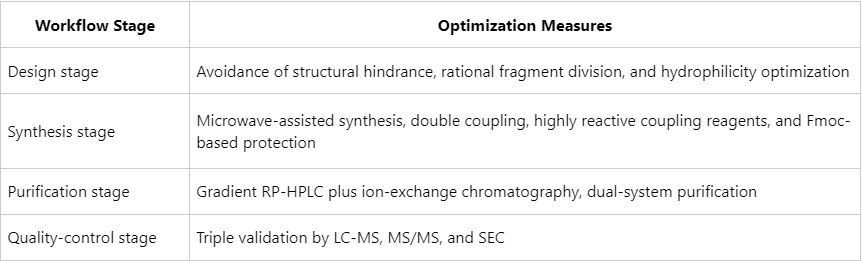
If you require high-purity long peptide synthesis (including modified, labeled, or isotope-enriched peptides), MtoZ Biolabs offers not only synthesis solutions but also enhanced reliability and reproducibility for your experimental outcomes.
MtoZ Biolabs, an integrated chromatography and mass spectrometry (MS) services provider.
Related Services
How to order?




