






How to Design an AP-MS Experiment for Protein Interaction Analysis
Introduction
An AP-MS experiment for protein interaction analysis succeeds or fails at the design stage. Teams often focus on whether mass spectrometry is available while leaving experimental arms, controls, and replicate structure undefined. The result is a bait purification with identifications but no defensible way to rank interactors, compare conditions, or plan validation.
Designing an AP-MS experiment means defining what each sample represents before lysis begins. Which arms compare bait to background? Which arms test mutant or treatment effects? How many biological replicates support ranking? Which proteins will enter validation if they appear in the final list? This article explains how to design an AP-MS experiment for protein interaction analysis with a practical arm structure, control logic, and pre-submission checklist.
Define the Interaction Decision the Experiment Must Support
Every AP-MS design should begin with one sentence that states the decision the dataset must support. Examples include nominating candidate partners of a tagged kinase under basal conditions, identifying partners lost by a binding-deficient mutant, or comparing bait-associated proteins after inhibitor treatment versus vehicle control.
Weak designs use vague goals such as mapping the interactome without defining the contrast, control, or validation step that follows the list. A usable design objective should specify the bait, the biological system, the comparison if any, and the action that follows from the candidate output. If those elements are missing, refine the objective before defining experimental arms.
Build the Experimental Arms Before Sample Generation
An AP-MS experiment is a set of matched enrichments, not a single bait pull-down. The bait arm captures the tagged or engineered bait under the condition of interest. The primary negative control arm captures background associated with the tag, beads, or purification system without bait-specific biology; empty-tag controls are common for tagged baits.
Secondary control arms may include bead-only purifications, unrelated baits, or parental untagged lines depending on the background model required. Contrast arms include mutant baits, stimulation states, inhibitor treatments, or time points when the project tests condition-dependent interaction remodeling. Each arm should be processed with the same lysis, wash, elution, digestion, and LC-MS/MS strategy unless the scientific question explicitly requires a justified protocol difference. Arm definition should be fixed in a design sheet before cultures are expanded or samples are collected.
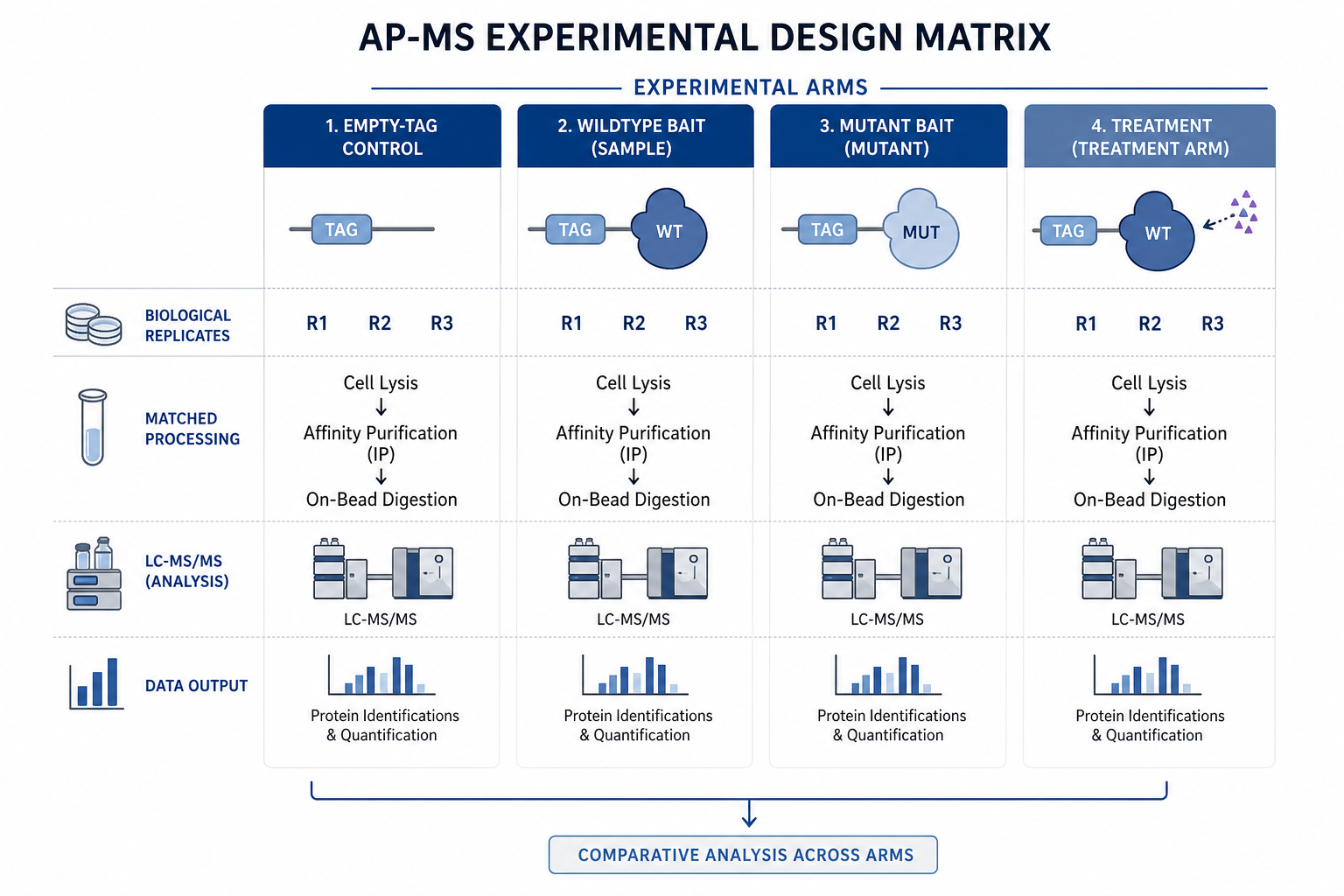
Figure 1. A usable AP-MS design defines all experimental arms, controls, and replicates before enrichment begins.
Design Controls That Match the Bait Format
Control design is part of experiment design, not a downstream correction. For tagged baits, an empty-tag line processed in parallel is the most common primary control and helps separate tag and resin binders from bait-associated recovery. For antibody capture designs, isotype or nonspecific antibody controls are required to model antibody background.
For comparative mutant studies, each mutant bait should have a matched expression context and, when possible, a matched empty-tag or control framework so that prey changes are not driven by unequal bait recovery. For treatment studies, vehicle or untreated controls must be processed with the same timing, lysis, and purification schedule as treated samples. Controls that differ in bead lot, wash volume, expression system, or processing day weaken the entire experiment regardless of MS performance.
Plan Replicates at the Right Level
Replicate planning determines whether the experiment supports ranking or only exploratory observation. Biological replicates are independent sample generations from separate cultures, treatments, or animals and support reproducibility claims for candidate interactors. Technical replicates repeat processing from the same starting material; they help monitor procedural variability but do not replace biological replication for interaction discovery.
For discovery interactome mapping, biological replicates of bait and primary control arms strengthen candidate filtering. For mutant or treatment contrasts, biological replicates in each arm are needed before condition-dependent prey changes are interpreted as biology rather than handling noise. Single unreplicated purifications may be useful for pilot assessment but are weak support for project go-forward decisions or publication-level interaction claims. Define replicate number before sample collection so that culture scale and scheduling can support the full design.
Match Processing Across All Arms
Matched processing is one of the most important design rules in AP-MS. All arms in a comparison should share lysis buffer composition, clarification method, incubation time, wash stringency, elution method, and sample cleanup strategy. Bait recovery should be monitored across arms when possible, because large bait recovery differences between wild-type and mutant baits, or between treatment groups, can create false prey enrichment patterns.
LC-MS/MS acquisition should follow a consistent strategy across arms intended for direct comparison. Changing gradient length, loading amount, or search thresholds between arms reduces comparability. If one arm requires a protocol deviation, document the reason before data collection, because unplanned asymmetry is difficult to interpret later.
Design by Protein Interaction Analysis Goal
Different PPI goals require different arm structures even when the same AP-MS platform is used.
|
PPI analysis goal |
Required arms |
Minimum design elements |
|---|---|---|
|
Bait partner discovery |
Bait plus empty-tag control |
Biological replicates and bait recovery check |
|
Mutant partner loss or gain |
Wild-type bait, mutant bait, matched controls |
Matched expression and purification chemistry |
|
Drug or stimulus remodeling |
Treated bait, vehicle control, empty-tag control |
Matched timing and processing across arms |
|
Complex subunit survey |
Tagged subunit bait plus bead or tag control |
Lysis conditions matched to complex stability |
|
Pilot feasibility test |
Bait plus one primary control |
Single replicate acceptable with limited claims |
Use the table to draft the design sheet, then confirm that each required arm is feasible with available constructs and sample material.
Lock Bait and Construct Design Into the Experiment Plan
Experiment design and bait engineering should be planned together. Tag choice and fusion position affect localization, partner access, and background; N-terminal and C-terminal fusions are not interchangeable without justification. Expression system and induction strategy should be chosen to support consistent bait recovery across replicates and arms.
If mutants, truncations, or domain swaps are included, design them as a matched construct series under the same tag and expression framework. Confirm bait expression and basic localization or function before committing to full-scale AP-MS sample generation when possible, because a mislocalized bait can produce reproducible but misleading interaction data.
Affinity Purification-Mass Spectrometry Service
MS-Based Protein-Protein Interaction Analysis Service
Predefine Validation Before the Protein List Arrives
Validation planning belongs in the design stage. Decide how many candidates the project can follow up with and what evidence standard they must meet. Reciprocal Co-IP, domain mapping, pairwise binding assays, and functional readouts are common follow-up routes depending on the claim.
If no validation path exists for the expected output, the experiment may still be useful for exploratory ranking but should not be designed as if it will support strong interaction proof. Predefining validation also helps limit over-collection of samples that exceed the downstream capacity of the lab.
AP-MS Experiment Design Checklist
Use this checklist before starting sample generation.
- Write a one-sentence objective that defines bait, contrast, and next action.
- List every experimental arm including bait, controls, and contrasts.
- Assign biological replicate number to each arm that will support claims.
- Confirm matched lysis, purification, and MS processing across compared arms.
- Verify that empty-tag or equivalent controls are feasible in the same expression system.
- Define bait recovery monitoring and acceptable recovery symmetry across arms.
- Record planned validation routes for top candidates.
- Confirm sample identity tracking across purification and LC-MS/MS stages.
Teams that complete this checklist can submit a design-ready AP-MS plan rather than an underspecified pull-down request.
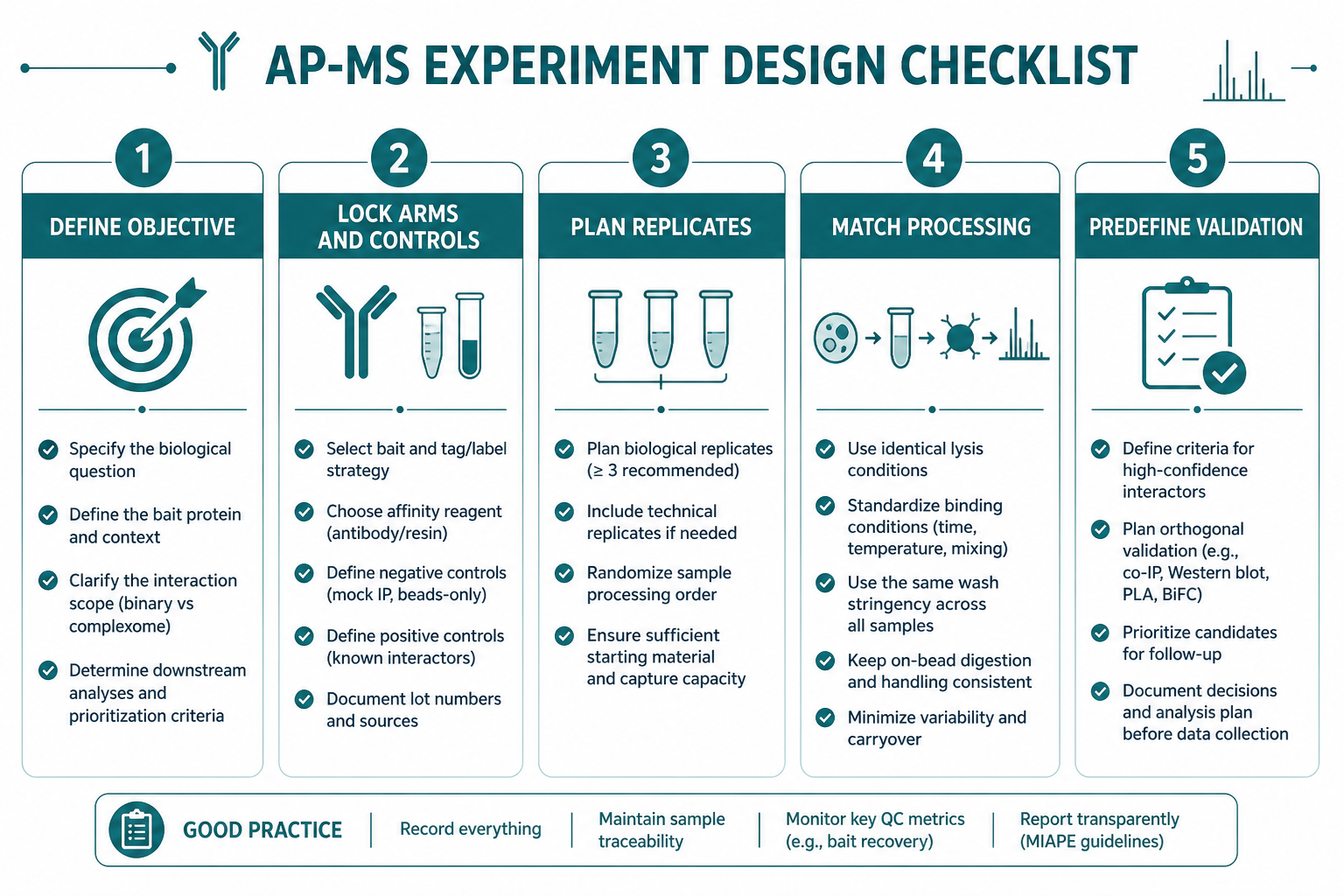
Figure 2. Lock objective, arms, controls, replicates, matched processing, and validation before AP-MS sample generation begins.
Common Design Failures to Avoid
Several design errors recur in protein interaction AP-MS projects:
- Running bait samples without a matched empty-tag or equivalent control.
- Comparing mutant and wild-type baits expressed at different levels without recovery normalization.
- Processing treatment and control samples on different days with different bead batches or wash protocols.
- Collecting only one biological replicate and reporting the result as a validated interactome.
- Leaving validation undefined until a long protein list creates decision fatigue.
- Changing lysis or wash conditions mid-project because earlier arms failed without redesigning the full comparison.
These failures are design problems. They cannot be fully repaired after LC-MS/MS data are collected.
Related Services
Complementary
MS-Based Protein-Protein Interaction Analysis Service
Use when the project needs broader PPI analysis support beyond a single bait enrichment design.
Complementary
Co-Immunoprecipitation Protein Interaction Analysis Service
Use for validation of AP-MS candidates defined during the experimental design stage.
Next Step
Affinity Purification-Mass Spectrometry Service
Submit the locked experimental design for review before sample intake.
What to Include in a Design-Ready Project Submission
A design-ready AP-MS submission should include more than sample type. Provide the one-sentence interaction objective, list all experimental arms and biological replicate numbers, and describe bait construct, tag, and expression system. Identify primary and secondary controls, state any treatment, mutant, or time-point contrasts, and note planned validation assays for prioritized candidates. Indicate whether samples exist now or constructs still need to be generated.
MtoZ Biolabs can review this information to confirm whether the proposed AP-MS experiment supports the intended protein interaction analysis before work begins.
Frequently Asked Questions
1. How many biological replicates should an AP-MS experiment include?
For discovery or comparative interaction analysis, biological replicates of bait and control arms are strongly recommended. Exact replicate number depends on project goals and should be defined before sample collection.
2. Is an empty-tag control always required?
For tagged-bait AP-MS, an empty-tag or equivalent control processed in parallel is the standard background model. Antibody-based designs require appropriate isotype or nonspecific controls instead.
3. Can I compare treated and untreated baits without a vehicle control arm?
A vehicle or untreated control arm processed with matched timing and chemistry is important when treatment effects on bait-associated proteins are part of the claim.
4. Should validation be planned before AP-MS sample prep?
Yes. Predefining validation routes helps determine how many candidates the project can support and what claim level the experiment must deliver.
5. What is the most common AP-MS design mistake?
Running bait purifications without matched negative controls or without biological replicates for the arms that must support interaction ranking.
Conclusion
Designing an AP-MS experiment for protein interaction analysis means defining arms, controls, replicates, and matched processing before enrichment starts. The objective, bait format, and validation plan should be locked early so that every sample has a clear role in the final comparison.
Strong AP-MS designs support discovery, mutant comparison, or treatment remodeling with control-based ranking rather than raw identification lists. Weak designs often fail because background arms, replicate structure, or processing symmetry were treated as optional. Researchers ready to finalize an AP-MS experimental design can review the Affinity Purification-Mass Spectrometry Service page or contact MtoZ Biolabs with the design sheet, arm list, and validation plan for project review.
How to order?




