






How to Choose an Antibody for IP-MS
Introduction
IP-MS experiments often encounter problems because the selected antibody does not perform adequately in immunoprecipitation, even when the mass spectrometry method itself is suitable. A researcher may already know the target protein and still order an antibody validated only for western blot. The IP step may enrich little of the intended bait, or it may pull down a crowded background that overwhelms LC-MS/MS. An antibody may be described as suitable for IP without evidence that it supports target recovery for downstream mass spectrometry analysis.
Choosing an antibody for IP-MS means selecting a reagent that can immunoprecipitate the target with enough specificity and recovery for mass spectrometry detection. Labels such as IP-MS validated antibody, antibody validated by IP-MS, or antibody validated for IP-MS are useful only when the validation evidence matches the planned experiment. This article explains what to evaluate before ordering, how IP-MS validation differs from other application data, and how to identify suitable antibodies for a specific target and experiment.
The Core Selection Question
The key consideration is not how many antibodies a supplier offers. The key question is whether the antibody can capture the intended target under IP conditions while producing an enriched sample suitable for MS identification.
If the goal is bait-centered interaction discovery, the antibody must recover the target protein itself with acceptable background. If the goal is confirmation of a known complex, the antibody must preserve enough associated partners through wash conditions. If the goal is endogenous IP without tagging, antibody specificity becomes even more important because there is no affinity-tag fallback.
Antibody selection should begin with the target protein and experimental objective, followed by evaluation of application-specific evidence rather than western blot data alone.
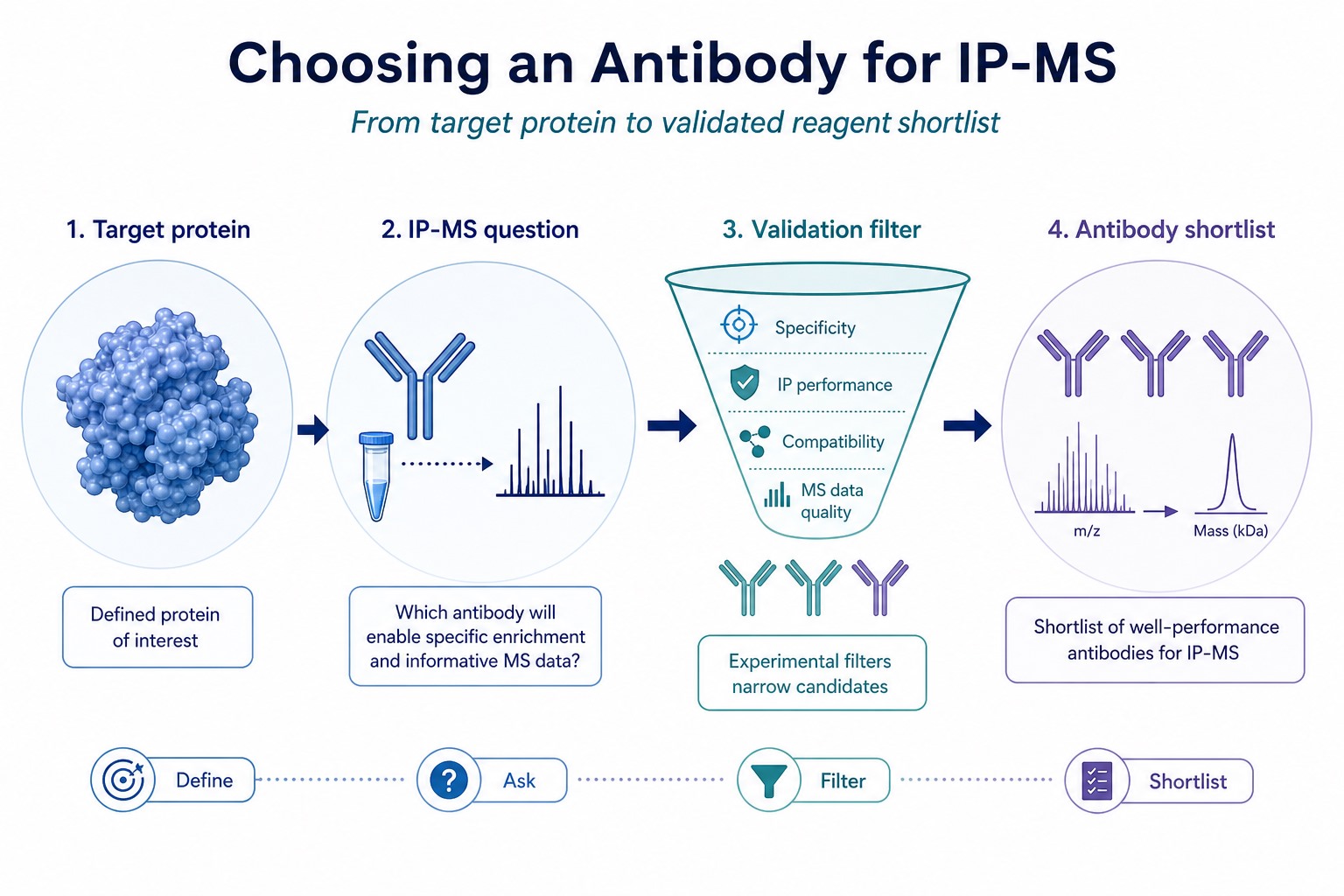
Figure 1. Antibody selection for IP-MS starts with the target protein and IP-MS question, then filters candidates by validation evidence and experimental fit.
What IP-MS Validation Should Mean
An IP-MS validated antibody should have evidence that immunoprecipitation with that antibody recovers the intended target protein in an MS-readable enrichment.
Strong IP-MS validation evidence should extend beyond the presence of a gel band. Useful evidence can include enrichment of the target in the IP eluate, MS identification of the bait, and some indication that background is manageable under the reported conditions. Antibody validated by IP-MS or antibody validated for IP-MS should therefore be read as a claim about capture performance in an IP-to-MS workflow, not as a guarantee of every interaction partner or every sample matrix.
By contrast, western blot validation shows recognition of a denatured or semi-denatured target in a blot format. IHC or IF validation shows localization performance. Those applications matter for other experiments, but they do not automatically prove IP recovery sufficient for LC-MS/MS. When an antibody is reported to support IP but no MS-based evidence is provided, additional evaluation may be needed before it is used for IP-MS.
Key Criteria for Choosing an Antibody for IP-MS
Use a practical checklist before ordering.
Confirm IP-MS or IP application evidence
Prefer antibodies with explicit IP-MS validation, or at least robust IP data plus a plan to confirm target recovery by MS. If only WB data are shown, expect extra risk at the enrichment step.
Match clonality and format to the workflow
Monoclonal antibodies can offer consistent lot behavior for repeated IP-MS. Polyclonal antibodies may recognize multiple epitopes and sometimes improve capture of low-abundance or partially modified targets, but lot variation and background risk can be higher. Choose based on the need for consistency versus epitope coverage.
Review immunogen and epitope relevance
Confirm that the immunogen corresponds to the species and isoform you will IP. Epitope location can affect whether the antibody still binds in native lysate conditions used for IP-MS.
Assess specificity signals
Look for KO, KD, overexpression, or peptide-blocking evidence when available. For IP-MS, specificity reduces the chance that MS will identify an off-target protein as the dominant enriched species.
Check host species and bead chemistry compatibility
Host species affects secondary reagents if used, and can matter for bead systems and isotype controls. Confirm that the antibody format works with your Protein A/G or related capture resin.
Estimate required amount and concentration
IP-MS often consumes more antibody than a single western blot. Confirm available vial size, recommended IP input, and whether scale-up for replicate IPs is realistic.
Review the validation conditions carefully
Note lysate type, species, wash conditions, and whether MS actually identified the target. An antibody validated for IP-MS in one matrix may still need pilot testing in yours.
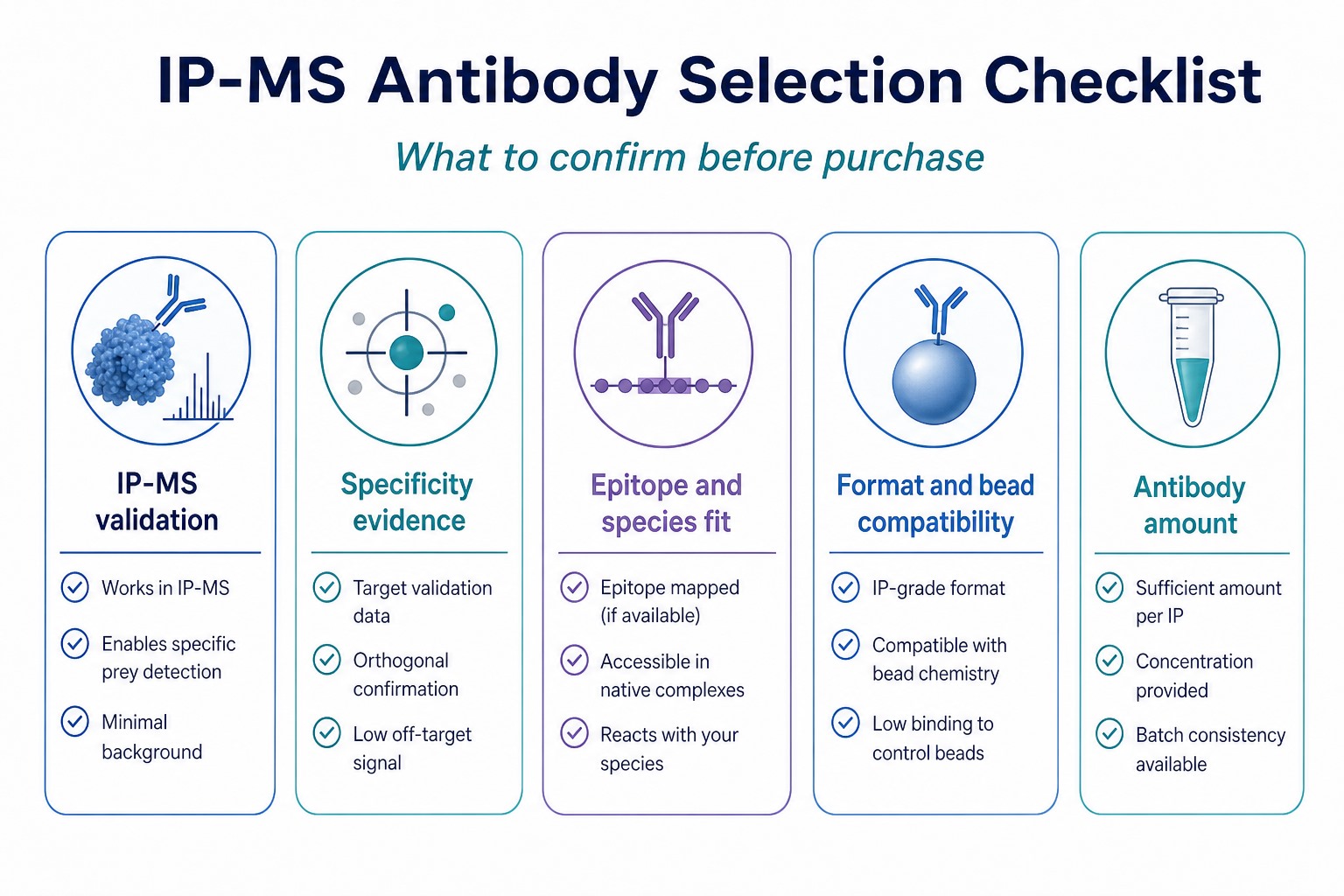
Figure 2. Before ordering, confirm IP-MS validation, specificity, epitope fit, format compatibility, and available antibody amount.
How to Compare Candidate Antibodies
When several antibodies are available for the same target, compare the relevance and quality of their validation evidence rather than the number of products offered.
|
Comparison point |
Prefer for IP-MS |
Higher risk for IP-MS |
|---|---|---|
|
Application claim |
IP-MS validated or IP plus MS evidence |
WB-only or untested IP |
|
Target recovery |
Clear bait enrichment in IP |
Weak or undocumented recovery |
|
Specificity support |
KO, KD, or strong orthogonal evidence |
Broad immunogen with little specificity data |
|
Format consistency |
Documented clone or controlled lot strategy |
Unclear lot-to-lot expectations |
|
Workflow fit |
Compatible host, isotype, and bead system |
Format mismatches with planned resin |
If two antibodies both claim IP use, prioritize the one with documented antibody validated by IP-MS evidence in a matrix close to your sample. A slightly narrower epitope with better IP-MS performance is often more useful than a broadly marketed reagent without enrichment data.
Related Products
IP-MS Validated NLRP3 Antibody
Researchers selecting antibodies for IP-MS can consult MtoZ Biolabs to assess target characteristics, validation evidence, and antibody suitability for the intended experiment. Selection can begin by reviewing IP-MS Validated Antibodies and Target Protein Antibodies, followed by comparison of individual antibodies based on evidence relevant to the planned enrichment conditions.
Step-by-Step Guide to Building an Antibody Shortlist
Step 1. Define the experimental objective
State whether you need bait recovery only, interaction discovery, or confirmation of selected partners.
Step 2. Define target identity details
Record species, isoform, expected modifications, and whether the target is tagged or endogenous.
Step 3. Filter for IP-MS relevant validation
Prioritize antibodies supported by IP-MS validation or by clear IP data combined with MS-based confirmation of target recovery.
Step 4. Eliminate obvious mismatches
Remove WB-only reagents, wrong-species immunogens, incompatible hosts, or formats that do not fit your bead system.
Step 5. Rank by specificity and documentation quality
Prefer transparent validation methods, clone information, and evidence that the intended protein is recovered.
Step 6. Plan a pilot IP before full MS scale-up
When possible, confirm target enrichment on a small scale before committing multiple replicates to deep LC-MS/MS.
Step 7. Align antibody choice with MS expectations
Confirm that expected bait peptides are detectable and that background assumptions match your wash strategy.
For researchers comparing multiple antibodies against the same bait protein, MtoZ Biolabs can help evaluate the available evidence and develop a practical antibody selection and experimental planning checklist.
What Good Selection Enables Downstream
A well-chosen antibody improves the entire IP-MS chain.
Target recovery becomes more reproducible across replicates. Background proteins are less likely to dominate identification tables. Interaction candidates, when sought, start from a bait-enriched sample rather than from a failed IP. Method troubleshooting also becomes clearer because antibody fitness has already been screened at selection.
Antibody choice does not replace controls, wash optimization, or MS method design. It reduces one of the most common sources of failure in IP-MS experiments.
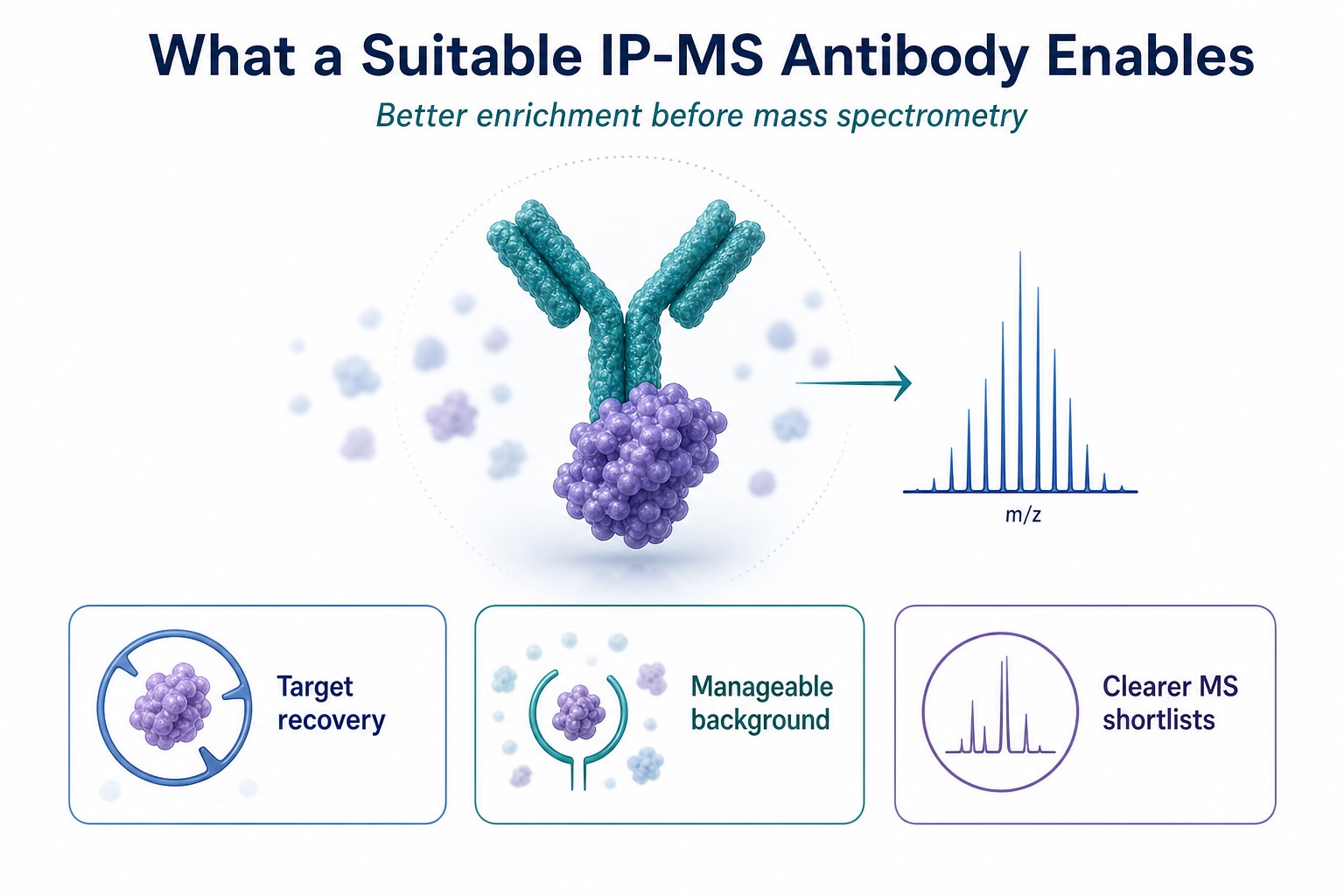
Figure 3. An IP-MS suitable antibody supports target recovery, manageable background, and clearer downstream MS interpretation.
Key Precautions When Buying Antibodies for IP-MS
Do not equate western blot validation with IP-MS performance. Do not ignore species and isoform mismatches. Do not assume every IP-labeled antibody has been tested with MS readout. Do not under-order antibody amount for replicate IPs. Do not skip controls even when using an antibody validated by IP-MS. Do not interpret partner lists if bait recovery itself is weak or undocumented.
IP-MS success depends on reagent fitness and workflow design together. Selection is the first control point.
Frequently Asked Questions
1. What does IP-MS validated antibody mean?
It usually means the antibody has evidence of immunoprecipitating the intended target in a workflow compatible with mass spectrometry identification.
2. Is an antibody validated for IP enough for IP-MS?
IP validation is helpful, but IP-MS is stronger when MS evidence shows target recovery and manageable background after enrichment.
3. Can I use a western blot antibody for IP-MS?
Sometimes, but WB success does not guarantee IP recovery under native lysate conditions. Pilot testing is important.
4. Should I choose monoclonal or polyclonal antibodies for IP-MS?
Either can work. Monoclonals often favor consistency. Polyclonals may improve capture in some cases but can increase background or lot variability.
5. What information should I review before ordering an antibody?
Review the reported applications, IP-MS or IP validation evidence, immunogen, species reactivity, specificity data, host species, antibody format, and recommended IP conditions or antibody amount.
6. What is the next step after choosing an antibody?
Run a pilot IP to confirm target enrichment, then proceed to controlled IP-MS with appropriate negative controls and MS identification.
Conclusion
Choosing an antibody for IP-MS is a product selection decision driven by enrichment performance, not by general antibody popularity. Prioritize reagents with IP-MS validation or clear IP plus MS evidence, confirm epitope and species fit, review specificity and format compatibility, and plan enough antibody for controlled replicates. Labels such as antibody validated by IP-MS are useful when the supporting data match your target and matrix.
A structured evaluation process can reduce failed immunoprecipitations and complex background signals before samples proceed to LC-MS/MS analysis. Researchers planning IP-MS experiments can contact MtoZ Biolabs to discuss target characteristics, antibody validation evidence, and compatibility with the intended experimental conditions.
How to order?




