






How Do Different Sample Types Affect Exosome Purification Efficiency? (Serum, Plasma, Urine, Saliva)
Exosomes are nanoscale extracellular vesicles that mediate intercellular communication and hold emerging value in disease biomarker discovery, early cancer screening, and therapeutic delivery. Although exosomes can be isolated from multiple human biofluids, differences in vesicle abundance, biochemical composition, and matrix complexity directly influence purification efficiency and downstream omics data quality. This article compares exosome isolation characteristics across serum, plasma, urine, and saliva, summarizes biofluid-specific challenges, and provides methodological recommendations for improving exosome purification efficiency and analytical reproducibility.
Influence of Biofluid Type on Exosome Purification Efficiency
1. Serum: High Protein Background Requiring Reinforced Impurity Removal
(1) Advantages
Serum is widely obtainable and operationally convenient. It contains relatively high concentrations of exosomes, facilitating vesicle collection.
(2) Challenges
Coagulation induces substantial release of platelet-derived exosomes and enriches abundant proteins such as albumin and immunoglobulins, which interfere with purification and downstream proteomic analyses.
(3) Extraction Efficiency
Medium to high (approximately 1–3 × 10⁹ particles/mL, NTA).
(4) Recommended Strategies
Density gradient centrifugation or size-exclusion chromatography (SEC) can improve sample purity. Protease pretreatment or polymer precipitation followed by SEC may further enhance purification performance.
2. Plasma: Anticoagulants Influence Exosome Purification Outcomes
(1) Advantages
Plasma preserves exosome populations in a more physiological state without coagulation-induced alteration.
(2) Challenges
Common anticoagulants (e.g., EDTA, heparin, sodium citrate) may bind to exosomal membrane proteins, affecting particle integrity or downstream molecular assays.
(3) Extraction Efficiency
Medium (approximately 1–2 × 10⁹ particles/mL, NTA).
(4) Recommended Strategies
EDTA anticoagulated plasma is preferable to minimize heparin interference. Removal of residual anticoagulants prior to extraction can improve vesicle recovery. SEC combined with differential ultracentrifugation is also recommended.
To reduce batch bias introduced by differing matrix properties, sample types should remain consistent within the same research project (e.g., uniformly using serum or plasma).
3. Urine: Low Background and Low Particle Concentration, Suitable for Non-Coding RNA Studies
(1) Advantages
Collection is non-invasive and convenient. Low protein background favors downstream analysis of non-coding RNAs such as miRNAs and circRNAs.
(2) Challenges
Exosome concentration is low and influenced by hydration status and kidney function. Urine pH, ionic strength, and protease activity affect vesicle stability.
(3) Extraction Efficiency
Relatively low (approximately 0.1–0.5 × 10⁹ particles/mL, NTA).
(4) Recommended Strategies
Morning urine collection and sample volume concentration (≥10-fold) are recommended. Ultrafiltration coupled with SEC can improve recovery. Protease inhibitors and pH control are required during processing.
4. Saliva: High Viscosity and High Biochemical Background
(1) Advantages
Collection is non-invasive and allows repeated sampling. Saliva also holds diagnostic potential for neurological and oral diseases.
(2) Challenges
High abundance of mucins and salivary enzymes (e.g., amylase) introduces contamination. Vesicles derived from oral microbiota may reduce biological specificity.
(3) Extraction Efficiency
Medium to low (approximately 0.2–1 × 10⁹ particles/mL, NTA).
(4) Recommended Strategies
Pretreatment with mucinase and protease inhibitors reduces viscosity and enzymatic degradation. Filtration prior to ultracentrifugation/SEC is recommended. Validation of canonical markers (e.g., CD9, CD63) via Western blot improves source attribution.
Biofluid Selection Recommendations and Application Scenarios
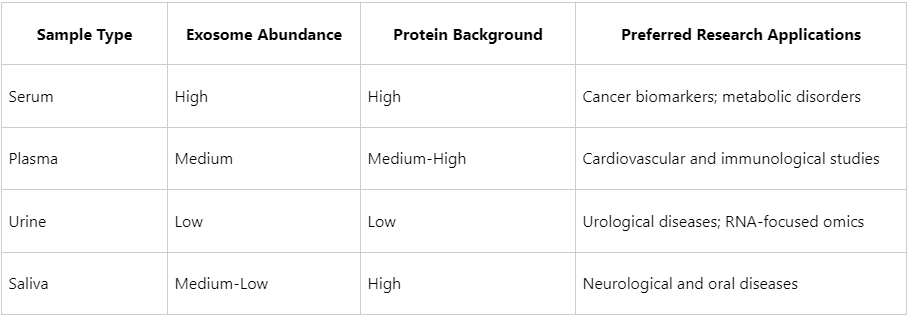
Strategies for Improving Exosome Purification Efficiency
1. Selection of appropriate biofluid type: Biofluid selection should align with research objectives (e.g., proteomics vs. miRNA studies) and prioritize matrices with higher exosome content and lower biochemical interference.
2. Optimization of isolation workflows: SEC combined with differential ultracentrifugation or commercial isolation kits followed by purification columns can enhance sample purity and recovery rate.
3. Quality assessment protocols: Comprehensive vesicle characterization should integrate nanoparticle tracking analysis (NTA), transmission electron microscopy (TEM), and Western blotting for canonical markers to ensure vesicle integrity and purity.
4. Workflow standardization for reproducibility: Standardized operating procedures minimize operator-dependent batch variation and improve data reliability for high-precision research and clinical translation.
Exosome research is transitioning from exploratory investigation to translational and clinical application. In this context, rational selection of biofluid sources and optimized purification workflows represent fundamental prerequisites for obtaining high-quality exosome purification preparations and reliable downstream omics data. MtoZ Biolabs offers a fully integrated exosome research pipeline, spanning sample preprocessing, vesicle purification, and downstream proteomics, transcriptomics, and metabolomics analyses, thereby enabling researchers to conduct exosome studies with improved efficiency and data consistency.
MtoZ Biolabs, an integrated chromatography and mass spectrometry (MS) services provider.
Related Services
How to order?




