






How Are Histone Phosphorylation Sites Identified?
Histones constitute critical components of chromatin, and their post-translational modifications (PTMs) are essential for regulating gene expression, chromatin remodeling, and the cell cycle. Among these modifications, phosphorylation is a dynamic and rapidly responsive PTM that is crucial for biological processes such as DNA damage repair and mitosis. Accurate identification of histone phosphorylation sites is a foundational step for systematically investigating their biological significance.
Challenges in Identifying Histone Phosphorylation
Compared with acetylation and methylation, histone phosphorylation presents several analytical challenges:
- Low-abundance modification: phosphorylation events are often transient and typically represent less than 1% of histone molecules.
- Labile sites: phosphate groups are prone to loss during mass spectrometry analysis.
- Coexistence with other modifications: e.g., phosphorylation with acetylation, increasing analytical complexity.
- Weak fragment ion signals: particularly at Ser/Thr residues, where MS/MS fragment ion intensities are frequently reduced.
Consequently, traditional Western blotting or antibody-based enrichment approaches cannot comprehensively capture the full modification landscape, making high-resolution mass spectrometry indispensable.
Standard Workflow for Histone Phosphorylation Site Identification
1. Histone Extraction and Preprocessing
- Sample sources: cell lines, animal tissues, or clinical specimens.
- Extraction method: acid extraction (e.g., 0.2 M H₂SO₄) to efficiently isolate histones.
- Desalting and protein quantification: ensures consistent sample loading and accurate MS-based quantification.
MtoZ Biolabs utilizes a low-pH, high-throughput processing system that preserves phosphorylation integrity and prevents modification loss.
2. Optimization of Enzymatic Digestion
Histones are rich in basic residues (Lys, Arg), and conventional trypsin digestion produces short peptides, which are suboptimal for mass spectrometry analysis. Recommended strategies include:
- Co-digestion with trypsin and GluC to extend peptide length and preserve phosphorylation information
- Chemical derivatization, e.g., propionylation, to block unmodified Lys residues, improving peptide distribution and charge states
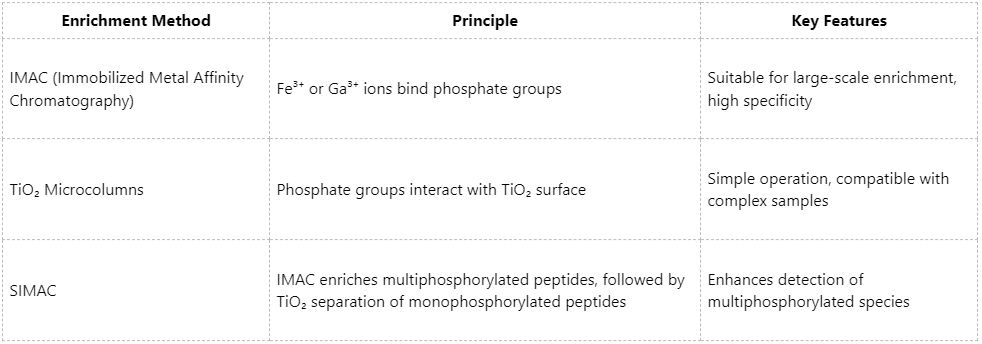
3. Phosphopeptide Enrichment (Critical Step)
Given the low abundance of phosphopeptides, enrichment prior to MS analysis is essential:
4. High-Resolution Mass Spectrometry Analysis
(1) Recommended Instrument Platforms:
- Orbitrap Fusion Lumos
- timsTOF Pro
- Q Exactive HF-X
(2) Fragmentation Methods:
- HCD (Higher-energy Collisional Dissociation): for routine phosphorylation site detection
- ETD (Electron Transfer Dissociation): preserves phosphorylation, facilitating site localization.
- EThcD: combines advantages of HCD and ETD, suitable for complex samples with coexisting modifications.
5. Data Analysis and Site Localization
Specialized software is used for data interpretation, including:
- MaxQuant: high-precision search supporting phosphorylation modifications
- Proteome Discoverer + PTM-RS: enables site probability scoring.
- Byonic: suitable for samples with multiple coexisting modifications.
By aligning data with the Uniprot database, specifying variable modifications (e.g., Phospho[S,T,Y]), and applying site probability thresholds (e.g., localization probability > 0.75), high-confidence identification of histone phosphorylation sites can be achieved.
Technical Advantages of MtoZ Biolabs in Histone Modification Research
MtoZ Biolabs provides comprehensive MS workflows from sample preparation to modification site identification. Key advantages in histone phosphorylation research include:
- Customizable enrichment strategies (IMAC, TiO₂, dual enrichment)
- Support for low starting amounts of histones (≥20 μg)
- High-resolution Orbitrap platforms ensuring deep coverage
- Full workflow quality control and bioinformatics analysis support
Accurate identification of histone phosphorylation sites is a critical first step for decoding the dynamic regulatory mechanisms of chromatin. High-resolution mass spectrometry has become the standard tool in this area. By optimizing sample handling, enrichment strategies, and MS acquisition parameters, researchers can generate comprehensive and reliable phosphorylation maps. These approaches are particularly relevant for studies of epigenetic regulation, cell cycle control, and DNA damage repair.
MtoZ Biolabs, an integrated chromatography and mass spectrometry (MS) services provider.
Related Services
How to order?




