






Heteropolysaccharides Analysis Service
Heteropolysaccharides are complex polysaccharides composed of two or more different monosaccharides linked by glycosidic bonds, commonly containing glucose, galactose, mannose, fucose, xylose, arabinose, and uronic acids. They are widely distributed in plant cell walls, microbial exopolysaccharides, algae, and animal tissues, exhibiting diverse structural and functional characteristics. Heteropolysaccharides have significant application value in fields such as food, medicine, cosmetics, and biomaterials, serving as thickeners, immunomodulators, and components with antioxidant and anti-inflammatory activities.
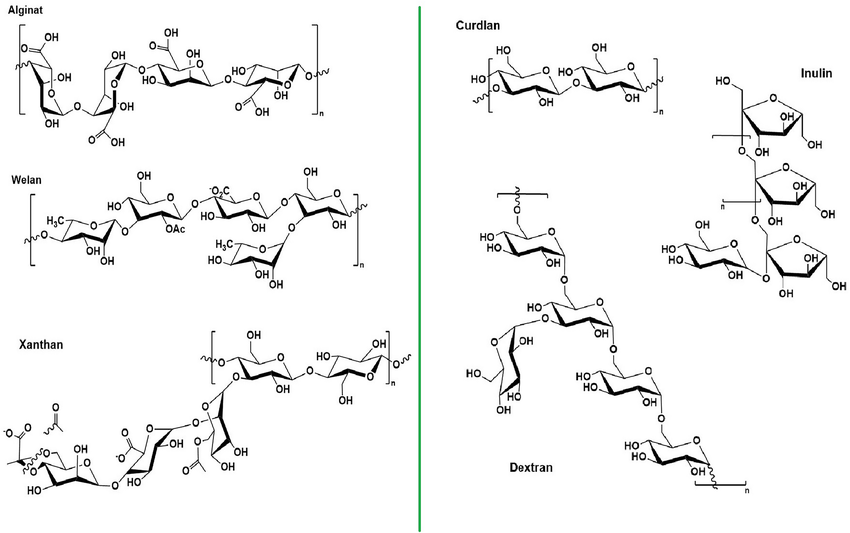
Salimi, F. et al. World Journal of Microbiology and Biotechnology, 2023.
Figure 1. Chemical structure of some heteropolysaccharides (left) homopolysaccharides (right).
Services at MtoZ Biolabs
Based on advanced instrumentation and multi-dimensional characterization platforms, the heteropolysaccharides analysis service launched by MtoZ Biolabs provides systematic analysis of the composition, structural features, and physicochemical properties of heteropolysaccharides, helping clients gain deeper insights into the complexity and functional characteristics of polysaccharide systems. The service includes but is not limited to the following aspects:
1. Monosaccharide Composition and Distribution Analysis
High-performance liquid chromatography (HPLC) and mass spectrometry (MS) are used to quantitatively detect the types and ratios of monosaccharides in heteropolysaccharides, clarifying their compositional features and complexity.
2. Structural and Functional Group Characterization
Infrared spectroscopy (FTIR), nuclear magnetic resonance (NMR), and ultraviolet spectroscopy (UV) are employed to analyze the main-chain configuration, branch distribution, glycosidic bond types, and functional group characteristics of heteropolysaccharides, revealing their spatial conformational features.
3. Elemental and Chemical Property Detection
Inductively coupled plasma mass spectrometry (ICP-MS) and related analytical methods are applied to determine the metal elements, uronic acid content, and possible impurities in heteropolysaccharides.
4. Morphology and Surface Structure Observation
Scanning electron microscopy (SEM) and cryo-electron microscopy (Cryo-EM) are combined to observe the surface morphology, aggregation state, and microstructural features of the samples.
5. Thermal Property and Stability Evaluation
Thermogravimetric analysis (TGA) and differential scanning calorimetry (DSC) are used to evaluate the thermal stability, decomposition temperature, and physical transition characteristics of heteropolysaccharides, assessing their physical properties and storage stability.
Sample Submission Suggestions
1. Sample Type
Purified heteropolysaccharide powders, lyophilized samples, or solutions are acceptable. Crude extracts or mixed samples can also be analyzed. A sample purity of ≥90% is recommended to ensure the accuracy and reproducibility of analytical results.
2. Sample Storage
Solid samples should be sealed and stored in a dark environment at 4°C or −20°C. Solution samples should be kept refrigerated at low temperatures and protected from repeated freeze-thaw cycles to prevent degradation.
3. Sample Transportation
Sealed and moisture-proof packaging is recommended. Liquid samples should be transported under cold-chain conditions, while powder samples can be shipped at room temperature for short periods but should be protected from heat and humidity.
Service Advantages
1. Comprehensive Analytical Capability
Integrating chemical composition, structural characterization, and physicochemical property detection to reveal the molecular features of heteropolysaccharides from multiple perspectives.
2. Advanced Analytical Instruments
Equipped with multiple high-end instruments, including LC-MS/MS, ICP-MS, and Cryo-EM, enabling precise and detailed analyses.
3. One-Time-Charge
Our pricing is transparent, no hidden fees or additional costs.
4. One-Stop Service Workflow
Providing end-to-end solutions from sample preparation to data reporting and result interpretation, ensuring efficient coordination and consistent output.
Applications
1. Natural Product Structure Research
By analyzing the monosaccharide composition and spatial structure of heteropolysaccharides from different sources, this service reveals their molecular diversity and biological origin characteristics.
2. Functional Activity Evaluation
The heteropolysaccharides analysis service supports studies on the potential roles of heteropolysaccharides in antioxidant, antibacterial, moisturizing, and cell adhesion regulation functions.
3. Pharmaceutical Excipient Research
Through the analysis of heteropolysaccharides in drug delivery systems, sustained-release formulations, and tissue repair materials, their physicochemical stability and structural features can be elucidated.
4. Fermentation Product Detection
The heteropolysaccharides analysis service can be used to monitor the production, content variation, and structural evolution of heteropolysaccharides in microbial fermentation products.
FAQ
Q1: Can Heteropolysaccharides from Different Sources Be Distinguished?
A1: Yes. By analyzing monosaccharide composition, identifying glycosidic bond characteristics, and performing structural comparisons, heteropolysaccharides from plants, algae, and microorganisms can be differentiated, and structural fingerprint profiles can be established.
Q2: Will Different Extraction Methods Affect the Analysis Results of Heteropolysaccharides?
A2: Yes. Factors such as extraction solvent, temperature, pH, and deproteinization method may alter the molecular weight distribution, branching structure, and degree of sulfation of heteropolysaccharides. MtoZ Biolabs recommends specifying the extraction procedure when submitting samples to facilitate accurate data interpretation.
Q3: Can the Sulfation or Phosphorylation Features of Heteropolysaccharides Be Analyzed?
A3: Yes. By combining FTIR detection of characteristic absorption peaks with elemental analysis and high-resolution mass spectrometry, the presence and distribution of substituents such as sulfate and phosphate groups in the sample can be determined.
How to order?




