






Glycogen Analysis Service
Glycogen is a highly branched polysaccharide composed of glucose units and serves as the primary energy storage form in animals, fungi, and some bacteria. It is mainly found in the liver and skeletal muscles, where it plays a crucial role in regulating blood glucose levels and maintaining energy homeostasis. The compact molecular structure of glycogen, consisting of both α-1,4 and α-1,6 glycosidic linkages, allows for rapid glucose release to meet immediate energy demands.
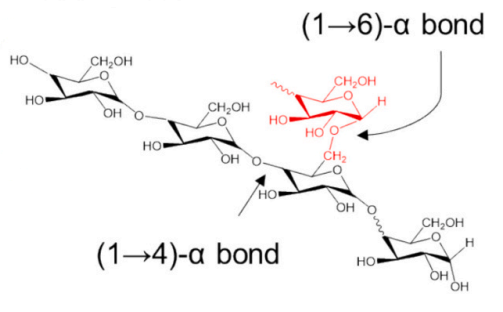
Figure 1. The Structure of Glycogen
In physiology, metabolic disease research, sports medicine, and food science, accurate analysis of glycogen content and structural characteristics is essential. Changes in glycogen levels reflect the body’s energy metabolism, while structural features such as branching patterns and molecular weight distribution are closely related to synthesis and degradation pathways. Therefore, glycogen analysis has become an important analytical approach for studying metabolic regulation, disease mechanisms, and nutritional metabolism assessment.
Leveraging advanced chromatographic and mass spectrometric platforms, MtoZ Biolabs delivers a high-resolution, reproducible glycogen analysis service designed for quantitative determination, structural elucidation, and molecular weight profiling of glycogen from various biological and food sources. The service supports applications in fundamental research, preclinical development, food quality assessment, and biopharmaceutical production, offering comprehensive and dependable analytical data.
Services at MtoZ Biolabs
MtoZ Biolabs’ glycogen analysis service aims to deliver a complete analytical solution covering both quantitative determination and structural characterization. Our service includes the following key components:
1. Glycogen Quantification
Using enzymatic assays or HPLC-RID/ELSD detection, glycogen content in samples is accurately measured. Combined with calibration curve analysis, the method achieves high sensitivity and a wide linear range, suitable for animal tissues, cell samples, and food extracts.
2. Monosaccharide Composition and Structural Analysis
Acid hydrolysis or enzymatic digestion combined with GC-MS or LC-MS/MS is used to determine the monosaccharide composition and branching structure ratios of glycogen. This analysis clarifies α-1,4 and α-1,6 linkage characteristics and branch length distribution.
3. Molecular Weight and Polydispersity Determination
Gel permeation chromatography (GPC) or size-exclusion chromatography coupled with multi-angle light scattering (SEC-MALS) is used to measure the average molecular weight, distribution range, and polydispersity, providing insights into polymerization properties and bioavailability.
4. Purity and Impurity Analysis
HPLC-UV, UPLC-ELSD, and Fourier transform infrared spectroscopy (FT-IR) are applied to assess impurities such as proteins, lipids, and inorganic salts, ensuring sample purity meets research standards.
5. Structural Characterization and Comparative Analysis
Nuclear magnetic resonance (NMR) and mass spectrometric fragmentation analysis are used to investigate branching points, terminal structures, and spatial conformations. Samples from different tissues, treatments, or extraction methods can be compared for structural variation and spectrum analysis.
Analysis Workflow
1. Sample Pretreatment: Depending on the sample type (tissue, cell, or food), steps such as deproteinization, defatting, lyophilization, and grinding are performed.
2. Glycogen Extraction and Purification: Glycogen is extracted using ethanol precipitation or centrifugation, followed by dialysis or enzymatic removal of impurities.
3. Hydrolysis and Derivatization: Acidic or enzymatic hydrolysis converts glycogen into detectable monosaccharides, which are then derivatized to enhance sensitivity.
4. Chromatographic and Mass Spectrometric Detection: HPLC, GC-MS, and LC-MS/MS are used for glycogen structural and quantitative analysis.
5. Data Interpretation and Report Generation: Experienced analysts interpret spectral data and generate a structured technical report.
Service Advantages
1. Comprehensive Multi-Platform Analysis
MtoZ Biolabs is equipped with HPLC, LC-MS/MS, GC-MS, NMR, and SEC-MALS systems, enabling multi-dimensional structural and quantitative analysis of glycogen. Complementary techniques ensure complete and reliable results, suitable for research, pharmaceutical, and food industry applications.
2. Customized Analytical Solutions
Our glycogen analysis service offers tailored analytical designs that consider sample source, research objectives, and analytical depth. Whether applied to animal tissue glycogen quantification, cellular metabolism studies, or food additive evaluation, the service provides flexible analytical strategies to meet specific research and industrial needs.
3. Experienced Scientific Team
Our scientists have extensive experience in carbohydrate chemistry and metabolic analysis, with strong expertise in sample handling and data interpretation. They provide scientific guidance and technical support to help clients achieve reliable research outcomes.
4. Complete Analytical Reports
Clients receive comprehensive reports including chromatograms, data tables, conclusions, and discussions. MtoZ Biolabs also provides optional verification, reanalysis, and data comparison services to ensure continuous project progress.
Applications
☑️ Metabolic Disease Research: Used to investigate the mechanisms of diabetes, glycogen storage diseases, and energy metabolism disorders.
☑️ Exercise Physiology and Nutrition: Evaluates muscle glycogen storage before and after exercise to assess energy consumption and metabolic adaptation.
☑️ Food and Functional Product Testing: Determines glycogen or starch-derived components in foods for quality assessment and nutritional evaluation.
☑️ Biopharmaceutical Quality Control: Identifies and verifies glycogen content and purity during the extraction and preparation of natural products.
☑️ Basic Biochemical Research: Supports studies on glycogen synthesis and degradation pathways, enzyme activities, and metabolic regulation mechanisms.
If you are conducting glycogen-related research or require accurate structural and quantitative data, contact MtoZ Biolabs. We are committed to providing a precise, reproducible, and scientifically sound glycogen analysis service to accelerate your research and product development.
Contact us today to get your customized glycogen analysis solution.
How to order?




