



Parallel reaction monitoring (PRM) is a targeted liquid chromatography-tandem mass spectrometry (LC-MS/MS) assay that isolates scheduled peptide precursors, fragments them, and records high-resolution product-ion spectra for quantitative extraction (Peterson et al. 2012). In project language, PRM names a closed peptide panel, a scheduling plan, and a trace from raw spectra to contrast statistics. It is not label-free discovery, not tandem mass tag (TMT) multiplex discovery, and not clinical diagnostic proof by default. The guide below defines PRM principle, contrasts it with multiple reaction monitoring (MRM), and links definition to workflow, parameters, limits, and route choice (Gallien et al. 2012).
PRM quantifies predefined peptides used as protein or modification surrogates. Relative change across groups is the usual discovery follow-up claim. Amount on named peptides needs stable isotope-labeled internal standard (SIS) peptides and a calibration model in the study matrix (Gerber et al. 2003).
In MtoZ Biolabs targeted offerings, PRM methods are built for declared peptide panels on high-resolution LC-MS/MS platforms when contrast design, prep parity, and panel size fit scheduling limits.
Targeted portfolio context appears in Targeted Proteomics Service. Service intake appears in Parallel Reaction Monitoring (PRM) Service.
What PRM Means in Targeted Quantitative Proteomics
Three definitions belong in the brief and stay separated.
Assay scope is targeted: only peptides on the inclusion list are scheduled. Open database search breadth is outside standard PRM principle.
Detection scope is parallel product-ion recording after quadrupole precursor isolation and collision-induced fragmentation. Quantification uses extracted fragment ion chromatograms from the stored high-resolution MS/MS scan.
Claim scope is contrast-based on the closed panel, for example treated versus control or time point A versus B, not proteome-wide hypothesis generation from the same file alone.
PRM principle is scheduled precursor isolation plus high-resolution MS/MS readout of product ions, not monitoring of the whole proteome.
Broader targeted quant framing appears in Parallel Reaction Monitoring for Targeted Quantification. Principle companion appears in Parallel Reaction Monitoring (PRM): Principles, Workflow, and Applications.
How PRM Detection Differs From MRM and From Discovery LFQ
Mechanism choice is separate from project question.
Selected reaction monitoring (SRM) and MRM on triple quadrupole instruments pass one precursor-product transition per dwell period (Lange et al. 2008). Transitions are chosen before acquisition.
PRM isolates the precursor in a quadrupole or similar filter, fragments in a collision cell, and records a full high-resolution product-ion spectrum. Fragment ions for quantification can be selected or re-evaluated after acquisition from the same spectrum (Peterson et al. 2012).
Label-free quantification (LFQ) on unlabeled discovery injections compares aligned MS1 features across runs without a closed schedule. PRM fits after candidates are named, not while the proteome is still open.
Unlabeled data-independent acquisition (DIA) discovery may supply candidates; PRM then remeasures a shortened list under targeted scheduling (Application of DIA-PRM Proteomics).
Mechanism depth appears in Mechanism of MRM/PRM in Protein Quantification. Comparative framing appears in PRM vs MRM: Comparative Analysis in Quantitative Proteomics.
End-to-End Workflow Anchored to PRM Principle
A practical PRM spine from principle to result usually runs as follows.
- Freeze contrast, replicates, and relative versus calibrated intent before method lock.
- Close the peptide panel from discovery, prior literature, or orthogonal evidence.
- Select proteotypic peptides with acceptable uniqueness and LC behavior.
- Match extraction, digestion, and load across all contrast arms.
- Build retention-time windows and inclusion lists with realistic cycle time for panel size.
- Acquire scheduled PRM with documented collision energy and fill-time rules.
- Extract product-ion chromatograms; review interference using multiple fragments.
- Normalize with declared rules; export peptide-by-sample matrix for predefined statistics.
- Archive method files, software versions, and panel version with deliverables.
Steps 1 through 5 define the PRM assay from principle. Steps 6 through 9 produce the quantitative record.
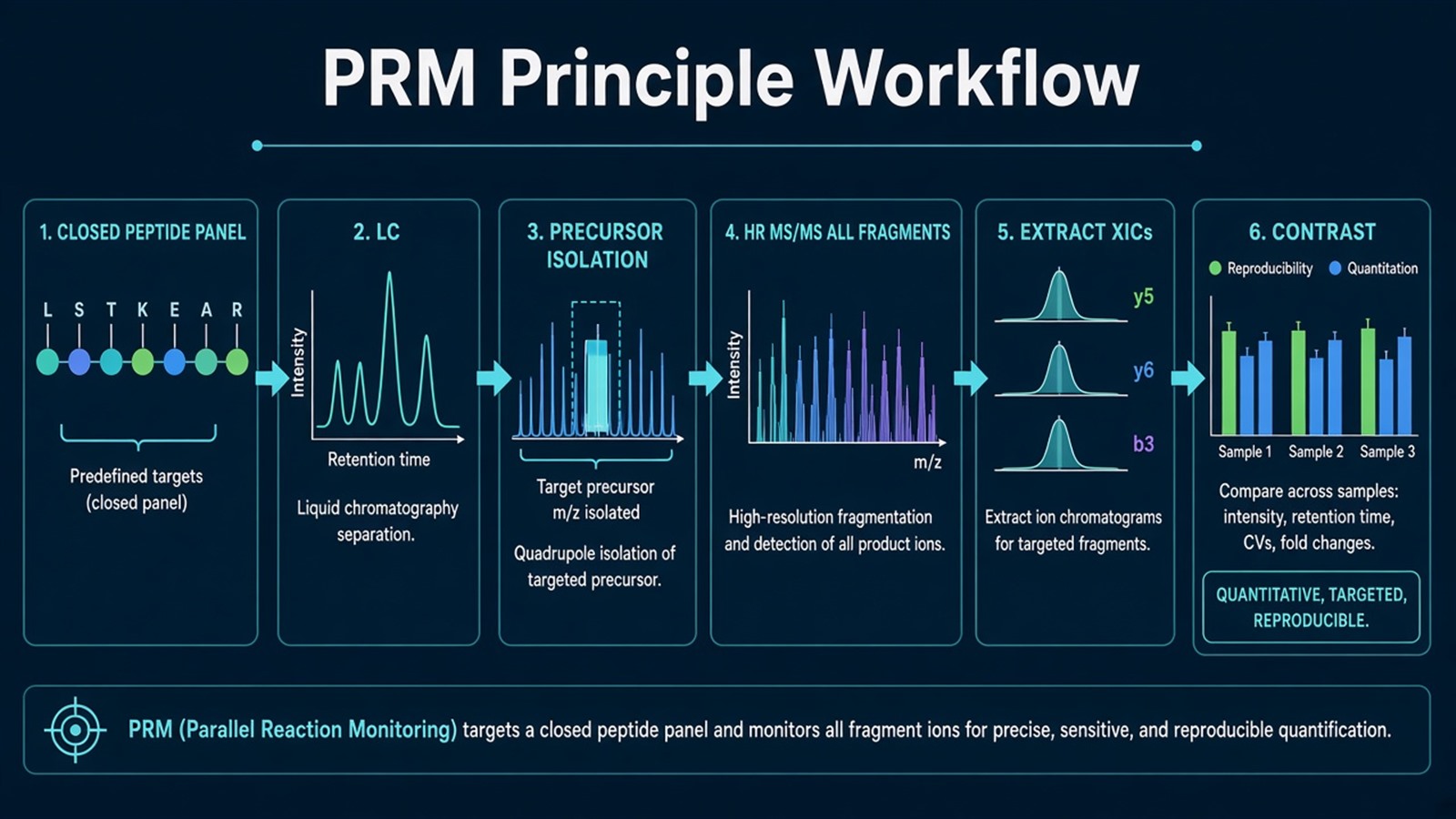
Figure 1. PRM principle links a closed panel to scheduled isolation and parallel product-ion recording before group contrasts are tested.
Bench detail appears in From Sample to Result: A Detailed PRM Quantitative Proteomics Workflow. Processing appears in PRM Proteomics Data Processing Workflow.
Parameters That Must Be Locked in PRM Methods
Layer |
Parameter that must be declared |
Failure mode if ignored |
|---|---|---|
Panel |
Peptide list version and protein mapping |
Moving targets mid study |
Peptide choice |
Proteotypic, unique, LC-stable surrogates |
Shared peptide ambiguity |
Schedule |
Retention windows and cycle time |
Missing peaks at elution |
Isolation |
Precursor isolation width |
Co-isolation interference |
MS/MS |
Collision energy and resolution |
Fragment yield drift |
Load |
Matrix-matched injection amount |
Suppression shifts ratios |
Standards |
Light-only versus SIS spiking plan |
False absolute claims |
QC |
Pool or SIS bracketing pattern |
Undetected drift |
Processing |
Extraction and normalization software version |
Non-reproducible peaks |
Contrast |
Frozen before peak review |
Post hoc panel edits |
Limits follow the same table. PRM principle does not remove matrix suppression in plasma or tissue. Panel size is bounded by chromatographic peak width and cycle time, not by marketing multiplex counts. High-resolution MS/MS improves specificity review but does not auto-validate biomarkers or drug targets without study design.
Validation planning appears in How to Plan a Targeted Proteomics Validation Study. Tradeoffs appear in Advantages and Disadvantages of Parallel Reaction Monitoring.
How to Choose PRM Versus Other Quantitative Routes
Use list status, claim unit, instrument context, and follow-up depth together.
Project need |
Quantitative route that often fits |
Recheck before committing |
|---|---|---|
Open proteome relative discovery |
Label-free LFQ or TMT |
PRM before candidates exist |
Shortlist after discovery |
PRM on closed peptides |
Discovery p-values as final panel |
Locked MRM transitions on triple quad |
MRM or SRM |
Need post-acquisition fragment audit |
Complex matrix, fragment review |
PRM with multiple product ions |
MRM when method already validated |
Amount on named peptides |
PRM or MRM with SIS calibration |
Relative PRM as concentration |
Large panel near cycle limit |
Split panels or reduce concurrent targets |
Overfilled schedule |
Pathway story from one PRM file |
Not supported alone |
Expanded panel or discovery arm |
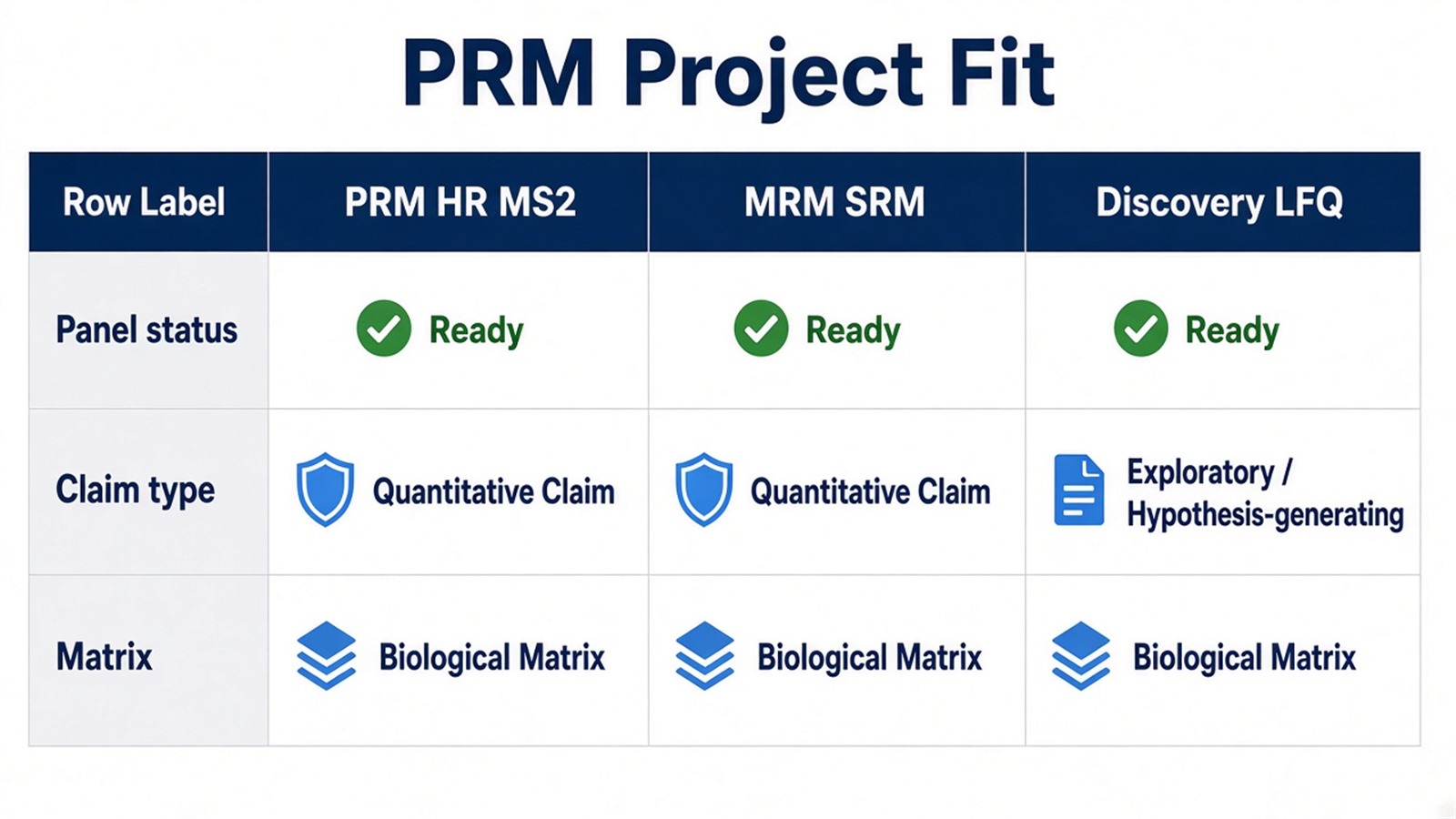
Figure 2. PRM fits a closed peptide list that needs scheduled HR MS/MS; open lists stay in discovery quantification until shortened.
MRM service context appears in SRM-MRM Quantitative Proteomics Services. Detection-oriented context appears in Detection of Proteins Using Parallel Reaction Monitoring.
Teams with closed peptide targets, contrast map, and claim unit can review the MtoZ Biolabs Parallel Reaction Monitoring (PRM) Service for PRM principle alignment when declared in the project record.
Frequently Asked Questions
1. Is PRM the same as MRM?
No. Both are targeted. MRM records predefined transitions on triple quadrupole systems. PRM records high-resolution product-ion spectra after precursor isolation so fragments can be evaluated in parallel.
2. Does PRM require Orbitrap instruments only?
PRM principle needs high-resolution product-ion readout after isolation. Several LC-MS/MS platforms implement that pattern. Instrument class does not replace panel design or contrast documentation.
3. Can PRM validate biomarkers from discovery alone?
PRM can remeasure candidate peptides on a new cohort or matrix when the panel and contrast are prespecified. Validation status depends on study design, not on PRM acquisition alone.
4. How many proteins fit one PRM method?
Fit depends on peptide count, chromatography length, peak width, and cycle time. Panels must be scheduled with realistic concurrent targets, not fixed headline numbers.
5. When should projects stay on discovery instead of PRM?
When proteins are not yet named, contrasts are still moving, or the brief needs proteome-wide relative discovery, open LFQ, DIA, or multiplex labeling routes remain the matching scope.
MtoZ Biolabs can discuss PRM principle and method scope when peptide panel, matrix prep, and contrast design are documented.
If further evaluation of PRM versus MRM, SIS calibration need, or discovery-to-PRM handoff is required, project details can be submitted for a feasibility review.
Reference
- A.C. Peterson, J.D. Russell, A.A. Klammer, P.F. Doubleday, H. Liu, J.N. Anderson, M.J. MacCoss (2012). Parallel reaction monitoring for high resolution and high mass accuracy quantitative, targeted proteomics. Mol. Cell. Proteomics, 11, 1475-1488. https://doi.org/10.1074/mcp.O112.020271
- S. Gallien, E. Duriez, A. Crone, M. Kellmann, T. Moehring, T. Domon (2012). Targeted proteomic quantification on quadrupole-orbitrap mass spectrometers. Mol. Cell. Proteomics, 11, 1709-1723. https://doi.org/10.1074/mcp.O112.019232
- V. Lange, P. Picotti, B. Domon, R. Aebersold (2008). Selected reaction monitoring for quantitative proteomics: a tutorial. Mol. Syst. Biol., 4, 222. https://doi.org/10.1038/msb.2008.61
- S.A. Gerber, J. Rush, O. Stemman, M.W. Kirschner, S.P. Gygi (2003). Absolute quantification of proteins and phosphoproteins from cell lysates by tandem MS. Proc. Natl. Acad. Sci. U.S.A., 100, 6940-6945. https://doi.org/10.1073/pnas.0832254100
- M. Choi, C. Chang, N. Clough, D. Broudy, T. Killeen, B. MacLean, M. Vitek (2014). MSstats: an R package for statistical analysis of quantitative mass spectrometry-based proteomic experiments. Bioinformatics, 30, 2524-2526. https://doi.org/10.1093/bioinformatics/btu305
