






Food Peptidomics Service
-
Peptide identification and quantification tables (Excel)
-
Peptide feature plots, heatmaps, distribution plots, and other visualization files (PNG or PDF)
-
Post-translational modification and bioactive peptide analysis files
-
Comprehensive analysis report (PDF), including workflow, analytical results, and conclusions
-
Raw mass spectrometry data files (RAW or mzML)
MtoZ Biolabs employs a high-resolution mass spectrometry platform to provide the food peptidomics service which enables systematic identification, quantitative analysis, and functional characterization of food-derived peptides. This service is widely applied in food quality research, nutritional activity assessment, and monitoring of food processing, offering a reliable data foundation for ingredient profiling, functional peptide screening, and product development.
Overview
Food peptidomics can be used to analyze the composition, variation, and potential functions of food-derived peptides, serving as an important approach for studying protein degradation patterns and bioactivity in foods. During processing, storage, or in vitro digestion, foods can generate various functional peptides that may participate in biological processes such as antioxidation, antihypertensive activity, or immune regulation. By conducting systematic food peptidomics studies, researchers can uncover the formation mechanisms of functional peptides, evaluate the effects of processing methods on peptide profiles, and provide scientific evidence for the development of functional foods and the enhancement of nutritional quality.
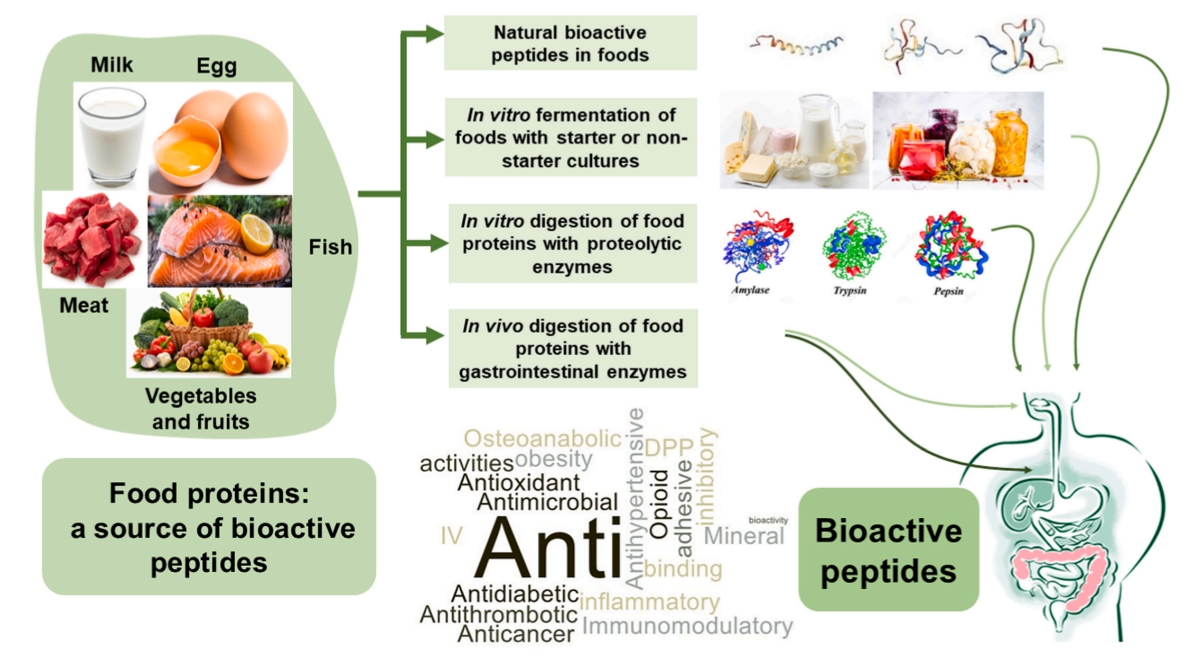
Caira, S. et al. Trends in Food Science & Technology, 2022.
Figure 1. Schematic Overview of the Different Sources of Food-Derived Bioactive Peptides.
Food Peptidomics Service at MtoZ Biolabs
1. Qualitative Analysis
MtoZ Biolabs precisely identifies the peptide composition in food samples through high-resolution mass spectrometry, elucidating their origins, sequence characteristics, and structural properties, and establishing comprehensive peptide profile information.
2. Quantitative Analysis
Using an advanced LC-MS/MS platform, the accurate measurement of peptide abundance is performed to support quantitative comparison of peptide variations under different processing methods, materials, or treatment conditions.
3. Bioactivity Analysis
By identifying and validating peptides related to antioxidation, antihypertensive effects, immune regulation, and other relevant activities, this approach helps assess the potential functions and application value of food-derived peptides.
4. Epitope Monitoring
Potential allergenic peptides generated during food processing or degradation are monitored, key epitopes are identified, and support is provided for allergen detection and food safety evaluation.
5. Post-translational Modification Analysis
Modification features such as oxidation, glycosylation, and phosphorylation in food-derived peptides are characterized to reveal the effects of processing conditions or external factors on the chemical properties and stability of peptides.
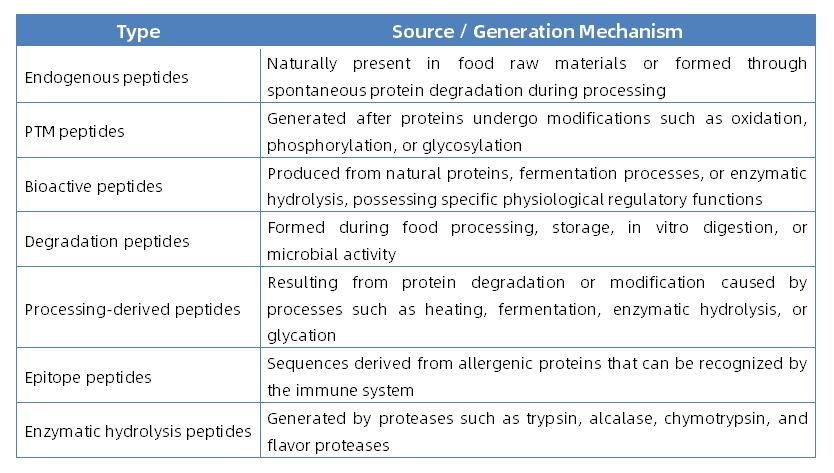
Common Peptide Types Detectable in Food Peptidomics
Workflow of Food Peptidomics Service
1. Sample Pretreatment
Food samples are homogenized and impurities are removed to obtain a clean matrix suitable for peptide extraction.
2. Peptide Extraction and Separation
Solid-phase extraction or chromatographic methods are used to enrich and separate peptides, improving detection sensitivity and coverage.
3. Mass Spectrometry Analysis
High-resolution LC-MS/MS is employed to obtain information on peptide mass, sequence, and abundance.
4. Data Analysis and Identification
Database searching and sequence matching are performed to identify peptides and detect post-translational modifications or key functional fragments.
5. Quantification and Annotation
Peptides are quantitatively analyzed, and preliminary functional or origin annotation is completed using relevant databases.
6. Report Output
A structured report is provided, including peptide lists, spectral displays, and comprehensive data interpretation.
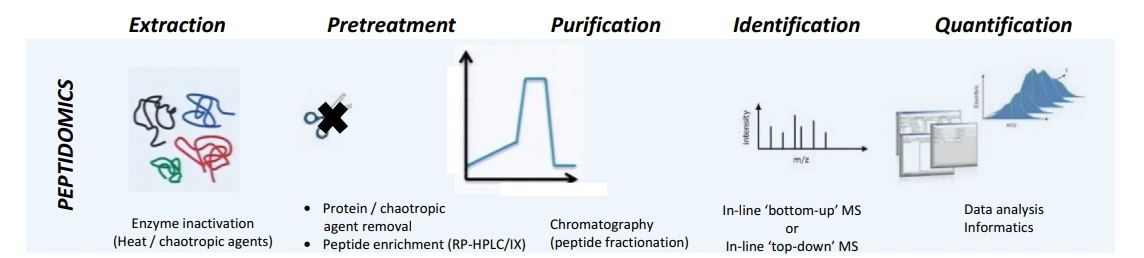
Greening, D W. et al. The Enzymes, 2017.
Figure 1. Strategies for Peptidomics.
Why Choose MtoZ Biolabs?
✅ High sensitivity analysis: Achieves precise detection of low-abundance peptides using high-resolution mass spectrometry.
✅ Strong quantitative capability: Supports both relative and absolute quantification to meet diverse research needs.
✅ Comprehensive quality control: A rigorous internal QC system ensures data accuracy and reproducibility.
✅ End-to-end workflow: A fully standardized process from sample handling to data reporting improves overall efficiency.
✅ Customized service: Analysis plans are tailored according to sample type, research objectives, and peptide characteristics.
Applications of Food Peptidomics Service
1. Functional Peptide Discovery and Activity Evaluation
Used to screen antioxidant, antimicrobial, antihypertensive, immune-modulating, and other functional peptides in foods, supporting the development of functional food products.
2. Processing Quality Monitoring
Monitors peptide changes during heating, fermentation, baking, enzymatic hydrolysis, and other processing steps to reveal mechanisms underlying quality formation and flavor development.
3. Potential Allergen and Epitope Monitoring
Used to detect allergenic peptides that may exist or form before and after processing, supporting allergen risk assessment.
4. Fermentation Process Analysis
Examines functional peptides generated during microbial fermentation and their structural characteristics.
5. Stability Assessment
Analyzes peptide changes under different storage conditions to determine stability and spoilage trends.
Deliverables
1. Comprehensive Experimental Details
2. Materials, Instruments, and Methods
3. Peptide Identification and Quantification Tables
4. Peptide Profile Information, Characteristic Peptides, and Relevant Visualization Charts
5. Bioinformatics Analysis
6. Raw Data Files
7. Comprehensive Analysis Report
FAQ
Q1: What types of samples are suitable?
A1: This service is applicable to a wide range of food raw materials and processed products, including plant-derived samples (grains, legumes, fruits, and vegetables), animal-derived samples (meat, dairy, eggs), fermented products, functional foods, and enzymatic hydrolysates. To ensure high-quality peptide detection, samples should have low fat and polysaccharide interference, moderate protein content, and stable composition.
Q2: What is the service general workflow?
A2:

Q3: What data formats are provided?
A3: The deliverables include:
If special analytical requirements exist, data formats can be customized according to project specifications.
Q4: How should I prepare the samples?
A4: To ensure analytical quality, it is recommended that:
(1) Sample purity: Avoid high-fat, high-sugar, high-salt, or strongly interfering components to maintain stable protein and peptide composition without obvious contamination
(2) Sample storage: Short-term storage at -20℃ is acceptable; for long-term storage, -80℃ is recommended to prevent peptide degradation
(3) Shipping conditions: Use cold-chain or dry ice transportation to maintain sample stability
(4) Additional information: Provide details regarding sample origin, processing methods, analytical objectives, and any known background information to optimize the experimental plan
For more information, please refer to Sample Submission Guidelines for Proteomics, Sample Submission Guidelines for Metabolomics.
Start Your Project with MtoZ Biolabs
Contact us to discuss your experimental design or request a quote. Whether you are exploring compositional changes in food-derived peptides or investigating the functional characteristics of specific bioactive peptides, MtoZ Biolabs is ready to provide precise and reliable peptidomics support for your research.
How to order?




