






What is the difference between native and denatured mass spectrometry?
Introduction
Intact protein projects often stall at a method choice. A structural biology team may ask whether a purified complex remains assembled after buffer exchange. A biologics group may need subunit molecular weight confirmation after reduction. A formulation scientist may want to know whether a cofactor stays bound under milder conditions. All three questions involve mass spectrometry of intact proteins, but they do not require the same sample conditions.
The difference between native and denatured mass spectrometry is mainly a difference in what the experiment is designed to preserve or disrupt. Native MS keeps non-covalent interactions and folded assemblies as intact as practical. Denatured mass spectrometry, also called denaturing intact mass analysis, deliberately unfolds proteins or breaks non-covalent contacts so subunit or covalent mass can be measured more directly.
This article compares the two approaches across key decision dimensions, shows when each method fits, and explains how teams can use both without treating them as interchangeable.
When the Method Choice Becomes Necessary
The native versus denatured decision usually appears when intact mass is requested without a clear analytical question.
One common scenario is product identity confirmation. The team needs the covalent mass of a protein or antibody chain and is less concerned with oligomer state. Another scenario is assembly verification. The team needs evidence that a multi-subunit complex or oligomer exists under native-like conditions. A third scenario is binding-state review. The team wants mass shifts linked to ligand or cofactor occupancy that may be lost under denaturing solvents.
Selecting the wrong condition can still generate a mass spectrum. The problem is interpretive. A denatured spectrum may correctly report subunit mass while missing the assembled species that mattered. A native spectrum may preserve assembly while leaving sequence-level or covalent-modification questions incomplete.
Clear question framing should come before buffer selection.
What Each Method Is Designed to Measure
Native mass spectrometry analyzes proteins and protein complexes under native-like or near-physiological conditions. Samples are typically exchanged into volatile aqueous buffers such as ammonium acetate. Soft electrospray ionization is used so folded proteins and non-covalent assemblies can be transferred into the gas phase with limited unfolding. The primary outputs are intact complex masses, oligomer distributions, stoichiometry evidence, and global mass heterogeneity.
Denatured mass spectrometry analyzes intact proteins under conditions that promote unfolding or disruption of non-covalent contacts. Organic solvents, acid, reduction, or chain separation are commonly used depending on the analyte. Higher charge states usually appear at lower m/z values. The primary outputs are subunit masses, denatured intact masses, and covalent mass evidence that supports identity and modification review.
Both methods measure mass-to-charge distributions of intact ions. They differ in which molecular forms are intended to survive into the mass spectrometer.
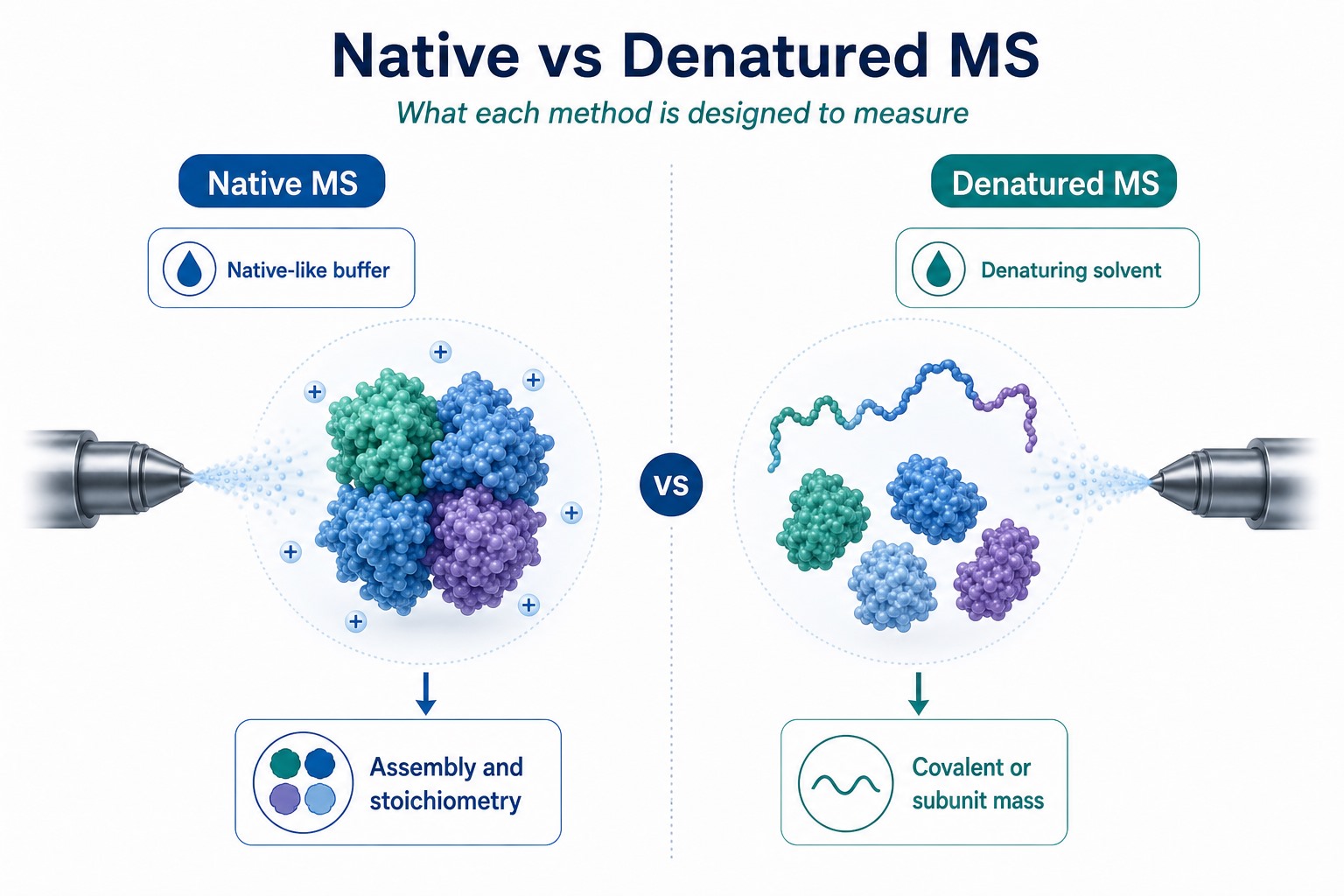
Figure 1. Native MS is designed to preserve assemblies, while denatured MS is designed to report unfolded or dissociated covalent mass forms.
Key Comparison Dimensions
A practical comparison should focus on decision-relevant dimensions rather than instrument branding.
Solution conditions
Native MS uses volatile native-compatible aqueous buffers. Denatured MS commonly uses organic solvent, acid, or other denaturants that disrupt non-covalent structure.
Interaction state
Native MS aims to preserve protein-protein and protein-ligand contacts when method conditions are suitable. Denatured MS deliberately removes those contacts so covalent mass dominates interpretation.
Charge-state behavior
Native ions usually carry fewer charges and appear at higher m/z. Denatured ions usually carry more charges and appear at lower m/z, which can simplify detection on some instrument configurations.
Analytical question
Native MS answers assembly, stoichiometry, and binding-state questions. Denatured MS answers subunit identity, covalent mass confirmation, and many intact-level modification screening questions.
These four dimensions determine which method should lead a given intact-protein project.
Side-by-Side Comparison
|
Dimension |
Native Mass Spectrometry |
Denatured Mass Spectrometry |
|---|---|---|
|
Buffer conditions |
Volatile native-compatible aqueous buffers |
Organic solvents, acid, or other denaturants common |
|
Non-covalent interactions |
Preserved when conditions are suitable |
Disrupted |
|
Typical charge pattern |
Lower charge states at higher m/z |
Higher charge states at lower m/z |
|
Primary output |
Complex mass, oligomer state, stoichiometry |
Subunit or denatured intact covalent mass |
|
Best suited question |
Is the expected assembly present? |
What is the covalent mass of the chain or protein? |
|
Main limitation |
Sensitive to salts, detergents, and sample purity |
Loses assembly and non-covalent binding information |
The table summarizes method intent. It does not mean one approach is universally preferred for every intact protein study.
Related Services
Protein Molecular Weight Determination Service
Therapeutics Characterization Service | Advanced Structure
Antibody Drug Analysis Service
Teams comparing native and denatured intact mass options can consult MtoZ Biolabs to match sample type, expected molecular form, and project phase to the appropriate MS condition set.
Decision Guidance by Project Goal
Method selection becomes clearer when the end goal is stated first.
Choose denatured MS when covalent mass is the priority
Denatured intact mass analysis is a practical first choice when the question is protein identity by molecular weight, reduced chain mass, or covalent mass confirmation after purification. It is also useful when non-covalent assembly is not part of the decision and when simpler charge-state envelopes are preferred for rapid review.
Choose native MS when assembly or binding state is the priority
Native MS is the better lead method when oligomeric state, complex stoichiometry, or non-covalent ligand occupancy must be preserved. It is also useful when a biologics or structural biology team needs solution-relevant assembly evidence before deeper structural work.
Use both when architecture and covalent identity are both required
Many characterization programs benefit from paired aliquots. Denatured MS confirms covalent subunit masses. Native MS then reports whether those subunits assemble as expected under native-like conditions. This sequence reduces the risk of interpreting an assembly spectrum without a clear covalent baseline, or of confirming subunit mass while missing an unexpected oligomer.
For project-specific selection between native and denatured intact mass conditions, MtoZ Biolabs can help align the analytical sequence with the current characterization goal.
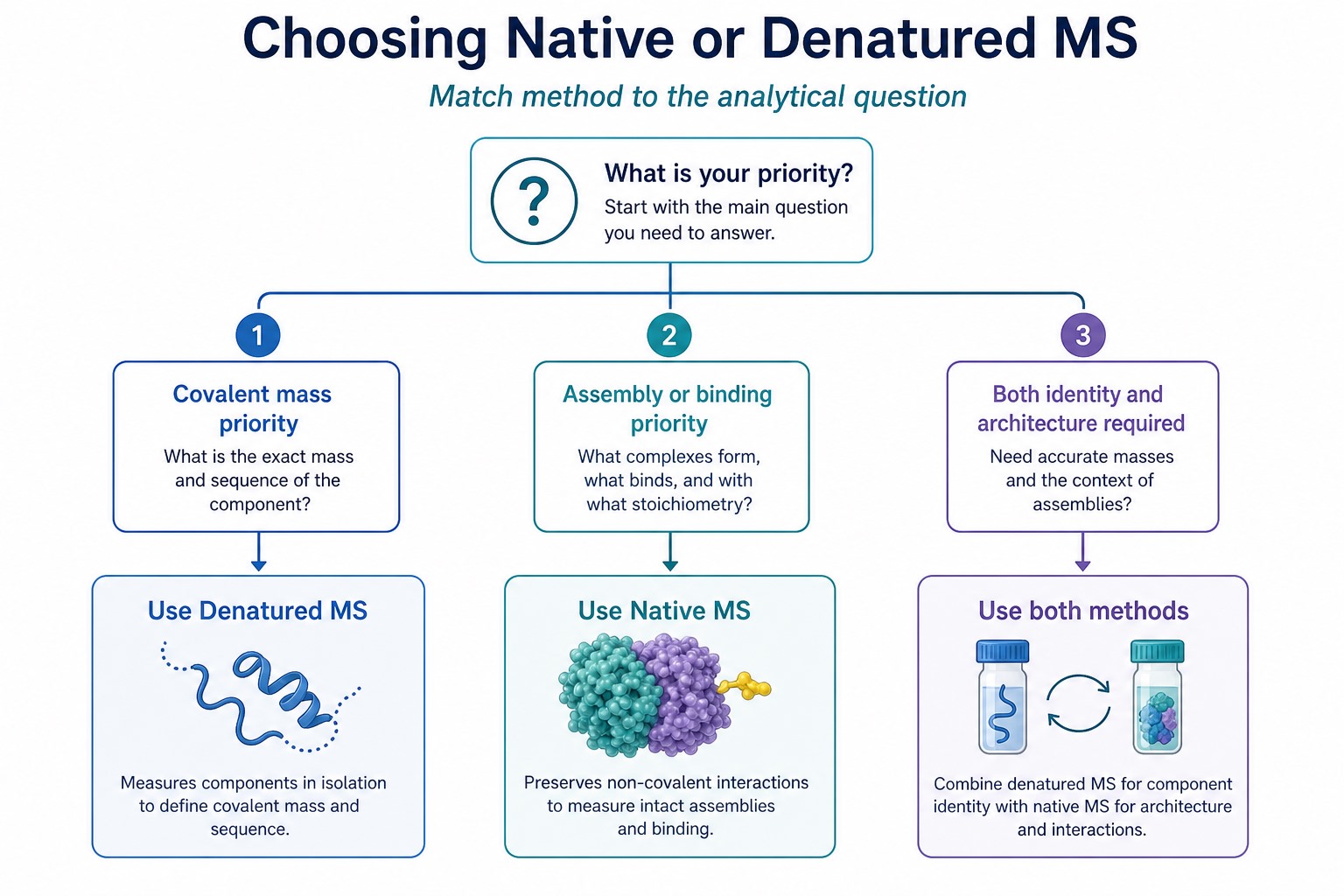
Figure 2. Choose denatured MS for covalent mass questions, native MS for assembly or binding questions, and both when architecture and identity are both required.
Practical Differences in Sample Handling and Output
Beyond the scientific question, the two methods also differ in laboratory practice.
Native MS usually requires careful desalting into volatile native buffers and attention to detergents, aggregates, and non-volatile salts. Spectra can be congested when multiple assemblies or adducts are present. Interpretation often focuses on complex models and stoichiometry assignment.
Denatured MS usually tolerates more aggressive solvent systems and is often easier for routine molecular weight confirmation of purified proteins or reduced chains. Interpretation focuses on expected covalent mass, clipping, and intact-level modification patterns that remain after denaturation.
Output packages therefore look different even when both reports include deconvoluted masses. Native reports emphasize assembly species. Denatured reports emphasize covalent species.
How the Methods Complement Each Other
Native and denatured mass spectrometry are complementary layers rather than competing replacements.
Denatured MS provides the covalent mass baseline. Native MS places that baseline into an assembly context. When observed native masses exceed the sum of expected covalent subunits, ligand occupancy or unexpected association may be present. When native spectra show only dissociated species under soft conditions, the complex may be unstable in the selected buffer or may not form as expected.
For antibody-related and other biologic products, denatured intact or reduced mass analysis supports chain identity, while native MS supports intact assembly and global heterogeneity review. For multi-subunit research proteins, the same complementary logic applies.
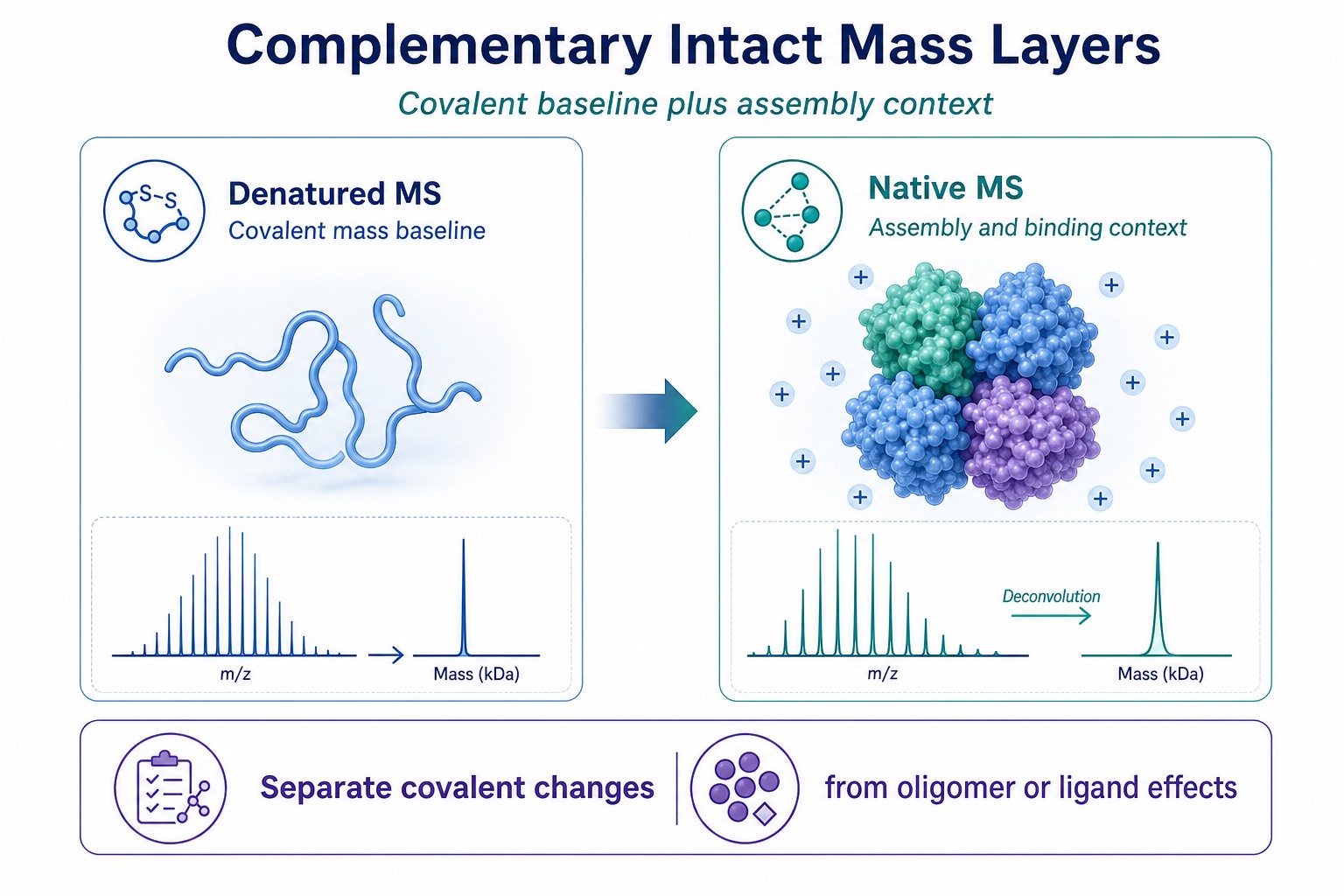
Figure 3. Denatured MS establishes covalent mass, and native MS places that mass information into an assembly and binding context.
Frequently Asked Questions
1. What is the main difference between native and denatured mass spectrometry?
The main difference is whether non-covalent interactions are preserved. Native MS aims to keep assemblies intact. Denatured MS disrupts those interactions to report covalent or subunit mass.
2. Can denatured MS measure protein complexes?
Denatured MS generally reports dissociated or unfolded forms. It is not designed to preserve non-covalent complexes for stoichiometry review.
3. Does native MS replace denatured intact mass analysis?
No. Native MS answers assembly and binding-state questions. Denatured intact mass analysis remains important for covalent mass confirmation.
4. Which method should be used for antibody molecular weight confirmation?
Denatured or reduced intact mass analysis is commonly used for covalent chain or intact mass confirmation. Native MS is added when assembly state or intact heterogeneity under native-like conditions is also required.
5. Why do native spectra appear at higher m/z?
Folded native ions usually carry fewer charges than denatured ions, which shifts the observed signals to higher mass-to-charge values.
6. When should both methods be run on the same sample set?
Both methods are useful when the project needs covalent identity and assembly evidence. Paired analysis helps separate mass shifts caused by covalent changes from those caused by oligomer or ligand state.
Conclusion
Native and denatured mass spectrometry differ in experimental intent, solution conditions, and the molecular forms they are designed to report. Native MS preserves non-covalent architecture and answers assembly, stoichiometry, and binding-state questions. Denatured MS disrupts non-covalent contacts and answers covalent mass and subunit identity questions.
The practical decision is question-first. Choose denatured MS when covalent mass is the priority. Choose native MS when assembly or binding state is the priority. Use both when a program needs a covalent baseline and an assembly context in the same characterization phase. Researchers comparing these intact mass options can contact MtoZ Biolabs to review sample readiness and select the condition set matched to the current project goal.
How to order?




